<?xml version="1.0" encoding="UTF-8"?>
<!DOCTYPE html PUBLIC "-//W3C//DTD XHTML 1.1//EN" "http://www.w3.org/TR/xhtml11/DTD/xhtml11.dtd">
<html xmlns="http://www.w3.org/1999/xhtml" xml:lang="en">
<head>
<meta content="text/html; charset=UTF-8" http-equiv="content-type" />
<meta http-equiv="Content-Language" content="en" />
<meta name="generator" content="Pressbooks 5.4.5" />
<meta name="pb-authors" content="Centre for Conflict Resolution" />
<meta name="pb-editors" content="" />
<meta name="pb-translators" content="" />
<meta name="pb-reviewers" content="" />
<meta name="pb-illustrators" content="" />
<meta name="pb-contributors" content="" />
<meta name="pb-title" content="Foundations of Collaborative Conflict Resolution" />
<meta name="pb-language" content="en" />
<meta name="pb-cover-image" content="https://cres1100.pressbooks.com/wp-content/uploads/sites/59093/2017/10/CRES-1100-cover.jpg" />
<meta name="pb-subtitle" content="CRES-1100/1101" />
<meta name="pb-copyright-holder" content="Justice Institute of British Columbia, Centre for Conflict Resolution" />
<meta name="pb-copyright-year" content="2017" />
<meta name="pb-book-license" content="all-rights-reserved" />
<title>Foundations of Collaborative Conflict Resolution</title>
</head>
<body lang='en'>
<div id="half-title-page"><h1 class="title">Foundations of Collaborative Conflict Resolution</h1></div>
<div id="title-page"><div class="wp-nocaption alignnone size-full wp-image-22"><img class="alignnone size-full wp-image-22" src="https://pressbooks.bccampus.ca/cres1100/wp-content/uploads/sites/334/2018/04/logo.gif" alt="" width="1012" height="141" /></div> <p>&nbsp;</p> <p>&nbsp;</p> <p>&nbsp;</p> <p style="text-align: center;font-size: 40px;line-height: 40px;color: #2393bd"><strong>Foundations of Collaborative</strong></p> <p style="text-align: center;font-size: 40px;line-height: 40px;color: #2393bd"><strong>Conflict Resolution</strong></p> <p>&nbsp;</p> <p>&nbsp;</p> <p>&nbsp;</p> <p style="text-align: center">Fifteenth Edition</p> <p style="text-align: center">New Westminster, BC</p> <p style="text-align: center">May 2017</p> </div>
<div id="copyright-page"><div class="ugc">
<div class="license-attribution"><p>Foundations of Collaborative Conflict Resolution Copyright © 2017 by <a href="https://pressbooks.bccampus.ca/cres1100">Justice Institute of British Columbia, Centre for Conflict Resolution</a>. All Rights Reserved.</p></div>
</div></div>
<div id="toc"><h1>Contents</h1><ul><li class="front-matter disclaimer"><a href="#front-matter-copyright"><span class="toc-chapter-title">Copyright</span></a></li><li class="front-matter acknowledgements"><a href="#front-matter-acknowledgements"><span class="toc-chapter-title">Acknowledgements</span></a></li><li class="part"><a href="#part-introduction">Introduction</a></li><li class="part"><a href="#part-part-i-conflict-awareness">Part I: Conflict Awareness</a></li><li class="chapter standard"><a href="#chapter-attitudes-about-conflict"><span class="toc-chapter-title">Attitudes About Conflict</span></a></li><li class="chapter standard"><a href="#chapter-how-i-see-conflict"><span class="toc-chapter-title">How I See Conflict</span></a></li><li class="chapter standard"><a href="#chapter-cultural-lenses"><span class="toc-chapter-title">Cultural Lenses</span></a></li><li class="chapter standard"><a href="#chapter-belief-cycle"><span class="toc-chapter-title">Belief Cycle</span></a><ul class="sections"><li class="section"><a href="#chapter-166-section-1"><span class="toc-subsection-title">Belief Cycle Examples</span></a></li><li class="section"><a href="#chapter-166-section-2"><span class="toc-subsection-title">Conflict Development</span></a></li></ul></li><li class="chapter standard"><a href="#chapter-definition-of-interpersonal-conflict"><span class="toc-chapter-title">Definition of Interpersonal Conflict</span></a></li><li class="chapter standard"><a href="#chapter-alternate-definitions-of-conflict"><span class="toc-chapter-title">Alternate Definitions of Conflict</span></a></li><li class="chapter standard"><a href="#chapter-types-of-conflicts"><span class="toc-chapter-title">Types of Conflicts</span></a></li><li class="chapter standard"><a href="#chapter-factors-affecting-conflict"><span class="toc-chapter-title">Factors Affecting Conflict</span></a></li><li class="chapter standard"><a href="#chapter-power-and-conflict"><span class="toc-chapter-title">Power and Conflict</span></a></li><li class="chapter standard"><a href="#chapter-sources-of-power"><span class="toc-chapter-title">Sources of Power</span></a></li><li class="chapter standard"><a href="#chapter-working-with-power"><span class="toc-chapter-title">Working with Power</span></a><ul class="sections"><li class="section"><a href="#chapter-175-section-1"><span class="toc-subsection-title">Destructive Conflict and Constructive Conflict</span></a></li></ul></li><li class="chapter standard"><a href="#chapter-conflict-approaches-win-lose-adversarial-versus-win-win-collaborative"><span class="toc-chapter-title">Conflict Approaches: Win - lose (Adversarial) Versus Win - win (Collaborative)</span></a></li><li class="chapter standard"><a href="#chapter-knowing-your-conflict-approach"><span class="toc-chapter-title">Knowing Your Conflict Approach</span></a></li><li class="chapter standard"><a href="#chapter-the-collaborative-view-of-conflict"><span class="toc-chapter-title">The Collaborative View of Conflict</span></a></li><li class="chapter standard"><a href="#chapter-five-conflict-styles"><span class="toc-chapter-title">Five Conflict Styles</span></a></li><li class="part"><a href="#part-part-ii-the-collaborative-approach-to-conflict">Part II: The Collaborative Approach to Conflict</a></li><li class="chapter standard"><a href="#chapter-beliefs-underlying-the-collaborative-approach"><span class="toc-chapter-title">Beliefs Underlying the Collaborative Approach</span></a></li><li class="chapter standard"><a href="#chapter-preparing-oneself-for-collaboration"><span class="toc-chapter-title">Preparing Oneself for Collaboration</span></a></li><li class="chapter standard"><a href="#chapter-internal-aspects-of-the-collaborative-approach"><span class="toc-chapter-title">Internal Aspects of the Collaborative Approach</span></a><ul class="sections"><li class="section"><a href="#chapter-190-section-1"><span class="toc-subsection-title"></span></a></li><li class="section"><a href="#chapter-190-section-2"><span class="toc-subsection-title">Awareness and Reflection</span></a></li></ul></li><li class="chapter standard"><a href="#chapter-external-phases-of-the-collaborative-approach"><span class="toc-chapter-title">External Phases of the Collaborative Approach</span></a><ul class="sections"><li class="section"><a href="#chapter-192-section-1"><span class="toc-subsection-title">Opening</span></a></li><li class="section"><a href="#chapter-192-section-2"><span class="toc-subsection-title">Identifying</span></a></li><li class="section"><a href="#chapter-192-section-3"><span class="toc-subsection-title">Exploring</span></a></li><li class="section"><a href="#chapter-192-section-4"><span class="toc-subsection-title">Closing</span></a></li></ul></li><li class="chapter standard"><a href="#chapter-summary-of-external-phases"><span class="toc-chapter-title">Summary of External Phases</span></a></li><li class="chapter standard"><a href="#chapter-the-big-picture-combining-inner-and-outer-strategies"><span class="toc-chapter-title">The Big Picture: Combining Inner and Outer Strategies</span></a></li><li class="part"><a href="#part-part-iii-collaborative-competencies">Part III: Collaborative Competencies</a></li><li class="chapter standard"><a href="#chapter-components-of-effective-communication"><span class="toc-chapter-title">Components of Effective Communication</span></a></li><li class="chapter standard"><a href="#chapter-language-of-collaboration"><span class="toc-chapter-title">Language of Collaboration</span></a></li><li class="chapter standard"><a href="#chapter-examples-of-collaborative-language"><span class="toc-chapter-title">Examples of Collaborative Language</span></a></li><li class="chapter standard"><a href="#chapter-clarifying-assumptions"><span class="toc-chapter-title">Clarifying Assumptions</span></a></li><li class="chapter standard"><a href="#chapter-balance-in-communication"><span class="toc-chapter-title">Balance in Communication</span></a></li><li class="chapter standard"><a href="#chapter-self-assessment-of-current-communication-capacities-competencies"><span class="toc-chapter-title">Self-Assessment of Current Communication Capacities/Competencies</span></a></li><li class="part"><a href="#part-part-iv-simulation-scenarios">Part IV: Simulation Scenarios</a></li><li class="chapter standard"><a href="#chapter-preparing-a-scenario"><span class="toc-chapter-title">Preparing a Scenario</span></a></li><li class="chapter standard"><a href="#chapter-conversation-preparation-sheet"><span class="toc-chapter-title">Conversation Preparation Sheet</span></a></li><li class="chapter standard"><a href="#chapter-workplace"><span class="toc-chapter-title">Workplace</span></a></li><li class="chapter standard"><a href="#chapter-personal"><span class="toc-chapter-title">Personal</span></a></li><li class="part"><a href="#part-additional-resources">Additional Resources</a></li><li class="chapter standard"><a href="#chapter-definition-of-terms"><span class="toc-chapter-title">Definition of terms</span></a><ul class="sections"><li class="section"><a href="#chapter-215-section-1"><span class="toc-subsection-title">Model: One Page “Reference Sheet”</span></a></li></ul></li><li class="chapter standard"><a href="#chapter-reference-list"><span class="toc-chapter-title">Reference List</span></a></li><li class="chapter standard"><a href="#chapter-notes"><span class="toc-chapter-title">Notes</span></a></li></ul></div>
<div class="front-matter disclaimer" id="front-matter-copyright"><div class="front-matter-title-wrap"><h3 class="front-matter-number">1</h3><h1 class="front-matter-title"><span class="display-none">Copyright</span></h1></div><div class="ugc front-matter-ugc"><p>© 2017, Justice Institute of British Columbia, Centre for Conflict Resolution</p> <p>All rights reserved. No part of this publication may be reproduced or transmitted in any form or by any means, electronic or mechanical, including photocopy, recording, or any information storage and retrieval system, without permission in writing from the publisher.</p> <p>For instructional use only for Justice Institute of British Columbia courses unless prior authorization has been obtained from the Centre for Conflict Resolution.</p> <p>Requests for permission to make copies of any part of this work should be directed to the publisher. Additional copies of the work may be obtained from the publisher:</p> <p style="padding-left: 30px">Centre for Conflict Resolution<br /> Justice Institute of British Columbia<br /> 715 McBride Boulevard<br /> New Westminster, BC V3L 5T4<br /> Canada<br /> Tel: (604) 528-5608&nbsp;&nbsp;&nbsp;&nbsp; Fax: (604) 528-5640<br /> <a href="http://www.jibc.ca">www.jibc.ca</a></p> <table border="1px" style="width: 100%"><tbody><tr><td>March 1990</td> <td>First Edition</td> <td>October 1996</td> <td>Eighth Edition</td> </tr> <tr><td>October 1991</td> <td>Second Edition</td> <td>November 1997</td> <td>Ninth Edition</td> </tr> <tr><td>June 1992</td> <td>Third Edition</td> <td>July 1999</td> <td>Tenth Edition</td> </tr> <tr><td>March 1994</td> <td>Fourth Edition</td> <td>August 2002</td> <td>Eleventh Edition</td> </tr> <tr><td>December 1994</td> <td>Fifth Edition</td> <td>January 2004</td> <td>Twelfth Edition</td> </tr> <tr><td>March 1995</td> <td>Sixth Edition</td> <td>September 2005</td> <td>Thirteenth Edition</td> </tr> <tr><td>October 1995</td> <td>Seventh Edition</td> <td>April 2007</td> <td>Fourteenth Edition</td> </tr> <tr><td></td> <td></td> <td>May 2017</td> <td>Fifteenth Edition</td> </tr> </tbody> </table> <p>Printed in Canada</p> <p><strong>National Library of Canada Cataloguing in Publication </strong>Data<br /> Main entry under title:<br /> [Conflict resolution (New Westminster, B.C.)]<br /> Conflict resolution. &#8212; [1st ed.]-</p> <p style="padding-left: 30px">Irregular.<br /> Includes bibliographical references: p.<br /> ISSN 1705-737X = Conflict resolution &#8211; New Westminster, B.C.</p> <p style="padding-left: 30px">1. Conflict management. 2. Interpersonal communication. 3. Conflict management &#8211; Problems, exercises, etc. I. Justice Institute of British Columbia. Centre for Conflict Resolution Training.</p> <p style="padding-left: 30px">BF637.I48C66&nbsp;&nbsp;&nbsp;&nbsp;&nbsp;&nbsp;&nbsp;&nbsp;&nbsp;&nbsp;&nbsp;&nbsp; 303.6’9&nbsp;&nbsp;&nbsp;&nbsp;&nbsp;&nbsp;&nbsp;&nbsp;&nbsp;&nbsp;&nbsp;&nbsp; C96-960305-3</p> </div>
</div>
<div class="front-matter acknowledgements" id="front-matter-acknowledgements"><div class="front-matter-title-wrap"><h3 class="front-matter-number">2</h3><h1 class="front-matter-title">Acknowledgements</h1></div><div class="ugc front-matter-ugc"><p>The Centre for Conflict Resolution would like to acknowledge all of the instructors and coaches who have contributed to the development of this course and its companion manual.</p> </div>
</div>
<div class="part introduction " id="part-introduction"><div class="part-title-wrap"><h3 class="part-number">I</h3><h1 class="part-title">Introduction</h1></div><p>Conflict is an inescapable part of our daily lives. In personal relationships or business interactions, each of us has our own perspective, temperament and ways of thinking. We also have needs and concerns we’d like to address. The question is – in conflict situations, how do we work together to address as many of our mutual needs and concerns as possible in a collaborative way?</p> <p>Conflicts that go unaddressed may keep our relationships from realizing their full potential, or they may become so severe that they do irreparable damage to individuals, families, workplaces, and entire communities. How we deal with these differences can determine the quality of our lives.</p> <p>Learning how to resolve conflicts effectively is an essential life skill needed by every person and every group regardless of age, social role, profession, or cultural background.</p> <p>William Ury, in <em>The Third Side</em>, poses the question, “What if fighting, violence, and war were preventable and we simply didn’t know it?”(Ury, 2000, p.xviii). It’s an interesting question.</p> <p>We cannot eliminate conflict, but we can transform how we approach it. Rather than blaming and judging, a move to more curiosity and openness is a first step in this direction.</p> <p>The goal of this course is to offer effective and practical knowledge, strategies and tools for approaching the resolution of interpersonal conflicts cooperatively and collaboratively. We believe that:</p> <ul><li>Success in managing conflict brings the potential for success in family and business life.</li> <li>Conflict constructively expressed and explored, allows creativity to flourish.</li> <li>Conflict is an opportunity to be seized.</li> <li>Effective conflict resolution contributes to personal happiness.</li> </ul> </div>
<div class="part " id="part-part-i-conflict-awareness"><div class="part-title-wrap"><h3 class="part-number">II</h3><h1 class="part-title">Part I: Conflict Awareness</h1></div></div>
<div class="chapter standard" id="chapter-attitudes-about-conflict"><div class="chapter-title-wrap"><h3 class="chapter-number">1</h3><h2 class="chapter-title">Attitudes About Conflict</h2></div><div class="ugc chapter-ugc"><p>We all have attitudes and experiences involving conflict. Becoming more aware of these can help us to recognize and deal with conflict more productively. Consider the questions below as part of this process.</p> <ul><li>To what degree do you find yourself involved in conflict?</li> <li>How often do you initiate the resolution of conflict, or do others bring conflict to your attention?</li> <li>Looking back over the conflicts you have had in your life, what kind of statements would you make about these conflicts? When have you said, “Conflict is great, and I love the exciting opportunities that it represents?” or, “Conflict has been nothing but a roller coaster, mainly on the fast-downhill part of the ride!” or, would you say something else entirely?</li> <li>If a newspaper article quoted you on your experience of conflict, what would your quote say?</li> </ul> </div>
</div>
<div class="chapter standard" id="chapter-how-i-see-conflict"><div class="chapter-title-wrap"><h3 class="chapter-number">2</h3><h2 class="chapter-title">How I See Conflict</h2></div><div class="ugc chapter-ugc"><p>We have a view of the world that is based on our experiences and our beliefs about how the world and those within it function in fundamental ways. One’s worldview can also be referred to as one’s personal philosophy of life, or one’s mindset. We are often unaware of the specific beliefs embedded in our worldview, and how much they influence our behaviour.</p> <p>Based on your current beliefs, answer the questions below.</p> <ol><li>I view the world as&#8230;?</li> <li>I see the people of the world as&#8230;?</li> <li>The best way to handle conflict is?</li> <li>From my family, I learned that when people get into conflict?</li> </ol> <div class="textbox exercises"><h3>Words I Associate with Conflict</h3> <p style="text-align: center">_________________________________________________</p> <p style="text-align: center">_________________________________________________</p> <p style="text-align: center">_________________________________________________</p> </div> <div class="wp-nocaption alignnone size-full wp-image-716"><img class="alignnone size-full wp-image-716" src="https://pressbooks.bccampus.ca/cres1100/wp-content/uploads/sites/334/2018/04/CRES-1101-Foundations_15thEd-May-2017-p-s.png" alt="" width="800" height="414" /></div> </div>
</div>
<div class="chapter standard" id="chapter-cultural-lenses"><div class="chapter-title-wrap"><h3 class="chapter-number">3</h3><h2 class="chapter-title">Cultural Lenses</h2></div><div class="ugc chapter-ugc"><p>How we experience the world around us is filtered through our own unique set of cultural lenses. Examples of these cultural lenses include our ethnicity, gender, religious or spiritual beliefs, socio-economic level, relationship orientation, and association or group membership (i.e. blue-collar worker, lawyer, social worker).</p> <p>Each of us sees the world through these multiple lenses which bring with them values, customs, norms and expected behaviours. This layering of lenses makes us complex and unique individuals.</p> <p>Cultures are living, changing systems that influence our interpretations of the past, starting points, and currencies or values. It is therefore inescapable that they also influence our conflicts. Cultures operate out of conscious awareness most of the time, imparting rhythm, melody, and tone to actions. They function as invisible, shared codes, defining “common sense.” The challenge is that everyone is singing a different song, drawing on his or her own unique multicultural makeup. Common sense is not necessarily common. As our identities and ways of making meaning fail to harmonize, we look more closely at conflict. (LeBaron, 2003, pp. 10-11)</p> <p>In conflict, each person sees the problem through their own cultural lenses which are often unique to the individual. Recognizing that these differences exist is a prerequisite to understanding how they affect our perception and contribute to the conflict.</p> <div class="textbox exercises"><h3>Questions to Ponder</h3> <ol><li>How does your family “culture” affect how you approach conflict?</li> <li>How does your ethnic “culture” affect how you approach conflict?</li> <li>How does your workplace, professional or industry “culture” affect how you approach conflict?</li> </ol> </div> </div>
</div>
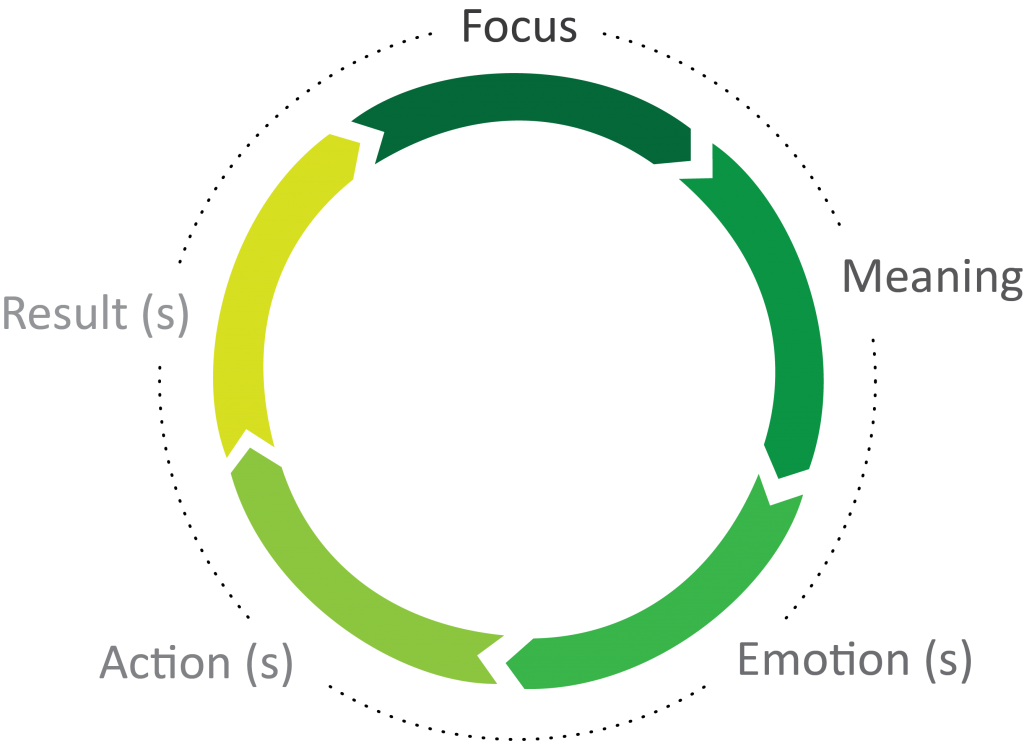
<div class="chapter standard" id="chapter-belief-cycle"><div class="chapter-title-wrap"><h3 class="chapter-number">4</h3><h2 class="chapter-title">Belief Cycle</h2></div><div class="ugc chapter-ugc"><p>Each of us has core values, beliefs, and attitudes about conflict based on early life experiences that affect how we perceive the world and other people. Many of our behaviours in conflict are based on these perceptions and are often automatic, regardless of their effectiveness.</p> <p>Nate Booth’s (1997, p.49) belief cycle below demonstrates how core values, beliefs, and attitudes lead to focus and meaning in conflict, which then leads to emotions, actions and results.</p> <p>In conflict, as in other times of stress, beliefs are powerful because they set in process a certain cycle:</p> <ul><li>Our beliefs focus our attention on certain “events” in our world.</li> <li>We give meaning to these events, turning them into triggers.</li> <li>The triggers cause a physiological response, which is sensed as emotion.</li> <li>Based on the emotion, we take action.</li> <li>The actions we take result in a response from others.</li> <li>This response reinforces our original belief.</li> </ul> <div class="wp-nocaption aligncenter wp-image-718 size-full"><img class="aligncenter wp-image-718 size-full" src="https://pressbooks.com/app/uploads/sites/59093/2017/09/CRES-1101-Foundations_15thEd-May-2017-p5-s.png#fixme" alt="" width="600" height="434"/></div> <div class="wp-nocaption aligncenter wp-image-164"><img class="aligncenter wp-image-164" src="https://pressbooks.bccampus.ca/cres1100/wp-content/uploads/sites/334/2018/04/CRES-1101-Foundations_15thEd-May-2017-p5-1024x741.png" alt="" width="600" height="434" srcset="https://pressbooks.bccampus.ca/cres1100/wp-content/uploads/sites/334/2018/04/CRES-1101-Foundations_15thEd-May-2017-p5-1024x741.png 1024w, https://pressbooks.bccampus.ca/cres1100/wp-content/uploads/sites/334/2018/04/CRES-1101-Foundations_15thEd-May-2017-p5-300x217.png 300w, https://pressbooks.bccampus.ca/cres1100/wp-content/uploads/sites/334/2018/04/CRES-1101-Foundations_15thEd-May-2017-p5-768x555.png 768w, https://pressbooks.bccampus.ca/cres1100/wp-content/uploads/sites/334/2018/04/CRES-1101-Foundations_15thEd-May-2017-p5-65x47.png 65w, https://pressbooks.bccampus.ca/cres1100/wp-content/uploads/sites/334/2018/04/CRES-1101-Foundations_15thEd-May-2017-p5-225x163.png 225w, https://pressbooks.bccampus.ca/cres1100/wp-content/uploads/sites/334/2018/04/CRES-1101-Foundations_15thEd-May-2017-p5-350x253.png 350w"/></div> <h1 id="chapter-166-section-1" class="section-header">Belief Cycle Examples</h1> <p class="ManualBullet-Arrows">The following examples of values, beliefs, and attitudes about conflict demonstrate how the belief cycle would play out in each conflict situation.</p> <div class="textbox learning-objectives"><span style="font-style: normal"><strong>Example 1:</strong></span><br/> <span style="font-style: normal"><strong>Beliefs, values, attitudes –</strong> Conflict is wrong. I shouldn’t be negative.</span><br/> <span style="font-style: normal"><strong>Actions/responses –</strong> Pretend nothing is wrong.</span><br/> <span style="font-style: normal"><strong>Results/consequences –</strong> Tension and cool distance between parties. Something is wrong in the relationship.</span></div> <div><div class="textbox learning-objectives"><span style="font-style: normal"><strong>Example 2:</strong></span><br/> <span style="font-style: normal"><strong>Beliefs, values, attitudes –</strong> Conflict means loss. I have to get my way.</span><br/> <span style="font-style: normal"><span style="font-style: normal"><strong>Actions/responses </strong>– Argue your point until the other caves in or walks away.</span><br/> <strong>Results/consequences –</strong> Conflict escalates, relationships are damaged, and outcomes are in jeopardy. Conflict is loss.</span></div> <div><div class="textbox learning-objectives"><span style="font-style: normal"><strong>Example 3:</strong></span><br/> <span style="font-style: normal"><strong>Beliefs, values, attitudes –</strong> Conflict means our relationship is in jeopardy.</span><br/> <span style="font-style: normal"><strong>Actions/responses –</strong> Let other people have their way so we can get along.</span><br/> <span style="font-style: normal"><strong>Results/consequences –</strong> Buried resentment. Conflict has put our relationship in jeopardy.</span></div> <div><div class="textbox learning-objectives"><span style="font-style: normal"><strong>Example 4:</strong></span><br/> <span style="font-style: normal"><strong>Beliefs, values, attitudes –</strong> Working out conflicts takes too much time and energy.</span><br/> <span style="font-style: normal"><strong>Actions/responses –</strong> Look for the quickest available solution.</span><br/> <span style="font-style: normal"><strong>Results/consequences –</strong> Conflict is fixed temporarily, but comes up repeatedly, taking more time and energy.</span></div> <div><div class="textbox learning-objectives"><span style="font-style: normal"><strong>Example 5:</strong></span><br/> <span style="font-style: normal"><strong>Beliefs, values, attitudes –</strong> Conflict is a normal part of being human.</span><br/> <span style="font-style: normal"><strong>Actions/responses –</strong> Say what you need to say and listen to the other side.</span><br/> <span style="font-style: normal"><strong>Results/consequences –</strong> Conflict is normalized and resolved.</span></div> <p>When caught in a negative belief cycle, one needs to change either one’s belief or one’s behaviour in order to get a different result, and thus break the cycle.</p> </div> </div> </div> </div> <h1 id="chapter-166-section-2" class="section-header">Conflict Development</h1> <p>Many people have negative attitudes toward conflict, and try to avoid it. Some perceive conflict and change as threatening, and try to resist it. For some, peace and harmony are held up as ideals. This desire for peace and harmony often symbolizes a desire for others to hold the same values, interests, and needs as ours. Paradoxically, this kind of thinking often generates conflict, since it doesn’t allow for the many real differences in needs and interests among individuals, systems, and cultures.</p> <p>The desire for life to remain the same is unrealistic. Life is not static. Everything changes and develops—the seasons, our minds and bodies, our circumstances and our nature. Attempting to keep change from occurring creates its own dynamics for conflict. Phases of conflict are as natural as phases of peace and harmony, and all are temporary states.</p> <p>Many theories of conflict are based on cycles of change that demonstrate how conflicts emerge and resolve. As Barbara Coloroso states, “Conflict is a normal, natural and necessary part of our lives. Conflict is inevitable in our homes, schools, workplaces, and communities, and so is the pain and discomfort that goes along with it. But conflict can be resolved and made less painful if it is dealt with directly, curatively, responsibly, and non-violently—not passively or aggressively”. (Coloroso, 2002, p.100)</p> <p class="ManualBullet-Arrows">Conflict can actually strengthen ongoing relationships. The true test of the parties’ investment and dedication to a relationship with each other can never be tested until it goes through some kind of challenge, or conflict. If you and I go through a conflict together successfully, we know we can trust that our relationship is strong enough to withstand conflict. Because we can “do” conflict together, it is not as scary or threatening when it occurs, as it will in every relationship periodically.</p> <p class="ManualText">Thinking of conflict in this way, we could actually weaken and deprive our relationship of being strengthened by avoiding, placating or overbearing others to “win” when conflict arises.</p> <p> </p> <div class="wp-nocaption alignnone wp-image-725 size-full"><img class="alignnone wp-image-725 size-full" src="https://pressbooks.bccampus.ca/cres1100/wp-content/uploads/sites/334/2018/04/CRES-1101-Foundations_15thEd-May-2017-p7-s.png" alt="" width="500" height="500"/></div> <p style="text-align: center">The Evolution of Conflict Development</p> </div>
</div>
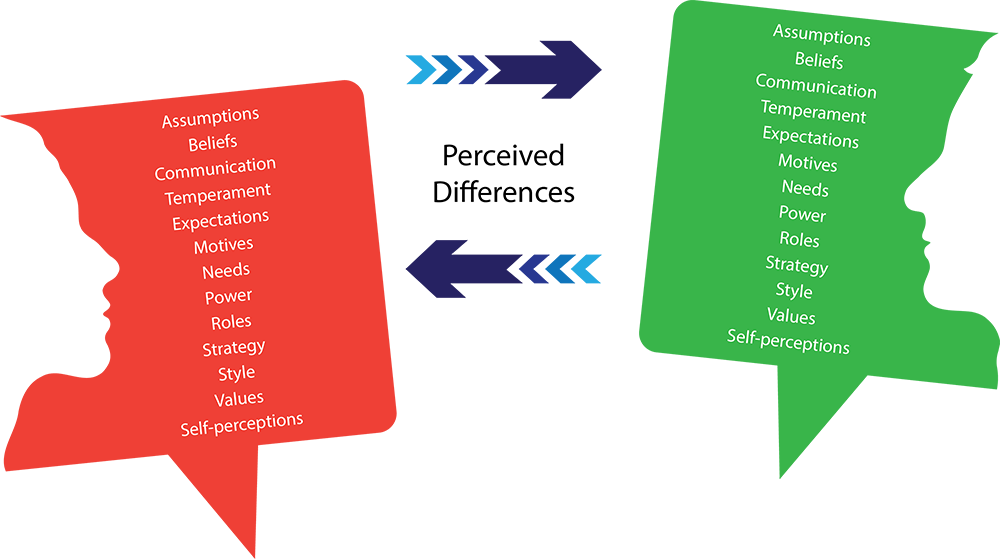
<div class="chapter standard" id="chapter-definition-of-interpersonal-conflict"><div class="chapter-title-wrap"><h3 class="chapter-number">5</h3><h2 class="chapter-title">Definition of Interpersonal Conflict</h2></div><div class="ugc chapter-ugc"><p>Interpersonal conflict can be defined as:</p> <p>Differences between at least two interdependent parties who perceive or are experiencing:</p> <ul><li>Incompatible goals or needs.</li> <li>Thinking differently about processes or routes to a goal.</li> <li>Interference in meeting their goals or needs.</li> </ul> <p>What’s at play when we are in conflict?</p> <div class="wp-nocaption alignnone wp-image-728 size-full"><img class="alignnone wp-image-728 size-full" src="https://pressbooks.bccampus.ca/cres1100/wp-content/uploads/sites/334/2018/04/CRES-1101-Foundations_15thEd-May-2017-p8-v2-s.png" alt="" width="1000" height="559" /></div> </div>
</div>
<div class="chapter standard" id="chapter-alternate-definitions-of-conflict"><div class="chapter-title-wrap"><h3 class="chapter-number">6</h3><h2 class="chapter-title">Alternate Definitions of Conflict</h2></div><div class="ugc chapter-ugc"><p>Below is a variety of alternate definitions of conflict derived from different theoretical perspectives&nbsp;<span style="color: #000000"><span class="footnote">(Cloke, 2001, p. 6 – 8)</span></span>.</p> <ul><li>Conflict arises wherever there is a failure of connection, collaboration, or community, an inability to understand our essential interconnectedness and the unity of the human spirit.</li> <li>Conflict is a lack of acceptance of ourselves that we project onto others. It is a way of blaming others for what we perceive as failures in our own lives. As people accept themselves more fully, they experience more acceptance of others and conflict diminishes.</li> <li>Conflict represents a boundary violation, a failure to value or recognize our own integrity or the personal space of others. When we respect and recognize our own boundaries as well as the boundaries of others, we experience less conflict.</li> <li>Conflict is a way of getting attention, acknowledgement, sympathy, or support by casting ourselves as the victim of some evil-doer. When we get the acknowledgement we need, we have no desire or need to seek conflict.</li> <li>Conflict is a way of opposing someone who represents a parent with whom we have not yet resolved our relationships. Often someone reminds us of a family of origin member and we act out our issues with them rather than with the real person.</li> <li>Conflict represents a lack of listening, a failure to appreciate the subtlety in what someone else is saying. Listening for metaphors and hidden meanings moves us to true content, thus having less counterattacking and defending.</li> <li>Conflict is the voice of a new paradigm, a demand for change in a system that has outlived its usefulness. Change always announces itself in the form of conflict. When the needed changes are made in a family, relationship or organization, the conflict disappears.</li> <li>Conflict is often a fearful interpretation of difference, diversity, and opposition, which ignores the essential role of polarity in creating unity, balance and symbiosis. As we see difference and disagreements as sources of potential unity or strength, conflicts tend to disappear.</li> <li>Conflict is a result of our inability to learn from our past mistakes, our failure to recognize them as opportunities for growth, learning, and improved understanding. Conflicts are often simply requests for authenticity, emotional honesty, acknowledgement, intimacy, empathy, and communication from others – they flow from the desire for a better relationship.</li> </ul> </div>
</div>
<div class="chapter standard" id="chapter-types-of-conflicts"><div class="chapter-title-wrap"><h3 class="chapter-number">7</h3><h2 class="chapter-title">Types of Conflicts</h2></div><div class="ugc chapter-ugc"><p>Conflicts originate from different sources and contain different qualities. Different conflicts, therefore, may require different approaches, and be more or less difficult to resolve. The following is a list of conflict types and their sources:</p> <div class="textbox learning-objectives"><p><span style="font-style: normal"><strong>Data / communication conflicts</strong></span></p> <p><span style="font-style: normal">Sources of conflict include misunderstandings, lack of information, assumptions, differences in perspective, misinformation, and ambiguities.</span></p> </div> <div class="textbox learning-objectives"><p><span style="font-style: normal"><strong>Structural conflicts</strong></span></p> <p><span style="font-style: normal">Ineffectual processes, time or geographical constraints, inappropriate structure, organizations, social structures and systems.</span></p> </div> <div class="textbox learning-objectives"><p><span style="font-style: normal"><strong>Relationship conflicts</strong></span></p> <p><span style="font-style: normal">Stereotypes, distorted perceptions, unmet expectations, fear, use of power, history.</span></p> </div> <div class="textbox learning-objectives"><p><span style="font-style: normal"><strong>Interest conflicts</strong></span></p> <p><span style="font-style: normal">Perceived or actual incompatibility of needs and interests, differences in preferences, style, ways of doing things, differences in emotional needs, etc.</span></p> </div> <div class="textbox learning-objectives"><p><span style="font-style: normal"><strong>Value conflicts</strong></span></p> <p><span style="font-style: normal">Opposing beliefs, values, philosophies, worldviews, etc.</span></p> </div> <p>Our emotional reactions to any of these types of conflict will determine whether possibilities for conflict develop into actual conflict, and the level at which we experience the conflict. For example, a situation may provoke fears about change, loss, or being controlled. The same situation may provoke a belief that rights have been violated. Depending on the situation and our reaction to it, we may perceive the conflict as a communication breakdown, a conflict between values, or both. (Moore, 2003, Ch. 4)</p> </div>
</div>
<div class="chapter standard" id="chapter-factors-affecting-conflict"><div class="chapter-title-wrap"><h3 class="chapter-number">8</h3><h2 class="chapter-title">Factors Affecting Conflict</h2></div><div class="ugc chapter-ugc"><p>When conflict surfaces, it is influenced by many factors that affect the character, direction, and outcome of the conflict and determine whether the conflict escalates or de-escalates. The following factors should be considered to determine how to best implement a collaborative approach to the conflict:</p> <div class="textbox learning-objectives"><span style="font-style: normal"><strong>Individuals involved<br /> </strong></span><span style="font-style: normal">Personality, self-image, and personal history.</span></div> <div><div class="textbox learning-objectives"><span style="font-style: normal"><strong>Relationship</strong></span><br /> <span style="font-style: normal">Nature and importance of the relationship, roles each person plays, assessment of each other’s motivations, level of interdependency, degree of negativity towards one another, degree of understanding and trust between the parties.</span></div> </div> <div><div class="textbox learning-objectives"><span style="font-style: normal"><strong>Approach</strong></span><br /> <span style="font-style: normal">Conflict style, attitude to the conflict and use of power.</span></div> <div><div class="textbox learning-objectives"><span style="font-style: normal"><strong>Nature of the conflict</strong></span><br /> <span style="font-style: normal">Scope and importance of the conflict, complexity of the conflict, number of issues, degree of differences, number of people involved, perceived consequences, and history or related issues surrounding the conflict.</span></div> <div><div class="textbox learning-objectives"><span style="font-style: normal"><strong>Context</strong></span><br /> <span style="font-style: normal">Setting, social conditions, culture, roles, and systems within which the conflict occurs.</span></div> <div><div class="textbox learning-objectives"><span style="font-style: normal"><strong>Time demands </strong></span><br /> <span style="font-style: normal">Amount of available time, degree of freedom from commitments.</span></div> <div><div class="textbox learning-objectives"><span style="font-style: normal"><strong>Power</strong></span><br /> <span style="font-style: normal">Perception of resources that each person has or controls, access to information, access to support, role or social status.</span></div> <div></div> </div> </div> </div> </div> </div> </div>
</div>
<div class="chapter standard" id="chapter-power-and-conflict"><div class="chapter-title-wrap"><h3 class="chapter-number">9</h3><h2 class="chapter-title">Power and Conflict</h2></div><div class="ugc chapter-ugc"><p><strong>What is power and how can it be used constructively or destructively?</strong></p> <p>Power can be defined as the degree to which we are able to advance our own goals and to influence the ability of others to meet their goals in a given conflict.</p> <p>Power is largely a matter of perception. Power is not something we own. Rather, it is a matter of how we perceive our own power and how others perceive our power. Each person in a conflict approaches the other with an idea of the degree of power each person has. Perceptions of the power relationship may differ and, as a result, the actual power relationship may play out quite differently than expected. If your power source is of no consequence or importance to the other person, it will not be effective.</p> <p><strong>How does power work in conflict?</strong></p> <p>Power is at the root of conflict. As soon as the interests, values, or needs of one person impact on another person, conflict emerges and power dynamics come into play. Power can be used constructively or destructively in the attainment of each person’s goals<strong>. </strong>Constructive uses of power tend toward de-escalation of the conflict. Destructive uses tend toward escalation.</p> <p>Simple disagreements that escalate into conflicts are often really about power. The actual issue in dispute is minor, although the intensity of the conflict is great. However, since power is something we tend to not talk about explicitly, the focus usually stays on the specific dispute. Until the power conflict is resolved, many other disputes between the parties will contain the same power dynamic.</p> </div>
</div>
<div class="chapter standard" id="chapter-sources-of-power"><div class="chapter-title-wrap"><h3 class="chapter-number">10</h3><h2 class="chapter-title">Sources of Power</h2></div><div class="ugc chapter-ugc"><p>Power, because it is so subjective, may come from almost any source the parties consider important. The following are some of the many categories from which power can be drawn.</p> <ul><li><strong>People: </strong>Includes numbers, allies, supporters and associates.</li> <li><strong>Personal: </strong>Physical size, voice, age, gender, personal qualities and skills, knowledge, ethnicity, sexual orientation, abilities and disabilities and style.</li> <li><strong>Economic: </strong>Accumulated wealth, access to resources and buying power.</li> <li><strong>Authority or role: </strong>Organizational status, social status and professional status.</li> <li><strong>Status quo: </strong>Law, custom or tradition and societal standards.</li> <li><strong>Social or moral values: </strong>Accepted social / cultural values, religious beliefs, individual values and beliefs.</li> </ul> <p>Each of these power sources can be used in cooperative or adversarial ways. In general, the perceived desirability of any of these power sources by disputants will determine whether they result in effective use of power. Increasing the quantity and quality of power sources can increase one’s overall power. Power is rarely, if ever, balanced. Rather, it is a dynamic quality that shifts over the course of a conflict interaction.</p> </div>
</div>
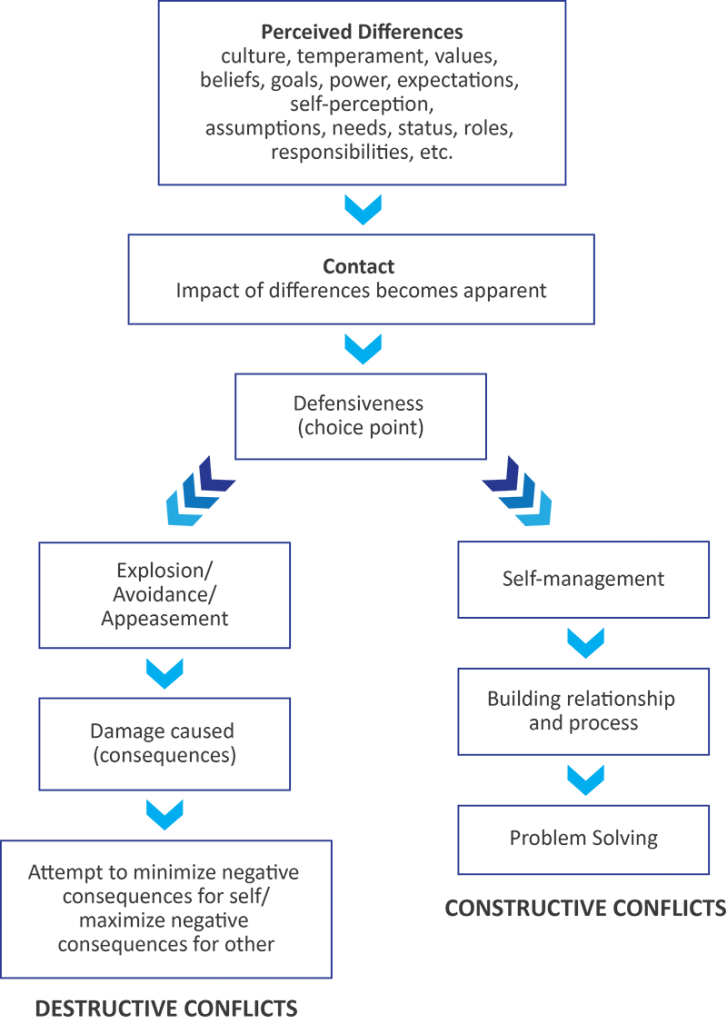
<div class="chapter standard" id="chapter-working-with-power"><div class="chapter-title-wrap"><h3 class="chapter-number">11</h3><h2 class="chapter-title">Working with Power</h2></div><div class="ugc chapter-ugc"><p><strong>If you believe you have more power:</strong></p> <ul><li>Consider working through the conflict in a location that is the most comfortable for the other person.</li> <li>Share the resources you have (e.g. information, expertise).</li> <li>Be willing to listen to the other person first.</li> <li>Do not use your power base to intimidate or retaliate against the other person. Seek to develop a ‘level playing field.’</li> <li>Look for indications that the other person perceives you as having more power, and clarify how you intend to use your power.</li> <li>Respond to challenges non-defensively.</li> </ul> <p> </p> <p><strong>If you believe you have less power: </strong></p> <ul><li>Find ways to increase your own power sources.</li> <li>Describe the consequences of a competitive use of power and the benefits to the other person of a collaborative use of power.</li> <li>Assert yourself and continue to keep your needs on the table while continuing to listen and acknowledge the other person’s needs.</li> <li>If asserting yourself results in the other person exerting his or her power over you, shift temporarily from a focus on your needs to a focus on the other person’s needs.</li> <li>Think about ways to lessen your dependence on the other person’s source of power.</li> </ul> <h1 id="chapter-175-section-1" class="section-header">Destructive Conflict and Constructive Conflict</h1> <p>Conflict can be defined as ‘destructive’ or ‘constructive’ in quality and outcome (Deutsch, 1973; Folger, Poole &amp; Stutman, 2005).</p> <p> </p> <div class="wp-nocaption alignnone wp-image-174"><img class="alignnone wp-image-174" src="https://pressbooks.bccampus.ca/cres1100/wp-content/uploads/sites/334/2018/04/CRES-1101-Foundations_15thEd-May-2017-p15-s-727x1024.png" alt="" width="500" height="704" srcset="https://pressbooks.bccampus.ca/cres1100/wp-content/uploads/sites/334/2018/04/CRES-1101-Foundations_15thEd-May-2017-p15-s-727x1024.png 727w, https://pressbooks.bccampus.ca/cres1100/wp-content/uploads/sites/334/2018/04/CRES-1101-Foundations_15thEd-May-2017-p15-s-213x300.png 213w, https://pressbooks.bccampus.ca/cres1100/wp-content/uploads/sites/334/2018/04/CRES-1101-Foundations_15thEd-May-2017-p15-s-768x1082.png 768w, https://pressbooks.bccampus.ca/cres1100/wp-content/uploads/sites/334/2018/04/CRES-1101-Foundations_15thEd-May-2017-p15-s-65x92.png 65w, https://pressbooks.bccampus.ca/cres1100/wp-content/uploads/sites/334/2018/04/CRES-1101-Foundations_15thEd-May-2017-p15-s-225x317.png 225w, https://pressbooks.bccampus.ca/cres1100/wp-content/uploads/sites/334/2018/04/CRES-1101-Foundations_15thEd-May-2017-p15-s-350x493.png 350w, https://pressbooks.bccampus.ca/cres1100/wp-content/uploads/sites/334/2018/04/CRES-1101-Foundations_15thEd-May-2017-p15-s.png 800w"/></div> </div>
</div>
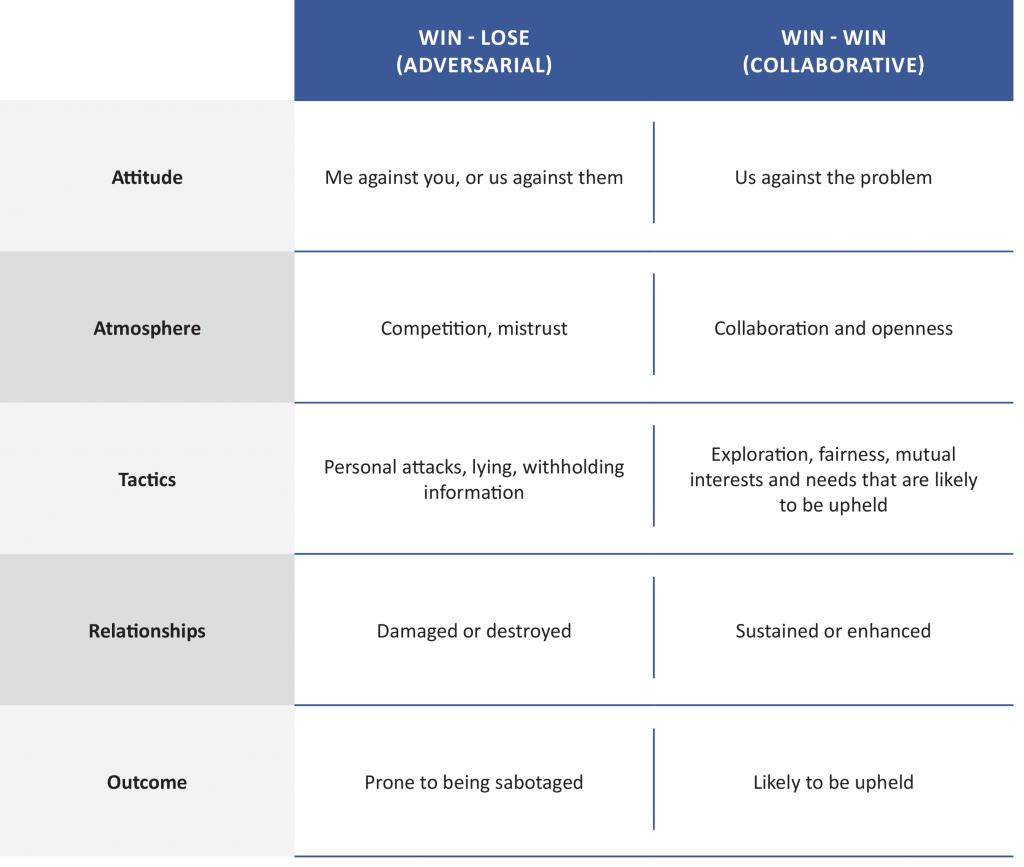
<div class="chapter standard" id="chapter-conflict-approaches-win-lose-adversarial-versus-win-win-collaborative"><div class="chapter-title-wrap"><h3 class="chapter-number">12</h3><h2 class="chapter-title">Conflict Approaches: Win - lose (Adversarial) Versus Win - win (Collaborative)</h2></div><div class="ugc chapter-ugc"><p><strong>Ways conflict can be approached:</strong></p> <div class="wp-nocaption alignnone wp-image-176 size-large"><img class="alignnone wp-image-176 size-large" src="https://pressbooks.bccampus.ca/cres1100/wp-content/uploads/sites/334/2018/04/tables-pp16-1024x867.png" alt="" width="1024" height="867" srcset="https://pressbooks.bccampus.ca/cres1100/wp-content/uploads/sites/334/2018/04/tables-pp16-1024x867.png 1024w, https://pressbooks.bccampus.ca/cres1100/wp-content/uploads/sites/334/2018/04/tables-pp16-300x254.png 300w, https://pressbooks.bccampus.ca/cres1100/wp-content/uploads/sites/334/2018/04/tables-pp16-768x650.png 768w, https://pressbooks.bccampus.ca/cres1100/wp-content/uploads/sites/334/2018/04/tables-pp16-65x55.png 65w, https://pressbooks.bccampus.ca/cres1100/wp-content/uploads/sites/334/2018/04/tables-pp16-225x190.png 225w, https://pressbooks.bccampus.ca/cres1100/wp-content/uploads/sites/334/2018/04/tables-pp16-350x296.png 350w" /></div> <div class="textbox exercises"><h3>What other differences do you believe exist between these two approaches to conflict?</h3> <p style="text-align: center">_________________________________________________</p> <p style="text-align: center">_________________________________________________</p> <p style="text-align: center">_________________________________________________</p> </div> </div>
</div>
<div class="chapter standard" id="chapter-knowing-your-conflict-approach"><div class="chapter-title-wrap"><h3 class="chapter-number">13</h3><h2 class="chapter-title">Knowing Your Conflict Approach</h2></div><div class="ugc chapter-ugc"><p>We tend to subconsciously develop conflict approaches over time. Because our approach proves useful in some circumstances, and can actually be a survival tactic at times, we tend to default to using it without thinking about alternative approaches.</p> <p>Some approaches to conflict are adversarial while other approaches are cooperative in nature.</p> <p>If your approach is adversarial, the climate of your engagement with the other may move toward low trust and guardedness, and the other person may move toward defensiveness and rigidity. If your approach is collaborative, the climate may be more inviting and comfortable, and the other person may move toward openness and flexibility.</p> <p>By becoming more conscious of your own conflict approach, you open the door to learn other ways of engaging in conflict and shift out of unproductive patterns when they don’t serve you. Here are some qualities of adversarial and collaborative conflict styles:</p> <div class="textbox learning-objectives"><p><span style="font-style: normal"><strong>Adversarial</strong></span></p> <ul style="font-style: normal"><li>Tendency of conflict to escalate (intensify) and expand (increase in scope and size).</li> <li>Tendency toward miscommunication and misunderstanding.</li> <li>Guarded, defensive, &amp; rigid behaviour, manner and atmosphere.</li> <li>Defensive posture and attack on differences.</li> <li>Lack of focus on commonalities.</li> <li>Coercion, close-mindedness, and resistance to change.</li> <li>Low concern for relationship.</li> <li>&nbsp;Strong desire to find resolution that meets own needs.</li> <li>Use of power to gain advantage for self.</li> </ul> </div> <div class="textbox learning-objectives"><p><span style="font-style: normal"><strong>Collaborative</strong></span></p> <ul style="font-style: normal"><li>Tendency toward de-escalation of conflict.</li> <li>Willingness to listen and understand, desire to be listened to and understood.</li> <li>Friendly and open behaviour, manner, and atmosphere.</li> <li>Willingness to recognize and work with differences.</li> <li>Motivation to build on commonalities.</li> <li>Use of persuasiveness, awareness, and understanding used to achieve change.</li> <li>Attention paid to improving relationship.</li> <li>Desire to find resolution that works for both.</li> <li>Use of power to benefit both parties.</li> </ul> </div> <p>&nbsp;</p> </div>
</div>
<div class="chapter standard" id="chapter-the-collaborative-view-of-conflict"><div class="chapter-title-wrap"><h3 class="chapter-number">14</h3><h2 class="chapter-title">The Collaborative View of Conflict</h2></div><div class="ugc chapter-ugc"><p><strong>From perceiving conflict as always being …</strong></p> <ul><li>A disruption of order, a negative experience, or an error or mistake in a relationship.</li> <li>A battle between incompatible self-interests or desires.</li> <li>An isolated event we allow to define the entire relationship.</li> <li>A struggle between right and wrong, or good and evil.</li> </ul> <p>&nbsp;</p> <p><strong>To perceiving conflict as often being …</strong></p> <ul><li>An outgrowth of diversity that might hold possibilities for mutual growth and for improving the relationship.</li> <li>One part of a relationship, that involves needs, values, perceptions, power, goals, feelings, desires, etc.</li> <li>Occurrences that punctuate a long-term relationship and that can help clarify it.</li> <li>A confrontation between differences in certain aspects of a relationship but not to the exclusion of other aspects that are still there to build on.</li> </ul> <p>(Weeks, 1994, p.8)</p> <p>&nbsp;</p> </div>
</div>
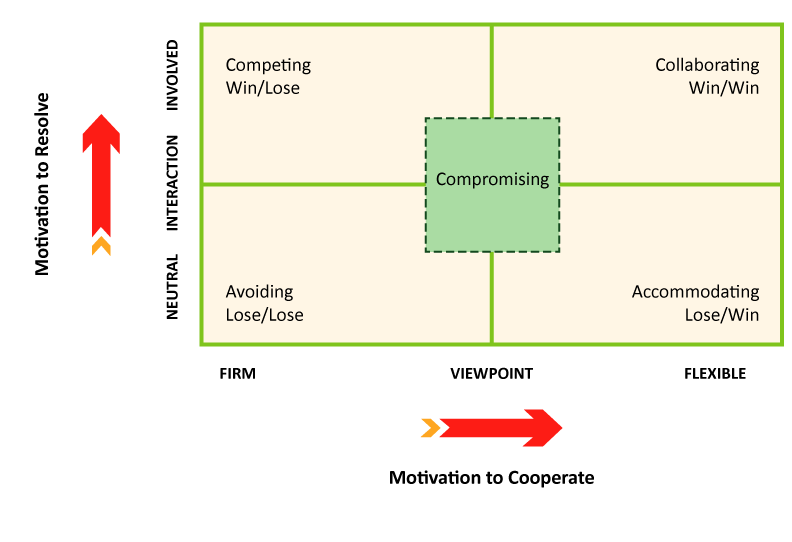
<div class="chapter standard" id="chapter-five-conflict-styles"><div class="chapter-title-wrap"><h3 class="chapter-number">15</h3><h2 class="chapter-title">Five Conflict Styles</h2></div><div class="ugc chapter-ugc"><p>There are five basic conflict styles. Each style reflects different attitudes toward conflict and the relationship with the other person. Examining your values about conflict and relationship helps to uncover your dominant style(s).<br /> Although style(s) can change with new awareness and changing circumstances, your dominant style(s) reflects your habitual learned response to conflict. Under pressure, a person’s dominant style tends to surface.</p> <div class="textbox learning-objectives"><p><span style="font-style: normal"><strong>Competing / Directing</strong></span></p> <p><span style="font-style: normal">This style is most self-focused and is least likely to be received as cooperative. Different modes related to this style vary from very forceful and domineering behaviours to more open and understanding (but still inflexible on outcome).</span></p> </div> <div class="textbox learning-objectives"><p><span style="font-style: normal"><strong>Avoiding</strong></span></p> <p><span style="font-style: normal">This style tends to turn away from conflict. Avoidance can be cooperative or adversarial but, as a dominant style, it can lead to unnecessary prolongation and escalation of conflicts. In many conflict situations, it serves neither person’s interests. When differences appear, behaviours can range from outright belligerent unwillingness to resolve conflict to a general ‘smoothing’ style. Short-term avoidance can be used constructively to allow both parties time to reflect on or prepare to address the conflict.</span></p> </div> <div class="textbox learning-objectives"><p><span style="font-style: normal"><strong>Accommodating / Harmonizing</strong></span></p> <p><span style="font-style: normal">This style is most focused on the other person and least focused on the self. Accommodating behaviour can be cooperative or adversarial in nature but, as a dominant style, leads to outcomes that favour the other person. Behaviours can range from total capitulation and disinterest in the outcome to ‘giving in’ after some exploration of the conflict.</span></p> </div> <div class="textbox learning-objectives"><p><span style="font-style: normal"><strong>Compromising</strong></span></p> <p><span style="font-style: normal">This style is focused on satisfying both parties, with a preference towards the self. It can be cooperative or adversarial, but as a dominant style, will tend toward a ‘split the difference’ solution and a competitive atmosphere. Behaviours range from very closed, positional stances to an approach that is more flexible and shows a willingness to move towards the middle.</span></p> </div> <div class="textbox learning-objectives"><p><span style="font-style: normal"><strong>Collaborating / Cooperating</strong></span></p> <p><span style="font-style: normal">This style focuses on satisfying both parties to the greatest degree possible. Behaviours range from making attempts to collaborate, to a committed attempt to continue using collaborative strategies even in challenging situations.</span></p> </div> <div class="textbox learning-objectives"><p><span style="font-style: normal"><strong>Use of conflict styles</strong></span></p> <p><span style="font-style: normal">Each conflict style has its appropriate uses, but the appropriateness of a particular style may differ between cultures. Depending on intentions and reactions, different behaviours can be intended and received as either adversarial or cooperative in nature.</span></p> </div> <p>&nbsp;</p> <div class="textbox exercises"><h3>Exercise: Conflict styles</h3> <p>Break into five groups. Each group works with the table below on one of the styles. The groups will rotate to give you a chance to comment on each style.</p> <ol><li>What are the benefits of each style?</li> <li>Where are the drawbacks to each style?</li> </ol> </div> <p>&nbsp;</p> <div class="wp-nocaption alignnone wp-image-180"><img class="alignnone wp-image-180" src="https://pressbooks.bccampus.ca/cres1100/wp-content/uploads/sites/334/2018/04/tables-pp22-1024x867.png" alt="" width="600" height="508" srcset="https://pressbooks.bccampus.ca/cres1100/wp-content/uploads/sites/334/2018/04/tables-pp22-1024x867.png 1024w, https://pressbooks.bccampus.ca/cres1100/wp-content/uploads/sites/334/2018/04/tables-pp22-300x254.png 300w, https://pressbooks.bccampus.ca/cres1100/wp-content/uploads/sites/334/2018/04/tables-pp22-768x650.png 768w, https://pressbooks.bccampus.ca/cres1100/wp-content/uploads/sites/334/2018/04/tables-pp22-65x55.png 65w, https://pressbooks.bccampus.ca/cres1100/wp-content/uploads/sites/334/2018/04/tables-pp22-225x190.png 225w, https://pressbooks.bccampus.ca/cres1100/wp-content/uploads/sites/334/2018/04/tables-pp22-350x296.png 350w" /></div> <p>&nbsp;</p> <p><strong>Conflict styles grid &#8211; view one</strong></p> <p class="ManualText">This grid can be used to identify conflict styles. (Scott, 2007, p.27)</p> <div class="wp-nocaption alignnone wp-image-811"><img class="alignnone wp-image-811" src="https://pressbooks.bccampus.ca/cres1100/wp-content/uploads/sites/334/2018/04/CRES-1101-Foundations_15thEd-May-2017-p23a_small.png" alt="" width="500" height="342" /></div> <p><strong>Conflict styles grid &#8211; view two</strong></p> <div class="wp-nocaption alignnone wp-image-812"><img class="alignnone wp-image-812" src="https://pressbooks.bccampus.ca/cres1100/wp-content/uploads/sites/334/2018/04/CRES-1101-Foundations_15thEd-May-2017-p23b_small.png" alt="" width="500" height="342" /></div> <p>&nbsp;</p> <div class="textbox exercises"><h3>Exercise: My conflict style preferences</h3> <p>Identify key people in your life in the satellite circles and identify the conflict style you most often use with each one (write this on the line).</p> <div class="wp-nocaption alignnone wp-image-738 size-full"><img class="alignnone wp-image-738 size-full" src="https://pressbooks.bccampus.ca/cres1100/wp-content/uploads/sites/334/2018/04/CRES-1101-Foundations_15thEd-May-2017-p24-s-e1515090609346.png" alt="" width="500" height="490" /></div> </div> <p>&nbsp;</p> <div class="textbox exercises"><h3>Questions to Ponder</h3> <ol><li>After looking at each situation you identified, how well is this style serving you and the other person?</li> <li>What if you were to focus on using a different style? How much would the situation and both of you benefit from a different conflict style? What impact might this have on the outcome?</li> </ol> </div> </div>
</div>
<div class="part " id="part-part-ii-the-collaborative-approach-to-conflict"><div class="part-title-wrap"><h3 class="part-number">III</h3><h1 class="part-title">Part II: The Collaborative Approach to Conflict</h1></div></div>
<div class="chapter standard" id="chapter-beliefs-underlying-the-collaborative-approach"><div class="chapter-title-wrap"><h3 class="chapter-number">16</h3><h2 class="chapter-title">Beliefs Underlying the Collaborative Approach</h2></div><div class="ugc chapter-ugc"> <ul><li>Conflict is part of an ongoing cycle of change; it is to be expected as a part of human interaction.</li> <li>Conflict itself is neither good nor bad. How people interact in conflict influences whether it leads to desirable or undesirable outcomes.</li> <li>Conflicts develop from a variety of situations and interactions.</li> <li>Specific disputes are often symbols of deeper, underlying conflicts.</li> <li>Humans tend to defend their own perception of a conflict situation, and adversarial dynamics tend to develop.</li> <li>It is best to establish a cooperative approach to conflict resolution before the conflict has developed into an adversarial pattern.</li> <li>Many conflicts that are avoided, battled out, or stalemated may be resolved by a collaborative approach.</li> <li>Relationships between people are influenced by their interactions. Cooperative approaches improve the quality of interactions and relationships.</li> <li>The awareness of conflict dynamics, shifts in thinking, and the use of collaborative skills and strategies enhances a person’s abilities to set a conflict in a cooperative direction.</li> </ul> <h2>Goals of the collaborative approach</h2> <p><strong>Conflicts involve relationships, issues, and individuals. The collaborative approach to conflict resolution aims to:</strong></p> <ul><li>Improve or repair relationships by increasing understanding between the parties, thereby diminishing or eradicating the tension between them.</li> <li>Provide outcomes to issues that result in gains to both parties.</li> <li>Provide parties with a positive experience of the conflict engagement process.</li> </ul> <h2>Conditions that support collaboration</h2> <p><strong>The collaborative approach to conflict resolution will work best when the following conditions exist:</strong></p> <ul><li>Recognition by the parties that a conflict exists.</li> <li>Desire to resolve the conflict.</li> <li>Willingness to try a collaborative approach.</li> <li>Willingness to depersonalize the conflict and to work together on issues.</li> <li>Collaborative conflict resolution competencies gained through education.</li> </ul> </div>
</div>
<div class="chapter standard" id="chapter-preparing-oneself-for-collaboration"><div class="chapter-title-wrap"><h3 class="chapter-number">17</h3><h2 class="chapter-title">Preparing Oneself for Collaboration</h2></div><div class="ugc chapter-ugc"><p>Effective conflict resolution practices start with oneself. This involves:</p> <p>&nbsp;</p> <div class="wp-nocaption alignnone wp-image-762 size-full"><img class="alignnone wp-image-762 size-full" src="https://pressbooks.bccampus.ca/cres1100/wp-content/uploads/sites/334/2018/04/CRES-1101-Foundations_15thEd-May-2017-p28-v2-s.png" alt="" width="800" height="484" /></div> <p style="text-align: center"></p></div>
</div>
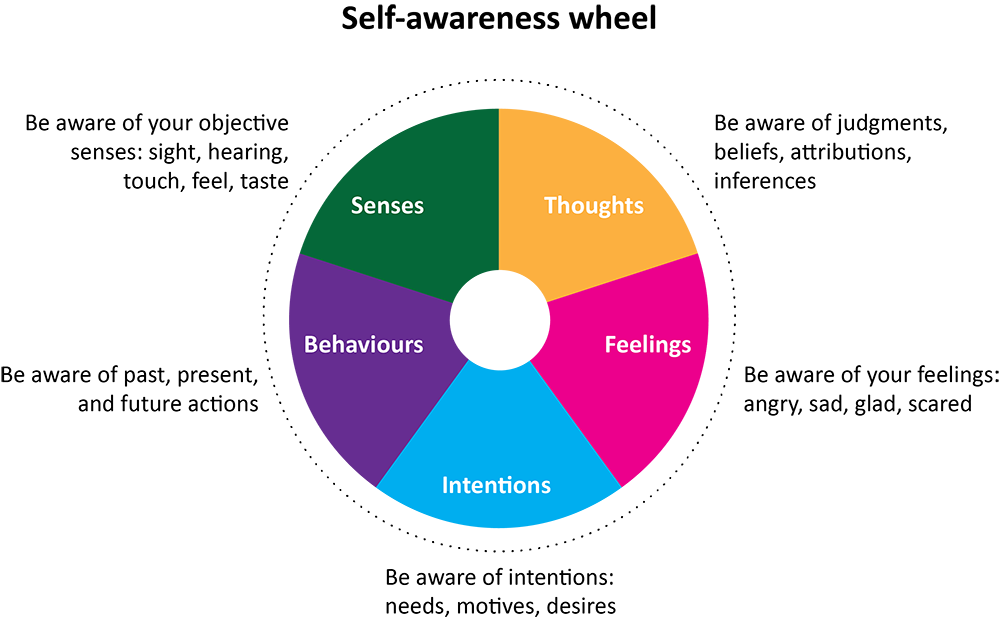
<div class="chapter standard" id="chapter-internal-aspects-of-the-collaborative-approach"><div class="chapter-title-wrap"><h3 class="chapter-number">18</h3><h2 class="chapter-title">Internal Aspects of the Collaborative Approach</h2></div><div class="ugc chapter-ugc"><p>The ‘inner work’ of conflict resolution includes exploring and questioning one’s attitudes, beliefs, values, perceptions, and feelings about the conflict.</p> <p class="p1">Changing one’s perspective and attitude is not always easy. However, adopting collaborative conflict resolution approaches will change behaviours and, over time, will lead to increased awareness, new experiences and better outcomes. This will reinforce a shift in attitude towards conflict.</p> <p>Shifting one’s conflict awareness ‑ being present with our experience and recognizing how our thinking patterns influence our behaviour‑ is a necessary first step.</p> <blockquote><p>It is all too easy to judge our thoughts and emotions, to see them as wrong or right, bad or good. But in a psychological sense, there is nothing really wrong that we feel or think. Actions can be wrong, but not thoughts or feelings. As inner scientists, we simply treat even the darker thoughts and emotions as interesting research material. I find a simple but powerful question to keep asking myself is: “Isn’t that <em>curious</em>?” The question creates distance and opens the way to inquiry rather than judgement. (Ury, 2015, p.25)</p></blockquote> <h1 id="chapter-190-section-1" class="section-header"></h1> <h1 id="chapter-190-section-2" class="section-header">Awareness and Reflection</h1> <p>Awareness is a state of becoming conscious about something — being aware of what you think, feel, sense, expect, assume, and your reactions to the world around you. Before attempting to understand others, it is important to increase self-awareness.</p> <p>A conflict arises when parties recognize that differences between them are causing problems, tension, or negative feelings. This may be experienced as tension, distance, defensiveness, as an argument, or one party may bring conflict to the other’s attention.</p> <p>In a conflict it is useful to be aware of:</p> <ul><li>Verbal and non-verbal cues.</li> <li>Perceptions, feelings, values, beliefs, fears, concerns, assumptions, and expectations, with regard to the conflict and the other person.</li> <li>Your own defensiveness, position taking, put-downs, ‘triggering’ or reactions that work against conflict resolution goals.</li> <li>The possible existence of a more primary, underlying conflict behind a particular dispute.</li> <li>Values, beliefs, attitudes, and what you believe you need in the situation.</li> <li>The moment when tension is de-escalating and feelings of friendliness or warmth are developing.</li> </ul> <p>With awareness comes a sense of readiness to resolve the conflict with the other party. Readiness may involve checking or shifting your thoughts and attitudes, mustering emotional courage, taking time to think or calm down, thinking about your goals in the conflict interaction, or orienting yourself away from a defensive or negative frame of mind towards a resolution or goal frame of mind.</p> <p>This internal processing of the conflict occurs during self-reflection<em>.</em> It can occur after the conflict is resolved or in the pauses during a conflict resolution process. Reflection is generally easier when you are away from direct interaction with the other person. Reflection at any point allows you to absorb all that has gone on and to step back and look at the big picture.</p> <p> </p> <p> </p> <p><strong>Reflection can help you to:</strong></p> <ul><li>Think about your role in the conflict.</li> <li>Think about your goals in the conflict.</li> <li>Let go of residual bad feelings toward yourself or the other person.</li> <li>Analyze how the conflict unfolded and gain understanding about why it unfolded that way.</li> <li>Think about any parts of the conflict that may not be resolved, or those that were missed entirely, but may still need to be addressed.</li> <li>Increase self-awareness about your conflict tendencies and resolve to act with intention in the future.</li> </ul> <p> </p> <p> </p> <p><strong>Separating internal states</strong></p> <p>Your awareness of your own internal experience and the internal experience of the other is critical to effective communication when resolving conflict.</p> <div class="wp-nocaption alignnone wp-image-743 size-full"><img class="alignnone wp-image-743 size-full" src="https://pressbooks.bccampus.ca/cres1100/wp-content/uploads/sites/334/2018/04/CRES-1101-Foundations_15thEd-May-2017-p31-s.png" alt="" width="1000" height="621"/></div> <p style="text-align: center">(Wackman, Nunnally &amp; Faline, 1982, p.52)</p> <div class="textbox exercises"><h3>Exercise: Building self-awareness</h3> <p>In a triad or with a partner, simulate a conflict resolution conversation. Debrief it afterward, focusing on what you were aware of in yourself, in the interaction, and in the other person. If there is an observer, ask what they were aware of during the discussion. You might want to break your self-awareness into components like, “what I was feeling,” “what I was thinking,” “what I was doing,” and refer back to the self-awareness wheel on the previous page.</p> </div> </div>
</div>
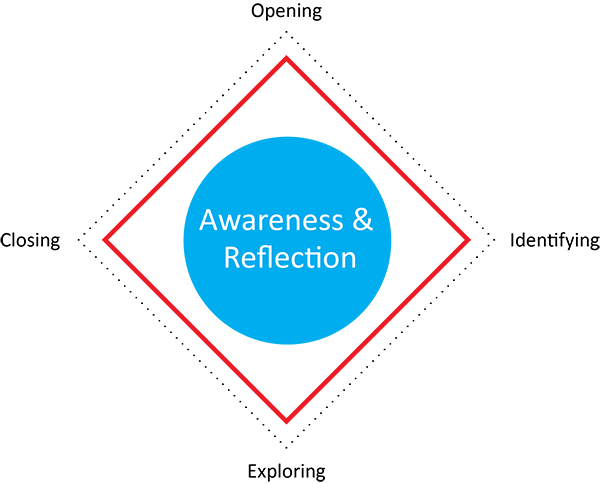
<div class="chapter standard" id="chapter-external-phases-of-the-collaborative-approach"><div class="chapter-title-wrap"><h3 class="chapter-number">19</h3><h2 class="chapter-title">External Phases of the Collaborative Approach</h2></div><div class="ugc chapter-ugc"><p>The external phases of a collaborative approach provide a framework for engaging in a collaborative conflict resolution process with others. The framework is developmental and, even though conflict interaction is not linear, may be perceived as steps that build on one another.</p> <p><strong>There are four major external phases: </strong></p> <div class="wp-nocaption alignnone wp-image-745 size-full"><img class="alignnone wp-image-745 size-full" src="https://pressbooks.bccampus.ca/cres1100/wp-content/uploads/sites/334/2018/04/CRES-1101-Foundations_15thEd-May-2017-p36-s.png" alt="" width="600" height="441"/></div> <h1 style="text-align: left" id="chapter-192-section-1" class="section-header">Opening</h1> <p>Opening is the act of one person approaching another for the purpose of beginning to resolve a conflict collaboratively. Opening is best accomplished by creating an environment that supports collaboration.</p> <p>When you open a conflict conversation or respond to someone else’s initiative, be responsive to the other person’s reaction to your approach and to their readiness.</p> <p><strong>Setting a collaborative tone</strong></p> <p>Tone refers to the general feeling between you and the other person. Most conflict resolution efforts begin with tension, fears, and other challenging feelings. Establishing and maintaining a collaborative tone requires establishing rapport and reducing tension before delving into the substance of the conflict conversation. It is important to continue to monitor the tone throughout the conversation.</p> <p><strong>Maintaining a collaborative tone includes:</strong></p> <ul><li>Using power to benefit both parties.</li> <li>Communicating assertively and empathetically.</li> <li>Referring to collaborative goals.</li> <li>Depersonalizing the conflict.</li> </ul> <div class="textbox learning-objectives"><p><span style="font-style: normal"><strong>Purpose of the Opening Phase</strong></span></p> <p><span style="font-style: normal">The main purpose of this phase is to establish a feeling of mutual commitment to discussing and resolving a conflict together in the safest and most collaborative atmosphere possible.</span></p> <p><span style="font-style: normal">Establishing a collaborative atmosphere involves attending to both physical and emotional environments. It involves how and when you begin the conversation, your tone of voice, your facial expression, and the physical setting you have chosen. The opening phase recognizes that the way in which the collaborative conversation begins can largely determine how it unfolds.</span></p> </div> <div class="textbox exercises"><h3><strong>Strategies of the opening phase may include:</strong><strong> </strong></h3> <ul><li>Finding a convenient time to discuss the conflict.</li> <li>Agreeing on a mutually convenient, comfortable, and possibly neutral location or setting conducive to discussion conversation.</li> <li>Acknowledging and valuing the need to resolve differences.</li> <li>Expressing your collaborative intent about how to address and solve the conflict together.</li> <li>Expressing motivation to resolve the differences to future mutual benefit, and assessing the other person’s readiness.</li> <li>Listening attentively and expressing yourself clearly.</li> <li>Keeping a positive attitude and remaining future focused.</li> </ul> </div> <h1 id="chapter-192-section-2" class="section-header">Identifying</h1> <p>The identifying phase involves framing the aspects of the conflict for conversation. In this phase, both parties express how they think, feel, and perceive the various aspects of the conflict. Identifying conflict in defensive and judgemental ways can lead to an adversarial climate and destructive outcomes. Identifying aspects of the conflict in depersonalized, objective and neutral terms can lead to a more collaborative and inviting climate.</p> <div class="textbox learning-objectives"><p><span style="font-style: normal"><strong>Purpose of the identifying phase</strong></span></p> <p><span style="font-style: normal">The identifying phase builds on the opening phase, and recognizes that what needs to be discussed may not be clear to one or both people in the conflict. This phase allows each person to establish the scope of the conversation by getting an overall sense of what needs to be resolved (the topics or subject areas requiring resolution).</span></p> <p><span style="font-style: normal">This phase also presumes that ensuing conversation will make more sense and be more focused if the general scope of the problem is understood before it is explored. Regardless of who initiates the discussion, this phase ensures that both parties get an opportunity to say what it is they want to talk about and attempt to resolve.</span></p> </div> <div class="textbox exercises"><h3><strong>Strategies of the identifying phase may include:</strong></h3> <ul><li>Stating your own point of view with respect to what you want to resolve in neutral, depersonalized terms.</li> <li>Inviting the other person to share his or her point of view with respect to what they want to resolve.</li> <li>Listening actively when the other person is speaking to ensure understanding.</li> <li>Checking for clarity while depersonalizing what they have said.</li> <li>Combining both sides’ topics into an agenda.</li> <li>Using descriptive language to frame agenda items in a way that does not assign blame or specify an outcome.</li> </ul> </div> <h1 id="chapter-192-section-3" class="section-header">Exploring</h1> <p>During the exploring phase, each party learns what underlies the dispute and comes to understand the perspectives, needs, values, and beliefs of both the other person, and themselves.</p> <p>This phase presumes that resolution can be reached more easily by achieving a truer and fuller understanding of one another, and working through differences and similarities without judgement and blame.</p> <div class="textbox learning-objectives"><p><span style="font-style: normal"><strong>Purpose of the exploring phase</strong></span></p> <p><span style="font-style: normal">The exploring phase of the conversation involves delving into the aspects of the past conflict (as determined in the identifying phase) for meaning and importance to both sides. It allows each party to relay what is important to them about that aspect, and why it is important.</span></p> <p><span style="font-style: normal">In collaborative conflict resolution, exploring the other person’s motivations and self-disclosing your motivations helps both parties understand the conflict more deeply.</span></p> <p><span style="font-style: normal">Motivations include our goals, beliefs, and hopes, as well as our concerns and fears. This phase involves questioning, listening, and asserting. It’s important to maintain an attitude of curiosity rather than judgement as you try to understand the different points of view.</span></p> <p><span style="font-style: normal">In this process of mutual discovery, areas of agreement begin to develop. You may find yourself thinking differently as a result of hearing what the other person says, and then being able to clear up assumptions and misunderstandings. Thoughts move toward ideas that help resolve the conflict in ways that lead to more mutual satisfaction.</span></p> </div> <div class="textbox exercises"><h3><strong>Strategies of the exploring phase may include:</strong></h3> <ul><li>Stating and checking your assumptions.</li> <li>Looking for common ground.</li> <li>Exploring what is important for each of you regarding the identified topics.</li> <li>Clarifying the interpretation of words, phrases, and information.</li> <li>Expressing and acknowledging feelings.</li> <li>Listening actively and continuing to check for understanding.</li> <li>Being descriptive rather than judgemental.</li> <li>Asking open-ended questions.</li> <li>Speaking your perspective in a respectful and assertive way.</li> <li>Summarizing what is important to both parties in this exploration.</li> </ul> </div> <h1 id="chapter-192-section-4" class="section-header">Closing</h1> <p>The closing phase can achieve either an expression of resolution or establish a temporary end to the conversation without a resolution. When a satisfactory resolution has been reached, it often includes a change in feelings between the parties as well as a resolution of the issues in dispute. Closing of this type may include decision-making, apologizing, creating a plan, providing restitution, reconciling negative feelings and/or physical demonstrations of friendship like shaking hands or hugging.</p> <p>When closing is either temporary or about ending discussion even though the conflict still exists, it may look and feel quite different from resolution. This type of closing may include taking time out to cool down, getting more information, living with the situation as it is, trying another method or style to resolve the conflict or deciding simply to go your separate ways.</p> <p>True resolution occurs when both the heart and head have let go of the conflict. If the substance of the dispute is resolved (the head), but feelings between the parties are not reconciled (the heart), further discussion, the passage of time, or future positive interactions may be required before true resolution occurs.</p> <p>The relationship aspect of closing may include:</p> <ul><li>Subsiding feelings of tension, anxiety, hostility, or resentment.</li> <li>New and more positive attitudes towards the other person.</li> <li>Feelings of connectedness, warmth, or friendliness towards the other person.</li> </ul> <p>The content aspect of closing may include:</p> <ul><li>Looking for ways to amend what has happened in the past.</li> <li>Looking at new ideas or changes to improve interactions in the future.</li> <li>Checking to see whether ideas work for both parties.</li> <li>Making agreements about who will do what.</li> </ul> <div class="textbox learning-objectives"><p><span style="font-style: normal"><strong>Purpose of the closing phase</strong></span></p> <p><span style="font-style: normal">During this phase, both people generate possible mutually satisfying solutions to the conflict based on what is important to them. They then select the options that best satisfy their needs, both shared and distinct, as discovered in the exploring phase. The solutions that meet the most needs of both parties will be the best.</span></p> </div> <div class="textbox exercises"><h3><strong>Strategies of the closing phase may include:</strong></h3> <ul><li>Inviting brainstorming – a mutual generation of options that meet the expressed needs of each party in the dispute.</li> <li>Evaluating the options and checking for fairness to ensure that the needs of both parties are met.</li> <li>Choosing one or a combination of options that work for both parties.</li> <li>Forming an action plan: who, what, when, where, how, and work out the details.</li> <li>Evaluating the effectiveness of the solution.</li> <li>Attending to the relationship aspects of closing.</li> </ul> </div> <p><strong>If a solution is still not apparent, try:</strong></p> <ul><li>Creating more trust or energy, or reduce fear.</li> <li>Breaking and coming back to the discussion later.</li> <li>Agreeing that we have different views or see things differently, or agree that we cannot resolve the issue at this time and setting a time for future discussion.</li> <li>Obtaining more information.</li> </ul> </div>
</div>
<div class="chapter standard" id="chapter-summary-of-external-phases"><div class="chapter-title-wrap"><h3 class="chapter-number">20</h3><h2 class="chapter-title">Summary of External Phases</h2></div><div class="ugc chapter-ugc"><h2>Opening phase</h2> <div><div class="textbox learning-objectives">How am I working with the other person to create an environment conducive to reaching agreement?</div> <p>Goal: establish a feeling of mutual commitment to discussing and resolving a conflict together, in as comfortable an atmosphere as possible.</p> </div> <ul><li>Agree on a mutually convenient, comfortable and possibly neutral setting conducive to discussion.</li> <li>Discuss awareness of the need to resolve differences.</li> <li>Express your motivation to resolve the differences to future mutual benefit and assess the other person’s motivation.</li> <li>Listen attentively and express yourself clearly.</li> <li>Maintain a positive, future focus.</li> </ul> <h2>Identifying phase</h2> <div><div class="textbox learning-objectives">What are we here to resolve?</div> <p>Goal: establish what needs to be resolved.</p> </div> <ul><li>State your own point of view with respect to what needs to be resolved.</li> <li>Invite the other person to share their point of view with respect to what they want to resolve.</li> <li>Listen actively when the other is speaking to ensure understanding.</li> <li>Check with one another for clarity.</li> <li>Depersonalize the conflict by stating topics in a neutral way that does not assign blame or specify an outcome.</li> <li>Combining both parties’ topics into an agenda.</li> </ul> <h2>Exploring phase</h2> <div><div class="textbox learning-objectives">What is important and why is it important?</div> <p>Goal: to give and receive information about what is important to each person, and why it is important.</p> <ul><li>State and check your assumptions.</li> <li>Look for common ground.</li> <li>Explore what is important in terms of each other’s perspectives.</li> <li>Clarify the interpretation of words, phrases, and information.</li> <li>Express and acknowledge feelings.</li> <li>Listen actively and continue to check for understanding.</li> <li>Be descriptive rather than judgemental.</li> <li>Ask open-ended questions.</li> <li>Speak about your perspective in a respectful, assertive way.</li> <li>Summarize what is important to both parties in this exploration.</li> </ul> <h2>Closing phase</h2> <div><div class="textbox learning-objectives">How do we meet our needs?</div> <p>Goal: find a mutually satisfying outcome.</p> </div> <ul><li>Invite brainstorming to mutually generate options based on what is important to both people.</li> <li>Evaluate the options and check for fairness to ensure that the needs of both people are met.</li> <li>Choose one or a combination of options that work for both people.</li> <li>Form an action plan: who, what, when, where, how and work out the details.</li> <li>Evaluate the effectiveness of the solution.</li> </ul> <h2>If a solution is still not apparent:</h2> <ul><li>Create more trust and reduce fear.</li> <li>Break and come back to the discussion.</li> <li>Agree that you cannot resolve the issue at this time and set a time for future discussion.</li> <li>Obtain more information.</li> <li>Form an action plan (if needed).</li> <li>Attend to the relationship aspects of the discussion.</li> </ul> <p>&nbsp;</p> </div> </div>
</div>
<div class="chapter standard" id="chapter-the-big-picture-combining-inner-and-outer-strategies"><div class="chapter-title-wrap"><h3 class="chapter-number">21</h3><h2 class="chapter-title">The Big Picture: Combining Inner and Outer Strategies</h2></div><div class="ugc chapter-ugc"><p>&nbsp;</p> <div class="wp-nocaption alignnone wp-image-748 size-full"><img class="alignnone wp-image-748 size-full" src="https://pressbooks.bccampus.ca/cres1100/wp-content/uploads/sites/334/2018/04/CRES-1101-Foundations_15thEd-May-2017-p47-s.png" alt="" width="600" height="484" /></div> <p>The diagram above is a map to guide you through conflict, not a formula to follow.</p> <p>Your inner work and the outer phases come together to support a collaborative style.</p> <p>Each phase of the conflict resolution process needs to be approached in a collaborative way in order for the conflict to move in a collaborative direction.</p> <p>Conflict and its resolution are part of an ongoing cycle. Closing is often not the end of a conflict interaction. Relationships and situations continue and change, conflict dynamics re-emerge, and the cycle continues.</p> <p>&nbsp;</p> <p>&nbsp;</p> <h2>When Conflicts Don’t Resolve</h2> <p>The truth is that sometimes conflicts do not resolve. Possible reasons for why a conflict doesn’t resolve are varied and, for any given situation, those reasons might never be fully known to either or both parties.</p> <p>We can only control half of any relationship. Sometimes, no matter what we say, no matter what we do, no matter how well-intended we are, we cannot and will not be able to “resolve” a conflict with someone else.</p> <p>This is not a failure; it’s simply an opportunity to find a different way forward that does not involve the agreement of the other. Say to yourself, “I did my best, I lived up to my values, I invited collaborative engagement, and now I need to find another path.” It’s an invitation to yourself to find resolution <em>within yourself</em>.</p> </div>
</div>
<div class="part " id="part-part-iii-collaborative-competencies"><div class="part-title-wrap"><h3 class="part-number">IV</h3><h1 class="part-title">Part III: Collaborative Competencies</h1></div></div>
<div class="chapter standard" id="chapter-components-of-effective-communication"><div class="chapter-title-wrap"><h3 class="chapter-number">22</h3><h2 class="chapter-title">Components of Effective Communication</h2></div><div class="ugc chapter-ugc"><p class="ManualText">Effective communication in collaborative conflict engagement involves attending to four components:</p> <ol><li style="list-style-type: none"><ol><li><strong>Content:&nbsp;</strong>What the conflict is about ‑ the substantive aspects of what we need to resolve&nbsp;e.g., budget, timeline, roles and responsibilities.</li> <li><strong>Process: </strong>The way in which we structure or organize our engagement with each other as we try to resolve the conflict, e.g., how and when to meet, how we share information, how we make decisions.</li> <li><strong>Relationship:&nbsp;</strong>How we treat each other, or how we demonstrate respect, validation, concern and positive intention toward the other (or not).</li> <li><strong>Emotion:&nbsp;</strong>How we feel about the above components: content, process and relationship, either positively, negatively or both.</li> </ol> </li> <li style="list-style-type: none"></li> </ol> <p>Ironically, when in conflict, we often focus on the substantive problems (content) to the detriment of process or relationship. This can create negative emotions regarding process and relationship that people will attach to content, regardless of their origin.</p> <p>Achieving the balance between Content, Process, Relationship and Emotion, requires the following:</p> <div class="textbox learning-objectives"><p><span style="font-style: normal"><strong>Management of self:</strong></span></p> <ul style="font-style: normal"><li>Be aware of your own resistance and defensiveness.</li> <li>Use positive self-talk and self-regulation.</li> <li>Remain curious.</li> </ul> </div> <div class="textbox learning-objectives"><p><span style="font-style: normal"><strong>Communication skills: </strong></span></p> <ul style="font-style: normal"><li>Facilitation: <ul style="font-style: normal"><li>Non-defensive listening</li> <li>Questions and probes</li> <li>Empathic response, reframing, summarizing</li> </ul> </li> </ul> <ul style="font-style: normal"><li>Assertion: <ul style="font-style: normal"><li>‘I’ messages</li> <li>Descriptive language</li> <li>Objective and specific language</li> </ul> </li> </ul> </div> <div class="textbox learning-objectives"><p><span style="font-style: normal"><strong>Dealing with resistance and defensiveness:</strong></span></p> <ul style="font-style: normal"><li>Focus on the other person.</li> <li>Acknowledge their feelings.</li> <li>Build trust and rapport.</li> <li>Identify underlying needs and motivators.</li> </ul> </div> <p>&nbsp;</p> <div></div> </div>
</div>
<div class="chapter standard" id="chapter-language-of-collaboration"><div class="chapter-title-wrap"><h3 class="chapter-number">23</h3><h2 class="chapter-title">Language of Collaboration</h2></div><div class="ugc chapter-ugc"><p>The following questions and phrases exemplify the language style that promotes good process, respectful relationships and mutually beneficial agreements.</p> <table style="background-color: #eee;width: 100%;border: 1px solid grey;font-size: 14px"><tbody><tr><td style="width: 443px">What if we…?</td> <td style="width: 401px">What is important to you about…?</td> </tr> <tr><td style="width: 443px">What&#8217;s your point of view on…?</td> <td style="width: 401px">Let&#8217;s look at how we both…</td> </tr> <tr><td style="width: 443px">Correct me if I&#8217;m wrong…</td> <td style="width: 401px">How do you feel about…?</td> </tr> <tr><td style="width: 443px">What was your intention…?</td> <td style="width: 401px">I&#8217;d like to focus on…</td> </tr> <tr><td style="width: 443px">How would you…if I…?</td> <td style="width: 401px">My concern is…</td> </tr> <tr><td style="width: 443px">Let me see if I understand you…</td> <td style="width: 401px">I&#8217;ll consider that and get back to you.</td> </tr> <tr><td style="width: 443px">How acceptable would this be&#8230;?</td> <td style="width: 401px">What more can you tell me about…?</td> </tr> <tr><td style="width: 443px">How fair does it seem (or make sense)&#8230;?</td> <td style="width: 401px">What thought have you given to…?</td> </tr> <tr><td style="width: 443px">Let&#8217;s consider…</td> <td style="width: 401px">How would it work if…?</td> </tr> <tr><td style="width: 443px">How do you see it?</td> <td style="width: 401px">My hope (intention / goal) is…</td> </tr> <tr><td style="width: 443px">In your experience…?</td> <td style="width: 401px">What I value most is…</td> </tr> </tbody> </table> <p><strong>Words and phrases to avoid (they signal argumentation)</strong></p> <p>Yes, but&#8230;</p> <p>I understand how you feel, however&#8230;</p> <p>I’m sorry you feel that way, nonetheless&#8230;</p> <p>With all due respect&#8230;</p> <p>And at the end of the day&#8230;</p> <p>That’s all well and good but&#8230;</p> <p>I completely disagree with you&#8230;</p> </div>
</div>
<div class="chapter standard" id="chapter-examples-of-collaborative-language"><div class="chapter-title-wrap"><h3 class="chapter-number">24</h3><h2 class="chapter-title">Examples of Collaborative Language</h2></div><div class="ugc chapter-ugc"><div class="wp-nocaption alignnone wp-image-199 size-large"><img class="alignnone wp-image-199 size-large" src="https://pressbooks.bccampus.ca/cres1100/wp-content/uploads/sites/334/2018/04/tables-pp49-889x1024.png" alt="" width="889" height="1024" srcset="https://pressbooks.bccampus.ca/cres1100/wp-content/uploads/sites/334/2018/04/tables-pp49-889x1024.png 889w, https://pressbooks.bccampus.ca/cres1100/wp-content/uploads/sites/334/2018/04/tables-pp49-260x300.png 260w, https://pressbooks.bccampus.ca/cres1100/wp-content/uploads/sites/334/2018/04/tables-pp49-768x885.png 768w, https://pressbooks.bccampus.ca/cres1100/wp-content/uploads/sites/334/2018/04/tables-pp49-65x75.png 65w, https://pressbooks.bccampus.ca/cres1100/wp-content/uploads/sites/334/2018/04/tables-pp49-225x259.png 225w, https://pressbooks.bccampus.ca/cres1100/wp-content/uploads/sites/334/2018/04/tables-pp49-350x403.png 350w" /></div> </div>
</div>
<div class="chapter standard" id="chapter-clarifying-assumptions"><div class="chapter-title-wrap"><h3 class="chapter-number">25</h3><h2 class="chapter-title">Clarifying Assumptions</h2></div><div class="ugc chapter-ugc"><p>While it is difficult to avoid making assumptions, it is possible to be aware of assumptions and to learn how to clarify them so that they do not contribute to conflict. Checking perceptions and clarifying assumptions can:</p> <ul><li>Reduce misunderstanding and negative perceptions.</li> <li>Eliminate some aspects of the conflict.</li> <li>Uncover commonalities.</li> <li>Create more favourable understandings.</li> <li>De-escalate conflict and promote both emotional and substantive resolution.</li> </ul> <p>The following diagram illustrates the formation of perceptions and assumptions:</p> <div class="wp-nocaption alignnone wp-image-750 size-full"><img class="alignnone wp-image-750 size-full" src="https://pressbooks.bccampus.ca/cres1100/wp-content/uploads/sites/334/2018/04/CRES-1101-Foundations_15thEd-May-2017-p54-s.png" alt="" width="500" height="295" /></div> <p>We tend to assume that our private intentions are understood through our public actions. We also tend to assume that we know the private intentions of others through the effect of their public action on us. In other words, if person B experiences hurt as a result of person A’s action, B will tend to assume that A’s intention was to hurt. However, person A’s private intentions could have been quite different.</p> <p class="ManualText">Without clarification, the effect provokes an action that has yet another effect, and the process spirals.</p> <div class="wp-nocaption alignnone wp-image-752"><img class="alignnone wp-image-752" src="https://pressbooks.bccampus.ca/cres1100/wp-content/uploads/sites/334/2018/04/CRES-1101-Foundations_15thEd-May-2017-p55-s.png" alt="" width="300" height="273" /></div> <p>In order to clarify an assumption, private information needs to be made public. Clarifying assumptions involves communication skills such as empathic listening, open questions, ‘I’ language, and descriptive language.</p> <p>You can clarify an assumption by:</p> <ul><li>Describing the effect of the other person’s action on you (‘I’ language, description of event, words, behaviour).</li> <li>Asking the other person for his or her interpretation of events (open question).</li> <li>Asking about the other person’s intention (open question).</li> <li>Clarifying your intentions (‘I’ language).</li> </ul> <div class="textbox learning-objectives"><p><span style="font-style: normal"><strong>An example: Checking out an assumption</strong></span></p> <p><span style="font-style: normal">Harriet laughs at a comment Bill makes in a staff meeting. Bill’s intentions are serious, although Harriet doesn’t know this. He is impacted by Harriet’s laughter by feeling humiliated. Based on this feeling, Bill assumes that Harriet thinks he is stupid. His resentment causes him to retaliate against Harriet by making cutting remarks at her expense. Harriet, not knowing why Bill is suddenly making cutting remarks, is offended, and thinks Bill is trying to discredit her. Harriet starts avoiding Bill, and so on.</span></p> <p><span style="font-style: normal">A conflict has developed around this set of perceptions, assumptions, and reactions. Either person could clarify the assumptions at play in many ways, and resolve the growing conflict:</span></p> <ul style="font-style: normal"><li>Bill could ask Harriet what made her laugh.</li> <li>Bill could tell Harriet how he felt when she laughed.</li> <li>Harriet could look for signs that Bill has reacted negatively to her laughter and ask about it.</li> <li>Harriet could explain why she found his remark funny.</li> <li>Harriet could tell Bill she is offended by the remarks and ask why he is doing it.</li> <li>Bill could ask Harriet why she is avoiding him.</li> </ul> </div> <div class="textbox exercises"><h3><strong>Exercise: Building self-awareness</strong></h3> <p>Think about an assumption you made in a conflict situation. Using the information on clarifying assumptions, describe the impact you think you had on the other person. How could you have dealt differently with the assumption(s) you were making?</p> </div> <p>&nbsp;</p> </div>
</div>
<div class="chapter standard" id="chapter-balance-in-communication"><div class="chapter-title-wrap"><h3 class="chapter-number">26</h3><h2 class="chapter-title">Balance in Communication</h2></div><div class="ugc chapter-ugc"><p>In interpersonal conflict and most other types of conversations, the people involved are both listeners and speakers. If you become an excellent listener, but do not express your own views and feelings about a conflict, you may tend to accommodate and/or avoid the other person and the conflict. If you are an excellent speaker, but do not make an effort to listen to or understand the other person, you may be considered aggressive, competitive, and uncaring by the other person. The key is to blend both listening and speaking skills to build and maintain a collaborative tone.</p> <div class="wp-nocaption alignnone wp-image-754"><img class="alignnone wp-image-754" src="https://pressbooks.bccampus.ca/cres1100/wp-content/uploads/sites/334/2018/04/CRES-1101-Foundations_15thEd-May-2017-p57-s.png" alt="" width="300" height="299" /></div> <p>In the Chinese belief of Yin and Yang, a balance is required in the communication of the two parties in conflict. This balance involves the self-expression of one’s perspective (assertion) with trying to understand the other person’s perspective (listening).</p> <p>Conflict resolution uses communication that can be broken down into two distinct parts: the exchange of information and relationship building between the conflict partners. Both aspects of communication are essential in conflict situations.</p> </div>
</div>
<div class="chapter standard" id="chapter-self-assessment-of-current-communication-capacities-competencies"><div class="chapter-title-wrap"><h3 class="chapter-number">27</h3><h2 class="chapter-title">Self-Assessment of Current Communication Capacities/Competencies</h2></div><div class="ugc chapter-ugc"><p>This table shows various communication competencies with their purpose and examples. As you read through this chart, identify those that you believe you have in your toolbox, and those that need development.</p> <div class="wp-nocaption alignnone wp-image-206 size-large"><img class="alignnone wp-image-206 size-large" src="https://pressbooks.bccampus.ca/cres1100/wp-content/uploads/sites/334/2018/04/tables-pp54-1024x924.png" alt="" width="1024" height="924" srcset="https://pressbooks.bccampus.ca/cres1100/wp-content/uploads/sites/334/2018/04/tables-pp54-1024x924.png 1024w, https://pressbooks.bccampus.ca/cres1100/wp-content/uploads/sites/334/2018/04/tables-pp54-300x271.png 300w, https://pressbooks.bccampus.ca/cres1100/wp-content/uploads/sites/334/2018/04/tables-pp54-768x693.png 768w, https://pressbooks.bccampus.ca/cres1100/wp-content/uploads/sites/334/2018/04/tables-pp54-65x59.png 65w, https://pressbooks.bccampus.ca/cres1100/wp-content/uploads/sites/334/2018/04/tables-pp54-225x203.png 225w, https://pressbooks.bccampus.ca/cres1100/wp-content/uploads/sites/334/2018/04/tables-pp54-350x316.png 350w" /></div> <div class="wp-nocaption alignnone wp-image-207 size-large"><img class="alignnone wp-image-207 size-large" style="padding: 0px 0px 0px 0px" src="https://pressbooks.bccampus.ca/cres1100/wp-content/uploads/sites/334/2018/04/tables-pp55-1024x606.png" alt="" width="1024" height="606" srcset="https://pressbooks.bccampus.ca/cres1100/wp-content/uploads/sites/334/2018/04/tables-pp55-1024x606.png 1024w, https://pressbooks.bccampus.ca/cres1100/wp-content/uploads/sites/334/2018/04/tables-pp55-300x178.png 300w, https://pressbooks.bccampus.ca/cres1100/wp-content/uploads/sites/334/2018/04/tables-pp55-768x455.png 768w, https://pressbooks.bccampus.ca/cres1100/wp-content/uploads/sites/334/2018/04/tables-pp55-65x38.png 65w, https://pressbooks.bccampus.ca/cres1100/wp-content/uploads/sites/334/2018/04/tables-pp55-225x133.png 225w, https://pressbooks.bccampus.ca/cres1100/wp-content/uploads/sites/334/2018/04/tables-pp55-350x207.png 350w" /></div> </div>
</div>
<div class="part " id="part-part-iv-simulation-scenarios"><div class="part-title-wrap"><h3 class="part-number">V</h3><h1 class="part-title">Part IV: Simulation Scenarios</h1></div></div>
<div class="chapter standard" id="chapter-preparing-a-scenario"><div class="chapter-title-wrap"><h3 class="chapter-number">28</h3><h2 class="chapter-title">Preparing a Scenario</h2></div><div class="ugc chapter-ugc"><p>If you prefer to work on a real-life situation rather than a scenario from the manual, think of a person, or type of person, with whom you are having difficulty establishing a relationship. This could also be a relationship that bothers or confuses you, or one in which you never seem to meet your objective. Think of what needs to be resolved.</p> <p>Write down specific details about the person’s behaviour, attitude, non-verbal communication patterns, and the types of difficulty you are having.</p> <p>You will simulate your situation with another person. Fellow students will observe your practice. Follow these steps:</p> <ol><li>Briefly tell your partner and the observers about the situation.</li> <li>Give your practice partner a brief description of the other person’s behaviour, attitude, etc.</li> <li>Tell your partner how you usually react in the situation you have described. Simulate the conflict resolution conversation.</li> </ol> <p>You will get feedback from the observers and your coach on the strengths and the challenge areas that they observed during your simulation practice.</p> </div>
</div>
<div class="chapter standard" id="chapter-conversation-preparation-sheet"><div class="chapter-title-wrap"><h3 class="chapter-number">29</h3><h2 class="chapter-title">Conversation Preparation Sheet</h2></div><div class="ugc chapter-ugc"><p>Use the following questions to assist you in preparing for a collaborative conflict conversation.</p> <div class="textbox exercises"><h3>Questions</h3> <ol><li>What are some of the beliefs/thoughts/assumptions that I have with regards to this conflict?</li> <li>What do I notice occurring in this conflict? E.g., style, feelings, power, history.</li> <li>What are the subject areas/topics that need to be resolved? How can I describe the conflict using descriptive rather than blaming language?</li> <li>What is important to me regarding this conflict? What are my needs?</li> <li>What do I imagine might be important to the other person regarding this conflict? What might be their needs?</li> <li>What will I do if we are unable to have this conversation? What is my back up plan?</li> </ol> </div> <p>&nbsp;</p> </div>
</div>
<div class="chapter standard" id="chapter-workplace"><div class="chapter-title-wrap"><h3 class="chapter-number">30</h3><h2 class="chapter-title">Workplace</h2></div><div class="ugc chapter-ugc"> <div class="textbox exercises"><h3>Scenario 1</h3> <p><span style="font-style: normal">You and another manager, B, are working together on a complex project that requires weekly meetings with the department manager. On several occasions, you have made statements in these meetings that B disagrees with. You believe B’s comments imply that you are not fully on top of things. You are not sure why B is doing this but you want it to stop. You would never say anything to make B appear incompetent and you want the same professional respect. You approach B to talk about it.<br /> </span></p> </div> <div class="textbox exercises" style="background-color: #eee"><h3 style="background-color: #333">Scenario 2</h3> <p><span style="font-style: normal">You need to meet with your assistant, C, to address some problems that have been surfacing. C has been arriving 10-15 minutes late for work one or two days a week for several weeks. This does not present the image that is expected in the office. You value C’s usual level of efficiency and quality of work. You decide to talk with C about this.</span></p> </div> <div class="textbox exercises"><h3>Scenario 3</h3> <p><span style="font-style: normal">Your job requires you to travel occasionally. In order to be reimbursed for expenses, you have to turn in an itemized expense sheet and receipts. There are policy guidelines for what is considered to be reimbursable. On your last trip, you bought dinner at the airport, since your flight left at 5 p.m., but you wouldn’t be returning home until after 7 p.m. The policy says that dinner cannot be claimed if your flight leaves before 6 p.m., but the accounts manager has been reasonable with these sorts of situations in the past. Now there is a new accounts manager who returns your form with a note saying, “Rejected: inappropriate expense.” You resent this kind of cold, formal response and think the rejection is quite heavy-handed.<br /> </span></p> </div> <div class="textbox exercises" style="background-color: #eee"><h3 style="background-color: #333">Scenario 4</h3> <p><span style="font-style: normal">You have confided a personal problem to a colleague with whom you have a friendship. You are a private person, and generally do not reveal personal things to many people. Recently, in a conversation with another colleague, you discovered that your friend told other people at the office this personal news about you, and you are very uncomfortable. You decide to approach your friend to talk about this.</span></p> </div> <div class="textbox exercises"><h3>Scenario 5</h3> <p><span style="font-style: normal">Your department is undergoing severe cutbacks. You are trying to manage it the best you can, and have asked a few employees to join a committee to discuss layoffs and the best process for handling them. One employee dislikes you and has convinced the others that this committee is nothing more than a ‘feel good’ exercise, and now none of the others will join. You believe it is in their best interest to be a part of the decision making process on something that will affect them greatly. You decide to talk to the employee who got the others stirred up.</span></p> </div> <div class="textbox exercises" style="background-color: #eee"><h3 style="background-color: #333">Scenario 6</h3> <p><span style="font-style: normal">You need to talk to an employee, D, about personal style in dealing with clients. You have had several complaints that this employee speaks in a rude and abrupt manner to clients.</span></p> </div> <div class="textbox exercises"><h3>Scenario 7</h3> <p><span style="font-style: normal">Many people in your office, including you, are grumbling about F’s management style. F gives little direction or support to the staff, and then wonders why people are confused and unmotivated. F has decided that a good way to improve things around the office is for everyone to take a workshop on time management. F wants your opinion on this idea.</span></p> </div> <div class="textbox exercises" style="background-color: #eee"><h3 style="background-color: #333">Scenario 8</h3> <p><span style="font-style: normal">Your manager, G, wants you to join a task force. The last time you joined one of these committees, you and others put in a lot of work and, in the end, G appeared to ignore your recommendations. G has said, once again, that the committee will play a major decision-making role. You decide to tell G that you don’t want to be on the task force.</span></p> </div> <div class="textbox exercises"><h3>Scenario 9</h3> <p><span style="font-style: normal">You have just finished a project, the success of which was greatly due to your work and leadership. You recently heard that your project partner, H, is taking credit for its success. Many people are talking about the project, and some have told you what a fantastic job H did. You want to talk to H because you are getting angry about this.</span></p> </div> <div class="textbox exercises" style="background-color: #eee"><h3 style="background-color: #333">Scenario 10</h3> <p><span style="font-style: normal">You are at a meeting that was supposed to be a final review of a project that has been underway for some time. There have been tensions among people during the course of the project, but, for the most part, the team has struggled through it without really addressing these concerns. At the meeting, you notice that J is making comments that indirectly target you as a problem person on the team. You don’t say anything at the meeting, but decide to talk to J afterward.</span></p> </div> <div class="textbox exercises"><h3>Scenario 11</h3> <p><span style="font-style: normal">Because of an argument several months ago, you and K have an icy but civil relationship. You are increasingly uncomfortable with this situation, since you have to work with K quite frequently and you want to talk with K to see if something can be worked out so your dealings with each other can be more cordial.</span></p> </div> <div class="textbox exercises" style="background-color: #eee"><h3 style="background-color: #333">Scenario 12</h3> <p><span style="font-style: normal">You share a small office with a co-worker. The co-worker’s level of orderliness is a problem for you and you are increasingly resenting the messiness, especially when clients come in to meet with you.</span></p> </div> <div class="textbox exercises"><h3>Scenario 13</h3> <p><span style="font-style: normal">Your colleague, A, frequently complains about other staff members when you two are talking together. A attacks and gripes about people you work with, which you find upsetting, irritating, and unethical. Lately, you find you are putting distance between yourself and A to avoid your discomfort.</span></p> </div> <div class="textbox exercises" style="background-color: #eee"><h3 style="background-color: #333">Scenario 14</h3> <p><span style="font-style: normal">The office manager, M, feels it is essential that all employees use the same computer program. Employee, E, has expressed an unwillingness to change to the new program because he/she has spent years trying to learn the old program and is overwhelmed by the change.</span></p> </div> <div class="textbox exercises"><h3>Scenario 15</h3> <p><span style="font-style: normal">You have been hired by Apex Inc. and have to share a small office with T, who has been with Apex for seven years. Neither of you like the situation, but there won’t be another free office for at least six months. After two months of sharing the office, your tolerance for T has been stretched to the limit. T tells jokes that you think are in poor taste, and talks loudly and often on the phone, making it hard for you to concentrate. T generally behaves as if you aren’t there. You finally decide to talk with T about these problems.</span></p> </div> <div class="textbox exercises" style="background-color: #eee"><h3 style="background-color: #333">Scenario 16</h3> <p><span style="font-style: normal">An employee you supervise tells clients inappropriate details about his personal life. You have to give the employee feedback about being too informal and personal with clients.</span></p> </div> <div class="textbox exercises"><h3>Scenario 17</h3> <p><span style="font-style: normal">You want to speak to an employee about what you consider an inappropriate style in the workplace. The employee wears casual dress and a nose ring.</span></p> </div> <div class="textbox exercises" style="background-color: #eee"><h3 style="background-color: #333">Scenario 18</h3> <p><span style="font-style: normal">You sit on a board with S, who has just taken on the role of chair. You’ve worked with S on the board for the previous two years, and you two have often had very different opinions on issues. S has now chaired three board meetings, and you have noticed that S asks for your opinion in front of the other directors, but then follows up by implying that you are wrong. The tone is condescending, and you feel humiliated. S can be too defensive, and responded this way when you once gently tried to bring the issue up during a board meeting. You want to discuss this issue privately with S before it escalates further.</span></p> </div> </div>
</div>
<div class="chapter standard" id="chapter-personal"><div class="chapter-title-wrap"><h3 class="chapter-number">31</h3><h2 class="chapter-title">Personal</h2></div><div class="ugc chapter-ugc"> <div class="textbox exercises"><h3>Scenario 1</h3> <p><span style="font-style: normal">You want to talk about the use of your car with T, your teenager, who has just earned a driver’s license and expects to be able to borrow the car whenever you aren’t using it. You want to put some limits on the borrowing since you often need the car for things that come up suddenly, and you also are uncomfortable with the possibility of accidents.<br /> </span></p> </div> <div class="textbox exercises" style="background-color: #eee"><h3 style="background-color: #333">Scenario 2</h3> <p><span style="font-style: normal">You want to talk with your mother about her criticism of the way you are raising C, your child. You want C to feel loved unconditionally, and express any feelings to you. You do not want C to fear or blindly obey you. Your mother thinks C shouldn’t be allowed to talk back to you and thinks that C should be reprimanded for this and taught to respect elders. You don’t agree that C is disrespectful to you or that reprimanding the expression of feelings is right. You have indirectly suggested to your mother that the situation is under control, but she continues to criticize. </span></p> </div> <div class="textbox exercises"><h3>Scenario 3</h3> <p><span style="font-style: normal">Your partner, S, takes you along on what is to be a combination business and pleasure trip. Once there, S continually sets up meetings with business associates, leaving you to fend for yourself. You were expecting to spend about half the time alone, but after four days of an eight-day trip, S has spent every day and evening doing business. S has invited you to come along to the dinner meetings, but after going to the first one, you felt like a fifth wheel. Now, on the eve of the fifth day, S announces that tomorrow he/she has an appointment in the morning and in the afternoon, and would like to invite a business associate to join the two of you for dinner. You would really like to spend the evening alone with S, and you resent what’s happening.<br /> </span></p> </div> <div class="textbox exercises" style="background-color: #eee"><h3 style="background-color: #333">Scenario 4</h3> <p><span style="font-style: normal">You approach a neighbour, N who plays the stereo loudly. N does this after returning from work at midnight, and often wakes you up. You have phoned on several occasions, and N has obligingly turned the stereo down. N has also, none too subtly, conveyed to you that he/she is becoming very impatient with your complaints.</span></p> </div> <div class="textbox exercises"><h3>Scenario 5</h3> <p><span style="font-style: normal">Your brother, B, has been visiting. B leaves the bathroom a mess, and drops clothes and belongings all over the house. He hasn’t offered to cook or do the dishes once in the week and a half he’s been there. It’s driving you crazy because you’re working and don’t like coming home to the mess. You haven’t said anything because you two don’t always get along, and the visit is going well otherwise. B bought some food for the house, but that’s about it. He is staying another two weeks.</span></p> </div> <div class="textbox exercises" style="background-color: #eee"><h3 style="background-color: #333">Scenario 6</h3> <p><span style="font-style: normal">You moved into an apartment with J a month ago. J has lived in the apartment for three years and parks his beater car in the underground lot. You have a new sports car and have to park it on the street. The trees lining the street drip sap on your car, and the other night somebody scratched the door with a key. You and J share the cost of the apartment, which includes one underground spot. J has agreed to deduct $20 from your share of the rent, in consideration of the parking, but doesn’t think he/she should have to give up the spot. You don’t really care about the money, but you do care about the fact that it’s beginning to feel like a power struggle around whose apartment it is.</span></p> </div> <div class="textbox exercises"><h3>Scenario 7</h3> <p><span style="font-style: normal">Every time you talk to Z, your partner, about problems with your job, you get advice on how you ‘should’ be handling it. This advice includes comments about how you aren’t handling it the right way. You feel criticized and lectured to, instead of supported. You want to talk to Z about this.</span></p> </div> <div class="textbox exercises" style="background-color: #eee"><h3 style="background-color: #333">Scenario 8</h3> <p><span style="font-style: normal">You’re planning a holiday with E. As the plans are being finalized, you realize that E doesn’t seem enthusiastic. You’re wondering if E really wants to go. Tickets have to be purchased soon, and you decide to talk with E about it.</span></p> </div> <div class="textbox exercises"><h3>Scenario 9</h3> <p><span style="font-style: normal">Your 15-year-old, A, wants to quit karate lessons because they are no longer fun and the instructor is criticizing a lot. You have noticed that A tends to quit a lot of things once they become challenging, and you are worried about this character trait. You think A should stick it out, and have said so. A is rebelling against you for ‘forcing’ him/her to keep going to the lessons, and believes he/she should be able to make the decision. </span></p> </div> <div class="textbox exercises" style="background-color: #eee"><h3 style="background-color: #333">Scenario 10</h3> <p><span style="font-style: normal">Your stepfather, P, has hired you for the summer to work on the family farm. You are 22, and P has lived with you since you were 13. You have never been especially close to P, but appreciate getting the work since you are trying to earn money for school. After a month of working, you received a partial payment, but the cheque wasn’t signed. When you asked P about this, he said it would be signed when you turned in your hours. You didn’t know you were supposed to be keeping a record of hours, but P now claims that he asked for a record of hours when he hired you. You recall the discussion being about wages. It seems to you that the hours should be quite easy to estimate, since P has seen you working and knows how many hours you put in. But P says you have to learn to take responsibility, and in a ‘real’ job, you wouldn’t get paid unless you kept records of your hours. You asked your Mom to help, but she said it was between you and P.</span></p> </div> <div class="textbox exercises"><h3>Scenario 11</h3> <p><span style="font-style: normal">Your partner, F, has an ex. F and the ex have a friendship that you are uncomfortable about. F occasionally has lunch with him or her, they call each other on the phone from time to time, and F has invited the ex to parties and other social events at your house. You don’t particularly dislike the ex, but are always uncomfortable having him or her around. You thought F would stop inviting the ex when you were married. F and the ex are always reminiscing about things and people that you don’t know, and sometimes the ex acts as if he/she knows more about F than you do. You want to talk to F about this.</span></p> </div> </div>
</div>
<div class="part " id="part-additional-resources"><div class="part-title-wrap"><h3 class="part-number">VI</h3><h1 class="part-title">Additional Resources</h1></div></div>
<div class="chapter standard" id="chapter-definition-of-terms"><div class="chapter-title-wrap"><h3 class="chapter-number">32</h3><h2 class="chapter-title">Definition of terms</h2></div><div class="ugc chapter-ugc"><p><strong>Adversarial</strong></p> <p>An approach to resolving conflict that tends to highlight differences and ignore or downplay commonalties. Adversarial approaches to conflict support climates of competition, hostility, increased tension and seek personal gain or advantage for one person.</p> <p><strong>Assertiveness</strong></p> <p>To speak directly about one’s thoughts, feelings, or experiences in ways that honour the other person’s point of view and feelings.</p> <p><strong>Collaboration</strong></p> <p>A conflict style from the cooperative approach, that seeks to resolve both surface disputes and underlying conflicts while improving relationships and building on commonalities. Outcomes meet the needs of both parties to the greatest possible degree.</p> <p><strong>Cooperative approach</strong></p> <p>Approaches to resolving conflict aimed at reducing tension, strengthening relationships, accepting differences, and seeking acceptable outcomes.</p> <p><strong>Conflict (interpersonal)</strong></p> <p>An expression of a struggle between at least two interdependent parties who perceive or are experiencing incompatible goals, scarce resources or rewards, interference from another person in meeting goals, or different processes or routes to a goal.</p> <p><strong>Conflict resolution</strong></p> <p>The phase of conflict represented by a lessening of tension and a perception of equilibrium between people, or the act of attempting to reach such a state.</p> <p><strong>Constructive conflict</strong></p> <p>A perception of conflict where the outcome is perceived as better than the situation. Following constructive conflict, parties are satisfied and feel they have gained as a result of resolving the conflict.</p> <p><strong>Context</strong></p> <p>The setting or ‘bigger picture’ within which a conflict occurs. This includes the systems, cultures, and climates that influence the nature, process, and structure of the conflict.</p> <p><strong>Destructive conflict</strong></p> <p>A conflict process and outcome that damages relationships and seeks to satisfy the interests of one person at the expense of others. Destructive conflict results in an overall sense of loss and ill will between parties.</p> <p><strong>Empathy</strong></p> <p>This includes responding to another with the goal of understanding their experience. A specific communication competency that acknowledges understanding of both the emotion and the meaning contained in a speaker’s message.</p> <p><strong>Framing or identifying</strong></p> <p>Framing is how one conceptualizes or expresses the perception of a situation or experience. Framing includes the thoughts, feelings, and actions associated with that perception.</p> <p><strong>Interests</strong></p> <p>Various concerns, goals, hopes, and fears an individual holds. The collection of interests related to the specific conflict, the relationship or the process in which disputants are involved.</p> <p><strong>Issues</strong></p> <p>The identified topics that the parties in conflict recognize as being important to them and must address to reach resolution.</p> <p><strong>Needs</strong></p> <p>Abraham Maslow, in his hierarchy of needs, theorized that human beings are driven by a common set of needs, starting with the most basic needs of air, food, rest and shelter and progressing through safety, security, trust, belonging, being loved and accepted, recognition, and reaching potential. Using this theory can help us to understand others and ourselves in conflict and to connect overt behaviours to underlying needs.</p> <p><strong>Position</strong></p> <p>A solution introduced by a person that benefits that person but does not take the other person’s interests, values, and needs into consideration.</p> <h1 id="chapter-215-section-1" class="section-header">Model: One Page “Reference Sheet”</h1> <p><strong>Opening: Set a collaborative tone</strong><strong> </strong></p> <ul><li>Let the other person know you would like to have a conversation and what it is about.</li> <li>Agree on a good time and location to convene.</li> <li>Express a desire to work together and collaborate.</li> <li>Listen attentively and express yourself clearly.</li> </ul> <p> </p> <p><strong>Identifying: Frame the topics for resolution</strong><strong> </strong></p> <ul><li>State your point of view using descriptive language.</li> <li>Speak for yourself.</li> <li>Invite the other person to share their perspective.</li> <li>Identify, depersonalize and neutralize areas and topics for exploration.</li> <li>Combine both parties’ topics into an agenda.</li> <li>Avoid blaming and specifying a particular outcome.</li> </ul> <p> </p> <p><strong>Exploring</strong><strong> </strong></p> <ul><li>Explore what is important to the other person regarding each topic, and why it is important.</li> <li>Disclose and describe what is important to you about each topic, and why it is important.</li> <li>Use non-defensive listening and speaking skills.</li> <li>Find commonalities.</li> <li>Summarize the needs you have uncovered.</li> </ul> <p> </p> <p><strong>Closure</strong></p> <ul><li>Generate solution options that have mutual gain.</li> <li>Choose options that meet both sets of needs and check for fairness.</li> </ul> </div>
</div>
<div class="chapter standard" id="chapter-reference-list"><div class="chapter-title-wrap"><h3 class="chapter-number">33</h3><h2 class="chapter-title">Reference List</h2></div><div class="ugc chapter-ugc"><p class="hangingindent">Booth, N. (1997). <em>Strategies for fast-changing times: The art of using change to your advantage.</em> Rocklin, CA: Prima Publishing</p> <p class="hangingindent">Bryson, K. (2010).&nbsp;<em>Don’t be nice, be real: Balancing passion for self with compassion for others. </em>Santa Rosa, CA: Elite Books.</p> <p class="hangingindent">Cloke, K. (2001).&nbsp;<em>Mediating dangerously</em>: <em>The frontiers of conflict resolution</em>. San Francisco, CA: Jossey-Bass.</p> <p class="hangingindent">Cloke, K. (2006).&nbsp;<em>The crossroads of conflict: A journey into the heart of dispute resolution. </em>Calgary, AB: Janis Publications.</p> <p class="hangingindent">Cloke, K., &amp; Goldsmith, J. (2000). <em>Resolving conflict at work: A complete guide for everyone on the job</em>. San Francisco, CA: Jossey-Bass.</p> <p class="hangingindent">Coloroso, B. (2002). <em>The bully, the bullied, and the not-so-innocent bystander </em>(3rd ed.). Toronto, ON: HarperCollins.</p> <p class="hangingindent">Deutsch, M. (1973). The resolution of conflict: Constructive and destructive processes.&nbsp; New Haven: Yale University Press.</p> <p class="hangingindent">Folger, J.P., Poole, M.S., &amp; Stutman, R.K. (2005). Working through conflict: Strategies for relationships, groups and organizations (5<sup>th</sup>ed.). New York: Pearson Education Inc.</p> <p class="hangingindent">Harper, G. (2004). <em>The joy of conflict resolution</em>. Gabriola Island, BC: New Society Publishers.</p> <p class="hangingindent">Isenhart, M. W., &amp; Spangle, M. (2000). <em>Collaborative approaches to resolving conflict</em>. Thousand Oaks, CA: Sage Publications.</p> <p class="hangingindent">LeBaron, M. (2002). <em>Bridging troubled waters: Conflict resolution from the heart</em>. San Francisco, CA: Jossey-Bass.</p> <p class="hangingindent">LeBaron, M. (2003). <em>Bridging cultural conflicts: A new approach for a changing world</em>. San Francisco, CA: Jossey-Bass.</p> <p class="hangingindent">Mayer, B. (2000). <em>The dynamics of conflict resolution: Practitioner’s guide</em>. San Francisco, CA: Jossey-Bass.</p> <p class="hangingindent">Mayer, B. (2015). <em>The conflict paradox: Seven dilemmas at the core of disputes. </em>San Francisco, CA: Jossey-Bass.</p> <p class="hangingindent">McLaren, K. (2010). <em>The language of emotion: What your feelings are trying to tell you. </em>Boulder, CO: Sounds True.</p> <p class="hangingindent">McLaren, K. (2013).&nbsp;<em>The art of empathy: A complete guide to life’s most essential skill. </em>Boulder, CO: Sounds True.</p> <p class="hangingindent">Miller, S., Wackman&nbsp;, D., Nunnally, E&nbsp;., &amp; Faline, C. (1982). <em>Straight</em><em>&nbsp;talk: A</em>&nbsp;<em>new way to get closer</em>&nbsp;<em>to others by saying what you really mean.</em> New York: Signet Press.</p> <p class="hangingindent">Moore, C. (2003). <em>The mediation process: Practical strategies for resolving conflict </em>(3rd ed.). San Francisco, CA: Jossey-Bass.</p> <p class="hangingindent">Perlow, L. A. (2003). <em>When you say yes but mean no: How silencing conflict wrecks relationships and companies—and what you can do about it</em>. New York, NY: Crown Business.</p> <p class="hangingindent">Scott, G. (2007). <em>Disagreements, disputes and all-out war: 3 simple steps for dealing with any kind of conflic</em>t. New York, NY: Amacon Publishing.</p> <p class="hangingindent">Stone, D., Patton, B., &amp; Heen, S. (1999). <em>Difficult conversations: How to discuss what matters most.</em> New York, NY: Viking.</p> <p class="hangingindent">Taberner, K., &amp; Taberner Siggins, K. (2015). <em>The power of curiosity: How to have real conversations that create collaboration, innovation and understanding.</em> New York, NY: Morgan James.</p> <p class="hangingindent">Ury, W. (1991). <em>Getting past no</em>. New York, NY: Bantam Books.</p> <p class="hangingindent">Ury, W. (2000). <em>The third side: Why we fight and how we can stop</em>. New York, NY: Penguin Books.</p> <p class="hangingindent">Ury, W. (2002). <em>Must we fight? From the battlefield to the schoolyard, a new perspective on violent conflict and its prevention</em>. San Francisco, CA: Jossey-Bass.</p> <p class="hangingindent">Ury, W. (2015). <em>Getting to yes with yourself and other worthy opponents</em>. New York, NY: Harper Collins.</p> <p class="hangingindent">Weeks, D. (1994). <em>The eight essential steps to conflict resolution: Preserving relationships at work, at home and in the community</em>. New York, NY: J.P. Tarcher-Perigee.</p> <p class="hangingindent">A complete bibliography on conflict resolution texts, DVDs and journals is available from the Justice Institute of British Columbia’s library.</p> <p class="hangingindent">Visit the library online at: <a href="http://www.jibc.ca/library/" target="_blank" rel="noopener">http://www.jibc.ca/library/</a>.</p> </div>
</div>
<div class="chapter standard" id="chapter-notes"><div class="chapter-title-wrap"><h3 class="chapter-number">34</h3><h2 class="chapter-title">Notes</h2></div><div class="ugc chapter-ugc"></div>
</div>

</body>
</html>