<?xml version="1.0" encoding="UTF-8"?>
<!DOCTYPE html PUBLIC "-//W3C//DTD XHTML 1.1//EN" "http://www.w3.org/TR/xhtml11/DTD/xhtml11.dtd">
<html xmlns="http://www.w3.org/1999/xhtml" xml:lang="en">
<head>
<meta content="text/html; charset=UTF-8" http-equiv="content-type" />
<meta http-equiv="Content-Language" content="en" />
<meta name="generator" content="Pressbooks 5.20.1" />
<meta name="pb-authors" content="Joanna Ashworth and Nick Mead-Fox" />
<meta name="pb-editors" content="" />
<meta name="pb-translators" content="" />
<meta name="pb-reviewers" content="" />
<meta name="pb-illustrators" content="" />
<meta name="pb-contributors" content="" />
<meta name="pb-title" content="Green Infrastructure in Urban Centres: Policy, Design and Practice" />
<meta name="pb-language" content="en-ca" />
<meta name="pb-cover-image" content="https://pressbooks.bccampus.ca/greeninfrastructure/wp-content/uploads/sites/1424/2021/07/Green-Infrastructures-for-a-Changing-Climate_Pressbooks.png" />
<meta name="pb-primary-subject" content="RNPG" />
<meta name="pb-short-title" content="Green Infrastructure in Urban Centres" />
<meta name="pb-copyright-holder" content="Joanna Ashworth and Nick Mead-Fox" />
<meta name="pb-book-license" content="cc-by" />
<meta name="pb-custom-copyright" content="Green Infrastructure in Urban Centres: Policy, Design and Practice by Joanna Ashworth and Nick Mead-Fox is licensed under CC BY 4.0  except where indicated. For external links to resources, review the rights and permission details." />

<meta name="pb-about-140" content="The course provides an overview of how GI systems work, the ecosystem services they can provide, and how they can be employed effectively." />
<meta name="pb-about-50" content="Green infrastructure and related nature-based solutions are gaining widespread support as effective components of healthy city building as well as climate adaptation strategies. The course provides an overview of how GI systems work, the ecosystem services they can provide, and how they can be employed effectively." />
<meta name="pb-about-unlimited" content="This 30 hour (over twelve weeks) online course is for policy makers, professionals, and students seeking to understand green infrastructure (GI) and its potential for managing the impacts of urbanization and climate change. The aim of the course is to foster a network of professionals engaged with the challenges and opportunities of blending nature and infrastructure.Green infrastructure and related nature-based solutions are gaining widespread support as effective components of healthy city building as well as climate adaptation strategies. The course provides an overview of how GI systems work, the ecosystem services they can provide, and how they can be employed effectively.The course has four parts that together provide a substantive overview of the current green infrastructure policy, design, and practice and the associated challenges and opportunities.This course is part of the Adaptation Learning Network led by the Resilience by Design Lab at Royal Roads University. The project is supported by the Climate Action Secretariat of the BC Ministry of Environment &amp; Climate Change Strategy and Natural Resources Canada through its Building Regional Adaptation Capacity and Expertise (BRACE) program. The BRACE program works with Canadian provinces to support training activities that help build skills and expertise on climate adaptation and resilience." />
<title>Green Infrastructure in Urban Centres: Policy, Design and Practice</title>
</head>
<body lang='en' >
<div id="half-title-page"><h1 class="title">Green Infrastructure in Urban Centres: Policy, Design and Practice</h1></div>
<div id="title-page"><h1 class="title">Green Infrastructure in Urban Centres: Policy, Design and Practice</h1><h2 class="subtitle"></h2><h3 class="author">Joanna Ashworth and Nick Mead-Fox</h3><h3 class="author"></h3><h4 class="publisher"></h4><h5 class="publisher-city"></h5></div>
<div id="copyright-page"><div class="ugc">
<div class="license-attribution"><p><img src="https://pressbooks.bccampus.ca/greeninfrastructure/wp-content/themes/pressbooks-book/packages/buckram/assets/images/cc-by.svg" alt="Icon for the Creative Commons Attribution 4.0 International License" /></p><p>Green Infrastructure in Urban Centres: Policy, Design and Practice by Joanna Ashworth and Nick Mead-Fox is licensed under a <a rel="license" href="https://creativecommons.org/licenses/by/4.0/">Creative Commons Attribution 4.0 International License</a>, except where otherwise noted.</p></div>
<p><a href="https://pressbooks.bccampus.ca/greeninfrastructure/" target="_blank" rel="noopener">Green Infrastructure in Urban Centres: Policy, Design and Practice</a> by <a href="https://www.sfu.ca/crj/about/our-people/Joanna-Ashworth.html" target="_blank" rel="noopener">Joanna Ashworth</a> and <a href="https://www.linkedin.com/in/nicholas-mead-fox-33583030/" target="_blank" rel="noopener">Nick Mead-Fox</a> is licensed under <a href="https://creativecommons.org/licenses/by/4.0/?ref=chooser-v1" target="_blank" rel="license noopener noreferrer">CC BY 4.0</a> <a href="https://creativecommons.org/licenses/by/4.0/?ref=chooser-v1" target="_blank" rel="license noopener noreferrer"><img src="https://mirrors.creativecommons.org/presskit/icons/cc.svg?ref=chooser-v1" alt="" width="32" height="32" /></a> <img src="https://mirrors.creativecommons.org/presskit/icons/by.svg?ref=chooser-v1" alt="" width="31" height="32" />except where indicated. For external links to resources, review the rights and permission details.</p></div></div>
<div id="toc"><h1>Contents</h1><ul><li class="front-matter introduction"><a href="#front-matter-introduction"><span class="toc-chapter-title">Introduction</span></a></li><li class="front-matter miscellaneous post-introduction"><a href="#front-matter-about-adaptation-learning-network"><span class="toc-chapter-title">About Adaptation Learning Network</span></a></li><li class="part display-none"><a href="#part-course-content">Course Content</a></li><li class="chapter numberless"><a href="#chapter-module-1"><span class="toc-chapter-title">Module 1: Defining Green Infrastructure</span></a></li><li class="chapter numberless"><a href="#chapter-module-2"><span class="toc-chapter-title">Module 2: Motivations for the Grey-to-Green Transition</span></a></li><li class="chapter numberless"><a href="#chapter-module-3"><span class="toc-chapter-title">Module 3: Leaders and Lessons of Green Infrastructure in Practice</span></a></li><li class="chapter numberless"><a href="#chapter-module-4"><span class="toc-chapter-title">Module 4: Design Principles of GI</span></a></li><li class="chapter numberless"><a href="#chapter-module-5"><span class="toc-chapter-title">Module 5: Guidelines, Targets and Incentives</span></a></li><li class="chapter numberless"><a href="#chapter-module-6"><span class="toc-chapter-title">Module 6: GI and Building Resilience For Climate Change</span></a></li><li class="chapter numberless"><a href="#chapter-module-7"><span class="toc-chapter-title">Module 7: Green Infrastructure Governance</span></a></li><li class="chapter numberless"><a href="#chapter-module-8"><span class="toc-chapter-title">Module 8: Planning Principles and Communicating GI Solutions</span></a></li><li class="chapter numberless"><a href="#chapter-module-9"><span class="toc-chapter-title">Module 9: Adaptive Management and GI</span></a></li><li class="chapter numberless"><a href="#chapter-module-10"><span class="toc-chapter-title">Module 10: Innovations in GI</span></a></li><li class="chapter numberless"><a href="#chapter-module-11"><span class="toc-chapter-title">Module 11: Regional Planning for Resilient Communities</span></a></li><li class="chapter numberless"><a href="#chapter-module-12"><span class="toc-chapter-title">Module 12: Leadership for GI</span></a></li><li class="back-matter appendix"><a href="#back-matter-appendix-a"><span class="toc-chapter-title">Appendix A: Compilation of Case Study Resources</span></a></li><li class="back-matter appendix"><a href="#back-matter-appendix-b"><span class="toc-chapter-title">Appendix B: Additional Citations and Resources</span></a></li></ul></div>
<div class="front-matter introduction" id="front-matter-introduction" title="Introduction"><div class="front-matter-title-wrap"><h3 class="front-matter-number">1</h3><h1 class="front-matter-title"><span class="display-none">Introduction</span></h1></div><div class="ugc front-matter-ugc"> <h2>WELCOME</h2> <p>This online course is for policy makers and professionals seeking to understand green infrastructure (GI) and its potential for managing the impacts of water in urban settings. Participants in this course will join the network of professionals engaged with the challenges and opportunities of blending nature and infrastructure.</p> <p>Green infrastructure and related nature-based solutions are gaining widespread support as effective components of healthy city building as well as as climate adaptation strategies. The course provides an overview of how GI systems work, the benefits they can provide, and how they can be employed effectively. The 12 modules of the course lay out a comprehensive overview of the current and growing green infrastructure theory, design, and practice and the associated challenges and opportunities.</p> <ul><li><strong>Modules 1-3 The Grey to Green Transition</strong> identifies the different types of GI, the reasons that motivate cities, suburbs, and towns to adopt and expand GI systems, and the multitude of benefits associated with them, and showcases successful employment of specific GI strategies.</li> <li><strong>Modules 4-6</strong> <strong>Design and Implementation</strong> discuss the principles and practices behind successful GI design and implementation, identifies design elements, targets and guidelines used to regulate GI implementation, and considers the data needed to inform GI design and implementation decisions, and potential sources for the relevant data.</li> <li><strong>Modules 7-9 Policy and Governance</strong> focus on the policies, institutions, and systems that govern and drive green infrastructure employment in cities around the world, highlights specific tools and regulations for GI, and compares and contrasts GI policies and governance.</li> <li><strong>Modules 10-12 Planning and Leadership for Green Cities</strong> review recent advances and most innovative examples of GI design, policy, and practice.&nbsp; This section explores what GI may offer cities in the future and how these progressive visions might be realized.</li> </ul> <div>Funding for this course is provided by <a class="external" href="https://adaptationlearningnetwork.com/" target="_blank" rel="noreferrer noopener" data-url="https://adaptationlearningnetwork.com/">Adaptation Learning Network,<span class="screenreader-only">&nbsp;(Links to an external site.)</span></a> an initiative supported through <a class="external" href="https://www.nrcan.gc.ca/climate-change/impacts-adaptations/building-regional-adaptation-capacity-and-expertise-brace-program/21324" target="_blank" rel="noreferrer noopener" data-url="https://www.nrcan.gc.ca/climate-change/impacts-adaptations/building-regional-adaptation-capacity-and-expertise-brace-program/21324">Natural Resources Canada BRACE<span class="screenreader-only">&nbsp;(Links to an external site.)</span></a> and the BC Ministry of Environment and Climate Change Strategy.</div> <h3>Course Material</h3> <p>This course consists of written material, readings, videos, and activities designed to enhance understanding of core concepts and evolving best practices of GI. The course draws on primary and secondary sources, practitioner knowledge and has been reviewed by leading experts in the field.</p> <p>The course is primarily self-guided. Working through the module will take up to three hours to complete. Learning activities for each module are in the form of active group discussions, reflection pieces, quizzes and case study research. Additional resources are also included in each module should you wish to pursue further study beyond the scope of this program.</p> <h3>Core Documents</h3> <p>The following documents will be referenced throughout the course. And although you won’t be expected to read all of them in one sitting, they are excellent resources to keep handy during the course and beyond.</p> <ul><li><span class="instructure_file_holder link_holder instructure_file_link_holder"><a class="" title="Integrating Grey and Green (World Bank).pdf" href="http://hdl.handle.net/10986/31430" target="_blank" rel="noopener" data-api-endpoint="https://canvas.sfu.ca/api/v1/courses/58485/files/13674281" data-api-returntype="file" data-url="http://hdl.handle.net/10986/31430">Integrating Grey and Green: Creating Next Generation Infrastructure (World Bank, 2018)</a></span></li> <li><span class="instructure_file_holder link_holder instructure_file_link_holder"><a class="" title="Blue and Green Cities (Brears, 2018).pdf" href="https://www.google.ca/books/edition/Blue_and_Green_Cities/QwtQDwAAQBAJ?hl=en&amp;gbpv=0&amp;kptab=getbook" target="_blank" rel="noopener" data-api-endpoint="https://canvas.sfu.ca/api/v1/courses/58485/files/13674290" data-api-returntype="file" data-url="https://www.google.ca/books/edition/Blue_and_Green_Cities/QwtQDwAAQBAJ?hl=en&amp;gbpv=0&amp;kptab=getbook">Blue and Green Cities: The Role of Blue-Green Infrastructure in Managing&nbsp;Urban Water Resources (Brears, 2018) (Note: this book is coyprighted).</a></span></li> <li><span class="instructure_file_holder link_holder instructure_file_link_holder"><a class="" title="EPA Green Infrastructure Case Studies.pdf" href="https://nepis.epa.gov/Exe/ZyNET.exe/P100FTEM.TXT?ZyActionD=ZyDocument&amp;Client=EPA&amp;Index=2006+Thru+2010&amp;Docs=&amp;Query=&amp;Time=&amp;EndTime=&amp;SearchMethod=1&amp;TocRestrict=n&amp;Toc=&amp;TocEntry=&amp;QField=&amp;QFieldYear=&amp;QFieldMonth=&amp;QFieldDay=&amp;IntQFieldOp=0&amp;ExtQFieldOp=0&amp;XmlQuery=&amp;File=D%3A%5Czyfiles%5CIndex%20Data%5C06thru10%5CTxt%5C00000033%5CP100FTEM.txt&amp;User=ANONYMOUS&amp;Password=anonymous&amp;SortMethod=h%7C-&amp;MaximumDocuments=1&amp;FuzzyDegree=0&amp;ImageQuality=r75g8/r75g8/x150y150g16/i425&amp;Display=hpfr&amp;DefSeekPage=x&amp;SearchBack=ZyActionL&amp;Back=ZyActionS&amp;BackDesc=Results%20page&amp;MaximumPages=1&amp;ZyEntry=1&amp;SeekPage=x&amp;ZyPURL#" target="_blank" rel="noopener" data-api-endpoint="https://canvas.sfu.ca/api/v1/courses/58485/files/13674289" data-api-returntype="file" data-url="https://nepis.epa.gov/Exe/ZyNET.exe/P100FTEM.TXT?ZyActionD=ZyDocument&amp;Client=EPA&amp;Index=2006+Thru+2010&amp;Docs=&amp;Query=&amp;Time=&amp;EndTime=&amp;SearchMethod=1&amp;TocRestrict=n&amp;Toc=&amp;TocEntry=&amp;QField=&amp;QFieldYear=&amp;QFieldMonth=&amp;QFieldDay=&amp;IntQFieldOp=0&amp;ExtQFieldOp=0&amp;XmlQuery=&amp;File=D%3A%5Czyfiles%5CIndex%20Data%5C06thru10%5CTxt%5C00000033%5CP100FTEM.txt&amp;User=ANONYMOUS&amp;Password=anonymous&amp;SortMethod=h%7C-&amp;MaximumDocuments=1&amp;FuzzyDegree=0&amp;ImageQuality=r75g8/r75g8/x150y150g16/i425&amp;Display=hpfr&amp;DefSeekPage=x&amp;SearchBack=ZyActionL&amp;Back=ZyActionS&amp;BackDesc=Results%20page&amp;MaximumPages=1&amp;ZyEntry=1&amp;SeekPage=x&amp;ZyPURL#">Green Infrastructure Case Studies and Lessons Learned (USEPA)</a></span></li> <li><span class="instructure_file_holder link_holder instructure_file_link_holder"><a class="" title="EU Green Surge Guide (Hansen, 2017).pdf" href="https://www.researchgate.net/profile/Rieke-Hansen/publication/319967102_Urban_Green_Infrastructure_Planning_A_Guide_for_Practitioners/links/5b8f7ea092851c6b7ec05691/Urban-Green-Infrastructure-Planning-A-Guide-for-Practitioners.pdf" target="_blank" rel="noopener" data-api-endpoint="https://canvas.sfu.ca/api/v1/courses/58485/files/13674291" data-api-returntype="file" data-url="https://www.researchgate.net/profile/Rieke-Hansen/publication/319967102_Urban_Green_Infrastructure_Planning_A_Guide_for_Practitioners/links/5b8f7ea092851c6b7ec05691/Urban-Green-Infrastructure-Planning-A-Guide-for-Practitioners.pdf">Urban Green Infrastructure Planning: A Guide for Practitioners</a></span></li> <li><span class="instructure_file_holder link_holder instructure_file_link_holder"><a class="" title="2019 - Vancouver Rain City Strategy.pdf" href="https://vancouver.ca/files/cov/rain-city-strategy.pdf" target="_blank" rel="noopener" data-api-endpoint="https://canvas.sfu.ca/api/v1/courses/58485/files/13674414" data-api-returntype="file" data-url="https://vancouver.ca/files/cov/rain-city-strategy.pdf">Rain City Strategy – City of Vancouver</a></span></li> </ul> </div></div>
<div class="front-matter miscellaneous post-introduction" id="front-matter-about-adaptation-learning-network" title="About Adaptation Learning Network"><div class="front-matter-title-wrap"><h3 class="front-matter-number">2</h3><h1 class="front-matter-title">About Adaptation Learning Network</h1></div><div class="ugc front-matter-ugc"> <p><img class="size-full wp-image-150 alignright" src="https://pressbooks.bccampus.ca/greeninfrastructure/wp-content/uploads/sites/1424/2021/06/ALN-logo.png" alt="" width="295" height="293" srcset="https://pressbooks.bccampus.ca/greeninfrastructure/wp-content/uploads/sites/1424/2021/06/ALN-logo.png 295w, https://pressbooks.bccampus.ca/greeninfrastructure/wp-content/uploads/sites/1424/2021/06/ALN-logo-150x150.png 150w, https://pressbooks.bccampus.ca/greeninfrastructure/wp-content/uploads/sites/1424/2021/06/ALN-logo-65x65.png 65w, https://pressbooks.bccampus.ca/greeninfrastructure/wp-content/uploads/sites/1424/2021/06/ALN-logo-225x223.png 225w" /></p> <p>Welcome to the Adaptation Learning Network (ALN). This course is one of&nbsp;<a href="http://climateactionbc.com/courses" target="_blank" rel="noopener" data-url="http://climateactionbc.com/courses">ten courses</a>&nbsp;developed for working professionals. These courses are designed for people who are addressing climate adaptation risks and impacts in their communities and jobs.</p> <h5>WHY DOES THIS MATTER?</h5> <p>Climate change adaptation requires expertise from many perspectives. The ALN is committed to connecting people, professional interests, and regions to advance skills, knowledge and solutions.</p> <h5>JOIN THE NETWORK</h5> <p>To join the network,&nbsp;<a href="https://mailchi.mp/39a6366df56d/newsletter" target="_blank" rel="noopener" data-url="https://mailchi.mp/39a6366df56d/newsletter">sign up for our monthly newsletter here</a>, and follow us on social media (<a href="https://twitter.com/ALNClimateActn" target="_blank" rel="noopener" data-url="https://twitter.com/ALNClimateActn">Twitter</a>,&nbsp; <a href="https://ca.linkedin.com/company/adaptationlearningnetwork" target="_blank" rel="noopener" data-url="https://ca.linkedin.com/company/adaptationlearningnetwork">LinkedIn</a>) to get adaptation news and hear about our latest course offerings and events.</p> <h5>LEARN MORE</h5> <p>To learn more about the Adaptation Learning Network read&nbsp;<a href="https://drive.google.com/file/d/1SigURnk77BIdcjjIT_Oqfj-ZgS-38aqJ/view?usp=sharing" target="_blank" rel="noopener" data-url="https://drive.google.com/file/d/1SigURnk77BIdcjjIT_Oqfj-ZgS-38aqJ/view?usp=sharing">this 5-minute introduction</a>.</p> </div></div>
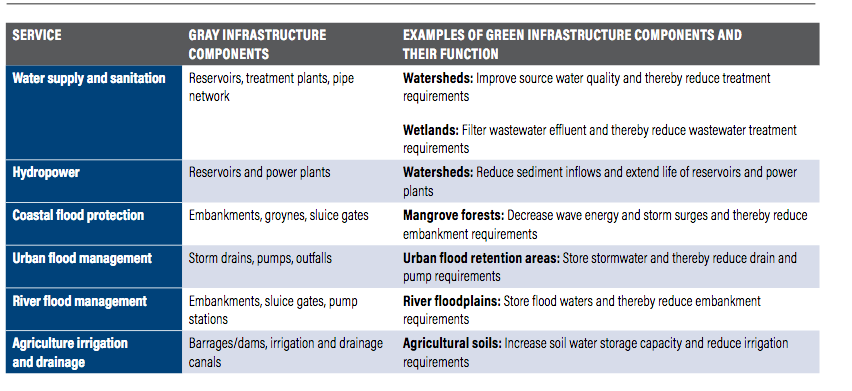
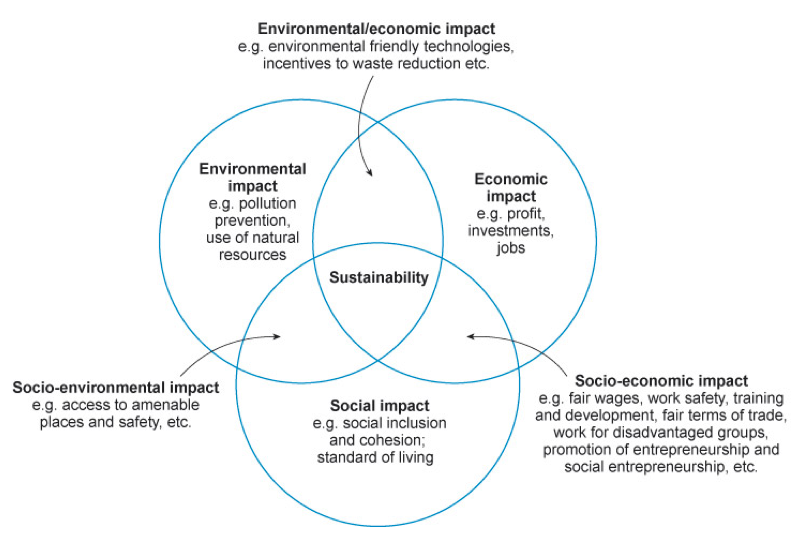
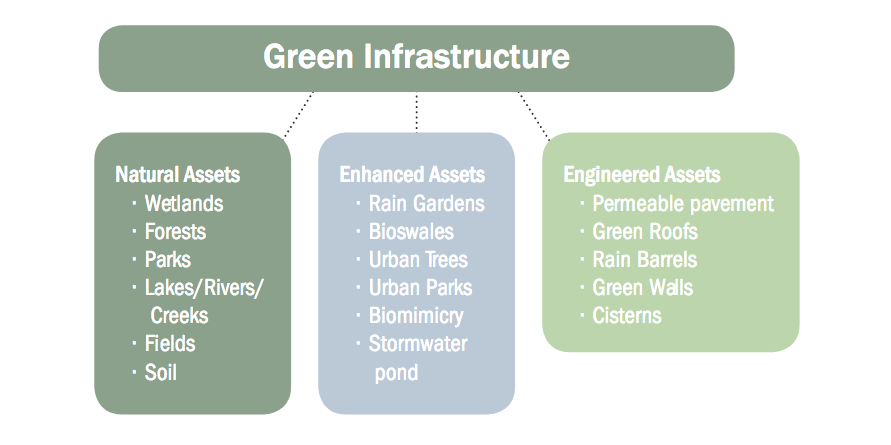
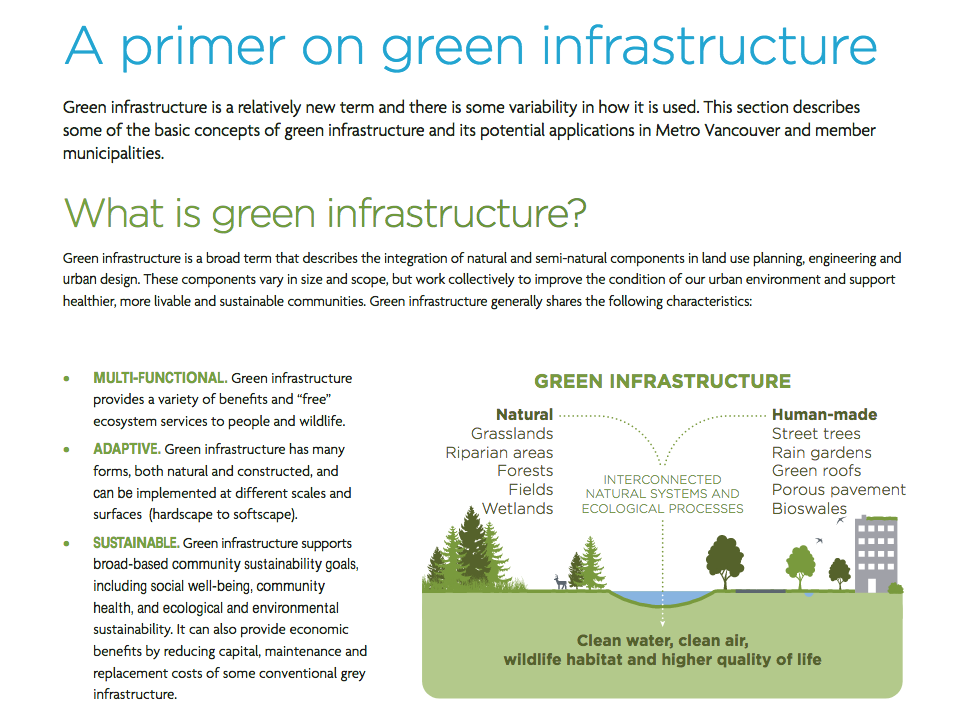
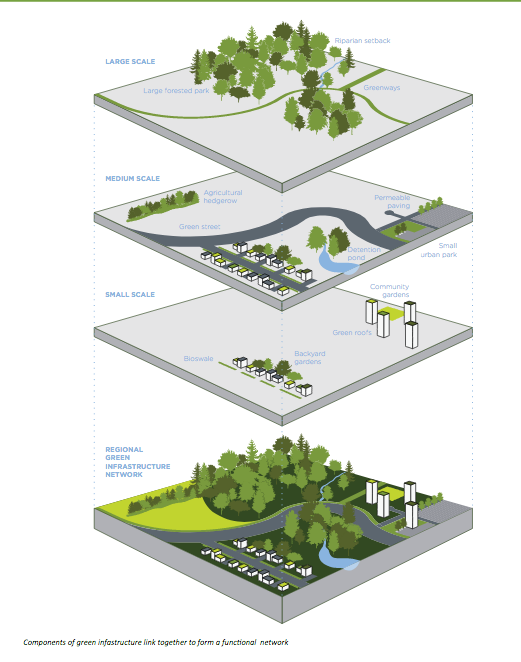
<div class="chapter numberless" id="chapter-module-1" title="Module 1: Defining Green Infrastructure"><div class="chapter-title-wrap"><h3 class="chapter-number"></h3><h2 class="chapter-title"><span class="display-none">Module 1: Defining Green Infrastructure</span></h2></div><div class="ugc chapter-ugc"> <div class="textbox textbox--learning-objectives"><div class="textbox__header"><p class="textbox__title">Learning Objectives</p> </div> <div class="textbox__content"><ul><li>Examine the terminology used to describe green infrastructure systems,</li> <li>Discuss what role green infrastructure has in addressing urban challenges.</li> </ul> </div> </div> <h3>Introduction</h3> <p>Welcome to the first module of the Green Infrastructure course. It makes sense to begin first by introducing yourself to other members of the class – as you will find this network of professionals to be a very rich resource for your continued learning journey.</p> <p>We are excited to begin this learning experience by clarifying some basic definitions for Green infrastructure (GI) and explore the fundamentals of GI. We begin with the assumption that urban centres face three main challenges with regard to water management: storm flooding, water pollution and water shortages. Urban areas around the world are working to reduce runoff and pollution, and also to restore downstream ecologies. This occurs when low impact development methods are integrated with grey infrastructures, large-scale flood control projects and ecological rehabilitation. There are some promising experiments taking place worldwide with Green Infrastructure systems to support these efforts.</p> <p>Green infrastructure is a broad category that includes both natural ecosystems and engineered systems created to mimic the natural functions and services provided by healthy ecosystems to human communities. Green infrastructure is referred to using various terms including natural asset infrastructure, low-impact development, green rainwater infrastructure, blue-green infrastructure, etc. Each term has been developed to describe a system focused on distinct outcomes and often on a particular scale. When you read the article by Fletcher, it will give you a sense of how these terms are used and how they have evolved over time. For the purposes of this course, we will focus primarily on enhanced and engineered green assets, particularly as they relate to water.</p> <p><a href="https://pressbooks.bccampus.ca/greeninfrastructure/wp-content/uploads/sites/1424/2021/06/Screen-Shot-2021-01-20-at-3.04.31-PM.png" data-url="https://pressbooks.bccampus.ca/greeninfrastructure/wp-content/uploads/sites/1424/2021/06/Screen-Shot-2021-01-20-at-3.04.31-PM.png"><img class="alignnone wp-image-117 size-full" src="https://pressbooks.bccampus.ca/greeninfrastructure/wp-content/uploads/sites/1424/2021/06/Screen-Shot-2021-01-20-at-3.04.31-PM.png" alt="" width="891" height="445" srcset="https://pressbooks.bccampus.ca/greeninfrastructure/wp-content/uploads/sites/1424/2021/06/Screen-Shot-2021-01-20-at-3.04.31-PM.png 891w, https://pressbooks.bccampus.ca/greeninfrastructure/wp-content/uploads/sites/1424/2021/06/Screen-Shot-2021-01-20-at-3.04.31-PM-300x150.png 300w, https://pressbooks.bccampus.ca/greeninfrastructure/wp-content/uploads/sites/1424/2021/06/Screen-Shot-2021-01-20-at-3.04.31-PM-768x384.png 768w, https://pressbooks.bccampus.ca/greeninfrastructure/wp-content/uploads/sites/1424/2021/06/Screen-Shot-2021-01-20-at-3.04.31-PM-65x32.png 65w, https://pressbooks.bccampus.ca/greeninfrastructure/wp-content/uploads/sites/1424/2021/06/Screen-Shot-2021-01-20-at-3.04.31-PM-225x112.png 225w, https://pressbooks.bccampus.ca/greeninfrastructure/wp-content/uploads/sites/1424/2021/06/Screen-Shot-2021-01-20-at-3.04.31-PM-350x175.png 350w" /></a></p> <h6>Source: <a href="https://mnai.ca/media/2019/07/SP_MNAI_Report-1-_June2019-2.pdf" target="_blank" rel="noopener" data-url="https://mnai.ca/media/2019/07/SP_MNAI_Report-1-_June2019-2.pdf">https://mnai.ca/media/2019/07/SP_MNAI_Report-1-_June2019-2.pdf</a></h6> <p>GI is considered a strategy for mitigating the harmful impacts of urban stormwater runoff and has been implemented in cities around the world. Also referred to as Green Rainwater Infrastructure (GRI) or Low-Impact Development (LID), these systems have the capacity to capture, infiltrate, treat, and convey urban runoff safely into the natural environment to avoid pollution, flooding, and many other unintended consequences. GI systems have been found to eliminate over 90% of pollutants that were commonly found in roadway runoff by way of infiltrating runoff through soils and plant tissues. In addition to natural GI, enhanced and engineered GI systems – often in the form of green roofs, bioretention cells, and permeable pavements – are capable of retaining 50-70% of annual stormwater runoff when maintained properly. This graphic provides a big picture primer.</p> <p><a href="https://pressbooks.bccampus.ca/greeninfrastructure/wp-content/uploads/sites/1424/2021/06/Screen-Shot-2021-01-20-at-2.52.33-PM.png" data-url="https://pressbooks.bccampus.ca/greeninfrastructure/wp-content/uploads/sites/1424/2021/06/Screen-Shot-2021-01-20-at-2.52.33-PM.png"><img class="alignnone wp-image-118 size-full" src="https://pressbooks.bccampus.ca/greeninfrastructure/wp-content/uploads/sites/1424/2021/06/Screen-Shot-2021-01-20-at-2.52.33-PM.png" alt="" width="967" height="724" srcset="https://pressbooks.bccampus.ca/greeninfrastructure/wp-content/uploads/sites/1424/2021/06/Screen-Shot-2021-01-20-at-2.52.33-PM.png 967w, https://pressbooks.bccampus.ca/greeninfrastructure/wp-content/uploads/sites/1424/2021/06/Screen-Shot-2021-01-20-at-2.52.33-PM-300x225.png 300w, https://pressbooks.bccampus.ca/greeninfrastructure/wp-content/uploads/sites/1424/2021/06/Screen-Shot-2021-01-20-at-2.52.33-PM-768x575.png 768w, https://pressbooks.bccampus.ca/greeninfrastructure/wp-content/uploads/sites/1424/2021/06/Screen-Shot-2021-01-20-at-2.52.33-PM-65x49.png 65w, https://pressbooks.bccampus.ca/greeninfrastructure/wp-content/uploads/sites/1424/2021/06/Screen-Shot-2021-01-20-at-2.52.33-PM-225x168.png 225w, https://pressbooks.bccampus.ca/greeninfrastructure/wp-content/uploads/sites/1424/2021/06/Screen-Shot-2021-01-20-at-2.52.33-PM-350x262.png 350w" /></a></p> <h6>Source: Page 6 of&nbsp;<a href="http://www.metrovancouver.org/services/regional-planning/PlanningPublications/ConnectintheDots.pdf" target="_blank" rel="noopener" data-url="http://www.metrovancouver.org/services/regional-planning/PlanningPublications/ConnectintheDots.pdf">http://www.metrovancouver.org/services/regional-planning/PlanningPublications/ConnectintheDots.pdf</a></h6> <p>Broadly speaking, green infrastructure (GI) encompasses any system that uses ecosystem functions to provide a service to human societies. GI systems vary significantly in their purpose, capacity, and complexity – however, all are assets that require ongoing strategic asset management. While green infrastructure is anything that uses biological systems and ecosystem functions to provide a service to humanity, effective green infrastructure does so without degrading those systems or functions. Here are some of the systems we will talk about in this course and what they are designed to do:</p> <h3>Green Infrastructure and Catchment Scale Effects</h3> <p><a href="https://pressbooks.bccampus.ca/greeninfrastructure/wp-content/uploads/sites/1424/2021/06/Screen-Shot-2021-01-25-at-2.45.46-PM.png" data-url="https://pressbooks.bccampus.ca/greeninfrastructure/wp-content/uploads/sites/1424/2021/06/Screen-Shot-2021-01-25-at-2.45.46-PM.png"><img class="alignnone wp-image-119 size-full" src="https://pressbooks.bccampus.ca/greeninfrastructure/wp-content/uploads/sites/1424/2021/06/Screen-Shot-2021-01-25-at-2.45.46-PM.png" alt="" width="691" height="342" srcset="https://pressbooks.bccampus.ca/greeninfrastructure/wp-content/uploads/sites/1424/2021/06/Screen-Shot-2021-01-25-at-2.45.46-PM.png 691w, https://pressbooks.bccampus.ca/greeninfrastructure/wp-content/uploads/sites/1424/2021/06/Screen-Shot-2021-01-25-at-2.45.46-PM-300x148.png 300w, https://pressbooks.bccampus.ca/greeninfrastructure/wp-content/uploads/sites/1424/2021/06/Screen-Shot-2021-01-25-at-2.45.46-PM-65x32.png 65w, https://pressbooks.bccampus.ca/greeninfrastructure/wp-content/uploads/sites/1424/2021/06/Screen-Shot-2021-01-25-at-2.45.46-PM-225x111.png 225w, https://pressbooks.bccampus.ca/greeninfrastructure/wp-content/uploads/sites/1424/2021/06/Screen-Shot-2021-01-25-at-2.45.46-PM-350x173.png 350w" /></a></p> <h6>Source: <span class="table-caption__label">Table 1. </span>Summary of Common Low-Impact Development (LID) Practices by <a id="a1_Ctrl" class="author-name accordion-tabbed__control" role="button" href="https://onlinelibrary.wiley.com/action/doSearch?ContribAuthorStored=Golden%2C+Heather+E" data-id="a1" data-db-target-for="a1" aria-controls="a1" aria-haspopup="true" data-url="https://onlinelibrary.wiley.com/action/doSearch?ContribAuthorStored=Golden%2C+Heather+E">Heather E. Golden</a> and <span class="comma-separator">&nbsp;</span><span class="accordion-tabbed__tab-mobile accordion__closed"><a id="a2_Ctrl" class="author-name accordion-tabbed__control" role="button" href="https://onlinelibrary.wiley.com/action/doSearch?ContribAuthorStored=Hoghooghi%2C+Nahal" data-id="a2" data-db-target-for="a2" aria-controls="a2" aria-haspopup="true" data-url="https://onlinelibrary.wiley.com/action/doSearch?ContribAuthorStored=Hoghooghi%2C+Nahal">Nahal Hoghooghi</a>&nbsp;is licensed under a <a href="https://creativecommons.org/licenses/by-nc/4.0/" data-url="https://creativecommons.org/licenses/by-nc/4.0/">CC BY NC license</a>.&nbsp;</span></h6> <p>Conventional (or grey) infrastructure benefits from decades of precedent and well-established, straightforward design guidance to help engineers meet quantifiable outcomes: load-bearing capacity, sewer discharge rates, reservoir storage, etc. While assessing the performance of conventional infrastructure is an established practice, methods for assessing all of GI’s benefits are only beginning to be understood, developed, and distributed. Measuring the performance of the GI is significantly more complex because it aspires to provide more for urban spaces than conventional grey infrastructure. Ecological and societal benefits are more difficult to quantify than the conveyance capacity of a pipe. The ecosystem services supported by GI operate on a variety of scales and can serve multiple functions: water quality improvements, enhanced water security, pollination, enhanced food security, health and wellness improvements, enhanced livability, and urban biodiversity. This diverse array of benefits provides GI with a compelling cost-benefit analysis.</p> <h3>Scales of GI</h3> <p>&nbsp;</p> <h6><a href="https://pressbooks.bccampus.ca/greeninfrastructure/wp-content/uploads/sites/1424/2021/06/Screen-Shot-2021-01-20-at-2.58.23-PM.png" data-url="https://pressbooks.bccampus.ca/greeninfrastructure/wp-content/uploads/sites/1424/2021/06/Screen-Shot-2021-01-20-at-2.58.23-PM.png"><img class="alignnone wp-image-120 size-full" src="https://pressbooks.bccampus.ca/greeninfrastructure/wp-content/uploads/sites/1424/2021/06/Screen-Shot-2021-01-20-at-2.58.23-PM.png" alt="" width="521" height="662" srcset="https://pressbooks.bccampus.ca/greeninfrastructure/wp-content/uploads/sites/1424/2021/06/Screen-Shot-2021-01-20-at-2.58.23-PM.png 521w, https://pressbooks.bccampus.ca/greeninfrastructure/wp-content/uploads/sites/1424/2021/06/Screen-Shot-2021-01-20-at-2.58.23-PM-236x300.png 236w, https://pressbooks.bccampus.ca/greeninfrastructure/wp-content/uploads/sites/1424/2021/06/Screen-Shot-2021-01-20-at-2.58.23-PM-65x83.png 65w, https://pressbooks.bccampus.ca/greeninfrastructure/wp-content/uploads/sites/1424/2021/06/Screen-Shot-2021-01-20-at-2.58.23-PM-225x286.png 225w, https://pressbooks.bccampus.ca/greeninfrastructure/wp-content/uploads/sites/1424/2021/06/Screen-Shot-2021-01-20-at-2.58.23-PM-350x445.png 350w" /></a></h6> <h6>Source: Page 8 of <a href="http://www.metrovancouver.org/services/regional-planning/PlanningPublications/ConnectintheDots.pdf" target="_blank" rel="noopener" data-url="http://www.metrovancouver.org/services/regional-planning/PlanningPublications/ConnectintheDots.pdf">http://www.metrovancouver.org/services/regional-planning/PlanningPublications/ConnectintheDots.pdf</a></h6> <p>As you will explore in upcoming modules, urban drainage and the integration of grey with blue-green cities through the implementation of GI is not only providing co-benefits such as supporting the management of stormwater, reducing the heat island effect, improving water quality, enhancing water security, and providing benefits to health and wellness, it is also contributing to climate change resilience.</p> <div class="textbox textbox--exercises"><div class="textbox__header"><p class="textbox__title">Learning Activities</p> </div> <div class="textbox__content"><ul><li>Read the four short articles and view the video for this module.</li> </ul> <h4>Discussion Question</h4> <ul><li>Introduce yourself and share your learning goals for the course.</li> </ul> </div> </div> <p>&nbsp;</p> <div class="textbox textbox--examples"><div class="textbox__header"><p class="textbox__title">Readings &amp; Resources</p> </div> <div class="textbox__content"><h4>Readings</h4> <ul><li><a class="external" href="https://www.epa.gov/green-infrastructure/what-green-infrastructure" target="_blank" rel="noreferrer noopener" data-url="https://www.epa.gov/green-infrastructure/what-green-infrastructure">EPA Green Infrastructure Guide<span class="screenreader-only">&nbsp;</span></a></li> <li><a class="external" href="https://doi.org/10.1080/1573062x.2014.916314" target="_blank" rel="noreferrer noopener" data-url="https://doi.org/10.1080/1573062x.2014.916314">Fletcher, T. D., Shuster, W., Hunt, W. F., Ashley, R., Butler, D., Arthur, S., Trowsdale, S., Barraud, S., Semadeni-Davies, A., Bertrand-Krajewski, J.-L., Mikkelsen, P. S., Rivard, G., Uhl, M., Dagenais, D., &amp; Viklander, M. (2014). SUDS, LID, BMPs, WSUD and more – The evolution and application of terminology surrounding urban drainage. Urban Water Journal, 12(7), 525–542. https://doi.org/10.1080/1573062x.2014.916314<span class="screenreader-only">&nbsp;</span></a></li> <li><span class="instructure_file_holder link_holder instructure_file_link_holder"><a id="15073357" class="" href="https://www.google.ca/books/edition/Blue_and_Green_Cities/QwtQDwAAQBAJ?hl=en&amp;gbpv=0" target="_blank" rel="noopener" data-canvas-previewable="true" data-api-endpoint="https://canvas.sfu.ca/api/v1/courses/58485/files/15073357" data-api-returntype="file" data-url="https://www.google.ca/books/edition/Blue_and_Green_Cities/QwtQDwAAQBAJ?hl=en&amp;gbpv=0">Blue and Green Cities: Blue-Green Infrastructure in Managing Urban Water Resources (pg. 43-57)</a><a class="file_preview_link" title="Preview the document" href="https://canvas.sfu.ca/courses/58485/files/15073357/download?wrap=1" aria-hidden="true" aria-expanded="false" aria-controls="preview_1" data-url="https://canvas.sfu.ca/courses/58485/files/15073357/download?wrap=1"><img src="https://canvas.sfu.ca/images/preview.png" alt="Preview the document" />&nbsp;(Note: this book is copyrighted).&nbsp;</a></span></li> </ul> <h4>Videos</h4> <div class="textbox interactive-content interactive-content--oembed"><img src="https://i.ytimg.com/vi/NxmD716pIEM/hqdefault.jpg" alt="Thumbnail for the embedded element &quot;Green Infrastructure Project&quot;" title="Green Infrastructure Project" /> <p>A YouTube element has been excluded from this version of the text. You can view it online here: <a href="https://pressbooks.bccampus.ca/greeninfrastructure/?p=5#pb-interactive-content" title="Green Infrastructure Project" data-url="https://pressbooks.bccampus.ca/greeninfrastructure/?p=5#pb-interactive-content">https://pressbooks.bccampus.ca/greeninfrastructure/?p=5</a> </p> </div> <h4>Additional Resources and Citations</h4> <p>&nbsp;</p> <div class="textbox interactive-content interactive-content--oembed"><img src="https://i.ytimg.com/vi/qIsDAewDgT8/hqdefault.jpg" alt="Thumbnail for the embedded element &quot;Innovative Stormwater Management at the Watershed Scale&quot;" title="Innovative Stormwater Management at the Watershed Scale" /> <p>A YouTube element has been excluded from this version of the text. You can view it online here: <a href="https://pressbooks.bccampus.ca/greeninfrastructure/?p=5#pb-interactive-content" title="Innovative Stormwater Management at the Watershed Scale" data-url="https://pressbooks.bccampus.ca/greeninfrastructure/?p=5#pb-interactive-content">https://pressbooks.bccampus.ca/greeninfrastructure/?p=5</a> </p> </div> <ul><li><a class="external" href="https://cvc.ca/low-impact-development/low-impact-development-support/stormwater-management-lid-guidance-documents/lid-factsheets/" target="_blank" rel="noreferrer noopener" data-url="https://cvc.ca/low-impact-development/low-impact-development-support/stormwater-management-lid-guidance-documents/lid-factsheets/">CVC LID Factsheets<span class="screenreader-only">&nbsp;</span></a></li> <li><a class="external" href="https://nacto.org/publication/urban-street-stormwater-guide/stormwater-elements/" target="_blank" rel="noreferrer noopener" data-url="https://nacto.org/publication/urban-street-stormwater-guide/stormwater-elements/">NACTO Green Infrastructure Guide<span class="screenreader-only">&nbsp;</span></a></li> </ul> <div class="textbox interactive-content interactive-content--oembed"><img src="https://i.ytimg.com/vi/D-aZgCIS9QI/hqdefault.jpg" alt="Thumbnail for the embedded element &quot;Greening Up Series: Green Infrastructure Intro (Session 1)&quot;" title="Greening Up Series: Green Infrastructure Intro (Session 1)" /> <p>A YouTube element has been excluded from this version of the text. You can view it online here: <a href="https://pressbooks.bccampus.ca/greeninfrastructure/?p=5#pb-interactive-content" title="Greening Up Series: Green Infrastructure Intro (Session 1)" data-url="https://pressbooks.bccampus.ca/greeninfrastructure/?p=5#pb-interactive-content">https://pressbooks.bccampus.ca/greeninfrastructure/?p=5</a> </p> </div> <ul><li>Bartesaghi Koc, C., Osmond, P., &amp; Peters, A. (2017). Towards a comprehensive green infrastructure typology: A systematic review of approaches, methods and typologies. <em>Urban Ecosystems</em>, <em>20</em>(1), 15–35. <a class="external" href="https://doi.org/10.1007/s11252-016-0578-5" target="_blank" rel="noreferrer noopener" data-url="https://doi.org/10.1007/s11252-016-0578-5">https://doi.org/10.1007/s11252-016-0578-5<span class="screenreader-only">&nbsp;</span></a></li> <li>Young, R., Zanders, J., Lieberknecht, K., &amp; Fassman-Beck, E. (2014). A comprehensive typology for mainstreaming urban green infrastructure. Journal of Hydrology, 519, 2571–2583. <a class="external" href="https://doi.org/10.1016/j.jhydrol.2014.05.048" target="_blank" rel="noreferrer noopener" data-url="https://doi.org/10.1016/j.jhydrol.2014.05.048">https://doi.org/10.1016/j.jhydrol.2014.05.048</a></li> </ul> </div> </div> </div></div>
<div class="chapter numberless" id="chapter-module-2" title="Module 2: Motivations for the Grey-to-Green Transition"><div class="chapter-title-wrap"><h3 class="chapter-number"></h3><h2 class="chapter-title">Module 2: Motivations for the Grey-to-Green Transition</h2></div><div class="ugc chapter-ugc"> <div class="textbox textbox--learning-objectives"><div class="textbox__header"><p class="textbox__title">Learning Objectives</p> </div> <div class="textbox__content"><ul><li>Examine the motivations behind green infrastructure systems and their potential for improving urban resilience to climate change and urban development.</li> </ul> </div> </div> <h3 id="Introduction">Introduction</h3> <p><em>Don’t it always seem to go</em><br /> <em>That you don’t know what you’ve got</em><br /> <em>‘Til it’s gone</em><br /> <em>They paved paradise</em><br /> <em>Put up a parking lot</em><em><br /> </em></p> <p>– Joni Mitchell</p> <p>In 1970, Joni Mitchell’s Big Yellow Taxi alluded to the truth that the essential services natural areas provide to human communities were only truly recognized in their absence. It took the absence of forests in upstream areas and the consequent flooding of city streets and properties for scientists and engineers to understand that forests absorb significant amounts of rainfall, slowing its progression towards rivers and stream and transforming intense rainfall events into steady stream flow instead of rushing, erosive torrents. It took the creation of wide swaths of paved surfaces before anyone could measure the difference in temperature between urban areas and their surrounding wilds. It took the drying of wells and the rapid deterioration of surface water quality before we could understand that soils provide natural water filtration, capable of transforming impurities in contaminated surface water into healthy groundwater reserves and stream flows.</p> <p>The density and infrastructure needs of urban centres make a complete transition to green infrastructure solutions challenging with today’s technology and materials. However GI systems can be strategically and successfully incorporated into existing grey infrastructure systems such as roads, buildings, cisterns, and sewers to augment the services provided by these traditional infrastructure systems. Green infrastructure implementation uses public spaces to greater effect in order to better serve communities and their surrounding environment and GI systems can also be the existing natural areas that provide services to communities which previously may have gone unnoticed. Recognizing these services can help protect these areas and prevent the need for grey infrastructures to replace the services that are lost by damaging them.</p> <p>The increasing interest in green infrastructure systems has been driven by a variety of issues largely caused by urbanization and the corresponding loss of natural spaces due to conventional development. The concept of a “grey-to-green” transition to describe the growing interest in green infrastructure is helpful to describe the mindset needed for green infrastructure in urban and suburban environments to&nbsp;dismantle or augment hardscape surfaces to make room for natural systems that mitigate for the negative impacts of grey infrastructure impermeability. To date, green infrastructure systems are frequently used to support rather than supplant conventional grey infrastructure, however, the grey-to-green transition represents a shift in how governments at all levels see and manage for the community’s assets and priorities as much as it does a physical transformation of human-occupied spaces. It is the result of a growing recognition that green infrastructure systems have the capacity to replicate and/or augment the services that nature provides and help solve the issues exacerbated by our continued urbanization and the impacts of climate change. It is important to note that while in heavily developed cities, green infrastructure tends to focus on addressing issues related to conventional infrastructure, developing cities and suburban cities may be able to avoid the unintended impacts of widespread grey infrastructure by ensuring that urbanization is informed by a green infrastructure lens to support strategic infrastructure investments that are able to manage capital costs, minimize impacts to the urban natural areas, while also continuing to provide the necessary municipal services.</p> <h5>How Green and Grey Infrastructure Can Work Together</h5> <p><a href="https://pressbooks.bccampus.ca/greeninfrastructure/wp-content/uploads/sites/1424/2021/06/Screen-Shot-2021-01-25-at-10.29.20-AM.png" data-url="https://pressbooks.bccampus.ca/greeninfrastructure/wp-content/uploads/sites/1424/2021/06/Screen-Shot-2021-01-25-at-10.29.20-AM.png"><img class="alignnone wp-image-124 size-full" src="https://pressbooks.bccampus.ca/greeninfrastructure/wp-content/uploads/sites/1424/2021/06/Screen-Shot-2021-01-25-at-10.29.20-AM.png" alt="" width="852" height="391" srcset="https://pressbooks.bccampus.ca/greeninfrastructure/wp-content/uploads/sites/1424/2021/06/Screen-Shot-2021-01-25-at-10.29.20-AM.png 852w, https://pressbooks.bccampus.ca/greeninfrastructure/wp-content/uploads/sites/1424/2021/06/Screen-Shot-2021-01-25-at-10.29.20-AM-300x138.png 300w, https://pressbooks.bccampus.ca/greeninfrastructure/wp-content/uploads/sites/1424/2021/06/Screen-Shot-2021-01-25-at-10.29.20-AM-768x352.png 768w, https://pressbooks.bccampus.ca/greeninfrastructure/wp-content/uploads/sites/1424/2021/06/Screen-Shot-2021-01-25-at-10.29.20-AM-65x30.png 65w, https://pressbooks.bccampus.ca/greeninfrastructure/wp-content/uploads/sites/1424/2021/06/Screen-Shot-2021-01-25-at-10.29.20-AM-225x103.png 225w, https://pressbooks.bccampus.ca/greeninfrastructure/wp-content/uploads/sites/1424/2021/06/Screen-Shot-2021-01-25-at-10.29.20-AM-350x161.png 350w" /></a></p> <h6>From: “Browder, Greg; Ozment, Suzanne; Rehberger Bescos, Irene; Gartner, Todd; Lange, Glenn-Marie. 2019. <span class="italic">Integrating Green and Gray : Creating Next Generation Infrastructure</span>. Washington, DC: World Bank and World Resources Institute. © World Bank and World Resources Institute. https://openknowledge.worldbank.org/handle/10986/31430 License: CC BY 4.0.”</h6> <p>To date, green infrastructure systems are most frequently designed for stormwater management, which are provided by retaining and filtering rainwater at its source via the use of parks, urban forests, recreation areas, and swales (Haghighatafshar et al., 2018). There are many types of GI that provide multiple value-add benefits such as forests, flood plains, wetlands, and reefs that exist around cities and semi-natural systems including rain gardens and green roofs that exist within cities (Bartesaghi Koc, Osmond, &amp; Peters, 2017). Urban green space provides multiple ecosystem services such as regulating temperatures during extreme heat events, improved air quality, providing human health benefits (e.g., physical activity), and mental well being (Obradovitch, 2018). The green infrastructure benefits described above are also essential in supporting cities in their efforts to adapt to a changing climate (e.g., mitigating the anticipated increase in extreme flooding events, water security/augmentation, extreme heat days and vegetation shading vs entire reliance upon air conditioning to name a few). The transition from grey to green infrastructure represents an expansion and added sophistication of municipal infrastructure priorities. The conventional responsibilities of facilitating transportation and the movement of goods and people, ‘waste’ removal, and flood prevention, will continue to be priorities for municipal governments. The employment of green infrastructure expands municipal infrastructure options while also improving water management, maintaining the integrity of the natural ecosystems, improving urban livability, and enhancing climate resilience. Planning justifications for green infrastructure are greatly improved by the use of triple bottom line analysis, which accounts for the economic, environmental and social impacts of infrastructure alternatives.</p> <p><strong>Triple Bottom Line Benefits of GI.</strong></p> <h4><a href="https://pressbooks.bccampus.ca/greeninfrastructure/wp-content/uploads/sites/1424/2021/06/Supporting-Image-1.png" data-url="https://pressbooks.bccampus.ca/greeninfrastructure/wp-content/uploads/sites/1424/2021/06/Supporting-Image-1.png"><img class="alignnone wp-image-125 size-full" src="https://pressbooks.bccampus.ca/greeninfrastructure/wp-content/uploads/sites/1424/2021/06/Supporting-Image-1.png" alt="" width="807" height="544" srcset="https://pressbooks.bccampus.ca/greeninfrastructure/wp-content/uploads/sites/1424/2021/06/Supporting-Image-1.png 807w, https://pressbooks.bccampus.ca/greeninfrastructure/wp-content/uploads/sites/1424/2021/06/Supporting-Image-1-300x202.png 300w, https://pressbooks.bccampus.ca/greeninfrastructure/wp-content/uploads/sites/1424/2021/06/Supporting-Image-1-768x518.png 768w, https://pressbooks.bccampus.ca/greeninfrastructure/wp-content/uploads/sites/1424/2021/06/Supporting-Image-1-65x44.png 65w, https://pressbooks.bccampus.ca/greeninfrastructure/wp-content/uploads/sites/1424/2021/06/Supporting-Image-1-225x152.png 225w, https://pressbooks.bccampus.ca/greeninfrastructure/wp-content/uploads/sites/1424/2021/06/Supporting-Image-1-350x236.png 350w" /></a></h4> <h6>Source: <a href="https://www.open.edu/openlearn/ocw/pluginfile.php/909710/mod_oucontent/oucontent/46887/91800eac/9d310429/b327_openlearn_f04.eps.jpg" target="_blank" rel="noopener" data-url="https://www.open.edu/openlearn/ocw/pluginfile.php/909710/mod_oucontent/oucontent/46887/91800eac/9d310429/b327_openlearn_f04.eps.jpg">This image</a> is licensed under <a href="http://creativecommons.org/licenses/by-sa/4.0/?ref=chooser-v1" target="_blank" rel="license noopener noreferrer" data-url="http://creativecommons.org/licenses/by-sa/4.0/?ref=chooser-v1">CC BY-SA 4.0</a>&nbsp;by The Open University.</h6> <h3 id="Water">Water Management</h3> <p>A significant focus of GI to date has been the management of urban stormwater. This focus is reasonable in light of the now known impacts of our over reliance on grey infrastructure and the increasing impacts of climate change, for which the grey infrastructure of the twentieth century was not designed. GI has the capacity to augment these aging systems. For example, natural assets such as urban and suburban forests, managed with their ecological integrity in mind, are highly effective at reducing surface runoff (retaining 85-95% onsite) due to the high interception of tree canopies and storage capacity in forest soils (Gill et al., 2007; Gunnell et al., 2019). Other engineered GI systems like green roofs, bio-retention cells, and permeable pavements can reduce stormwater runoff and flooding in dense urban areas (Dong et al., 2017) with effective systems retaining 50-70 % of stormwater onsite (Demuzere et al. 2014). However, the capacity to deal with heavy rainfall events is most limited for engineered GI like green roofs and permeable pavements, which have less surface area to intercept and absorb rainfall compared to naturally vegetated areas (Gill et al. 2007). These engineered systems also can degrade with use over time and require regular maintenance to ensure performance (Selarno et al., 2018). Integrated systems of grey (e.g. pipes and concrete gutters) and green infrastructure provide the greatest resilience to urban flooding. GI appears to be most effective when used throughout the upper portions of a drainage basin, reducing flows to low-lying areas by up to 70% even during extreme rainfall events (Haghighatafshar et al., 2018; Gunnell et al., 2019). Reducing runoff with GI can decrease the likelihood of combined sewer overflows (Selarno et al., 2018) and further improve water quality by trapping surface pollutants in soils and plant tissue where they can be broken down over time or removed if necessary (Demuzere et al. 2014).</p> <h3 id="Ecosystem">Ecosystem Health</h3> <p>There is a growing recognition that ecosystems have inherent value (i.e., value in and of itself; not only as a service to humanity). Fostering biological diversity in human inhabited areas should not require additional justification. However, in most areas around the globe and throughout most of human history, inherent ecosystem inherent value has not figured prominently (or at all) in infrastructure decision-making and investments. Conventional economics plays into the increasingly high dollar value of land in urban areas, rendering the capacity to quantify the true economic (triple bottom line) value provided by natural assets essential to its justification and the expansion and preservation of natural systems in human-occupied environments. This is particularly important in the context of climate change and the ongoing mass extinction that has accompanied global urbanization. The literature reviewed for this course largely concludes that investments in natural assets can provide significant improvements to ecosystem health within and surrounding urban areas. However uncertainty remains as to how much investment is required, where the investment should be directed, and how to calculate the influence and impact of GI investments on ecosystem health and productivity.</p> <h3 id="Urban">Urban Livability</h3> <p>An important factor about green infrastructure that is often overlooked (or simply not known) by municipalities is its capacity to improve the health and wellness of its residents and enhance the attractiveness of the community. The presence of green spaces in urban areas has been shown to yield a surprising number of community benefits for residents; improvements to health and self-reported happiness and feelings of wellness, along with reductions in crime and poverty (Burley, 2018; Dunn, 2010). The reasons behind these connections are only beginning to be quantified in academic studies but are easily intuited. Access to nature and natural spaces are an important part of being human. Natural areas provide improved air quality and space for physical activity, but they are also essential to feeling connected to nature and can also enable residents to feel connected with their broader communities. Public green spaces also provide cool, shaded outdoor meeting places on hot summer days, and places of solace and privacy for those who may not have it elsewhere. These public areas can also lead to feelings of mutual accountability within the community for the care and maintenance of these natural spaces, as all residents benefit from their use. Green Infrastructure implementation can also help address some of the important racial and economic inequities common in urban areas. In cities around the world, areas with higher concentrations of visible minorities and lower income people are far more likely to have poor access to green space and poorly maintained public infrastructure. These conditions contribute to lower home values, worse health outcomes, and continued marginalization and poverty. Green Infrastructure can help address each of these historical inequities (Schell, 2020).</p> <h3 id="Temperature">Temperature Moderation</h3> <p>Urban green spaces moderate temperature by providing evaporative cooling and shading from trees (Demuzere et al., 2014; Sun &amp; Chen, 2017). This temperature moderation improves thermal comfort of urban residents and, combined with the added insulation of green roofs and green walls, can lower building energy use. Studies have illustrated that GI can, through strategic planting and maintenance, reduce heat-related deaths during extreme heatwaves through heat moderation of homes and entire residential areas (Demuzere et al., 2014). Dong et al (2018). Natural areas with mature trees provide significant cooling benefits, providing upwards of 10<sup>o</sup>C cooling effect compared to neighbouring areas in urban centres during extreme heat events (Gill et al, 2007). Though localized in benefit, trees can be complimented by other forms of GI such as bodies of water (GI; both engineered and natural), and manufactured shelter structures. (Sun &amp; Chen, 2017). Green roofs may also augment green space access, especially in areas where the entrenched urban structure disallows for green space expansion/creation. Green roofs can help make up for a lack of parks and open space in high-density urban cores. Gill et al. (2007) show that greening all roofs in town centers of Manchester could reduce maximum surface temperatures by 6.6<sup>o</sup>C from current conditions and effectively counteract the projected rise in temperatures by the 2050s.</p> <h3 id="Climate">Climate Change Resilience</h3> <p>Each of the green infrastructure benefits described above improves community resilience to the impacts of climate change. Green infrastructure (GI) has been identified by UN-Water and the Intergovernmental Panel on Climate Change (IPCC) as essential to climate change adaptivity, enabling and supporting community resiliency, and promoting global water security, yet advances strategic and deliberate integration of GI into municipal infrastructure systems is uneven (Browder et. al., 2019; Revi et. al., 2014, Matthews, 2015). Climate change is expected to change weather patterns in a variety of ways; primarily exaggerating seasonal weather systems and the manifestations of these. Increased frequency and intensity of storms will pose challenges for managing stormwater flows and surface flooding (Collins et al., 2013). Extreme heat and drought are expected to become more common and will worsen the impacts of the urban heat island effect and further strain potable water supplies, especially in rapidly growing cities. Coastal communities will continue to incur and need to respond to sea-level rise (SLR), with specific emphasis on the potential displacement of hundreds of millions of people (Wong et al., 2014; de Jong et al., 2002; Valiela, 2006; McGranahan et al., 2007). Without strategic and deliberate actions to address community resilience, these conditions are likely to overwhelm existing urban infrastructure leading to extensive damage and loss of community infrastructure, increased public health risks, and negative impacts to social equity (Demuzere et al., 2014). Green infrastructure is effectively being employed around the world to fortify shorelines from sea-level rise, restore urban and exurban ecosystems, provide cool relief in urban areas, protect from drought and floods, and improve the physical and mental well-being of residents. The connections between green infrastructure and climate change resilience are discussed additional modules in the course.</p> <h3>Equity<strong><br /> </strong></h3> <p>Social Justice is another important lens through which to view green infrastructure and in the video clip provided, you will hear from the remarkable researcher/scholar Christopher Schell who speaks of the interplay between natural and human systems and the importance of looking at where trees and green spaces are located in urban centres. Be sure to watch this presentation (it is the closing keynote of the Puget Sound Infrastructure series). Pay attention to what Schell means when he says, “follow the trees.”</p> <p>&nbsp;</p> <div class="textbox textbox--exercises"><div class="textbox__header"><p class="textbox__title">Learning Activities</p> </div> <div class="textbox__content"><ul><li>After viewing the video on GI and Social Justice, take some time to consider where the green spaces are located in your own neighbourhood. Draw a simple map of the area and highlight where the gray and green spaces are located. On the discussion board,&nbsp;<strong>post your map of the green and grey spaces in your neighbourhood and consider what it means to “follow the trees” when it comes to equity and GI.<br /> </strong></li> </ul> <h4>Discussion Questions</h4> <ul><li>After reading the articles and viewing the two videos for this module, what do you think are the most compelling reasons for an urban centre to expand Green Infrastructure systems? Provide an example from the readings and one from your own jurisdiction.</li> <li>Share the map of a neighbourhood in the city where you live showing where that indicates where the grey and green spaces are located.</li> </ul> </div> </div> <p>&nbsp;</p> <div class="textbox textbox--examples"><div class="textbox__header"><p class="textbox__title">Readings &amp; Resources</p> </div> <p>&nbsp;</p> <div class="textbox__content"><h4>Readings</h4> <ul><li><span class="instructure_file_holder link_holder instructure_file_link_holder"><a class="" href="https://www.google.ca/books/edition/Blue_and_Green_Cities/QwtQDwAAQBAJ?hl=en&amp;gbpv=0" target="_blank" rel="noopener" data-canvas-previewable="true" data-api-endpoint="https://canvas.sfu.ca/api/v1/courses/58485/files/15073357" data-api-returntype="file" data-url="https://www.google.ca/books/edition/Blue_and_Green_Cities/QwtQDwAAQBAJ?hl=en&amp;gbpv=0"><strong>Blue and Green Cities: Blue-Green Infrastructure in Managing Urban Water Resources</strong> (</a> <a class="" title="2018_Book_BlueAndGreenCities - Chapter 1.pdf" href="https://canvas.sfu.ca/courses/58485/files/13674319/download?wrap=1" data-api-endpoint="https://canvas.sfu.ca/api/v1/courses/58485/files/13674319" data-api-returntype="file" data-url="https://canvas.sfu.ca/courses/58485/files/13674319/download?wrap=1">pg. xvii – pg. 17)</a><img src="https://canvas.sfu.ca/images/preview.png" alt="Preview the document" />&nbsp;(Note: this book is copyrighted but these pages are available as a free preview on Google Books).</span></li> <li><span class="instructure_file_holder link_holder instructure_file_link_holder"><a id="15073441" class="" href="https://openknowledge.worldbank.org/handle/10986/31430" target="_blank" rel="noopener" data-canvas-previewable="true" data-api-endpoint="https://canvas.sfu.ca/api/v1/courses/58485/files/15073441" data-api-returntype="file" data-url="https://openknowledge.worldbank.org/handle/10986/31430"><strong>Integrating Green and Gray (World Bank, 2018): </strong></a><a class="file_preview_link" title="Preview the document" href="https://canvas.sfu.ca/courses/58485/files/15073441/download?wrap=1" aria-hidden="true" aria-expanded="false" aria-controls="preview_1" data-url="https://canvas.sfu.ca/courses/58485/files/15073441/download?wrap=1"><img src="https://canvas.sfu.ca/images/preview.png" alt="Preview the document" /></a></span> <ul><li style="list-style-type: none;"><ul><li style="list-style-type: none;"><ul><li><span class="instructure_file_holder link_holder instructure_file_link_holder"><a class="" href="https://canvas.sfu.ca/courses/58485/files/15073441/download?wrap=1" target="_blank" rel="noopener" data-canvas-previewable="true" data-api-endpoint="https://canvas.sfu.ca/api/v1/courses/58485/files/15073441" data-api-returntype="file" data-url="https://canvas.sfu.ca/courses/58485/files/15073441/download?wrap=1">Why Integrate Green and Gray Infrastructure (pg. 13-27)</a><a class="file_preview_link" title="Preview the document" href="https://canvas.sfu.ca/courses/58485/files/15073441/download?wrap=1" aria-hidden="true" aria-expanded="false" aria-controls="preview_2" data-url="https://canvas.sfu.ca/courses/58485/files/15073441/download?wrap=1"><img src="https://canvas.sfu.ca/images/preview.png" alt="Preview the document" /></a></span></li> </ul> </li> </ul> </li> </ul> </li> <li><span class="instructure_file_holder link_holder instructure_file_link_holder"><a class="" title="EPA Green Infrastructure Case Studies - Common Drivers and Regulatory Frameworks.pdf" href="https://nepis.epa.gov/Exe/ZyPURL.cgi?Dockey=P100FTEM.TXT" data-api-endpoint="https://canvas.sfu.ca/api/v1/courses/58485/files/13674324" data-api-returntype="file" data-url="https://nepis.epa.gov/Exe/ZyPURL.cgi?Dockey=P100FTEM.TXT"><strong>EPA Green Infrastructure Case Studies </strong></a></span> <ul><li style="list-style-type: none;"><ul><li><span class="instructure_file_holder link_holder instructure_file_link_holder"><a class="" title="EPA Green Infrastructure Case Studies - Common Drivers and Regulatory Frameworks.pdf" href="https://canvas.sfu.ca/courses/58485/files/13674324/download?wrap=1" data-api-endpoint="https://canvas.sfu.ca/api/v1/courses/58485/files/13674324" data-api-returntype="file" data-url="https://canvas.sfu.ca/courses/58485/files/13674324/download?wrap=1">Common Drivers and Regulatory Framework (pg. 7-10)</a></span></li> </ul> </li> </ul> </li> <li><span class="instructure_file_holder link_holder instructure_file_link_holder"><a class="" title="Handbook_on_Green_Infrastructure_Planning_Design_a..._----_(1_Green_infrastructure_and_health) (1).pdf" href="https://www.google.ca/books/edition/Handbook_on_Green_Infrastructure/SnThCgAAQBAJ?hl=en&amp;gbpv=0" target="_blank" rel="noopener" data-api-endpoint="https://canvas.sfu.ca/api/v1/courses/58485/files/13674321" data-api-returntype="file" data-url="https://www.google.ca/books/edition/Handbook_on_Green_Infrastructure/SnThCgAAQBAJ?hl=en&amp;gbpv=0"><strong>Handbook on Green Infrastructure Planning, Design, and Implementation </strong></a></span> <ul><li style="list-style-type: none;"><ul><li><span class="instructure_file_holder link_holder instructure_file_link_holder"><a class="" title="Handbook_on_Green_Infrastructure_Planning_Design_a..._----_(1_Green_infrastructure_and_health) (1).pdf" href="https://www.google.ca/books/edition/Handbook_on_Green_Infrastructure/SnThCgAAQBAJ?hl=en&amp;gbpv=0" target="_blank" rel="noopener" data-api-endpoint="https://canvas.sfu.ca/api/v1/courses/58485/files/13674321" data-api-returntype="file" data-url="https://www.google.ca/books/edition/Handbook_on_Green_Infrastructure/SnThCgAAQBAJ?hl=en&amp;gbpv=0">Chapter 1 – Green Infrastructure and Health</a> (Note: this book is copyrighted but this chapter is available as a free preview on Google Books).</span></li> </ul> </li> </ul> </li> </ul> <h4>Videos</h4> <div class="textbox interactive-content interactive-content--oembed"><img src="https://i.ytimg.com/vi/LMq6FYiF1mo/hqdefault.jpg" alt="Thumbnail for the embedded element &quot;Ever wondered where the rain goes? Sustainable drainage animation&quot;" title="Ever wondered where the rain goes? Sustainable drainage animation" /> <p>A YouTube element has been excluded from this version of the text. You can view it online here: <a href="https://pressbooks.bccampus.ca/greeninfrastructure/?p=30#pb-interactive-content" title="Ever wondered where the rain goes? Sustainable drainage animation" data-url="https://pressbooks.bccampus.ca/greeninfrastructure/?p=30#pb-interactive-content">https://pressbooks.bccampus.ca/greeninfrastructure/?p=30</a> </p> </div> <p>Puget Sound Green Infrastructure Series: Closing Keynote – by Christopher J. Schell (Schell, 2020) – GI and Justice (Watch from 45m-1h3m)</p> <div class="textbox interactive-content interactive-content--oembed"><img src="https://i.ytimg.com/vi/5AaG8_XbOcU/hqdefault.jpg" alt="Thumbnail for the embedded element &quot;Puget Sound Green Infrastructure Series: Closing Keynote&quot;" title="Puget Sound Green Infrastructure Series: Closing Keynote" /> <p>A YouTube element has been excluded from this version of the text. You can view it online here: <a href="https://pressbooks.bccampus.ca/greeninfrastructure/?p=30#pb-interactive-content" title="Puget Sound Green Infrastructure Series: Closing Keynote" data-url="https://pressbooks.bccampus.ca/greeninfrastructure/?p=30#pb-interactive-content">https://pressbooks.bccampus.ca/greeninfrastructure/?p=30</a> </p> </div> <p>&nbsp;</p> <h4>Additional Resources and Citations</h4> <div class="textbox interactive-content interactive-content--oembed"><img src="https://i.ytimg.com/vi/xOM1MtRmwzQ/hqdefault.jpg" alt="Thumbnail for the embedded element &quot;How Green Infrastructure Grows Safer, Stronger Neighborhoods and Healthier People&quot;" title="How Green Infrastructure Grows Safer, Stronger Neighborhoods and Healthier People" /> <p>A YouTube element has been excluded from this version of the text. You can view it online here: <a href="https://pressbooks.bccampus.ca/greeninfrastructure/?p=30#pb-interactive-content" title="How Green Infrastructure Grows Safer, Stronger Neighborhoods and Healthier People" data-url="https://pressbooks.bccampus.ca/greeninfrastructure/?p=30#pb-interactive-content">https://pressbooks.bccampus.ca/greeninfrastructure/?p=30</a> </p> </div> <div class="textbox interactive-content interactive-content--oembed"><img src="https://i.ytimg.com/vi/lVikSQ53dKI/hqdefault.jpg" alt="Thumbnail for the embedded element &quot;Green Infrastructure and its Benefits&quot;" title="Green Infrastructure and its Benefits" /> <p>A YouTube element has been excluded from this version of the text. You can view it online here: <a href="https://pressbooks.bccampus.ca/greeninfrastructure/?p=30#pb-interactive-content" title="Green Infrastructure and its Benefits" data-url="https://pressbooks.bccampus.ca/greeninfrastructure/?p=30#pb-interactive-content">https://pressbooks.bccampus.ca/greeninfrastructure/?p=30</a> </p> </div> <p>&nbsp;</p> <ul><li>City of Vancouver. (2018). Vancouver’s Changing Shoreline: Preparing for Sea Level Rise. Retrieved from <a class="external" href="https://vancouver.ca/files/cov/vancouvers-changing-shoreline.pdf" target="_blank" rel="noreferrer noopener" data-url="https://vancouver.ca/files/cov/vancouvers-changing-shoreline.pdf">https://vancouver.ca/files/cov/vancouvers-changing-shoreline.pdf<span class="screenreader-only">&nbsp;</span></a></li> <li>Demuzere, M., Orru, K., Heidrich, O., Olazabal, E., Geneletti, D., Orru, H., Bhave, A. G., Mittal, N., Feliu, E., &amp; Faehnle, M. (2014). Mitigating and adapting to climate change: Multi-functional and multi-scale assessment of green urban infrastructure. <em>Journal of Environmental Management</em>, <em>146</em>, 107–115. <a class="external" href="https://doi.org/10.1016/j.jenvman.2014.07.025" target="_blank" rel="noreferrer noopener" data-url="https://doi.org/10.1016/j.jenvman.2014.07.025">https://doi.org/10.1016/j.jenvman.2014.07.025</a></li> <li>Samora-Arvela, A., Ferrão, J., Ferreira, J., Panagopoulos, T., &amp; Vaz, E. (2017). Green Infrastructure, Climate Change and Spatial Planning:Learning Lessons Across Borders. <em>Journal of Spatial and Organizational Dynamics</em>, <em>5</em>(3), 13.</li> <li>Sun, R., &amp; Chen, L. (2017). Effects of green space dynamics on urban heat islands: Mitigation and diversification. <em>Ecosystem Services</em>, <em>23</em>, 38–46. <a class="external" href="https://doi.org/10.1016/j.ecoser.2016.11.011" target="_blank" rel="noreferrer noopener" data-url="https://doi.org/10.1016/j.ecoser.2016.11.011">https://doi.org/10.1016/j.ecoser.2016.11.011<span class="screenreader-only">&nbsp;</span></a></li> <li>Moore, T. L., Gulliver, J. S., Stack, L., &amp; Simpson, M. H. (2016). Stormwater management and climate change: Vulnerability and capacity for adaptation in urban and suburban contexts. Climatic Change, 138(3–4), 491–504. <a class="external" href="https://doi.org/10.1007/s10584-016-1766-2" target="_blank" rel="noreferrer noopener" data-url="https://doi.org/10.1007/s10584-016-1766-2">https://doi.org/10.1007/s10584-016-1766-2<span class="screenreader-only">&nbsp;</span></a></li> <li>Burley, B. (2018). Green infrastructure and violence: Do new street trees mitigate violent crime? Health &amp; Place, 54, 43–49. <a href="https://doi.org/10.1016/j.healthplace.2018.08.015" data-url="https://doi.org/10.1016/j.healthplace.2018.08.015">https://doi.org/10.1016/j.healthplace.2018.08.015</a></li> <li><a href="https://lawdigitalcommons.bc.edu/cgi/viewcontent.cgi?article=1022&amp;context=ealr" target="_blank" rel="noopener" data-url="https://lawdigitalcommons.bc.edu/cgi/viewcontent.cgi?article=1022&amp;context=ealr">Siting Green Infrastructure: Legal and Policy Solutions to Alleviate Urban Poverty and Promote Healthy Communities</a> (Dunn, 2010)</li> <li><a href="https://www.google.ca/books/edition/Landscape_Urbanism_and_Green_Infrastruct/-vOpDwAAQBAJ?hl=en&amp;gbpv=0" target="_blank" rel="noopener" data-url="https://www.google.ca/books/edition/Landscape_Urbanism_and_Green_Infrastruct/-vOpDwAAQBAJ?hl=en&amp;gbpv=0">Landscape Urbanism and Green Infrastructure</a> (Public Green Infrastructure Contributes to City Livability: A Systematic Quantitative Overview – pg. 22-48) (Full book available to read on Google Books)</li> </ul> </div> </div> </div></div>
<div class="chapter numberless" id="chapter-module-3" title="Module 3: Leaders and Lessons of Green Infrastructure in Practice"><div class="chapter-title-wrap"><h3 class="chapter-number"></h3><h2 class="chapter-title">Module 3: Leaders and Lessons of Green Infrastructure in Practice</h2></div><div class="ugc chapter-ugc"> <div class="textbox textbox--learning-objectives"><div class="textbox__header"><p class="textbox__title">Learning Objective</p> </div> <div class="textbox__content"><ul><li>Cite the factors that contribute to the success of a city’s efforts to implement green infrastructure by exploring methods used to employ and maintain green infrastructure and mitigate potential risks associated with its implementation.</li> </ul> </div> </div> <p>&nbsp;</p> <p>GI exists in all cities to some degree, depending upon factors such as level of investment, protection of existing natural areas, adherence to engineering and planning standards, cultural and traditional designs that are reflected in the infrastructure, and geographical citing of urban centres. In many cases GI success and the benefits ecosystem services provide can be attributed to greater investment from the public and private sector. However, there are many factors that contribute to GI implementation success that are not dependent on significant levels of monetary resources. This module explores how cities around the world have made the most of the resources available to them to reap the greatest benefit from their GI systems.</p> <p>The new technical terminology used to define modern green infrastructure belies an important truth: green infrastructure systems are often reminiscent of old solutions to familiar problems. Green (i.e. made of living things) infrastructure was the foundation of every successful pre-industrial human society. As early as 5000 BC, human societies used natural systems to try to stabilize their environments to help support larger concentrations of people. The ancient Egyptians were dependent on large floodable landscapes and shaded irrigation systems to manage the ebb and flow of the Nile. In the 1100s, the Khmer empire used vegetated channels to create irrigation works that survive to this day at sites like Angkor Wat. In the 1600s, the Dutch created living dikes that held rising seas at bay and contributed to their rise as a global sea power. Ancient empires often collapsed when they could no longer maintain the green infrastructure systems that supported them (Diamond, 2005).</p> <p>The Dutch continue to proficiently mitigate sea level rise by adapting their traditional infrastructure systems to solve new challenges. Dutch green infrastructure has roots in the founding of their nation. Levies, dikes, and canals have enabled Dutch society. Today the Dutch systems are informed by modern science and technology to optimise the strengths inherent in living systems: adaptability, expansion and/or contraction, and durability/resiliency. Only after extensive deforestation and infrastructure failures did the Netherlands realize the indispensability of street trees to the stability of their canals and adjacent building foundations. These lessons have been learned through trial and error; invaluable lessons to be learned, adapted to and applied in other jurisdictions.</p> <p>Cities that succeed in implementing GI do so because they acknowledge and account for the benefits that GI provides which traditional infrastructure does not. When the additional benefits of green infrastructure are accounted for, the case for integrating GI makes sense. Cities in the Pacific Northwest such as Portland, Oregon, Seattle, Washington and Vancouver, British Columbia have begun to plan and account for green infrastructure benefits beyond stormwater management such as improved urban livability, healthier ecosystems and low carbon resilience. Accounting for these additional benefits has helped redirect municipal resources towards green infrastructure development.</p> <p>While New York City is famous for its wealth, it is infamous for its lack of space and its dense, narrow boulevards. Motivated by the need to reduce combined sewer overflows, the streets of New York City have undergone a rapid greening by streamlining the design and approval process for roadside green infrastructure systems. New York City created a thorough manual of standard GI designs that could be replicated throughout the city at relatively low cost. By utilizing economies of scale, the New York City Department of Environment reduced the material and labour costs of GI implementation and managed to install thousands of roadside bioretention systems in less than five years.</p> <p>In Ontario, major flooding in the 1950s led to the creation of Conservation Authorities charged with managing and protecting watersheds to help protect communities and preserve local ecology. The Conservation Authorities are organized by watershed and work in partnership with all levels of governments and local communities. Their mandate is to protect life and property from water-related hazards and develop and maintain programs to conserve natural resources. The Conservation Authorities have the power to set standards and guidelines for development proposals in their jurisdictions and provide resources to member municipalities on how and where to implement green infrastructure systems. Two conservation authorities in particular, the Toronto Region Conservation Authority and the Credit Valley Conservation Authority, have become national leaders in green infrastructure research and development.</p> <div class="textbox textbox--exercises"><div class="textbox__header"><p class="textbox__title">Learning Activities</p> </div> <div class="textbox__content"><ul><li>Select one of the three city cases – Copenhagen, Portland or New York – and create a one page summary of GI motivations including the risks are they mitigating? What are the strategies, policies and identified benefits for that city? Do your own desk top research as well.</li> </ul> <h4>Discussion Questions</h4> <ul><li>After reading the chapter on Best Practice in Blue Green Cities and reflecting on your City case, cite what you consider are the key factors that contribute to the success of a city’s efforts to implement green infrastructure.</li> </ul> </div> </div> <p>&nbsp;</p> <p>&nbsp;</p> <div class="textbox textbox--examples"><div class="textbox__header"><p class="textbox__title">Readings &amp; Resources</p> </div> <div class="textbox__content"><h4>Readings</h4> <ul><li><a class="external" href="https://www.epa.gov/green-infrastructure/what-green-infrastructure" target="_blank" rel="noreferrer noopener" data-url="https://www.epa.gov/green-infrastructure/what-green-infrastructure">EPA Green Infrastructure Guide<span class="screenreader-only">&nbsp;</span></a></li> <li><a class="external" href="https://doi.org/10.1080/1573062x.2014.916314" target="_blank" rel="noreferrer noopener" data-url="https://doi.org/10.1080/1573062x.2014.916314">Fletcher, T. D., Shuster, W., Hunt, W. F., Ashley, R., Butler, D., Arthur, S., Trowsdale, S., Barraud, S., Semadeni-Davies, A., Bertrand-Krajewski, J.-L., Mikkelsen, P. S., Rivard, G., Uhl, M., Dagenais, D., &amp; Viklander, M. (2014). SUDS, LID, BMPs, WSUD and more – The evolution and application of terminology surrounding urban drainage. Urban Water Journal, 12(7), 525–542. https://doi.org/10.1080/1573062x.2014.916314<span class="screenreader-only">&nbsp;</span></a></li> <li><span class="instructure_file_holder link_holder instructure_file_link_holder"><a class="" href="https://www.google.ca/books/edition/Blue_and_Green_Cities/QwtQDwAAQBAJ?hl=en&amp;gbpv=0" target="_blank" rel="noopener" data-canvas-previewable="true" data-api-endpoint="https://canvas.sfu.ca/api/v1/courses/58485/files/15073357" data-api-returntype="file" data-url="https://www.google.ca/books/edition/Blue_and_Green_Cities/QwtQDwAAQBAJ?hl=en&amp;gbpv=0">Blue and Green Cities: </a></span> <ul><li><span class="instructure_file_holder link_holder instructure_file_link_holder">Blue-Green Infrastructure in Managing Urban Water Resources (pg. 291-301<a class="" href="https://www.google.ca/books/edition/Blue_and_Green_Cities/QwtQDwAAQBAJ?hl=en&amp;gbpv=0" target="_blank" rel="noopener" data-canvas-previewable="true" data-api-endpoint="https://canvas.sfu.ca/api/v1/courses/58485/files/15073357" data-api-returntype="file" data-url="https://www.google.ca/books/edition/Blue_and_Green_Cities/QwtQDwAAQBAJ?hl=en&amp;gbpv=0">)</a>&nbsp;(Note: this book is copyrighted).&nbsp;</span></li> </ul> </li> <li><span class="instructure_file_holder link_holder instructure_file_link_holder"><a class="" title="City of Portland - Green Infrastructure and Health Guide.pdf" href="http://willamettepartnership.org/wp-content/uploads/2018/07/Green-Infrastructure_final_7_12_18_sm.pdf" target="_blank" rel="noopener" data-api-endpoint="https://canvas.sfu.ca/api/v1/courses/58485/files/14033772" data-api-returntype="file" data-url="http://willamettepartnership.org/wp-content/uploads/2018/07/Green-Infrastructure_final_7_12_18_sm.pdf">City of Portland – GI and Health Guide (p.4-22)</a></span></li> <li>Portland GI approach to both stormwater and wastewater in a highly urbanized mixed use neighbourhood called Hassalo and 8<sup>th</sup> designed by <a class="external" href="https://www.biohabitats.com/project/hassalo-on-8th-wastewater-treatment-reuse-system-2/" target="_blank" rel="noreferrer noopener" data-url="https://www.biohabitats.com/project/hassalo-on-8th-wastewater-treatment-reuse-system-2/">Biohabitats.</a>The video is available for your viewing pleasure at <a class="external" href="https://vimeo.com/421179074" target="_blank" rel="noreferrer noopener" data-url="https://vimeo.com/421179074">https://vimeo.com/421179074<span class="screenreader-only">&nbsp;</span></a></li> </ul> <div class="textbox interactive-content interactive-content--oembed"><img src="https://i.vimeocdn.com/video/896772346_295x166" alt="Thumbnail for the embedded element &quot;2019 ASLA Honor Award | Hassalo on Eighth&quot;" title="2019 ASLA Honor Award | Hassalo on Eighth" /> <p>A Vimeo element has been excluded from this version of the text. You can view it online here: <a href="https://pressbooks.bccampus.ca/greeninfrastructure/?p=37#pb-interactive-content" title="2019 ASLA Honor Award | Hassalo on Eighth" data-url="https://pressbooks.bccampus.ca/greeninfrastructure/?p=37#pb-interactive-content">https://pressbooks.bccampus.ca/greeninfrastructure/?p=37</a> </p> </div> <ul><li><a href="https://www.google.ca/books/edition/Blue_and_Green_Cities/QwtQDwAAQBAJ?hl=en&amp;gbpv=0" target="_blank" rel="noopener" data-url="https://www.google.ca/books/edition/Blue_and_Green_Cities/QwtQDwAAQBAJ?hl=en&amp;gbpv=0">Blue and G</a><a href="https://www.google.ca/books/edition/Blue_and_Green_Cities/QwtQDwAAQBAJ?hl=en&amp;gbpv=0" target="_blank" rel="noopener" data-url="https://www.google.ca/books/edition/Blue_and_Green_Cities/QwtQDwAAQBAJ?hl=en&amp;gbpv=0">reen Cities</a> <ul><li><span class="instructure_file_holder link_holder instructure_file_link_holder"><a class="" title="New York City Becoming a Blue-Green City - from 2018_Book_BlueAndGreenCities.pdf" href="https://www.google.ca/books/edition/Blue_and_Green_Cities/QwtQDwAAQBAJ?hl=en&amp;gbpv=0" target="_blank" rel="noopener" data-api-endpoint="https://canvas.sfu.ca/api/v1/courses/58485/files/13674402" data-api-returntype="file" data-url="https://www.google.ca/books/edition/Blue_and_Green_Cities/QwtQDwAAQBAJ?hl=en&amp;gbpv=0">New York City – Becoming a Blue-Green City</a></span></li> <li><span class="instructure_file_holder link_holder instructure_file_link_holder"><a id="15117058" class="" href="https://www.google.ca/books/edition/Blue_and_Green_Cities/QwtQDwAAQBAJ?hl=en&amp;gbpv=0" target="_blank" rel="noopener" data-canvas-previewable="true" data-api-endpoint="https://canvas.sfu.ca/api/v1/courses/58485/files/15117058" data-api-returntype="file" data-url="https://www.google.ca/books/edition/Blue_and_Green_Cities/QwtQDwAAQBAJ?hl=en&amp;gbpv=0">Copenhagen – Becoming a Green Blue City</a><a class="file_preview_link" title="Preview the document" href="https://canvas.sfu.ca/courses/58485/files/15117058/download?wrap=1" aria-hidden="true" aria-expanded="false" aria-controls="preview_1" data-url="https://canvas.sfu.ca/courses/58485/files/15117058/download?wrap=1"><img src="https://canvas.sfu.ca/images/preview.png" alt="Preview the document" /></a></span></li> </ul> </li> <li><a class="external" href="https://www1.nyc.gov/assets/dep/downloads/pdf/water/stormwater/green-infrastructure/right-of-way-green-infrastructure-protections-during-construction.pdf" target="_blank" rel="noreferrer noopener" data-url="https://www1.nyc.gov/assets/dep/downloads/pdf/water/stormwater/green-infrastructure/right-of-way-green-infrastructure-protections-during-construction.pdf">Right-of-way Green Infrastructure<span class="screenreader-only">&nbsp;</span></a></li> <li><span class="instructure_file_holder link_holder instructure_file_link_holder"><a id="15073513" class="" href="https://vancouver.ca/files/cov/rain-city-strategy.pdf" target="_blank" rel="noopener" data-canvas-previewable="true" data-api-endpoint="https://canvas.sfu.ca/api/v1/courses/58485/files/15073513" data-api-returntype="file" data-url="https://vancouver.ca/files/cov/rain-city-strategy.pdf">City of Vancouver. (2019). 2019 Rain City Strategy [City Standards]. City of Vancouver: Green Infrastructure Implementation Team.(pg. 1-14)</a></span></li> </ul> <h4>Videos</h4> <div class="textbox interactive-content interactive-content--oembed"><img src="https://i.ytimg.com/vi/Bfj75Wi87tg/hqdefault.jpg" alt="Thumbnail for the embedded element &quot;New York City's Green Revolution&quot;" title="New York City's Green Revolution" /> <p>A YouTube element has been excluded from this version of the text. You can view it online here: <a href="https://pressbooks.bccampus.ca/greeninfrastructure/?p=37#pb-interactive-content" title="New York City's Green Revolution" data-url="https://pressbooks.bccampus.ca/greeninfrastructure/?p=37#pb-interactive-content">https://pressbooks.bccampus.ca/greeninfrastructure/?p=37</a> </p> </div> <p><strong>Vancouver’s Rain City Strategy</strong> – 4 min – (This video provides a brief introductory snapshot to GI in Vancouver and includes interview of folks dealing with rainwater management on both public and private property)</p> <div class="textbox interactive-content interactive-content--oembed"><img src="https://i.ytimg.com/vi/3BqQ_KvMeGM/hqdefault.jpg" alt="Thumbnail for the embedded element &quot;Vancouver's Rain City Strategy&quot;" title="Vancouver's Rain City Strategy" /> <p>A YouTube element has been excluded from this version of the text. You can view it online here: <a href="https://pressbooks.bccampus.ca/greeninfrastructure/?p=37#pb-interactive-content" title="Vancouver's Rain City Strategy" data-url="https://pressbooks.bccampus.ca/greeninfrastructure/?p=37#pb-interactive-content">https://pressbooks.bccampus.ca/greeninfrastructure/?p=37</a> </p> </div> <p>&nbsp;</p> <h4>Additional Resources and Citations</h4> <ul><li>Winch, R., Clough, J., Mant, A., Hamilton – Russell, E., Barker, A., Payne, S., Gilchrist, A., Tantanasi, I., Clay, G., &amp; Rothwell, J. (2020). Making the case for green infrastructure: Lessons from best practice. UK Green Building Council. <a class="external" href="http://eprints.whiterose.ac.uk/156025/8/08635_Making_the_Case_for_GI_FINAL__Web_.pdf" target="_blank" rel="noreferrer noopener" data-url="http://eprints.whiterose.ac.uk/156025/8/08635_Making_the_Case_for_GI_FINAL__Web_.pdf">http://eprints.whiterose.ac.uk/156025/8/08635_Making_the_Case_for_GI_FINAL__Web_.pdf</a></li> <li>Credit Valley Conservation <a class="external" href="https://cvc.ca/low-impact-development/low-impact-development-support/stormwater-management-lid-guidance-documents/" target="_blank" rel="noreferrer noopener" data-url="https://cvc.ca/low-impact-development/low-impact-development-support/stormwater-management-lid-guidance-documents/">Low Impact Development Guidance Documents</a></li> <li>Gunnell, K., Mulligan, M., Francis, R. A., &amp; Hole, D. G. (2019). Evaluating natural infrastructure for flood management within the watersheds of selected global cities. <em>Science of The Total Environment</em>, <em>670</em>, 411–424. <a class="external" href="https://doi.org/10.1016/j.scitotenv.2019.03.212" target="_blank" rel="noreferrer noopener" data-url="https://doi.org/10.1016/j.scitotenv.2019.03.212">https://doi.org/10.1016/j.scitotenv.2019.03.212<span class="screenreader-only">&nbsp;</span></a></li> <li>Haghighatafshar, S., Nordlöf, B., Roldin, M., Gustafsson, L.-G., la Cour Jansen, J., &amp; Jönsson, K. (2018). Efficiency of blue-green stormwater retrofits for flood mitigation – Conclusions drawn from a case study in Malmö, Sweden. <em>Journal of Environmental Management</em>, <em>207</em>, 60–69. <a class="external" href="https://doi.org/10.1016/j.jenvman.2017.11.018" target="_blank" rel="noreferrer noopener" data-url="https://doi.org/10.1016/j.jenvman.2017.11.018">https://doi.org/10.1016/j.jenvman.2017.11.018</a></li> <li>Samora-Arvela, A., Ferrão, J., Ferreira, J., Panagopoulos, T., &amp; Vaz, E. (2017). <a href="https://run.unl.pt/bitstream/10362/31098/1/selection_8_.pdf" target="_blank" rel="noopener" data-url="https://run.unl.pt/bitstream/10362/31098/1/selection_8_.pdf">Green Infrastructure, Climate Change and Spatial Planning: Learning Lessons Across Borders</a>. <em>Journal of Spatial and Organizational Dynamics</em>, <em>5</em>(3), 13.</li> <li>VIDEO: Philadelphia’s Green Infrastructure Program – 2.5min<span class="screenreader-only">&nbsp;</span></li> </ul> <div class="textbox interactive-content interactive-content--oembed"><img src="https://i.ytimg.com/vi/xglzNrnJ0Gc/hqdefault.jpg" alt="Thumbnail for the embedded element &quot;Green City, Clean Waters: Philadelphia's Green Stormwater Infrastructure Program&quot;" title="Green City, Clean Waters: Philadelphia's Green Stormwater Infrastructure Program" /> <p>A YouTube element has been excluded from this version of the text. You can view it online here: <a href="https://pressbooks.bccampus.ca/greeninfrastructure/?p=37#pb-interactive-content" title="Green City, Clean Waters: Philadelphia's Green Stormwater Infrastructure Program" data-url="https://pressbooks.bccampus.ca/greeninfrastructure/?p=37#pb-interactive-content">https://pressbooks.bccampus.ca/greeninfrastructure/?p=37</a> </p> </div> <ul><li><a href="https://www.google.ca/books/edition/Handbook_on_Green_Infrastructure/SnThCgAAQBAJ?hl=en&amp;gbpv=0" target="_blank" rel="noopener" data-url="https://www.google.ca/books/edition/Handbook_on_Green_Infrastructure/SnThCgAAQBAJ?hl=en&amp;gbpv=0">Handbook on Green Infrastructure Planning, Design, and Implementation</a> <ul><li><a href="https://www.google.ca/books/edition/Handbook_on_Green_Infrastructure/SnThCgAAQBAJ?hl=en&amp;gbpv=0" target="_blank" rel="noopener" data-url="https://www.google.ca/books/edition/Handbook_on_Green_Infrastructure/SnThCgAAQBAJ?hl=en&amp;gbpv=0">Multifunctional Green Infrastructure: A Typology (pg. 227-242)</a></li> </ul> </li> </ul> </div> </div> </div></div>
<div class="chapter numberless" id="chapter-module-4" title="Module 4: Design Principles of GI"><div class="chapter-title-wrap"><h3 class="chapter-number"></h3><h2 class="chapter-title">Module 4: Design Principles of GI</h2></div><div class="ugc chapter-ugc"> <div class="textbox textbox--learning-objectives"><div class="textbox__header"><p class="textbox__title">Learning Objective</p> </div> <div class="textbox__content"><ul><li>Identify the basic design principles that make GI work and how design can inform site locations for GI</li> </ul> </div> </div> <p>&nbsp;</p> <p>Green Infrastructure systems rely on a number of environmental and operational principles to provide the broad array of services. These principles, along with the science, engineering, and materials needed to harness them for effective green infrastructure, are well-established. However, they continue to be updated and refined in response to research studies, municipal experiences, and technical innovations. In this module you will explore the current state of green infrastructure science: what is known, what is still being studied, and what the implications are for GI design and planning.</p> <p>Stormwater management is a significant motivation for GI implementation. In most urban and suburban areas, rainfall flows quickly along hard surfaces and enters the storm sewer system within five to 10 minutes. This short lag time between the rate of rainfall and the rate of sewer flow means that periods of intense (i.e. peak) rainfall inevitably lead to periods of intense sewer flow that may exceed the capacity of municipal sewers, leading to flooding and combined sewer overflows. The process of slowing water down so it does not quickly enter storm sewers is referred to as peak flow reduction. GI systems that aim to reduce the peak flow into municipal sewers have two primary components: storage capacity and discharge control. Green Infrastructure storage capacity holds rainfall onsite before it can enter the storm sewer system, increasing the time that it takes for rainfall to turn into sewer flow. This storage can be provided in soil, gravel, and may include above-ground and below-ground components. For GI systems to drain properly and retain capacity for future storm events, a discharge path must be designed to drain the system within a time frame deemed acceptable by city planners and policy-makers (usually between 12 and 48 hrs). This time-period is referred to as the maximum drawdown time.</p> <p>The Water Budget Table is a tool intended as a visual indicator of the distribution of mass outflow among event runoff (Q), evapotranspiration (ET) and percolated or stored drainage (I). You will read about this in the article by Eger et al.</p> <h5>Water Budget Triangle</h5> <p><a href="https://pressbooks.bccampus.ca/greeninfrastructure/wp-content/uploads/sites/1424/2021/06/Screen-Shot-2021-01-25-at-11.22.52-AM.png" data-url="https://pressbooks.bccampus.ca/greeninfrastructure/wp-content/uploads/sites/1424/2021/06/Screen-Shot-2021-01-25-at-11.22.52-AM.png"><img class="alignnone wp-image-127 size-full" src="https://pressbooks.bccampus.ca/greeninfrastructure/wp-content/uploads/sites/1424/2021/06/Screen-Shot-2021-01-25-at-11.22.52-AM.png" alt="" width="369" height="322" srcset="https://pressbooks.bccampus.ca/greeninfrastructure/wp-content/uploads/sites/1424/2021/06/Screen-Shot-2021-01-25-at-11.22.52-AM.png 369w, https://pressbooks.bccampus.ca/greeninfrastructure/wp-content/uploads/sites/1424/2021/06/Screen-Shot-2021-01-25-at-11.22.52-AM-300x262.png 300w, https://pressbooks.bccampus.ca/greeninfrastructure/wp-content/uploads/sites/1424/2021/06/Screen-Shot-2021-01-25-at-11.22.52-AM-65x57.png 65w, https://pressbooks.bccampus.ca/greeninfrastructure/wp-content/uploads/sites/1424/2021/06/Screen-Shot-2021-01-25-at-11.22.52-AM-225x196.png 225w, https://pressbooks.bccampus.ca/greeninfrastructure/wp-content/uploads/sites/1424/2021/06/Screen-Shot-2021-01-25-at-11.22.52-AM-350x305.png 350w" /></a></p> <h6>Source: Page 2 of <a href="https://www.researchgate.net/publication/286426965_Water_Budget_Triangle_A_New_Conceptual_Framework_for_Comparison_of_Green_and_Gray_Infrastructure" target="_blank" rel="noopener" data-url="https://www.researchgate.net/publication/286426965_Water_Budget_Triangle_A_New_Conceptual_Framework_for_Comparison_of_Green_and_Gray_Infrastructure">https://www.researchgate.net/publication/286426965_Water_Budget_Triangle_A_New_Conceptual_Framework_for_Comparison_of_Green_and_Gray_Infrastructure</a></h6> <p>Water can leave a GI system through several pathways. GI systems may be designed to infiltrate a portion of rainfall into groundwater reserves in order to replenish depleted groundwater reserves and improve regional water security. When the underlying soil cannot infiltrate fast enough to drain the system, a perforated underdrain may be installed at the bottom of a GI system to slowly drain saturated soil layers. The vegetated components of GI turn some rainfall into water vapour through evapotranspiration. Once the surface and subsurface storage capacity of a GI system is full, an overflow pathway should be designed to ensure that excess water spills into the existing storm sewers and not into homes and businesses. Establishing infiltration rates and evapotranspiration rates is an essential part of GI design. There are a variety of technical procedures and scientific equations used for establishing these variables. Municipalities that adopt a single standard for determining them can decrease the design costs for developers and the review burden for municipalities.</p> <h3>Source Control</h3> <p>Just as rainfall hits all areas of a development site, the design of stormwater source controls should be integrated with the entire development concept. The Metro Vancouver Source Control Guidelines document in your readingsoutlines a design process for stormwater source control practices – identifying key steps and their arrangement in a typical development process. This document is used widely in the Metro Vancouver area.</p> <h5>Stormwater Variables of Absorbent Landscapes</h5> <p><a href="https://pressbooks.bccampus.ca/greeninfrastructure/wp-content/uploads/sites/1424/2021/06/Screen-Shot-2021-02-07-at-10.28.24-AM.png" data-url="https://pressbooks.bccampus.ca/greeninfrastructure/wp-content/uploads/sites/1424/2021/06/Screen-Shot-2021-02-07-at-10.28.24-AM.png"><img class="alignnone wp-image-128 size-full" src="https://pressbooks.bccampus.ca/greeninfrastructure/wp-content/uploads/sites/1424/2021/06/Screen-Shot-2021-02-07-at-10.28.24-AM.png" alt="" width="776" height="526" srcset="https://pressbooks.bccampus.ca/greeninfrastructure/wp-content/uploads/sites/1424/2021/06/Screen-Shot-2021-02-07-at-10.28.24-AM.png 776w, https://pressbooks.bccampus.ca/greeninfrastructure/wp-content/uploads/sites/1424/2021/06/Screen-Shot-2021-02-07-at-10.28.24-AM-300x203.png 300w, https://pressbooks.bccampus.ca/greeninfrastructure/wp-content/uploads/sites/1424/2021/06/Screen-Shot-2021-02-07-at-10.28.24-AM-768x521.png 768w, https://pressbooks.bccampus.ca/greeninfrastructure/wp-content/uploads/sites/1424/2021/06/Screen-Shot-2021-02-07-at-10.28.24-AM-65x44.png 65w, https://pressbooks.bccampus.ca/greeninfrastructure/wp-content/uploads/sites/1424/2021/06/Screen-Shot-2021-02-07-at-10.28.24-AM-225x153.png 225w, https://pressbooks.bccampus.ca/greeninfrastructure/wp-content/uploads/sites/1424/2021/06/Screen-Shot-2021-02-07-at-10.28.24-AM-350x237.png 350w" /></a></p> <h6>Source: <a href="http://www.metrovancouver.org/services/liquid-waste/LiquidWastePublications/StormwaterSourceControlDesignGuidelines2012StormwaterSourceControlDesignGuidelines2012.pdf" data-url="http://www.metrovancouver.org/services/liquid-waste/LiquidWastePublications/StormwaterSourceControlDesignGuidelines2012StormwaterSourceControlDesignGuidelines2012.pdf">Stormwater Source Control Design Guidelines</a>, page 2-1</h6> <p>GI systems are increasingly being used to prioritize a specific performance outcome. Where heat island reduction is a priority, plants with high evapotranspiration rates may be used to shed heat from the surrounding area. Where infiltration is a priority, systems can be designed to maximize their underground surface area or can use sandy soils with high infiltration rates. If a system is intended to maximize peak flow reduction, additional surface storage (through increased area or depth) can be provided to hold more rainfall onsite. GI systems that aim to improve water quality rely on bioretention or biofiltration to trap pollutants in soil and absorb pollutants into the systems biomass. Plant selection can be used to target specific pollutants of concern. Bioretention relies on a number of mechanisms to remove pollutants: volatilization, sedimentation, adsorption, absorption, microbial action, plant resistance and uptake, and filtration. Bioretention pollutant removal can also be targeted towards specific pollutants of concern by using soil amendments shown to improve desired outcomes. The mechanisms of pollutant removal and the soil amendments used to supplement them, are described further in the supporting images of this module (Mangangka et al, 2015). Cities such as Vancouver, Ottawa, and Portland are also using city GIS data to incorporate other variables into GI design and planning decisions, such as the absence of existing green spaces or the compatibility of existing infrastructure constraints (Jolliet, 2019; Coutts, 2016; Dunn, 2010).</p> <p>Planting is a significant dimension of GI and there is a great deal of knowledge about what works under what conditions. Plants are a natural form of pollutant removal. Numerous resources are available in the reading section that provide lessons learned, planting guides and other landscape related materials.</p> <h5>Pollutant Removal Mechanisms Used in GI Systems</h5> <p><a href="https://pressbooks.bccampus.ca/greeninfrastructure/wp-content/uploads/sites/1424/2021/06/Module-4-Supporting-Image-1.png" data-url="https://pressbooks.bccampus.ca/greeninfrastructure/wp-content/uploads/sites/1424/2021/06/Module-4-Supporting-Image-1.png"><img class="alignnone wp-image-129 size-large" src="https://pressbooks.bccampus.ca/greeninfrastructure/wp-content/uploads/sites/1424/2021/06/Module-4-Supporting-Image-1-1024x359.png" alt="" width="1024" height="359" srcset="https://pressbooks.bccampus.ca/greeninfrastructure/wp-content/uploads/sites/1424/2021/06/Module-4-Supporting-Image-1-1024x359.png 1024w, https://pressbooks.bccampus.ca/greeninfrastructure/wp-content/uploads/sites/1424/2021/06/Module-4-Supporting-Image-1-300x105.png 300w, https://pressbooks.bccampus.ca/greeninfrastructure/wp-content/uploads/sites/1424/2021/06/Module-4-Supporting-Image-1-768x269.png 768w, https://pressbooks.bccampus.ca/greeninfrastructure/wp-content/uploads/sites/1424/2021/06/Module-4-Supporting-Image-1-1536x539.png 1536w, https://pressbooks.bccampus.ca/greeninfrastructure/wp-content/uploads/sites/1424/2021/06/Module-4-Supporting-Image-1-65x23.png 65w, https://pressbooks.bccampus.ca/greeninfrastructure/wp-content/uploads/sites/1424/2021/06/Module-4-Supporting-Image-1-225x79.png 225w, https://pressbooks.bccampus.ca/greeninfrastructure/wp-content/uploads/sites/1424/2021/06/Module-4-Supporting-Image-1-350x123.png 350w, https://pressbooks.bccampus.ca/greeninfrastructure/wp-content/uploads/sites/1424/2021/06/Module-4-Supporting-Image-1.png 1796w" /></a></p> <h6>Source: Stiffler, 2013., Table By Nick Mead-Fox</h6> <p>Another principle that municipalities and private firms often refer to when planning and implementing GI systems is the impervious to pervious (IP) ratio. The IP ratio is a ratio of the amount of impervious drainage area directed towards a given pervious green infrastructure area. This ratio can capture many aspects of GI design. It can account for erosion potential in the cell, volume retention, water quality improvements, and heat island reduction by setting the IP ratio to the most limiting performance variable. Many municipalities use an IP ratio to provide quick estimates of system sizing in a particular drainage area. A standard IP ratio depends on a standard design, as changes in GI design such as increased ponding depth or filter media depth can increase the acceptable impervious drainage area. By committing to a specific IP ratio, municipalities may not be accounting for the impact of design variations and consequently they can stymie GI innovation. However, a maximum IP ratio can also help ensure that green infrastructure systems are not undersized and that GI can serve the multiple purposes for which it should be designed. This is just one example of the difficulties in providing dependable guidelines to ensure GI systems perform well without tying the hands of designers and preventing them from pursuing innovations in a rapidly changing field.</p> <p>The readings for this module will introduce you to the Water Budget Triangle, source control guidelines, as well and overview of key terms that describe how design principles are applied in GI. The short videos discuss the application of design principles in GI, demonstrate how bioretention operates and, for example, how a rooftop garden functions to capture and store rainwater. Be sure to view the video presentation by City of Vancouver Engineer, Rob Lukes who provides a detailed explanation of considerations and myths of bioretention design.</p> <div class="textbox textbox--exercises"><div class="textbox__header"><p class="textbox__title">Learning Activities</p> </div> <div class="textbox__content"><ul><li>After reviewing the introduction to this module, the reading and videos, create a one page set of definitions for the following concepts: <ul><li>Source Control</li> <li>Biofiltration</li> <li>Peak Flow Reduction</li> <li>Infiltration</li> <li>IP Ratios</li> <li>Pollutant Removal Rates</li> <li>Planting Materials in GI</li> </ul> </li> </ul> <h4>Discussion Questions</h4> <ul><li>Imagine that your neighbour or colleague is curious about how GI works. What is one design principle from the list you have created that you would share with them and why? What questions remain for you about the the design principles of GI?</li> </ul> </div> </div> <div class="textbox textbox--examples"><div class="textbox__header"><p class="textbox__title">Readings and Resources</p> </div> <div class="textbox__content"><h4>Readings</h4> <p><strong>Recommended:</strong></p> <ul><li><a href="https://www.google.ca/books/edition/Landscape_Urbanism_and_Green_Infrastruct/-vOpDwAAQBAJ?hl=en&amp;gbpv=0" target="_blank" rel="noopener" data-url="https://www.google.ca/books/edition/Landscape_Urbanism_and_Green_Infrastruct/-vOpDwAAQBAJ?hl=en&amp;gbpv=0">Landscape Urbanism and Green Infrastructure</a> (<span class="instructure_file_holder link_holder instructure_file_link_holder">Assessing Stormwater Nutrient and Heavy Metal Plant Uptake in an Experimental Bioretention Pond – pg. 108-124</span>) (Full book available to read on Google Books)</li> <li><span class="instructure_file_holder link_holder instructure_file_link_holder"><a class="" title="STEP_Bioretention-Synthesis_Tech-Brief-New-Template-2019-Oct-10.-2019.pdf" href="https://sustainabletechnologies.ca/app/uploads/2019/10/STEP_Bioretention-Synthesis_Tech-Brief-New-Template-2019-Oct-10.-2019.pdf" target="_blank" rel="noopener" data-api-endpoint="https://canvas.sfu.ca/api/v1/courses/58485/files/14034935" data-api-returntype="file" data-url="https://sustainabletechnologies.ca/app/uploads/2019/10/STEP_Bioretention-Synthesis_Tech-Brief-New-Template-2019-Oct-10.-2019.pdf">Comparative Performance Assessment of Bioretention in Ontario – CVC (6 pages)</a></span></li> <li><span class="instructure_file_holder link_holder instructure_file_link_holder">International Stormwater Best Management Practices (BMP) Database Advanced Analysis: Influence of Design Parameters on Achievable Design Parameters: 1-10 <a class="" title="Review of Bioretention System Research and Design - Past, Present, and Future.pdf" href="https://canvas.sfu.ca/courses/58485/files/13674295/download?wrap=1" data-api-endpoint="https://canvas.sfu.ca/api/v1/courses/58485/files/13674295" data-api-returntype="file" data-url="https://canvas.sfu.ca/courses/58485/files/13674295/download?wrap=1">https://doi.org/10.1061/(ASCE)EE.1943-7870.0000227</a></span></li> <li><span class="instructure_file_holder link_holder instructure_file_link_holder"><a id="14924319" class="" href="https://www.researchgate.net/publication/286426965_Water_Budget_Triangle_A_New_Conceptual_Framework_for_Comparison_of_Green_and_Gray_Infrastructure" target="_blank" rel="noopener" data-canvas-previewable="true" data-api-endpoint="https://canvas.sfu.ca/api/v1/courses/58485/files/14924319" data-api-returntype="file" data-url="https://www.researchgate.net/publication/286426965_Water_Budget_Triangle_A_New_Conceptual_Framework_for_Comparison_of_Green_and_Gray_Infrastructure">Water Budget Triangle: A New Conceptual Framework for Comparison of Green and Gray Infrastructure</a></span></li> <li><span class="instructure_file_holder link_holder instructure_file_link_holder"><a id="15338051" class="" href="https://eatyouryard.com/wp-content/uploads/2015/11/RainWise-Planting-Plan.pdf" target="_blank" rel="noopener" data-canvas-previewable="true" data-api-endpoint="https://canvas.sfu.ca/api/v1/courses/58485/files/15338051" data-api-returntype="file" data-url="https://eatyouryard.com/wp-content/uploads/2015/11/RainWise-Planting-Plan.pdf">Water Wise Planting Plan (West Coast of North American)</a></span></li> </ul> <p><strong>Optional Resources (if you have time):</strong></p> <ul><li>Credit Valley Conservation (Ontario) <a class="external" href="https://cvc.ca/wp-content/uploads/2012/02/cvc-lid-swm-guide-appendix-b.pdf" target="_blank" rel="noreferrer noopener" data-url="https://cvc.ca/wp-content/uploads/2012/02/cvc-lid-swm-guide-appendix-b.pdf">LID Landscape Design Guide<span class="screenreader-only">&nbsp;</span></a></li> <li>Montgomery Country (suburb of Washington, DC, very progressive in their GI implementation) – <a class="external" href="https://www.montgomerycountymd.gov/water/Resources/Files/rainscapes/RGPlantingDesigns2020.pdf" target="_blank" rel="noreferrer noopener" data-url="https://www.montgomerycountymd.gov/water/Resources/Files/rainscapes/RGPlantingDesigns2020.pdf">Guide to Rain Garden Planting</a></li> <li>New York City – very prescriptive planting plans for GI in road ROWs. Starting at <a class="external" href="https://www1.nyc.gov/assets/dep/downloads/pdf/water/stormwater/green-infrastructure/green-infrastructure-standard-designs.pdf" target="_blank" rel="noreferrer noopener" data-url="https://www1.nyc.gov/assets/dep/downloads/pdf/water/stormwater/green-infrastructure/green-infrastructure-standard-designs.pdf">sheet GI-501A</a></li> <li>Designed plant communities – <a class="external" href="https://phytostudio.com/" target="_blank" rel="noreferrer noopener" data-url="https://phytostudio.com/">Phyto Studio</a></li> <li><a class="external" href="http://www.metrovancouver.org/services/liquid-waste/LiquidWastePublications/StormwaterSourceControlDesignGuidelines2012StormwaterSourceControlDesignGuidelines2012.pdf" target="_blank" rel="noreferrer noopener" data-url="http://www.metrovancouver.org/services/liquid-waste/LiquidWastePublications/StormwaterSourceControlDesignGuidelines2012StormwaterSourceControlDesignGuidelines2012.pdf">Metro Vancouver Source Control Guidelines</a> Very useful design guidance widely used within the region. Generally very good but oriented more towards suburban built forms. Currently being updated to modernize.</li> </ul> <h4><strong>Videos:</strong></h4> <div class="textbox interactive-content interactive-content--oembed"><img src="https://i.ytimg.com/vi/LiNd2ZaYS2k/hqdefault.jpg" alt="Thumbnail for the embedded element &quot;Bioretention Explained in 3 minutes&quot;" title="Bioretention Explained in 3 minutes" /> <p>A YouTube element has been excluded from this version of the text. You can view it online here: <a href="https://pressbooks.bccampus.ca/greeninfrastructure/?p=40#pb-interactive-content" title="Bioretention Explained in 3 minutes" data-url="https://pressbooks.bccampus.ca/greeninfrastructure/?p=40#pb-interactive-content">https://pressbooks.bccampus.ca/greeninfrastructure/?p=40</a> </p> </div> <p>&nbsp;</p> <div class="textbox interactive-content interactive-content--oembed"><img src="https://i.ytimg.com/vi/TvRqvuRLKjM/hqdefault.jpg" alt="Thumbnail for the embedded element &quot;Bioswale Time Lapse (single storm)&quot;" title="Bioswale Time Lapse (single storm)" /> <p>A YouTube element has been excluded from this version of the text. You can view it online here: <a href="https://pressbooks.bccampus.ca/greeninfrastructure/?p=40#pb-interactive-content" title="Bioswale Time Lapse (single storm)" data-url="https://pressbooks.bccampus.ca/greeninfrastructure/?p=40#pb-interactive-content">https://pressbooks.bccampus.ca/greeninfrastructure/?p=40</a> </p> </div> <div class="textbox interactive-content interactive-content--oembed"><img src="https://i.ytimg.com/vi/TqkYS-wyUEw/hqdefault.jpg" alt="Thumbnail for the embedded element &quot;Concept and Construction of Project Smartroof 2.0 - a new Blue-Green Roof System&quot;" title="Concept and Construction of Project Smartroof 2.0 - a new Blue-Green Roof System" /> <p>A YouTube element has been excluded from this version of the text. You can view it online here: <a href="https://pressbooks.bccampus.ca/greeninfrastructure/?p=40#pb-interactive-content" title="Concept and Construction of Project Smartroof 2.0 - a new Blue-Green Roof System" data-url="https://pressbooks.bccampus.ca/greeninfrastructure/?p=40#pb-interactive-content">https://pressbooks.bccampus.ca/greeninfrastructure/?p=40</a> </p> </div> <p>&nbsp;</p> <ul><li><a class="instructure_file_link" title="Design Principles - City of Vancouver Presentation - Robb Lukes.mp4" href="https://canvas.sfu.ca/media_objects_iframe?mediahref=/files/15337762/download&amp;type=video?type=video" target="_blank" rel="noopener" data-url="https://canvas.sfu.ca/media_objects_iframe?mediahref=/files/15337762/download&amp;type=video?type=video">Design Principles City of Vancouver Presentation by Robb Lukes, P.Eng.</a></li> </ul> </div> </div> <p>&nbsp;</p> <p>&nbsp;</p> </div></div>
<div class="chapter numberless" id="chapter-module-5" title="Module 5: Guidelines, Targets and Incentives"><div class="chapter-title-wrap"><h3 class="chapter-number"></h3><h2 class="chapter-title">Module 5: Guidelines, Targets and Incentives</h2></div><div class="ugc chapter-ugc"> <div class="textbox textbox--learning-objectives"><div class="textbox__header"><p class="textbox__title">Learning Objective</p> </div> <div class="textbox__content"><ul><li>Examine the guidelines, targets and incentives used by municipal governments to guide GI design and implementation.</li> </ul> </div> </div> <p>&nbsp;</p> <p>This module explores further how guidelines, targets and incentives are used by municipalities to regulate and stimulate the implementation of green infrastructure. Guidelines and targets are used to communicate the desired outcomes of GI systems and the acceptable means of reaching them. Incentives include: stormwater fee discounts; development incentives; rebates and financing; and awards and recognition.</p> <p>The guidelines and targets adopted by a municipality often represent a balance between the goals of a municipality and their will, capacity and resources to meet those goals and they can vary greatly between municipalities. Contextual factors such as climatic conditions, local ecological resources and the purpose of the system being designed also have important considerations. As well, guidelines and targets are dependent on institutional factors such as the level of commitment of the governing bodies that set these regulations and the capacity of their workforces to carry them out.</p> <p>Targets and guidelines represent two distinct regulatory tactics common to most engineering disciplines. Targets refer to quantitative or qualitative performance goals of individual GI systems that are designed to help address whatever factors motivate a municipalities grey-to-green transition. Targets are prescriptive in the sense that a designer will have to demonstrate using established monitoring data or best practices that a proposed GI system will provide the level of service that the target requires. However targets can also be flexible means of regulation that allow designers the freedom to create systems as they see fit, as long as they meet the performance target. Guidelines refer to the approved best practices for designing GI systems in a particular municipality. Guidelines can represent a flexible form of regulation that can be superseded when context or innovation require. Many municipalities will accept designs that are not in line with their adopted engineering guidelines if the proponent can demonstrate the system is safe and effective, however the approval process for designs that fall outside approved guidelines is often prohibitively long and expensive. When municipalities go to the effort of reviewing and adopting an engineering design guideline for a specific system, it can make them less inclined to approve systems that vary from that guidance.</p> <p>In Ontario, the Conservation Authorities offer guidelines to developers and municipalities on green infrastructure best practices for design, installation, and maintenance. These guidelines are outlined in the STEP Low Impact Development Stormwater Management Planning and Design Guide included in the Additional Resources section. While the Conservation Authorities have development approval authority for development applications near waterways, the guidelines they produce are only suggestions on how to receive their approval within theses areas. Municipalities within the Conservation Authorities watershed are under no obligation to adopt these recommendations as their own binding standards for development proposals. In contrast, New York City has adopted a broad and comprehensive set of standards for GI implementation that apply everywhere within city limits. These standards are outlined in their 2020 document, <em>Standard Designs and Guidelines for Green Infrastructure Practice </em>included in the Additional Resources section.</p> <p>In November 2019 the City of Vancouver set a target for new developments to capture and clean 48mm of rainfall over 24 hours. In contrast, Toronto municipalities are facing difficulties in implementing a capture target of less than 29mm. Upon adopting the 48mm target, the City of Vancouver had few approved GI standards in place which would allow engineers and developers to meet it. The target is intentionally aspirational and relatively open-ended. It has been adopted to spur GI implementation and accelerate the adoption of the regulations and standards required to ensure the efficacy of these systems. The City intends to create a set of adaptable regulatory guidelines that are better suited to accommodating the relatively rapid rate of change in GI best practices and technologies. City of Vancouver will also require new developments to control post-development flows to pre-development flows based on a post-development IDF curve for the year 2100 to account for additional rainfall due to climate change. If these new standards are successfully implemented, the City of Vancouver will be a global leader in sustainable rainwater management and an example to other municipalities pursuing grey-to-green infrastructure transitions.</p> <p>&nbsp;</p> <div class="textbox textbox--exercises"><div class="textbox__header"><p class="textbox__title">Learning Activities</p> </div> <div class="textbox__content"><ul><li>Drawing on the examples provided in your readings, list at least two guidelines and one incentive that you believe would help GI address issues in your own municipality. Consider the advantages and disadvantages of these guidelines as suggestions rather that enforceable regulations. 500 words max. Upload your paper for feedback.</li> </ul> <h4>Discussion Question</h4> <ul><li>Based on your reading, discuss how federal guidelines and targets have influenced GI implementation in New York City</li> </ul> </div> </div> <p>&nbsp;</p> <p>&nbsp;</p> <div class="textbox textbox--examples"><div class="textbox__header"><p class="textbox__title">Readings &amp; Resources</p> </div> <div class="textbox__content"><h4>Readings</h4> <ul><li><a href="https://nepis.epa.gov/Exe/ZyPURL.cgi?Dockey=P100FTEM.TXT" target="_blank" rel="noopener" data-url="https://nepis.epa.gov/Exe/ZyPURL.cgi?Dockey=P100FTEM.TXT">EPA Green Infrastructure Guide</a> <ul><li><span class="screenreader-only">Menu of Local Green Infrastructure Policies – pg. 13-23</span></li> </ul> </li> </ul> <h4>Videos</h4> <div class="textbox interactive-content interactive-content--oembed"><img src="https://i.ytimg.com/vi/zrhw2cMTpJs/hqdefault.jpg" alt="Thumbnail for the embedded element &quot;NYC Green Infrastructure&quot;" title="NYC Green Infrastructure" /> <p>A YouTube element has been excluded from this version of the text. You can view it online here: <a href="https://pressbooks.bccampus.ca/greeninfrastructure/?p=44#pb-interactive-content" title="NYC Green Infrastructure" data-url="https://pressbooks.bccampus.ca/greeninfrastructure/?p=44#pb-interactive-content">https://pressbooks.bccampus.ca/greeninfrastructure/?p=44</a> </p> </div> <p>&nbsp;</p> <h4>Additional Resources and Citations</h4> <div class="textbox interactive-content interactive-content--oembed"><img src="https://i.ytimg.com/vi/CyCDQlguKPg/hqdefault.jpg" alt="Thumbnail for the embedded element &quot;Green Stormwater Infrastructure / Low-Impact Development Toolbox of Solutions&quot;" title="Green Stormwater Infrastructure / Low-Impact Development Toolbox of Solutions" /> <p>A YouTube element has been excluded from this version of the text. You can view it online here: <a href="https://pressbooks.bccampus.ca/greeninfrastructure/?p=44#pb-interactive-content" title="Green Stormwater Infrastructure / Low-Impact Development Toolbox of Solutions" data-url="https://pressbooks.bccampus.ca/greeninfrastructure/?p=44#pb-interactive-content">https://pressbooks.bccampus.ca/greeninfrastructure/?p=44</a> </p> </div> <div class="textbox interactive-content interactive-content--oembed"><img src="https://i.ytimg.com/vi/RXLmBbhAZpI/hqdefault.jpg" alt="Thumbnail for the embedded element &quot;Lessons Learned From Green Stormwater Infrastructure&quot;" title="Lessons Learned From Green Stormwater Infrastructure" /> <p>A YouTube element has been excluded from this version of the text. You can view it online here: <a href="https://pressbooks.bccampus.ca/greeninfrastructure/?p=44#pb-interactive-content" title="Lessons Learned From Green Stormwater Infrastructure" data-url="https://pressbooks.bccampus.ca/greeninfrastructure/?p=44#pb-interactive-content">https://pressbooks.bccampus.ca/greeninfrastructure/?p=44</a> </p> </div> <ul><li><a class="external" href="https://www.hydrocad.net/pdf/MN-Simple-Method.pdf" target="_blank" rel="noreferrer noopener" data-url="https://www.hydrocad.net/pdf/MN-Simple-Method.pdf">Minnesota Stormwater Manual – Simple Method for Phosphorus Loading and Removal</a></li> <li><a class="external" href="https://wiki.sustainabletechnologies.ca/index.php?title=Main_Page" target="_blank" rel="noreferrer noopener" data-url="https://wiki.sustainabletechnologies.ca/index.php?title=Main_Page">STEP Low Impact Development Stormwater Management Planning and Design Guide</a></li> <li><a class="external" href="https://www1.nyc.gov/assets/dep/downloads/pdf/water/stormwater/ms4/stormwater-manual-final.pdf" target="_blank" rel="noreferrer noopener" data-url="https://www1.nyc.gov/assets/dep/downloads/pdf/water/stormwater/ms4/stormwater-manual-final.pdf">New York City Stormwater Manual</a></li> <li><a class="external" href="https://www1.nyc.gov/assets/dep/downloads/pdf/water/stormwater/green-infrastructure/green-infrastructure-standard-designs.pdf" target="_blank" rel="noreferrer noopener" data-url="https://www1.nyc.gov/assets/dep/downloads/pdf/water/stormwater/green-infrastructure/green-infrastructure-standard-designs.pdf">New York City Standard Designs and Guidelines for Green Infrastructure</a></li> <li><a class="external" href="https://sfwater.org/index.aspx?page=1008" target="_blank" rel="noreferrer noopener" data-url="https://sfwater.org/index.aspx?page=1008">San Francisco Stormwater Control Plan Materials</a></li> <li><span class="instructure_file_holder link_holder instructure_file_link_holder"><a class="" title="Integrating Grey and Green (World Bank) - Improving Service Delivery.pdf" href="https://openknowledge.worldbank.org/handle/10986/31430" target="_blank" rel="noopener" data-api-endpoint="https://canvas.sfu.ca/api/v1/courses/58485/files/13674325" data-api-returntype="file" data-url="https://openknowledge.worldbank.org/handle/10986/31430">Integrating Green and Gray (World Bank, 2018): Why Integrate Green and Gray Infrastructure</a></span> <ul><li><span class="instructure_file_holder link_holder instructure_file_link_holder">Improving Service Delivery with Green Infrastructure: pg. 27-41</span></li> </ul> </li> <li>Sage, J., Berthier, E., &amp; Gromaire, M.-C. (2015). Stormwater Management Criteria for On-Site Pollution Control: A Comparative Assessment of International Practices. Environmental Management, 56(1), 66–80. <a class="external" href="https://doi.org/10.1007/s00267-015-0485-1" target="_blank" rel="noreferrer noopener" data-url="https://doi.org/10.1007/s00267-015-0485-1">https://doi.org/10.1007/s00267-015-0485-1</a></li> </ul> </div> </div> </div></div>
<div class="chapter numberless" id="chapter-module-6" title="Module 6: GI and Building Resilience For Climate Change"><div class="chapter-title-wrap"><h3 class="chapter-number"></h3><h2 class="chapter-title">Module 6: GI and Building Resilience For Climate Change</h2></div><div class="ugc chapter-ugc"> <div class="textbox textbox--learning-objectives"><div class="textbox__header"><p class="textbox__title">Learning Objective</p> </div> <div class="textbox__content"><ul><li>Identify the mechanisms by which GI can improve climate resilience and adaptability and discuss examples of best practices.</li> </ul> </div> </div> <p>&nbsp;</p> <p>All municipal infrastructure is designed using statistical projections of likely weather patterns. To make a building or a bridge safe from floods you need to know how high the surrounding water may rise. To build a reservoir and a dam you need to know how much water will flow into it and how much water you need. To design a sewer well you need to know that it will not flood during an average spring storm. As climate change leads to changes in precipitation rates and depths around the world, infrastructure designed for the 20<sup>th</sup> century will become obsolete. Cities that construct infrastructure pre-emptively, with projections of rainfall and heat, may end up spending too much on oversized systems. Or focus on the wrong issue altogether; planning for drought, when they should have been protecting from floods. Even the best global climate models (GCMs) acknowledge margins of error that represent trillions of dollars in infrastructure over the next hundred years.</p> <p>Whether cities attempt to plan for a projected climate future or rebuild after failure, an unprecedented global reconstruction of infrastructure is likely at hand. This reconstruction is an opportunity to rethink how cities work and what they can provide for the growing number of people that call them home. Planning for this reconstruction well requires adaptable infrastructure designed not for a measured “what-has-been” but for a feasible range of “what-could-be”. This is green infrastructure’s greatest potential; a capacity for resilience that could help fortify cities against climate uncertainty while also reducing the emissions associated with development. The combination of these benefits is captured by the term “Low-carbon resilience (LCR)” (ACT, 2018). LCR focuses on solutions that simultaneously decrease GHG emissions while improving system resilience to climate change impacts. GI is a common entry point for municipalities to begin accounting for LCR in their planning decisions. Green infrastructure is a LCR entry point for local governments because GI interventions avoid or reduce the use of carbon-intensive products like concrete and steel that define grey infrastructure and require less carbon intensive construction techniques, while also improving system resilience to impacts like flooding and extreme heat temperatures. GI systems can also absorb carbon throughout their lifetime, potentially offsetting the emissions associated with their construction. A study of 28 U.S cities found that urban trees sequester an average of 2.05 t C ha<sup>-1</sup> year<sup>-1</sup>(Demuzere et al., 2014). With proper maintenance, GI systems can become more effective with age as plant communities grow and establish (Denjean et al., 2017).</p> <p>Successful design of GI systems requires a thorough understanding of local environmental and ecological conditions to determine the potential rates of rainfall, infiltration and evapotranspiration. If available, downscaled climate models should be considered to assess how climate change may shift these variables in the future. Locally available flora should also be considered when determining evapotranspiration rates and potential rates of pollutant removal through adsorption or biotransformation. Locally available soils should be accounted for when determining the target drawdown times and infiltration rates of GI systems. Locally available grey infrastructure components that contribute to GI functionality, such as perforated pipes, overflow inlet grates, inspection chambers, and pipe cleanouts must also be assessed and sourced. Collecting and analyzing this environmental, ecological, and industrial data represents a significant challenge for budget-constrained municipalities.</p> <p>For traditional infrastructure, municipal responsibility has worked well. It is relatively easy to transfer traditional grey infrastructure design principles from one region to another. Even when accounting for changing rainfall patterns and climatic conditions, grey infrastructure can be designed and installed based on a few fundamental principles that govern the performance of constructed systems like roads, sewers, and building. GI must be designed to accommodate local context because it utilizes living components such as vegetation, soil biota, and local fauna which are essential to GI performance and success. A GI system designed for southern Ontario will use vegetation and soil from that region which may not be available in Vancouver or suitable for Vancouver’s climate. The living components of Green Infrastructure require each municipality to establish their own GI best practices that account for projected local impacts, existing vulnerabilities, and available ecological and biological resources.</p> <p>Despite these challenges, resources are being developed around the world that other municipalities are learning from and using to decrease the burden of their own data collection. Municipalities pursuing GI are looking to cities within their ecological and climatic zones to coordinate on research projects and testing. For example, when selecting an appropriate soil for pollutant removal, municipalities can look to research undertaken elsewhere that uses soils with similar properties to those available locally (i.e. particle size distribution and organic content) to help inform the selection process.</p> <p>In the context of climate change, physical system adaptability is defined by its capacity to handle the extremes that climate change may bring. The readings and other resources in this module provide insights and tools for discussing adaptation to climate change via GI and outline policies and practices that will require city leaders, in the language used in the Vancouver’s Changing Shoreline report, to either resist, accommodate, move or provide a combination of all three strategies.</p> <p>&nbsp;</p> <div class="textbox textbox--exercises"><div class="textbox__header"><p class="textbox__title">Learning Activities</p> </div> <div class="textbox__content"><h4>Discussion Question</h4> <ul><li>In light of the climate risk assessment resources provided in this module, what are the risks that concern you most in the jurisdiction where you live and work and what arguments can be made to integrate GI into existing infrastructure to build in greater resilience?</li> </ul> </div> </div> <p>&nbsp;</p> <p>&nbsp;</p> <div class="textbox textbox--examples"><div class="textbox__header"><p class="textbox__title">Readings &amp; Resources</p> </div> <div class="textbox__content"><h4>Readings</h4> <ul><li>Vancouver Greenest City Scholar report – <a class="external" href="https://sustain.ubc.ca/sites/default/files/2018-43%20Resilient%20Streetscapes_Ndemeye.pdf" target="_blank" rel="noreferrer noopener" data-url="https://sustain.ubc.ca/sites/default/files/2018-43%20Resilient%20Streetscapes_Ndemeye.pdf">resilient landscapes<span class="screenreader-only">&nbsp;</span></a></li> <li>Ramyar, R., &amp; Zarghami, E. (2017). Green Infrastructure Contribution for Climate Change Adaptation in Urban Landscape Context. Applied Ecology &amp; Environmental Research, 15(3), 1193–1209. <a class="external" href="https://doi.org/10.15666/aeer/1503_11931209" target="_blank" rel="noreferrer noopener" data-url="https://doi.org/10.15666/aeer/1503_11931209">https://doi.org/10.15666/aeer/1503_11931209</a></li> <li>Vallejo, L., &amp; Mullan, M. (2017). Climate-resilient infrastructure: Getting the policies right.<a class="external" href="https://doi.org/10.1787/02f74d61-en" target="_blank" rel="noreferrer noopener" data-url="https://doi.org/10.1787/02f74d61-en">https://doi.org/10.1787/02f74d61-en<span class="screenreader-only">&nbsp;</span></a></li> <li><span class="instructure_file_holder link_holder instructure_file_link_holder"><a class="" title="Vancouvers Changing Shoreline.pdf" href="https://vancouver.ca/files/cov/vancouvers-changing-shoreline.pdf" target="_blank" rel="noopener" data-api-endpoint="https://canvas.sfu.ca/api/v1/courses/58485/files/13674335" data-api-returntype="file" data-url="https://vancouver.ca/files/cov/vancouvers-changing-shoreline.pdf">Vancouver’s Changing Shoreline – Preparing for Sea Level Rise</a></span></li> <li><span class="instructure_file_holder link_holder instructure_file_link_holder"><a id="15023753" class="" href="https://www.researchgate.net/publication/318465795_Enhancing_future_resilience_in_urban_drainage_system_Green_versus_grey_infrastructure" target="_blank" rel="noopener" data-canvas-previewable="true" data-api-endpoint="https://canvas.sfu.ca/api/v1/courses/58485/files/15023753" data-api-returntype="file" data-url="https://www.researchgate.net/publication/318465795_Enhancing_future_resilience_in_urban_drainage_system_Green_versus_grey_infrastructure">Enhancing Future Resilience in Urban Drainage System: Green versus Grey Infrastructure</a></span></li> <li><span class="instructure_file_holder link_holder instructure_file_link_holder"><a id="15086494" class="" href="https://www.researchgate.net/publication/316489096_The_role_of_science-policy_interface_in_sustainable_urban_water_transitions_Lessons_from_Rotterdam" target="_blank" rel="noopener" data-canvas-previewable="true" data-api-endpoint="https://canvas.sfu.ca/api/v1/courses/58485/files/15086494" data-api-returntype="file" data-url="https://www.researchgate.net/publication/316489096_The_role_of_science-policy_interface_in_sustainable_urban_water_transitions_Lessons_from_Rotterdam">The role of science-policy interface in sustainable urban water transitions: Lessons from Rotterdam (2017)</a></span></li> </ul> <h4>Videos</h4> <div class="textbox interactive-content interactive-content--oembed"><img src="https://i.ytimg.com/vi/Zwx8s9J80vE/hqdefault.jpg" alt="Thumbnail for the embedded element &quot;Shaped by Water&quot;" title="Shaped by Water" /> <p>A YouTube element has been excluded from this version of the text. You can view it online here: <a href="https://pressbooks.bccampus.ca/greeninfrastructure/?p=46#pb-interactive-content" title="Shaped by Water" data-url="https://pressbooks.bccampus.ca/greeninfrastructure/?p=46#pb-interactive-content">https://pressbooks.bccampus.ca/greeninfrastructure/?p=46</a> </p> </div> <div class="textbox interactive-content interactive-content--oembed"><img src="https://i.ytimg.com/vi/HC3gtucN24o/hqdefault.jpg" alt="Thumbnail for the embedded element &quot;Why use asset management to build climate resilience?&quot;" title="Why use asset management to build climate resilience?" /> <p>A YouTube element has been excluded from this version of the text. You can view it online here: <a href="https://pressbooks.bccampus.ca/greeninfrastructure/?p=46#pb-interactive-content" title="Why use asset management to build climate resilience?" data-url="https://pressbooks.bccampus.ca/greeninfrastructure/?p=46#pb-interactive-content">https://pressbooks.bccampus.ca/greeninfrastructure/?p=46</a> </p> </div> <h4>Additional Resources and Citations</h4> <ul><li>Childers, D. Cadenasso, M. Grove, M. Victoria Marshall, Brian Mcgrath, &amp; Steward T. A. Pickett. (2015). An Ecology for Cities: A Transformational Nexus of Design and Ecology to Advance Climate Change Resilience and Urban Sustainability. Sustainability, 7(4), 3774–3791. <a class="external" href="https://doi.org/10.3390/su7043774" target="_blank" rel="noreferrer noopener" data-url="https://doi.org/10.3390/su7043774">https://doi.org/10.3390/su7043774</a></li> <li>Ching, L. (2016). Resilience to climate change events: The paradox of water (In)-security. Sustainable Cities And Society, 27, 439–447. <a class="external" href="https://doi.org/10.1016/j.scs.2016.06.023" target="_blank" rel="noreferrer noopener" data-url="https://doi.org/10.1016/j.scs.2016.06.023">https://doi.org/10.1016/j.scs.2016.06.023</a></li> <li>Gibbs, M. T. (2015). Guiding principles for infrastructure climate change risk and adaptation studies. Civil Engineering and Environmental Systems, 32(3), 206–215. <a class="external" href="https://doi.org/10.1080/10286608.2015.1025385" target="_blank" rel="noreferrer noopener" data-url="https://doi.org/10.1080/10286608.2015.1025385">https://doi.org/10.1080/10286608.2015.1025385</a></li> <li>Mullan, M. (2018). <a href="https://unfccc.int/resource/docs/2011/sbsta/eng/inf08.pdf" data-url="https://unfccc.int/resource/docs/2011/sbsta/eng/inf08.pdf">Ecosystem-based approaches to adaptation: Compilation of information</a> (Synthesis Report FCCC/SBSTA/2011/INF.8; OECD ENVIRONMENT POLICY PAPER NO. 14). OECD.</li> <li>Zahmatkesh Zahra, Karamouz Mohammad, Burian Steven J., Tavakol-Davani Hassan, &amp; Goharian Erfan. (n.d.). LID Implementation to Mitigate Climate Change Impacts on Urban Runoff. World Environmental and Water Resources Congress 2014, 952–965. <a class="external" href="https://doi.org/10.1061/9780784413548.097" target="_blank" rel="noreferrer noopener" data-url="https://doi.org/10.1061/9780784413548.097">https://doi.org/10.1061/9780784413548.097<span class="screenreader-only">&nbsp;</span></a></li> <li><a href="https://www.cgenarchive.org/gulf-islands-ecosystems.html" target="_blank" rel="noopener" data-url="https://www.cgenarchive.org/gulf-islands-ecosystems.html">Waterscape – Gulf Islands</a></li> <li><a href="https://mnai.ca/about/" target="_blank" rel="noopener" data-url="https://mnai.ca/about/">MNAI</a></li> <li><a href="http://assets.ibc.ca/Documents/Resources/IBC-Natural-Infrastructure-Report-2018.pdf" target="_blank" rel="noopener" data-url="http://assets.ibc.ca/Documents/Resources/IBC-Natural-Infrastructure-Report-2018.pdf">Combatting Canada’s Rising Flood Costs: Natural infrastructure is an underutilized option</a></li> <li><a href="https://www.northperth.ca/en/municipal-services/asset-management.aspx" target="_blank" rel="noopener" data-url="https://www.northperth.ca/en/municipal-services/asset-management.aspx">North Perth Asset Management</a></li> </ul> </div> </div> </div></div>
<div class="chapter numberless" id="chapter-module-7" title="Module 7: Green Infrastructure Governance"><div class="chapter-title-wrap"><h3 class="chapter-number"></h3><h2 class="chapter-title">Module 7: Green Infrastructure Governance</h2></div><div class="ugc chapter-ugc"> <div class="textbox textbox--learning-objectives"><div class="textbox__header"><p class="textbox__title">Learning Outcome</p> </div> <div class="textbox__content"><ul><li>Gain familiarity with decision-making for GI implementation in different municipalities and the professionals involved in the process.</li> </ul> </div> </div> <p>The benefits of GI have been established in practice and in academic literature, yet not all urban centres have recognized its potential. Reasons for this relate to various factors; a lack of municipal capacity and technical expertise, the need for new regulatory requirements, uncertainty regarding industry capacity, unfamiliarity with related risks and opportunities, and conflicting goals and mandates of municipal departments and institutions (Tayouga, 2016; Dhakal, 2017; Young et. al., 2014). Addressing the uncertainties and obstacles to GI implementation is essential to ensuring that environmental damage from 20<sup>th</sup> century urbanization does not continue throughout the 21<sup>st</sup>.</p> <p>Grey infrastructure systems have been the keystone of 20th century urbanization. For green infrastructure to become integrated as standard practice for urbanization in the 21<sup>st</sup> century, design principles and operating procedures must become as understood, reliable and accessible as those used for traditional grey infrastructure design. Transitioning towards new infrastructure typologies requires significant administrative resources, technical capacity, and political will. While climate change is a global phenomenon, the responsibility for managing its impacts will fall largely on the shoulders of regional and municipal governments. This module will explore the strategies and processes employed by municipalities, regions, and nations to govern green infrastructure and promote high-quality, successful systems. Case examples will be analyzed to explore both the determinants of success and the challenges that remain for successful GI governance.</p> <p>As the Porse article suggests, “Governance typically describes rules for decision-making involving many stakeholders, including individuals, civic organizations, and government institutions, in the context of laws and policies. Governance is distinguished from governmental actions to recognize flexibility, decentralization, and inclusiveness of private and community participants, who may have established, extra-governmental processes for managing environmental resources.”</p> <p>To effectively implement GI, municipal policies and procedures must consider the additional challenges inherent to approving, maintaining, and expanding a publicly accessible and decentralized infrastructure grid. Changing institutions and policies related to infrastructure management involve changing the primary mode by which citizens and corporations interact with their municipal government. Successful GI governance requires top-down, lateral and bottom-up approaches depending upon the specific topic at hand and the target audiences being sought. As the primary managers of infrastructure systems, top-down directives from governments will play a primary role, supported by the numerous non-government organizations that conduct the community outreach, secure community partners for pilot projects, etc. in addition to government agencies ( i.e., Federation of Canadian Municipalities). GI success relies on the involvement and support of local citizen collaborations with government agencies, private sector developers and practitioners who are often the one’s responsible for implementing and maintaining GI systems.</p> <p>As this chart from Danish researchers suggests, governance innovations in GI implementation involve a spectrum of stakeholders leaders including NGOs, Citizens and Governments.</p> <p><a href="https://pressbooks.bccampus.ca/greeninfrastructure/wp-content/uploads/sites/1424/2021/06/2017-11-20_D6-3_GREENSURGE-WP6-guide-FINAL-2.png" data-url="https://pressbooks.bccampus.ca/greeninfrastructure/wp-content/uploads/sites/1424/2021/06/2017-11-20_D6-3_GREENSURGE-WP6-guide-FINAL-2.png"><img class="alignnone wp-image-138 size-full" src="https://pressbooks.bccampus.ca/greeninfrastructure/wp-content/uploads/sites/1424/2021/06/2017-11-20_D6-3_GREENSURGE-WP6-guide-FINAL-2.png" alt="" width="1080" height="1213" srcset="https://pressbooks.bccampus.ca/greeninfrastructure/wp-content/uploads/sites/1424/2021/06/2017-11-20_D6-3_GREENSURGE-WP6-guide-FINAL-2.png 1080w, https://pressbooks.bccampus.ca/greeninfrastructure/wp-content/uploads/sites/1424/2021/06/2017-11-20_D6-3_GREENSURGE-WP6-guide-FINAL-2-267x300.png 267w, https://pressbooks.bccampus.ca/greeninfrastructure/wp-content/uploads/sites/1424/2021/06/2017-11-20_D6-3_GREENSURGE-WP6-guide-FINAL-2-912x1024.png 912w, https://pressbooks.bccampus.ca/greeninfrastructure/wp-content/uploads/sites/1424/2021/06/2017-11-20_D6-3_GREENSURGE-WP6-guide-FINAL-2-768x863.png 768w, https://pressbooks.bccampus.ca/greeninfrastructure/wp-content/uploads/sites/1424/2021/06/2017-11-20_D6-3_GREENSURGE-WP6-guide-FINAL-2-65x73.png 65w, https://pressbooks.bccampus.ca/greeninfrastructure/wp-content/uploads/sites/1424/2021/06/2017-11-20_D6-3_GREENSURGE-WP6-guide-FINAL-2-225x253.png 225w, https://pressbooks.bccampus.ca/greeninfrastructure/wp-content/uploads/sites/1424/2021/06/2017-11-20_D6-3_GREENSURGE-WP6-guide-FINAL-2-350x393.png 350w" /></a></p> <h6>Source: Figure 3:&nbsp;<span style="font-size: 0.75em; word-spacing: normal;">Typology Characterising Different Kinds of Active Citizenship Approaches in UGI Governance is&nbsp;</span><span style="font-size: 0.75em; word-spacing: normal;">found on page 16 of Report on the Green Surge in Denmark, University of Copenhagen (2017).</span><a style="font-size: 0.75em; word-spacing: normal;" href="https://ign.ku.dk/english/green-surge/" target="_blank" rel="noopener" data-url="https://ign.ku.dk/english/green-surge/">https://www.e-pages.dk/ku/1337/html5/</a></h6> <p>This module will look at three distinct governance regimes for green infrastructure implementation: centralized GI control in Singapore, federally motivated GI in New York City, and locally directed GI in Rotterdam. Each of these governance mechanisms has distinct strengths and weaknesses that will be explored in the readings and module discussions. In Singapore, centralized control has allowed for the quick implementation of a broad array of green infrastructure programs. Some of these programs are implemented at great expense, such as a program to cover 50% of rooftop greenery expenses. In Rotterdam, a series of floods and droughts has led to a comprehensive, city-led climate adaptation strategy that encourages experimentation to pursue customized solutions for local context. Each of these systems often require approval from multiple government agencies, requiring extensive cooperation between municipal agencies, private sector actors, and researchers. In New York City, frequent combined sewer overflows in violation of the federal Clean Waters Act have led to a focusing of resources towards water retention and quality improvements. To save costs and ensure high-performing systems, the City has created a suite of standardized designs and procedures that increase implementation rates but may also stymie innovative and adaptable designs. In the short term these changes have been useful however these very same measures may also inadvertently thwart innovative and adaptable GI designs.</p> <p>&nbsp;</p> <div class="textbox textbox--exercises"><div class="textbox__header"><p class="textbox__title">Learning Activities</p> </div> <div class="textbox__content"><ul><li>After reviewing the video and reading the Porse article on goverance, select at least one of the two case studies and describe the array of GI Tools implemented, the range of policies to incentivize and regulate GI projects and the importance given to the role of partnerships – public-private, and community-based.</li> </ul> <h4>Discussion Questions</h4> <ul><li>Why might green infrastructure systems need different forms of governance than traditional infrastructure?</li> <li>How can governance regimes become more inclusive to the variety of stakeholders in green infrastructure?</li> </ul> </div> </div> <p>&nbsp;</p> <p>&nbsp;</p> <div class="textbox textbox--examples"><div class="textbox__header"><p class="textbox__title">Readings &amp; Resources</p> </div> <div class="textbox__content"><h4>Readings</h4> <ul><li>Porse, E. (2013). Stormwater Governance and Future Cities. Water (Basel), 5(1), 29–52. <a class="external" href="https://doi.org/10.3390/w5010029" target="_blank" rel="noreferrer noopener" data-url="https://doi.org/10.3390/w5010029">https://doi.org/10.3390/w5010029</a></li> <li><a href="https://www.google.ca/books/edition/Blue_and_Green_Cities/QwtQDwAAQBAJ?hl=en&amp;gbpv=0" target="_blank" rel="noopener" data-url="https://www.google.ca/books/edition/Blue_and_Green_Cities/QwtQDwAAQBAJ?hl=en&amp;gbpv=0">Blue and G</a><a href="https://www.google.ca/books/edition/Blue_and_Green_Cities/QwtQDwAAQBAJ?hl=en&amp;gbpv=0" target="_blank" rel="noopener" data-url="https://www.google.ca/books/edition/Blue_and_Green_Cities/QwtQDwAAQBAJ?hl=en&amp;gbpv=0">reen Cities</a> <ul><li><span class="instructure_file_holder link_holder instructure_file_link_holder">Rotterdam – Becoming a Blue-Green City</span></li> <li><span class="instructure_file_holder link_holder instructure_file_link_holder">Singapore – Becoming a Blue-Green City</span></li> </ul> </li> </ul> <h4>Videos</h4> <div class="textbox interactive-content interactive-content--oembed"><img src="https://i.vimeocdn.com/video/823341723_295x166" alt="Thumbnail for the embedded element &quot;Finding Room for Green Infrastructure in New York City&quot;" title="Finding Room for Green Infrastructure in New York City" /> <p>A Vimeo element has been excluded from this version of the text. You can view it online here: <a href="https://pressbooks.bccampus.ca/greeninfrastructure/?p=48#pb-interactive-content" title="Finding Room for Green Infrastructure in New York City" data-url="https://pressbooks.bccampus.ca/greeninfrastructure/?p=48#pb-interactive-content">https://pressbooks.bccampus.ca/greeninfrastructure/?p=48</a> </p> </div> <p>&nbsp;</p> <h4>Additional Resources and Citations</h4> <ul><li><a href="https://www.google.ca/books/edition/Handbook_on_Green_Infrastructure/SnThCgAAQBAJ?hl=en&amp;gbpv=0" target="_blank" rel="noopener" data-url="https://www.google.ca/books/edition/Handbook_on_Green_Infrastructure/SnThCgAAQBAJ?hl=en&amp;gbpv=0">Handbook on Green Infrastructure Planning, Design, and Implementation</a> <ul><li>The Governance and Management of Public Green Spaces – pg. 337-354</li> </ul> </li> <li>Young, R. F., &amp; McPherson, E. G. (2013). Governing metropolitan green infrastructure in the United States. Landscape and Urban Planning, 109(1), 67–75. <a class="external" href="https://doi.org/10.1016/j.landurbplan.2012.09.004" target="_blank" rel="noreferrer noopener" data-url="https://doi.org/10.1016/j.landurbplan.2012.09.004">https://doi.org/10.1016/j.landurbplan.2012.09.004</a></li> <li>Zhang, D., Gersberg, R. M., Ng, W. J., &amp; Tan, S. K. (2017). Conventional and decentralized urban stormwater management: A comparison through case studies of Singapore and Berlin, Germany. Urban Water Journal, 14(2), 113–124. <a href="https://doi.org/10.1080/1573062X.2015.1076488" target="_blank" rel="noopener" data-url="https://doi.org/10.1080/1573062X.2015.1076488">https://doi.org/10.1080/1573062X.2015.1076488</a></li> <li><a href="https://www.google.ca/books/edition/Green_Planning_for_Cities_and_Communitie/Yi3YDwAAQBAJ?hl=en&amp;gbpv=0" target="_blank" rel="noopener" data-url="https://www.google.ca/books/edition/Green_Planning_for_Cities_and_Communitie/Yi3YDwAAQBAJ?hl=en&amp;gbpv=0">Green Planning for Cities and Communities: Renaturing Cities</a> <ul><li>Green and Blue Urban Spaces as Paradigms for Urban Planning – pg. 43-67</li> </ul> </li> </ul> </div> </div> </div></div>
<div class="chapter numberless" id="chapter-module-8" title="Module 8: Planning Principles and Communicating GI Solutions"><div class="chapter-title-wrap"><h3 class="chapter-number"></h3><h2 class="chapter-title">Module 8: Planning Principles and Communicating GI Solutions</h2></div><div class="ugc chapter-ugc"> <div class="textbox textbox--learning-objectives"><div class="textbox__header"><p class="textbox__title">Learning Objectives</p> </div> <div class="textbox__content"><ul><li>GI Planning</li> <li>Communicating GI Solutions</li> </ul> </div> </div> <p>Successfully integrating GI into urban planning, as we can see from the examples of the Cities of Vancouver and Rotterdam, requires adaptive management. Adaptive management for GI calls for “embedding water sensitive values, behaviours and design principles into city wide systems planning” e.g., sewer and drainage systems, transportation, parks and natural assets of the community. Taking into account the water cycle and the built environment, adaptive management is a form of planning that is flexible and responsive, as well as interdisciplinary — involving not only engineers, but architects, economists, urban designers, construction, citizens and even artists.</p> <h5>Exploring Rainwater Values</h5> <p><a href="https://pressbooks.bccampus.ca/greeninfrastructure/wp-content/uploads/sites/1424/2021/06/Screen-Shot-2021-02-07-at-1.43.12-PM.png" data-url="https://pressbooks.bccampus.ca/greeninfrastructure/wp-content/uploads/sites/1424/2021/06/Screen-Shot-2021-02-07-at-1.43.12-PM.png"><img class="alignnone wp-image-140 size-full" src="https://pressbooks.bccampus.ca/greeninfrastructure/wp-content/uploads/sites/1424/2021/06/Screen-Shot-2021-02-07-at-1.43.12-PM.png" alt="" width="886" height="717" srcset="https://pressbooks.bccampus.ca/greeninfrastructure/wp-content/uploads/sites/1424/2021/06/Screen-Shot-2021-02-07-at-1.43.12-PM.png 886w, https://pressbooks.bccampus.ca/greeninfrastructure/wp-content/uploads/sites/1424/2021/06/Screen-Shot-2021-02-07-at-1.43.12-PM-300x243.png 300w, https://pressbooks.bccampus.ca/greeninfrastructure/wp-content/uploads/sites/1424/2021/06/Screen-Shot-2021-02-07-at-1.43.12-PM-768x622.png 768w, https://pressbooks.bccampus.ca/greeninfrastructure/wp-content/uploads/sites/1424/2021/06/Screen-Shot-2021-02-07-at-1.43.12-PM-65x53.png 65w, https://pressbooks.bccampus.ca/greeninfrastructure/wp-content/uploads/sites/1424/2021/06/Screen-Shot-2021-02-07-at-1.43.12-PM-225x182.png 225w, https://pressbooks.bccampus.ca/greeninfrastructure/wp-content/uploads/sites/1424/2021/06/Screen-Shot-2021-02-07-at-1.43.12-PM-350x283.png 350w" /></a></p> <h6>Source: URBAN WATER TRANSITION FRAMEWORK. Adapted from“ <a href="https://doi.org/10.2166/wst.2009.029" target="_blank" rel="noopener" data-url="https://doi.org/10.2166/wst.2009.029">Urban Water Management in Cities</a>” T.H.Wongetal, 2009, Water Science and Technology, 59(5), page 85.</h6> <p>As the ‘Making it Happen’ chapters explores green-to-grey integration, whether for stormwater management or urban cooling. This integration is not only connected to climate change adaptation; it is also concerned with enhancing ecological connectivity and protecting biodiversity. “A socially inclusive planning process might not guarantee a socially cohesive community – but it is an important step towards one.” As you can see from the matrix below, green infrastructure or urban green infrastructure (UGI) addresses urban challenges by applying the principles of integration, connectivity, multifunctionality and social inclusion.</p> <p><a href="https://pressbooks.bccampus.ca/greeninfrastructure/wp-content/uploads/sites/1424/2021/06/Screen-Shot-2021-01-31-at-1.04.56-PM.png" data-url="https://pressbooks.bccampus.ca/greeninfrastructure/wp-content/uploads/sites/1424/2021/06/Screen-Shot-2021-01-31-at-1.04.56-PM.png"><img class="alignnone wp-image-141 size-full" src="https://pressbooks.bccampus.ca/greeninfrastructure/wp-content/uploads/sites/1424/2021/06/Screen-Shot-2021-01-31-at-1.04.56-PM.png" alt="" width="718" height="639" srcset="https://pressbooks.bccampus.ca/greeninfrastructure/wp-content/uploads/sites/1424/2021/06/Screen-Shot-2021-01-31-at-1.04.56-PM.png 718w, https://pressbooks.bccampus.ca/greeninfrastructure/wp-content/uploads/sites/1424/2021/06/Screen-Shot-2021-01-31-at-1.04.56-PM-300x267.png 300w, https://pressbooks.bccampus.ca/greeninfrastructure/wp-content/uploads/sites/1424/2021/06/Screen-Shot-2021-01-31-at-1.04.56-PM-65x58.png 65w, https://pressbooks.bccampus.ca/greeninfrastructure/wp-content/uploads/sites/1424/2021/06/Screen-Shot-2021-01-31-at-1.04.56-PM-225x200.png 225w, https://pressbooks.bccampus.ca/greeninfrastructure/wp-content/uploads/sites/1424/2021/06/Screen-Shot-2021-01-31-at-1.04.56-PM-350x311.png 350w" /></a></p> <h6>Source:&nbsp;<a href="https://www.researchgate.net/publication/319967102_Urban_Green_Infrastructure_Planning_A_Guide_for_Practitioners" target="_blank" rel="noopener" data-url="https://www.researchgate.net/publication/319967102_Urban_Green_Infrastructure_Planning_A_Guide_for_Practitioners">UGI Planning Guide</a></h6> <p>This module provides examples of municipalities that are creating new ways of communicating and encouraging green infrastructure solutions. From online technical design manuals to public outreach and volunteer programs, green infrastructure is motivating municipalities to rethink the opaque engineering manuals traditionally used for infrastructure management. And these approaches are being woven into urban planning practices.</p> <p>In Ontario, the Sustainable Technologies Evaluation Program has developed a comprehensive online resource for GI professionals to easily access new information and changing best practices. In Minnesota, an ever-growing collection of green infrastructure guidance and resources led to the complete digitization of a traditionally hard copy document. The San Francisco Public Utilities Commission now has its Stormwater Control Plan guidance, GI calculators, background information and guidebooks, in a centrally available online database. (These resources are located in the Additional Readings tab).</p> <p>Successful municipal planning for GI requires the understanding and support of local residents. The World Bank reading provides an international context for the ways that local communities are key to successful GI implementation. The Blue Green Cities chapter on best practices provides an overview of GI in municipalities. Key findings from the City of Vancouver’s Rain City Strategy provide insight into how integration of GI works ‘on the ground’ and the projects funded by the Federation of Canadian Municipalities offer insights into a range of innovative GI projects.</p> <p>&nbsp;</p> <div class="textbox textbox--exercises"><div class="textbox__header"><p class="textbox__title">Learning Activities</p> </div> <div class="textbox__content"><ul><li>Read the articles provided.</li> <li>Scan the additional readings</li> </ul> <h4>Discussion Question</h4> <ul><li>From your readings in this module or cases highlighted in past modules, what urban centre does an exceptional job at communicating the power and potential of urban green infrastructure because it integrates well with existing infrastructure, promotes connectivity and/or multifunctionality or fosters social inclusion?</li> </ul> </div> </div> <p>&nbsp;</p> <p>&nbsp;</p> <div class="textbox textbox--examples"><div class="textbox__header"><p class="textbox__title">Readings &amp; Resources</p> </div> <div class="textbox__content"><h4>Readings</h4> <ul><li><span class="instructure_file_holder link_holder instructure_file_link_holder"><a class="" title="Integrating Grey and Green - The Social Foundation of Green Infrastructure.pdf" href="https://openknowledge.worldbank.org/handle/10986/31430" target="_blank" rel="noopener" data-api-endpoint="https://canvas.sfu.ca/api/v1/courses/58485/files/15036462" data-api-returntype="file" data-url="https://openknowledge.worldbank.org/handle/10986/31430">Integrating Green and Gray (World Bank, 2018): </a></span> <ul><li><span class="instructure_file_holder link_holder instructure_file_link_holder">Why Integrate Green and Gray Infrastructure –&nbsp;The Social Foundation of Green Infrastructure pg. 41-51<img src="https://canvas.sfu.ca/images/preview.png" alt="Preview the document" /></span></li> </ul> </li> <li><span class="instructure_file_holder link_holder instructure_file_link_holder"><a class="" title="Blue and Green Cities - Best Practices.pdf" href="https://www.google.ca/books/edition/Blue_and_Green_Cities/QwtQDwAAQBAJ?hl=en&amp;gbpv=0" target="_blank" rel="noopener" data-api-endpoint="https://canvas.sfu.ca/api/v1/courses/58485/files/15036461" data-api-returntype="file" data-url="https://www.google.ca/books/edition/Blue_and_Green_Cities/QwtQDwAAQBAJ?hl=en&amp;gbpv=0">Blue and Green Cities: </a></span> <ul><li><span class="instructure_file_holder link_holder instructure_file_link_holder">The Role of Blue-Green Infrastructure in Managing Urban Water Resources – Best Practices – pg. 291-303<a class="file_preview_link" title="Preview the document" href="https://canvas.sfu.ca/courses/58485/files/15036461/download?wrap=1" aria-hidden="true" aria-expanded="false" aria-controls="preview_2" data-url="https://canvas.sfu.ca/courses/58485/files/15036461/download?wrap=1"><img src="https://canvas.sfu.ca/images/preview.png" alt="Preview the document" /></a></span></li> </ul> </li> <li><span class="instructure_file_holder link_holder instructure_file_link_holder"><a class="" title="Renaturing Green Spaces - Green Planning for Cities and Communities (Dall_O, 2020).pdf" href="https://www.google.ca/books/edition/Green_Planning_for_Cities_and_Communitie/Yi3YDwAAQBAJ?hl=en&amp;gbpv=0" target="_blank" rel="noopener" data-api-endpoint="https://canvas.sfu.ca/api/v1/courses/58485/files/13674326" data-api-returntype="file" data-url="https://www.google.ca/books/edition/Green_Planning_for_Cities_and_Communitie/Yi3YDwAAQBAJ?hl=en&amp;gbpv=0">Green Planning for Cities and Communities:</a></span> <ul><li><span class="instructure_file_holder link_holder instructure_file_link_holder">Renaturing Cities – 23 pages</span></li> </ul> </li> <li><span class="instructure_file_holder link_holder instructure_file_link_holder"><a class="" title="EU Green Surge Guide - Making It Happen.pdf" href="https://www.google.ca/books/edition/Green_Planning_for_Cities_and_Communitie/Yi3YDwAAQBAJ?hl=en&amp;gbpv=0" target="_blank" rel="noopener" data-api-endpoint="https://canvas.sfu.ca/api/v1/courses/58485/files/15036458" data-api-returntype="file" data-url="https://www.google.ca/books/edition/Green_Planning_for_Cities_and_Communitie/Yi3YDwAAQBAJ?hl=en&amp;gbpv=0">Urban Green Infrastructure Planning:</a></span> <ul><li><span class="instructure_file_holder link_holder instructure_file_link_holder">A Guide for Practitioners Making it Happen: pg. 43-55<img src="https://canvas.sfu.ca/images/preview.png" alt="Preview the document" /></span></li> </ul> </li> <li><span class="instructure_file_holder link_holder instructure_file_link_holder"><a class="" title="Core Principles of UGI PLanning from GREENSURGE_Guide_Sep_2018_digital.pdf" href="https://www.researchgate.net/profile/Rieke-Hansen/publication/319967102_Urban_Green_Infrastructure_Planning_A_Guide_for_Practitioners/links/5b8f7ea092851c6b7ec05691/Urban-Green-Infrastructure-Planning-A-Guide-for-Practitioners.pdf" target="_blank" rel="noopener" data-api-endpoint="https://canvas.sfu.ca/api/v1/courses/58485/files/13674314" data-api-returntype="file" data-url="https://www.researchgate.net/profile/Rieke-Hansen/publication/319967102_Urban_Green_Infrastructure_Planning_A_Guide_for_Practitioners/links/5b8f7ea092851c6b7ec05691/Urban-Green-Infrastructure-Planning-A-Guide-for-Practitioners.pdf">Core Principles of UGI Planning from EU GreenSurge Guide (pg.22-42)</a></span></li> <li>Review the funded projects for 2020 by <a class="instructure_file_link inline_disabled external" href="https://fcm.ca/en/news-media/news-release/gmf/canada-and-fcm-support-seven-green-infrastructure-projects-in-bc" target="_blank" rel="noreferrer noopener" data-url="https://fcm.ca/en/news-media/news-release/gmf/canada-and-fcm-support-seven-green-infrastructure-projects-in-bc">The Green Municipal Fund (GMF)</a>&nbsp;a $1-billion program funded by the Government of Canada and delivered by FCM.</li> <li><span class="instructure_file_holder link_holder instructure_file_link_holder"><a class="" title="Vancouver Rain City Strategy 2019 - Chapter 4 - Key Findings.pdf" href="https://vancouver.ca/files/cov/rain-city-strategy.pdf" target="_blank" rel="noopener" data-api-endpoint="https://canvas.sfu.ca/api/v1/courses/58485/files/15036466" data-api-returntype="file" data-url="https://vancouver.ca/files/cov/rain-city-strategy.pdf">Vancouver Rain City Strategy – Key Findings (6 pages)</a></span></li> </ul> <h4>Additional Resources and Citations</h4> <ul><li><a class="external" href="https://www.epa.gov/green-infrastructure/overcoming-barriers-green-infrastructure" target="_blank" rel="noreferrer noopener" data-url="https://www.epa.gov/green-infrastructure/overcoming-barriers-green-infrastructure">EPA – Overcoming Barriers to Green Infrastructure Implementation<span class="screenreader-only">&nbsp;</span></a></li> <li><span class="instructure_file_holder link_holder instructure_file_link_holder">Shandas, V., Matsler, A. M., Caughman, L., &amp; Harris, A. (2020). <a class="" title="Towards the Implementation of Green Stormwater Infrastructure Perspectives from Municipal Managers in the Pacific Northwest.pdf" href="https://canvas.sfu.ca/courses/58485/files/15036457/download?wrap=1" target="_blank" rel="noopener" data-api-endpoint="https://canvas.sfu.ca/api/v1/courses/58485/files/15036457" data-api-returntype="file" data-url="https://canvas.sfu.ca/courses/58485/files/15036457/download?wrap=1">Towards the implementation of green stormwater infrastructure: Perspectives from municipal managers in the Pacific Northwest</a>. Journal of Environmental Planning and Management, 63(6), 959–980.</span></li> <li><a class="external" href="https://publications.aqua.wisc.edu/product/tackling-barriers-to-green-infrastructure-an-audit-of-municipal-codes-and-ordinances/" target="_blank" rel="noreferrer noopener" data-url="https://publications.aqua.wisc.edu/product/tackling-barriers-to-green-infrastructure-an-audit-of-municipal-codes-and-ordinances/">Tackling Barriers to Green Infrastructure: An Audit of Municipal Codes and Ordinances</a></li> <li><a class="external" href="https://www.lakesuperiorstreams.org/stormwater/toolkit/resources.html" target="_blank" rel="noreferrer noopener" data-url="https://www.lakesuperiorstreams.org/stormwater/toolkit/resources.html">Minnesota Stormwater Management Resources</a></li> <li><a class="external" href="https://www.pca.state.mn.us/water/stormwater-best-management-practices-manual" target="_blank" rel="noreferrer noopener" data-url="https://www.pca.state.mn.us/water/stormwater-best-management-practices-manual">Minnesota Stormwater Best Practices</a></li> <li><a class="external" href="https://www.pca.state.mn.us/water/minnesotas-stormwater-manual" target="_blank" rel="noreferrer noopener" data-url="https://www.pca.state.mn.us/water/minnesotas-stormwater-manual">Minnesota Stormwater Manual</a></li> <li><a class="external" href="http://northlandnemo.org/wsg-student.html" target="_blank" rel="noreferrer noopener" data-url="http://northlandnemo.org/wsg-student.html">University of Minnesota Watershed Game</a></li> <li>Lieberherr, E; Odom Green, O. (2018). Green Infrastructure through Citizen Stormwater Management: Policy Instruments, Participation and Engagement. Sustainability, 10(6), 2099. <a class="external" href="https://doi.org/10.3390/su10062099" target="_blank" rel="noreferrer noopener" data-url="https://doi.org/10.3390/su10062099">https://doi.org/10.3390/su10062099<span class="screenreader-only">&nbsp;</span></a></li> <li>Wilker, J., Rusche, K., &amp; Rymsa-Fitschen, C. (2016). Improving Participation in Green Infrastructure Planning. Planning Practice &amp; Research, 31(3), 229–249. <a class="external" href="https://doi.org/10.1080/02697459.2016.1158065" target="_blank" rel="noreferrer noopener" data-url="https://doi.org/10.1080/02697459.2016.1158065">https://doi.org/10.1080/02697459.2016.1158065</a></li> <li>Dhakal, K. P., &amp; Chevalier, L. R. (2017). Managing urban stormwater for urban sustainability: Barriers and policy solutions for green infrastructure application. Journal of Environmental Management, 203(Pt 1), 171–181.<a class="external" href="https://doi.org/10.1016/j.jenvman.2017.07.065" target="_blank" rel="noreferrer noopener" data-url="https://doi.org/10.1016/j.jenvman.2017.07.065">https://doi.org/10.1016/j.jenvman.2017.07.065<span class="screenreader-only">&nbsp;</span></a></li> <li>Lennon, M. (2015). Green infrastructure and planning policy: A critical assessment. Local Environment, 20(8), 957–980. <a class="external" href="https://doi.org/10.1080/13549839.2014.880411" target="_blank" rel="noreferrer noopener" data-url="https://doi.org/10.1080/13549839.2014.880411">https://doi.org/10.1080/13549839.2014.880411</a></li> <li>Thomas Beery. (2018). Engaging the Private Homeowner: Linking Climate Change and Green Stormwater Infrastructure. Sustainability, 10(12), 4791. <a href="https://doi.org/10.3390/su10124791" target="_blank" rel="noopener" data-url="https://doi.org/10.3390/su10124791">https://doi.org/10.3390/su10124791</a></li> </ul> </div> </div> </div></div>
<div class="chapter numberless" id="chapter-module-9" title="Module 9: Adaptive Management and GI"><div class="chapter-title-wrap"><h3 class="chapter-number"></h3><h2 class="chapter-title">Module 9: Adaptive Management and GI</h2></div><div class="ugc chapter-ugc"> <div class="textbox textbox--learning-objectives"><div class="textbox__header"><p class="textbox__title">Learning Objective</p> </div> <div class="textbox__content"><ul><li>Discuss adaptive regulatory guidelines and GI implementation.</li> </ul> </div> </div> <p>The design and performance of traditional infrastructure has been established based on centuries of precedent. Establishing the same level of certainty for green infrastructure systems will require decades of testing, but the need for implementation is pressing and immediate. Adaptive regulatory guidelines will allow municipalities to determine more detailed performance characteristics over time and incorporate new evidence into established best practices as it becomes available. This module will explore strategies for adaptive management of GI and its potential to reduce the time it takes for proven best practices to become engineering standards and to encourage innovation without sacrificing infrastructure quality or durability.</p> <p>Municipalities traditionally meet their infrastructure servicing goals through static engineering design manuals which provide specific guidance related to every aspect of municipal design and are based on decades or centuries of precedent.&nbsp;However the impacts of climate change are upending these precedents and making existing infrastructure obsolete. Municipalities must now design infrastructure in an environment of increasing uncertainty, requiring more adaptable regulatory frameworks. Adaptable regulatory frameworks represent a significant deviation from traditional infrastructure standards but may be well-suited to opportunistically implementing GI on public and private lands to supplement traditional infrastructure systems as needed. The uncertainty associated with green infrastructure requires municipalities to more efficiently adopt and reject designs, principles, and technologies while minimizing the risk exposure inherent to experimental public service provision. In addition to promoting climate change resilience, adaptive regulatory guidelines are essential for ensuring that GI designs are continuously updated to align with the evolving best practice of GI implementation. The <a href="https://wiki.sustainabletechnologies.ca/wiki/Main_Page" target="_blank" rel="noopener" data-url="https://wiki.sustainabletechnologies.ca/wiki/Main_Page">Sustainable Technologies Evaluation Program (STEP) Low Impact Development Stormwater Management Planning and Design Guide wiki</a><span class="screenreader-only">&nbsp;</span>is an excellent example of a tool that can be used to rapidly disseminate GI best practices and design guidance.</p> <p>The living components of green infrastructure require a living document to regulate them. There is inherent variability in the functioning of living infrastructure and an overwhelming variety of living components to incorporate. The complexity of evaluating all the goals associated with GI is one of the greatest hurdles to its implementation. It is important that municipalities pursue training and capacity development along with design tools and guidance for internal engineering staff and private developers.</p> <p>Adaptive regulatory guidelines will allow municipalities to determine these characteristics over time and incorporate new evidence and performance metrics into their established best practices. Adaptive GI allows a City to meet its performance goals while minimizing the risks of under-performing infrastructure systems and future re-development costs. Success of the adaptive management strategy is dependent on the municipalities ability to adopt and implement new guidelines in response to emerging evidence and best practices.</p> <p>&nbsp;</p> <div class="textbox textbox--exercises"><div class="textbox__header"><p class="textbox__title">Learning Activities</p> </div> <div class="textbox__content"><h4>Discussion Questions</h4> <ul><li>What are the enabling policies and programs that support successful GI implementation? Based on your readings so far, what city is a model for working with such approaches?</li> </ul> </div> </div> <p>&nbsp;</p> <p>&nbsp;</p> <div class="textbox textbox--examples"><div class="textbox__header"><p class="textbox__title">Readings &amp; Resources</p> </div> <div class="textbox__content"><h4>Readings</h4> <ul><li><span class="instructure_file_holder link_holder instructure_file_link_holder">Dong, X., Guo, H., &amp; Zeng, S. (2017). <a href="https://www.researchgate.net/publication/318465795_Enhancing_future_resilience_in_urban_drainage_system_Green_versus_grey_infrastructure" target="_blank" rel="noopener" data-url="https://www.researchgate.net/publication/318465795_Enhancing_future_resilience_in_urban_drainage_system_Green_versus_grey_infrastructure">Enhancing future resilience in urban drainage system: Green versus grey infrastructure. Water Research</a>, 124, 280–289&nbsp;</span></li> <li></li> <li><a href="https://www.google.ca/books/edition/Blue_and_Green_Cities/QwtQDwAAQBAJ?hl=en&amp;gbpv=0" target="_blank" rel="noopener" data-url="https://www.google.ca/books/edition/Blue_and_Green_Cities/QwtQDwAAQBAJ?hl=en&amp;gbpv=0">Blue and G</a><a href="https://www.google.ca/books/edition/Blue_and_Green_Cities/QwtQDwAAQBAJ?hl=en&amp;gbpv=0" target="_blank" rel="noopener" data-url="https://www.google.ca/books/edition/Blue_and_Green_Cities/QwtQDwAAQBAJ?hl=en&amp;gbpv=0">reen Cities</a> <ul><li><span class="instructure_file_holder link_holder instructure_file_link_holder">The Role of Blue-Green Infrastructure in Managing Urban Water Resources</span></li> <li><span class="instructure_file_holder link_holder instructure_file_link_holder">Adaptive Management and Blue-Green Infrastructure – pg. 43 – pg. 63</span></li> </ul> </li> <li><span class="instructure_file_holder link_holder instructure_file_link_holder"><a class="" title="Integrating Grey and Green - The Social Foundation of Green Infrastructure.pdf" href="https://openknowledge.worldbank.org/handle/10986/31430" target="_blank" rel="noopener" data-api-endpoint="https://canvas.sfu.ca/api/v1/courses/58485/files/15036462" data-api-returntype="file" data-url="https://openknowledge.worldbank.org/handle/10986/31430">Integrating Green and Gray (World Bank, 2018)</a></span> <ul><li><span class="instructure_file_holder link_holder instructure_file_link_holder">Why Integrate Green and Gray Infrastructure</span></li> </ul> </li> <li><span class="instructure_file_holder link_holder instructure_file_link_holder"><a class="" title="Enabling Policies - Integrating Grey and Green (World Bank).pdf" href="https://canvas.sfu.ca/courses/58485/files/13674303/download?wrap=1" data-api-endpoint="https://canvas.sfu.ca/api/v1/courses/58485/files/13674303" data-api-returntype="file" data-url="https://canvas.sfu.ca/courses/58485/files/13674303/download?wrap=1">Enabling Policies for Effective Green Infrastructure pg. 73-81</a></span></li> <li><a href="https://www.google.ca/books/edition/Handbook_on_Green_Infrastructure/SnThCgAAQBAJ?hl=en&amp;gbpv=0" target="_blank" rel="noopener" data-url="https://www.google.ca/books/edition/Handbook_on_Green_Infrastructure/SnThCgAAQBAJ?hl=en&amp;gbpv=0">Handbook on Green Infrastructure Planning, Design, and Implementation</a> <ul><li><span class="instructure_file_holder link_holder instructure_file_link_holder">Chapter 4- Putting an Economic Value on Green Infrastructure</span></li> </ul> </li> <li><span class="instructure_file_holder link_holder instructure_file_link_holder"><a id="15100872" class="" href="https://www.researchgate.net/publication/319967102_Urban_Green_Infrastructure_Planning_A_Guide_for_Practitioners" target="_blank" rel="noopener" data-canvas-previewable="true" data-api-endpoint="https://canvas.sfu.ca/api/v1/courses/58485/files/15100872" data-api-returntype="file" data-url="https://www.researchgate.net/publication/319967102_Urban_Green_Infrastructure_Planning_A_Guide_for_Practitioners">EU Green Surge Guide (Hansen, 2017).pdf</a><a class="file_preview_link" title="Preview the document" href="https://canvas.sfu.ca/courses/58485/files/15100872/download?wrap=1" aria-hidden="true" aria-expanded="false" aria-controls="preview_2" data-url="https://canvas.sfu.ca/courses/58485/files/15100872/download?wrap=1"><img src="https://canvas.sfu.ca/images/preview.png" alt="Preview the document" /></a></span></li> </ul> <h4>Additional Resources and Citations</h4> <ul><li>Truffer, B., Störmer, E., Maurer, M., &amp; Ruef, A. (2010). Local strategic planning processes and sustainability transitions in infrastructure sectors. Environmental Policy and Governance, 20(4), 258–269. <a class="external" href="https://doi.org/10.1002/eet.550" target="_blank" rel="noreferrer noopener" data-url="https://doi.org/10.1002/eet.550">https://doi.org/10.1002/eet.550</a></li> <li>Johnson, P. A., Tereska, R. L., &amp; Brown, E. R. (2002). Using technical adaptive management to improve design guidelines for urban instream structures1. JAWRA Journal of the American Water Resources Association, 38(4), 1143–1152. <a class="external" href="https://doi.org/10.1111/j.1752-1688.2002.tb05552.x" target="_blank" rel="noreferrer noopener" data-url="https://doi.org/10.1111/j.1752-1688.2002.tb05552.x">https://doi.org/10.1111/j.1752-1688.2002.tb05552.x</a></li> <li>Sussams, L. W., Sheate, W. R., &amp; Eales, R. P. (2015). Green infrastructure as a climate change adaptation policy intervention: Muddying the waters or clearing a path to a more secure future? Journal of Environmental Management, 147, 184–193. <a class="external" href="https://doi.org/10.1016/j.jenvman.2014.09.003" target="_blank" rel="noreferrer noopener" data-url="https://doi.org/10.1016/j.jenvman.2014.09.003">https://doi.org/10.1016/j.jenvman.2014.09.003</a></li> <li>Berry, J., &amp; Danielson, L. (2015). <a href="https://act-adapt.org/wp-content/uploads/2015/06/Urban-Infrastructure-Optimized3.pdf" target="_blank" rel="noopener" data-url="https://act-adapt.org/wp-content/uploads/2015/06/Urban-Infrastructure-Optimized3.pdf">Paying for Urban Infrastructure Adaptation in Canada: An Analysis of Existing and Potential Economic Instruments for Local Governments</a>. Simon Fraser University.</li> </ul> </div> </div> </div></div>
<div class="chapter numberless" id="chapter-module-10" title="Module 10: Innovations in GI"><div class="chapter-title-wrap"><h3 class="chapter-number"></h3><h2 class="chapter-title">Module 10: Innovations in GI</h2></div><div class="ugc chapter-ugc"> <div class="textbox textbox--learning-objectives"><div class="textbox__header"><p class="textbox__title">Learning Objective</p> </div> <div class="textbox__content"><ul><li>Examine best practices and technologies that are pushing the boundaries of GI performance and planning.</li> </ul> </div> </div> <p>The UN estimates that nearly 70% of the global population will live in cities by 2050, yet uncertainty remains as to how the current infrastructure can accommodate this rapid increase in population and associated infrastructure needs; a significant leverage point for integrating GI to augment and/or replace conventional infrastructure (Ritchie, 2018). The difficulties of accommodating this demographic shift are compounded by the impacts of climate change and potential corresponding loss of existing natural areas. Addressing the uncertainties and potential impediments to GI design and employment is essential to mitigating the environmental damage from 20th century urbanization and minimize the potential for continued ecological impacts into the future. Recent advances in GI science and technology hint at the possibilities of how GI can help facilitate urbanization and mitigate environmental harm to enable and support increased resilience to change.</p> <p>One of the most important categories of GI innovations are efforts to more accurately account for the benefits that GI systems provide. Municipalities, national agencies, and academic institutions are developing easy-to-use calculators that can provide broad estimates of GI benefits; such as heat island reductions, ecological improvements, livability benefits, and water quality improvements. These innovations allow municipalities to make better informed decisions regarding GI design and investment and can support informed decision making in terms of quantifying the full range of benefits a GI system can provide. Stormwater management benefits of GI are continuing to be refined as innovative designs are tested for new performance variables, such as microplastic removal and microbiota concentrations. New materials or new uses of old materials are continuing to ‘push the envelope’ of GI performance standards.</p> <p>An important innovation in GI employment is expanding municipal understanding of GI from single, isolated systems, to expansive networks that can address larger, city-wide demands and requirements. GI systems are being integrated into city planning efforts to optimize the benefits that GI can provide. GIS analysis is enabling greater information and understanding as to where GI can be effective and what information should be considered in implementation decisions. In Ottawa, a machine learning algorithm is compiling municipal GIS data to enable city engineers to choose the most proficient and effective sites for GI applications. Heat-mapping and socio-economic data is being used in the City of Vancouver to ensure that GI is implemented with a lens towards equity and city livability. Blue-green corridors are being used throughout Ontario to protect against floods and provide recreation space for residents.</p> <p>Active monitoring of grey and green infrastructure system performance is also expanding what cities can achieve through green infrastructure. To date, GI systems have largely relied upon passive methods to reduce peak flow; the infiltration rate of soil, the number of orifices in a perforated pipe, the size of an overflow inlet. New methods of experimental control and system modelling are allowing cities to predict and optimize GI performance with greater precision and accuracy. Active sewer system monitoring and remote GI system control will allow city engineers to hold back and release water from GI systems as needed to accommodate back-to-back storm events or retain water in times of drought or potential sewer overflow. Active monitoring of groundwater levels may allow city planners make informed decisions on where GI can most effectively contribute to replenishing groundwater and improving urban water security.</p> <p>Planning for biodiversity using GI requires supporting and protecting existing ecosystems and important biodiversity principles include habitat protection, connectivity and multitropic interactions. GI can prioritize habitat protection by providing habitat or creating buffer zones for existing habitat. Three case studies are presented in this module that highlight policy and GI tools fit for scale.</p> <p>&nbsp;</p> <div class="textbox textbox--exercises"><div class="textbox__header"><p class="textbox__title">Learning Activities</p> </div> <div class="textbox__content"><ul><li>As you review the reading and video cases, consider which of the GI systems described is most interesting to you? Which do you think would be most applicable in your municipality?</li> </ul> <h4>Discussion Question</h4> <ul><li>Which of the innovative GI systems described in the readings and videos is most interesting to you and why?</li> </ul> </div> </div> <p>&nbsp;</p> <p>&nbsp;</p> <div class="textbox textbox--examples"><div class="textbox__header"><p class="textbox__title">Readings &amp; Resources</p> </div> <div class="textbox__content"><h4>Readings</h4> <ul><li>Xiang, C., Liu, J., Shao, W., Mei, C., &amp; Zhou, J. (2019). Sponge city construction in China: Policy and implementation experiences. Water Policy, 21(1), 19–https://youtu.be/rrY1ohMLXiM37. <a class="external" href="https://doi.org/10.2166/wp.2018.021" target="_blank" rel="noreferrer noopener" data-url="https://doi.org/10.2166/wp.2018.021">https://doi.org/10.2166/wp.2018.02</a></li> </ul> <h4>Videos</h4> <div class="textbox interactive-content interactive-content--oembed"><img src="https://i.ytimg.com/vi/rrY1ohMLXiM/hqdefault.jpg" alt="Thumbnail for the embedded element &quot;Towerside District Stormwater: A New Model of Green Infrastructure&quot;" title="Towerside District Stormwater: A New Model of Green Infrastructure" /> <p>A YouTube element has been excluded from this version of the text. You can view it online here: <a href="https://pressbooks.bccampus.ca/greeninfrastructure/?p=54#pb-interactive-content" title="Towerside District Stormwater: A New Model of Green Infrastructure" data-url="https://pressbooks.bccampus.ca/greeninfrastructure/?p=54#pb-interactive-content">https://pressbooks.bccampus.ca/greeninfrastructure/?p=54</a> </p> </div> <div class="textbox interactive-content interactive-content--oembed"><img src="https://i.ytimg.com/vi/ZCizKJJKYes/hqdefault.jpg" alt="Thumbnail for the embedded element &quot;Sponge Cities absorb and re-use rainwater&quot;" title="Sponge Cities absorb and re-use rainwater" /> <p>A YouTube element has been excluded from this version of the text. You can view it online here: <a href="https://pressbooks.bccampus.ca/greeninfrastructure/?p=54#pb-interactive-content" title="Sponge Cities absorb and re-use rainwater" data-url="https://pressbooks.bccampus.ca/greeninfrastructure/?p=54#pb-interactive-content">https://pressbooks.bccampus.ca/greeninfrastructure/?p=54</a> </p> </div> <div class="textbox interactive-content interactive-content--oembed"><img src="https://i.ytimg.com/vi/YqrIVhd-AdM/hqdefault.jpg" alt="Thumbnail for the embedded element &quot;Jiangsu—Victoria Sponge City Innovation Park –&nbsp;Flythrough&quot;" title="Jiangsu—Victoria Sponge City Innovation Park –&nbsp;Flythrough" /> <p>A YouTube element has been excluded from this version of the text. You can view it online here: <a href="https://pressbooks.bccampus.ca/greeninfrastructure/?p=54#pb-interactive-content" title="Jiangsu—Victoria Sponge City Innovation Park –&nbsp;Flythrough" data-url="https://pressbooks.bccampus.ca/greeninfrastructure/?p=54#pb-interactive-content">https://pressbooks.bccampus.ca/greeninfrastructure/?p=54</a> </p> </div> <div class="textbox interactive-content interactive-content--oembed"><img src="https://i.ytimg.com/vi/TqkYS-wyUEw/hqdefault.jpg" alt="Thumbnail for the embedded element &quot;Concept and Construction of Project Smartroof 2.0 - a new Blue-Green Roof System&quot;" title="Concept and Construction of Project Smartroof 2.0 - a new Blue-Green Roof System" /> <p>A YouTube element has been excluded from this version of the text. You can view it online here: <a href="https://pressbooks.bccampus.ca/greeninfrastructure/?p=54#pb-interactive-content" title="Concept and Construction of Project Smartroof 2.0 - a new Blue-Green Roof System" data-url="https://pressbooks.bccampus.ca/greeninfrastructure/?p=54#pb-interactive-content">https://pressbooks.bccampus.ca/greeninfrastructure/?p=54</a> </p> </div> <div class="textbox interactive-content interactive-content--oembed"><img src="https://i.ytimg.com/vi/3BqQ_KvMeGM/hqdefault.jpg" alt="Thumbnail for the embedded element &quot;Vancouver's Rain City Strategy&quot;" title="Vancouver's Rain City Strategy" /> <p>A YouTube element has been excluded from this version of the text. You can view it online here: <a href="https://pressbooks.bccampus.ca/greeninfrastructure/?p=54#pb-interactive-content" title="Vancouver's Rain City Strategy" data-url="https://pressbooks.bccampus.ca/greeninfrastructure/?p=54#pb-interactive-content">https://pressbooks.bccampus.ca/greeninfrastructure/?p=54</a> </p> </div> <div class="textbox interactive-content interactive-content--oembed"><img src="https://i.ytimg.com/vi/ph_G3HmYI80/hqdefault.jpg" alt="Thumbnail for the embedded element &quot;What is green infrastructure?&quot;" title="What is green infrastructure?" /> <p>A YouTube element has been excluded from this version of the text. You can view it online here: <a href="https://pressbooks.bccampus.ca/greeninfrastructure/?p=54#pb-interactive-content" title="What is green infrastructure?" data-url="https://pressbooks.bccampus.ca/greeninfrastructure/?p=54#pb-interactive-content">https://pressbooks.bccampus.ca/greeninfrastructure/?p=54</a> </p> </div> <div class="textbox interactive-content interactive-content--oembed"><img src="https://i.ytimg.com/vi/8Hl4S-_G9-E/hqdefault.jpg" alt="Thumbnail for the embedded element &quot;Best Practices for LID Implementation&quot;" title="Best Practices for LID Implementation" /> <p>A YouTube element has been excluded from this version of the text. You can view it online here: <a href="https://pressbooks.bccampus.ca/greeninfrastructure/?p=54#pb-interactive-content" title="Best Practices for LID Implementation" data-url="https://pressbooks.bccampus.ca/greeninfrastructure/?p=54#pb-interactive-content">https://pressbooks.bccampus.ca/greeninfrastructure/?p=54</a> </p> </div> <h4></h4> <h4>Additional Resources and Citations</h4> <ul><li><a class="external" href="https://swcweb.epa.gov/stormwatercalculator/location" target="_blank" rel="noreferrer noopener" data-url="https://swcweb.epa.gov/stormwatercalculator/location">EPA Stormwater Calculator</a></li> </ul> <div class="textbox interactive-content interactive-content--oembed"><img src="https://i.ytimg.com/vi/SRuHEH_iBH4/hqdefault.jpg" alt="Thumbnail for the embedded element &quot;Wetland Filtration for Pond Health&quot;" title="Wetland Filtration for Pond Health" /> <p>A YouTube element has been excluded from this version of the text. You can view it online here: <a href="https://pressbooks.bccampus.ca/greeninfrastructure/?p=54#pb-interactive-content" title="Wetland Filtration for Pond Health" data-url="https://pressbooks.bccampus.ca/greeninfrastructure/?p=54#pb-interactive-content">https://pressbooks.bccampus.ca/greeninfrastructure/?p=54</a> </p> </div> <div class="textbox interactive-content interactive-content--oembed"><img src="https://i.ytimg.com/vi/o86Ut6kAEMQ/hqdefault.jpg" alt="Thumbnail for the embedded element &quot;The Urban Green&quot;" title="The Urban Green" /> <p>A YouTube element has been excluded from this version of the text. You can view it online here: <a href="https://pressbooks.bccampus.ca/greeninfrastructure/?p=54#pb-interactive-content" title="The Urban Green" data-url="https://pressbooks.bccampus.ca/greeninfrastructure/?p=54#pb-interactive-content">https://pressbooks.bccampus.ca/greeninfrastructure/?p=54</a> </p> </div> <p>&nbsp;</p> <ul><li><span class="instructure_file_holder link_holder instructure_file_link_holder"><a class="" title="Integrating Grey and Green - The Social Foundation of Green Infrastructure.pdf" href="https://openknowledge.worldbank.org/handle/10986/31430" target="_blank" rel="noopener" data-api-endpoint="https://canvas.sfu.ca/api/v1/courses/58485/files/15036462" data-api-returntype="file" data-url="https://openknowledge.worldbank.org/handle/10986/31430">Integrating Green and Gray (World Bank, 2018)</a></span>&nbsp;Why Integrate Green and Gray Infrastructure <ul><li>The Economics of Green Infrastructure &amp; Creating New Financing Options with Green Infrastructure pg. 51-73</li> </ul> </li> <li>Wamsler, C. (2015). Mainstreaming ecosystem-based adaptation transformation toward sustainability in urban governance and planning. Ecology and Society, 20(2). <a class="external" href="https://doi.org/10.5751/ES-07489-200230" target="_blank" rel="noreferrer noopener" data-url="https://doi.org/10.5751/ES-07489-200230">https://doi.org/10.5751/ES-07489-200230</a></li> <li>Mao, X., Jia, H., &amp; Yu, S. (2017). Assessing the ecological benefits of aggregate LID-BMPs through modelling. Ecological Modelling, 353, 139–149. <a class="external" href="https://doi.org/10.1016/j.ecolmodel.2016.10.018" target="_blank" rel="noreferrer noopener" data-url="https://doi.org/10.1016/j.ecolmodel.2016.10.018">https://doi.org/10.1016/j.ecolmodel.2016.10.018</a></li> <li><a class="external" href="https://www.aurora.ca/en/your-government/resources/Environment-and-Sustainability/AURORA---ECRA-CAP-ASSETS.pdf" target="_blank" rel="noreferrer noopener" data-url="https://www.aurora.ca/en/your-government/resources/Environment-and-Sustainability/AURORA---ECRA-CAP-ASSETS.pdf">The Economic Value of Natural Capital Assets Associated with Ecosystem Protection</a>Town of Aurora(Kyle, 2013)</li> <li><a class="external" href="http://www.shuswapwatershed.ca/docs/2.%20How%20Watersheds%20Work/Values%20of%20Natural%20Areas/Natural%20Values%20Fact%20Sheets/nv1_ecolog_goods.pdf" target="_blank" rel="noreferrer noopener" data-url="http://www.shuswapwatershed.ca/docs/2.%20How%20Watersheds%20Work/Values%20of%20Natural%20Areas/Natural%20Values%20Fact%20Sheets/nv1_ecolog_goods.pdf">Natural Values: Linking the Environment to the Economy</a>(Ducks Unlimited Canada, 2020)</li> </ul> </div> </div> </div></div>
<div class="chapter numberless" id="chapter-module-11" title="Module 11: Regional Planning for Resilient Communities"><div class="chapter-title-wrap"><h3 class="chapter-number"></h3><h2 class="chapter-title">Module 11: Regional Planning for Resilient Communities</h2></div><div class="ugc chapter-ugc"> <div class="textbox textbox--learning-objectives"><div class="textbox__header"><p class="textbox__title">Learning Objectives</p> </div> <div class="textbox__content"><ul><li>Gain an understanding of the significance of regional planning for GI.</li> </ul> </div> </div> <p>Cities that integrate GI into urban planning on many levels may reap the greatest benefits from GI systems. Creating more resilient cities requires an approach to GI that transcends the application of individual systems and focuses on how large-scale green spaces can be integrated into a city’s infrastructure and its goals for regional planning; from citizen engagement to district planning and development applications. Planning for green infrastructure on a regional level allows for green infrastructure systems that offer significantly more services than a roadside bioretention system. With effective city planning, storm sewers and cisterns can be replaced with riparian corridors and floodable landscapes, offering improved flood protection, better water quality, and expanded habitat alongside recreational pathways, trails, and parks. Large-scale GI represents a valuable public allocation of multi-purpose and easily re-purposable land.</p> <p>Conventional stormwater infrastructure was designed to be out of sight and out of mind; occupying as little visual space as possible, while minimizing the potential for damage. GI on the other hand is largely visible and, unless otherwise posted, accessible to the public such as alongside a city street, urban waterways, urban green space, etc. GI provides the opportunity for neighbourhoods to work together to design, employ and maintain the GI while also encouraging community ownership of GI and thus often mitigating for the potential of vandalism. GI also provides a chance for cities in settler-colonial nations to learn from and support First Nations peoples, whose knowledge of plants and ecosystem maintenance has historically been disregarded. In Vancouver, Canada, the Cities Green Infrastructure Implementation division is working with local First Nations to identify goals for GI performance, design, and implementation.</p> <p>Planning for GI requires assessments of the value of the natural assets being planned for. The most site-suitable and affordable GI systems are the ones that already exist: urban waterways, boundary forests and urban tree stands, community green spaces, parks and recreation areas, and unmodified coastline. Preserving these systems often requires a comparison of their true value (including water treatment, ecosystem services, public health, climate resilience, etc.) with the cost of providing these benefits with conventional infrastructure.</p> <p>Regional planning provides the potential for the employment of GI at the ‘watershed’ level (keeping in mind that regional government jurisdictional boundaries do not always follow watershed boundaries) providing municipalities with the ability to coordinate with other regional governments to make larger, interconnected systems that acknowledge the reality that our political boundaries rarely match hydrologic or ecological ones. The Ontario Conservation Authorities, which are organized by watershed as opposed to regional districts, are an example of the importance of working within natural, as opposed to political, boundaries. Municipalities within the same watershed or habitat can achieve similar ends by creating dedicated working groups to coordinate and influence provincial legislation and regulations to enable and support GI planning to create wildlife and riparian corridors on geographically relevant scales and then strategically scale down to the community level. Regional planning for resilient communities can be amplified with support from federal and provincial governments. The multi-functionality of GI makes it likely that that some portion of its intended benefits is also a priority for a larger regional or federal governing body increasing interest in supporting communities and regional governments across Canada with the strategic employment of GI.</p> <p>&nbsp;</p> <div class="textbox textbox--exercises"><div class="textbox__header"><p class="textbox__title">Learning Activities</p> </div> <div class="textbox__content"><p><span style="font-size: 1.266em; font-style: italic; word-spacing: normal;">Discussion Question</span></p> <ul><li>What advantages can arise from regional planning efforts that cannot be achieved through municipal planning?</li> </ul> </div> </div> <p>&nbsp;</p> <p>&nbsp;</p> <div class="textbox textbox--examples"><div class="textbox__header"><p class="textbox__title">Readings &amp; Resources</p> </div> <div class="textbox__content"><h4>Readings</h4> <ul><li><span class="instructure_file_holder link_holder instructure_file_link_holder"><a class="" title="2019 - Vancouver Rain City Strategy.pdf" href="https://vancouver.ca/files/cov/rain-city-strategy.pdf" target="_blank" rel="noopener" data-api-endpoint="https://canvas.sfu.ca/api/v1/courses/58485/files/13674414" data-api-returntype="file" data-url="https://vancouver.ca/files/cov/rain-city-strategy.pdf">Rain City Strategy – Watershed Characterization Efforts</a></span></li> <li>Lerer, S., Arnbjerg-Nielsen, K., &amp; Mikkelsen, P. (2015). A Mapping of Tools for Informing Water Sensitive Urban Design Planning Decisions-Questions, Aspects and Context Sensitivity. Water, 7(3), 993–1012. <a class="external" href="https://doi.org/10.3390/w7030993" target="_blank" rel="noreferrer noopener" data-url="https://doi.org/10.3390/w7030993">https://doi.org/10.3390/w7030993</a></li> <li>Golden, H. E., &amp; Hoghooghi, N. (2018). Green infrastructure and its catchment-scale effects: An emerging science. WIREs Water, 5(1), e1254. <a class="external" href="https://doi.org/10.1002/wat2.1254" target="_blank" rel="noreferrer noopener" data-url="https://doi.org/10.1002/wat2.1254">https://doi.org/10.1002/wat2.1254</a></li> <li></li> </ul> <h4>Videos</h4> <div class="textbox interactive-content interactive-content--oembed"><img src="https://i.vimeocdn.com/video/483884918_295x166" alt="Thumbnail for the embedded element &quot;Healthy Urban Waters: Empowering People, Improving Communities, Creating Jobs&quot;" title="Healthy Urban Waters: Empowering People, Improving Communities, Creating Jobs" /> <p>A Vimeo element has been excluded from this version of the text. You can view it online here: <a href="https://pressbooks.bccampus.ca/greeninfrastructure/?p=56#pb-interactive-content" title="Healthy Urban Waters: Empowering People, Improving Communities, Creating Jobs" data-url="https://pressbooks.bccampus.ca/greeninfrastructure/?p=56#pb-interactive-content">https://pressbooks.bccampus.ca/greeninfrastructure/?p=56</a> </p> </div> <div class="textbox interactive-content interactive-content--oembed"><img src="https://i.ytimg.com/vi/IR7dDa7M5oc/hqdefault.jpg" alt="Thumbnail for the embedded element &quot;Investing in Green Infrastructure&quot;" title="Investing in Green Infrastructure" /> <p>A YouTube element has been excluded from this version of the text. You can view it online here: <a href="https://pressbooks.bccampus.ca/greeninfrastructure/?p=56#pb-interactive-content" title="Investing in Green Infrastructure" data-url="https://pressbooks.bccampus.ca/greeninfrastructure/?p=56#pb-interactive-content">https://pressbooks.bccampus.ca/greeninfrastructure/?p=56</a> </p> </div> <h4>Additional Resources and Citations</h4> <ul><li><a href="https://www.google.ca/books/edition/Planning_the_Pacific_Northwest/ReawoQEACAAJ?hl=en" target="_blank" rel="noopener" data-url="https://www.google.ca/books/edition/Planning_the_Pacific_Northwest/ReawoQEACAAJ?hl=en">Planning the Pacific Northwest</a>. Edited by Jill Sterret, Connie Ozawa, Dennis Ryan, Ethan Seltzer, and Jan Whittington. American Planning Association/Planners Press.</li> </ul> </div> </div> </div></div>
<div class="chapter numberless" id="chapter-module-12" title="Module 12: Leadership for GI"><div class="chapter-title-wrap"><h3 class="chapter-number"></h3><h2 class="chapter-title">Module 12: Leadership for GI</h2></div><div class="ugc chapter-ugc"> <p>Congratulations! You have arrived at the end of your learning journey. Now is the time to take stock of your learning and to consider what kind of leadership you can bring to moving the GI conversation forward. We know from research that a focus on technical innovation will not be enough to realize a full integration of GI systems in how urban centres approach water management. It is also important to understand the social and institutional dynamics that underlie any city’s attempt at integration. In the article ‘Moving toward Water Sensitive Cities ‘ we revisit a framework for what a water sensitive city can look like, and what the motivations, drivers and arguments are for each phase in the transition.</p> <p><a href="https://pressbooks.bccampus.ca/greeninfrastructure/wp-content/uploads/sites/1424/2021/06/Screen-Shot-2021-02-08-at-7.32.23-AM.png" data-url="https://pressbooks.bccampus.ca/greeninfrastructure/wp-content/uploads/sites/1424/2021/06/Screen-Shot-2021-02-08-at-7.32.23-AM.png"><img class="alignnone wp-image-144 size-full" src="https://pressbooks.bccampus.ca/greeninfrastructure/wp-content/uploads/sites/1424/2021/06/Screen-Shot-2021-02-08-at-7.32.23-AM.png" alt="" width="801" height="633" srcset="https://pressbooks.bccampus.ca/greeninfrastructure/wp-content/uploads/sites/1424/2021/06/Screen-Shot-2021-02-08-at-7.32.23-AM.png 801w, https://pressbooks.bccampus.ca/greeninfrastructure/wp-content/uploads/sites/1424/2021/06/Screen-Shot-2021-02-08-at-7.32.23-AM-300x237.png 300w, https://pressbooks.bccampus.ca/greeninfrastructure/wp-content/uploads/sites/1424/2021/06/Screen-Shot-2021-02-08-at-7.32.23-AM-768x607.png 768w, https://pressbooks.bccampus.ca/greeninfrastructure/wp-content/uploads/sites/1424/2021/06/Screen-Shot-2021-02-08-at-7.32.23-AM-65x51.png 65w, https://pressbooks.bccampus.ca/greeninfrastructure/wp-content/uploads/sites/1424/2021/06/Screen-Shot-2021-02-08-at-7.32.23-AM-225x178.png 225w, https://pressbooks.bccampus.ca/greeninfrastructure/wp-content/uploads/sites/1424/2021/06/Screen-Shot-2021-02-08-at-7.32.23-AM-350x277.png 350w" /></a></p> <h6>Source: From page 12 of <a href="https://watersensitivecities.org.au/wp-content/uploads/2016/05/TMR_A4-1_MovingTowardWSC.pdf" data-url="https://watersensitivecities.org.au/wp-content/uploads/2016/05/TMR_A4-1_MovingTowardWSC.pdf">Moving Toward a Water Sensitive City</a>, 2016.</h6> <p>For change to happen in small and big ways, shifts will be needed in several domains to bridge units and organizations: in the actors who participate (including professionals working in diverse sectors) and the public. We need interdisciplinary knowledge, innovative projects and the use of diverse policy and planning tools. (Toward a Water Sensitive City, p 16).</p> <p>What is the leadership that is needed to make this happen? At its core GI leadership is interdisciplinary. All professional disciplines in both the public and private sector are required. Such leadership will require having a vision and a narrative that focuses on the quality of life that GI brings to an urban setting. In a recent report prepared by Danish researcher Helleshøj Sørensen, who studied the water resilience, water systems and urban qualities of Vancouver, Rotterdam and Copenhagen, she outlines the important role that compelling water narratives, the professions and an engaged community play in the blue-green transition.</p> <p>Many of the writers and practitioners in the GI field note that designing and implementing experiments is one strategy for moving toward the Blue-Green vision. Experiments and programs by community organizations, universities, developers and municipalities build capacity and confidence in the design, planning and community engagement dimensions of GI.</p> <p>Among the cases highlighted in Sørensen’s study is the ‘Cloud Burst Management Plan’ of Copenhagen. It outlines a “state of the art” way of doing things in Copenhagen, which, she says, to be truly effective needs to be “a plan that is incorporated into the administration’s general planning process, the municipal master plan, sectoral plans (e.g., wastewater plan), and local master plans, as well as in urban renewal plans and the local neighbourhood facelift scheme” (City of Copenhagen, 2012). Clearly this approach requires a “joint effort and close coordination between the utility company, the municipality, the water industry, research institutions, and consultancies in developing new, practical, and successful solutions that only became possible due to alignment of understanding about water and the need for action” (Ziersen et al., 2017).</p> <h5>Copenhagen Cloudburst Formula: Blue-Green Solutions</h5> <p><a href="https://pressbooks.bccampus.ca/greeninfrastructure/wp-content/uploads/sites/1424/2021/06/Screen-Shot-2021-02-08-at-7.07.29-AM.png" data-url="https://pressbooks.bccampus.ca/greeninfrastructure/wp-content/uploads/sites/1424/2021/06/Screen-Shot-2021-02-08-at-7.07.29-AM.png"><img class="alignnone wp-image-145 size-full" src="https://pressbooks.bccampus.ca/greeninfrastructure/wp-content/uploads/sites/1424/2021/06/Screen-Shot-2021-02-08-at-7.07.29-AM.png" alt="" width="902" height="754" srcset="https://pressbooks.bccampus.ca/greeninfrastructure/wp-content/uploads/sites/1424/2021/06/Screen-Shot-2021-02-08-at-7.07.29-AM.png 902w, https://pressbooks.bccampus.ca/greeninfrastructure/wp-content/uploads/sites/1424/2021/06/Screen-Shot-2021-02-08-at-7.07.29-AM-300x251.png 300w, https://pressbooks.bccampus.ca/greeninfrastructure/wp-content/uploads/sites/1424/2021/06/Screen-Shot-2021-02-08-at-7.07.29-AM-768x642.png 768w, https://pressbooks.bccampus.ca/greeninfrastructure/wp-content/uploads/sites/1424/2021/06/Screen-Shot-2021-02-08-at-7.07.29-AM-65x54.png 65w, https://pressbooks.bccampus.ca/greeninfrastructure/wp-content/uploads/sites/1424/2021/06/Screen-Shot-2021-02-08-at-7.07.29-AM-225x188.png 225w, https://pressbooks.bccampus.ca/greeninfrastructure/wp-content/uploads/sites/1424/2021/06/Screen-Shot-2021-02-08-at-7.07.29-AM-350x293.png 350w" /></a></p> <h6>Source: Helleshøj Sørensen (2019).&nbsp;From page 8 of <a href="https://acwi.gov/climate_wkg/minutes/Copenhagen_Cloudburst_Ramboll_April_20_2016%20(4).pdf" target="_blank" rel="noopener" data-url="https://acwi.gov/climate_wkg/minutes/Copenhagen_Cloudburst_Ramboll_April_20_2016%20(4).pdf">https://acwi.gov/climate_wkg/minutes/Copenhagen_Cloudburst_Ramboll_April_20_2016%20(4).pdf</a>.</h6> <p>The strategic design method is a useful tool for thinking about project design and has leaders asking important questions about problem definition and the design of solutions. This model by Quayle, is outlined in your reading. Specific tools for framing problems and solutions are also found in The Urban Green Infrastructure Planning Guide on pages 83-92.</p> <p><a href="https://pressbooks.bccampus.ca/greeninfrastructure/wp-content/uploads/sites/1424/2021/06/Screen-Shot-2021-02-08-at-7.22.03-AM.png" data-url="https://pressbooks.bccampus.ca/greeninfrastructure/wp-content/uploads/sites/1424/2021/06/Screen-Shot-2021-02-08-at-7.22.03-AM.png"><img class="alignnone wp-image-146 size-full" src="https://pressbooks.bccampus.ca/greeninfrastructure/wp-content/uploads/sites/1424/2021/06/Screen-Shot-2021-02-08-at-7.22.03-AM.png" alt="" width="853" height="404" srcset="https://pressbooks.bccampus.ca/greeninfrastructure/wp-content/uploads/sites/1424/2021/06/Screen-Shot-2021-02-08-at-7.22.03-AM.png 853w, https://pressbooks.bccampus.ca/greeninfrastructure/wp-content/uploads/sites/1424/2021/06/Screen-Shot-2021-02-08-at-7.22.03-AM-300x142.png 300w, https://pressbooks.bccampus.ca/greeninfrastructure/wp-content/uploads/sites/1424/2021/06/Screen-Shot-2021-02-08-at-7.22.03-AM-768x364.png 768w, https://pressbooks.bccampus.ca/greeninfrastructure/wp-content/uploads/sites/1424/2021/06/Screen-Shot-2021-02-08-at-7.22.03-AM-65x31.png 65w, https://pressbooks.bccampus.ca/greeninfrastructure/wp-content/uploads/sites/1424/2021/06/Screen-Shot-2021-02-08-at-7.22.03-AM-225x107.png 225w, https://pressbooks.bccampus.ca/greeninfrastructure/wp-content/uploads/sites/1424/2021/06/Screen-Shot-2021-02-08-at-7.22.03-AM-350x166.png 350w" /></a></p> <h6>Source: Qualye, 2017 From page 6 of <a href="http://blogs.ubc.ca/saladesigncharrette/files/2017/05/Quayle_StrategicDesign.pdf" target="_blank" rel="noopener" data-url="http://blogs.ubc.ca/saladesigncharrette/files/2017/05/Quayle_StrategicDesign.pdf">http://blogs.ubc.ca/saladesigncharrette/files/2017/05/Quayle_StrategicDesign.pdf</a></h6> <h3>Dealing with Obstacles</h3> <p>Communities across the country are experiencing the benefits of green infrastructure. They have adopted performance standards or incentives promoting green infrastructure while others have built demonstration projects. The article on barriers to adopting green infrastructure highlights typical obstacles confronted by municipalities, developers and designers and suggest strategies to overcome them.</p> <h3>Become Part of a Growing Learning Community: Adaptation Learning Network</h3> <p>There is a growing network of professionals who are committed to supporting climate change adaptation practices such as GI. The Adaptation Learning Network is committed to building a community of learners that exchange ideas across fields to better prepare for the effects of the climate crisis. If you have a story about climate adaptation from your GI experience and beyond that you want to share, please get in touch with them. They produce a <a class="external" href="https://adaptationinspiration.buzzsprout.com/924160" target="_blank" rel="noreferrer noopener" data-url="https://adaptationinspiration.buzzsprout.com/924160">podcast</a> and <a class="external" href="http://climateactionbc.com/aln-news" target="_blank" rel="noreferrer noopener" data-url="http://climateactionbc.com/aln-news">original web content</a> to amplify inspiring stories of climate action. You can find them at these links:</p> <ul><li><a class="external" href="https://ca.linkedin.com/company/adaptationlearningnetwork" target="_blank" rel="noreferrer noopener" data-url="https://ca.linkedin.com/company/adaptationlearningnetwork">LinkedIn</a></li> <li><a class="external" href="https://twitter.com/ALNClimateActn" target="_blank" rel="noreferrer noopener" data-url="https://twitter.com/ALNClimateActn">Twitter</a></li> <li><a class="external" href="https://mailchi.mp/39a6366df56d/newsletter" target="_blank" rel="noreferrer noopener" data-url="https://mailchi.mp/39a6366df56d/newsletter">Subscribe to our Newsletter</a></li> </ul> <p>If you would like to provide feedback on your experience in this course to the ALN, please do so here in: <a class="external" href="https://docs.google.com/forms/d/e/1FAIpQLSfTksm8OEITMTNy2ObHWgygdq_CgI1PpWJL-ou6D-uWoZeHuw/viewform" target="_blank" rel="noreferrer noopener" data-url="https://docs.google.com/forms/d/e/1FAIpQLSfTksm8OEITMTNy2ObHWgygdq_CgI1PpWJL-ou6D-uWoZeHuw/viewform">this short survey.</a></p> <h3>A Learning Review</h3> <p>Now is the time in the course to take stock of <strong>your</strong> learning. Thinking back to the beginning of the course what were the learning goals you identified at that time? Where have you come? What are you taking away from the course experience via the readings, the interactions with other students and your course facilitator? What questions remain for you? We will take some time in the discussion forum to explore these questions and the final Zoom meeting will give you the chance to reflect together on the meaning of this learning for your practice. You will be invited to complete a short course evaluation to provide us with your feedback on your experience. We hope you will continue to stay connected with the growing network of professionals who are involved in GI for climate change adaptation.</p> <p>&nbsp;</p> <div class="textbox textbox--exercises"><div class="textbox__header"><p class="textbox__title">Learning Activities</p> </div> <div class="textbox__content"><ul><li>Take a moment to review your learning goals from the beginning of the course.</li> <li>Review the readings for this unit and review the core resources available to you.</li> <li>Take part in the final discussion forum of the course reflecting on learning and questions remaining</li> </ul> <h4>Discussion Questions</h4> <ul><li>What has been the most significant learning for you in this course?</li> <li>What questions do you have about what has been covered in the course?</li> </ul> </div> </div> <p>&nbsp;</p> <p>&nbsp;</p> <div class="textbox textbox--examples"><div class="textbox__header"><p class="textbox__title">Readings &amp; Resources</p> </div> <div class="textbox__content"><h4>Readings</h4> <ul><li><span class="instructure_file_holder link_holder instructure_file_link_holder"><a id="15086809" class="" href="https://watersensitivecities.org.au/wp-content/uploads/2016/05/TMR_A4-1_MovingTowardWSC.pdf" target="_blank" rel="noopener" data-canvas-previewable="true" data-api-endpoint="https://canvas.sfu.ca/api/v1/courses/58485/files/15086809" data-api-returntype="file" data-url="https://watersensitivecities.org.au/wp-content/uploads/2016/05/TMR_A4-1_MovingTowardWSC.pdf">Moving Toward a Water Sensitive City</a></span></li> <li><span class="instructure_file_holder link_holder instructure_file_link_holder"><a id="15086816" class="" href="https://act-adapt.org/reports/vancouvers-water-narrative/" target="_blank" rel="noopener" data-canvas-previewable="true" data-api-endpoint="https://canvas.sfu.ca/api/v1/courses/58485/files/15086816" data-api-returntype="file" data-url="https://act-adapt.org/reports/vancouvers-water-narrative/">Vancouver’s Water Narrative: Learning from Copenhagen and Rotterdam</a></span></li> <li><span class="instructure_file_holder link_holder instructure_file_link_holder"><a id="15086837" class="" href="http://blogs.ubc.ca/saladesigncharrette/files/2017/05/Quayle_StrategicDesign.pdf" target="_blank" rel="noopener" data-canvas-previewable="true" data-api-endpoint="https://canvas.sfu.ca/api/v1/courses/58485/files/15086837" data-api-returntype="file" data-url="http://blogs.ubc.ca/saladesigncharrette/files/2017/05/Quayle_StrategicDesign.pdf">Quayle Presentation on Strategic Design</a></span></li> <li><a class="instructure_file_link inline_disabled external" href="https://www.epa.gov/green-infrastructure/overcoming-barriers-green-infrastructure" target="_blank" rel="noreferrer noopener" data-url="https://www.epa.gov/green-infrastructure/overcoming-barriers-green-infrastructure">Overcoming Barriers to Green Infrastructure</a></li> <li><span class="instructure_file_holder link_holder instructure_file_link_holder"><a class="" title="EU Green Surge Guide - Making It Happen.pdf" href="https://www.google.ca/books/edition/Green_Planning_for_Cities_and_Communitie/Yi3YDwAAQBAJ?hl=en&amp;gbpv=0" target="_blank" rel="noopener" data-api-endpoint="https://canvas.sfu.ca/api/v1/courses/58485/files/15036458" data-api-returntype="file" data-url="https://www.google.ca/books/edition/Green_Planning_for_Cities_and_Communitie/Yi3YDwAAQBAJ?hl=en&amp;gbpv=0">Urban Green Infrastructure Planning</a></span> <ul><li>(Toolbox: pg. 83-92)</li> </ul> </li> <li><a class="external" href="https://ramboll.com/-/media/files/rgr/documents/markets/water/m/making-cities-liveable.pdf?la=en" target="_blank" rel="noreferrer noopener" data-url="https://ramboll.com/-/media/files/rgr/documents/markets/water/m/making-cities-liveable.pdf?la=en">Making Cities Livable – Ramboll</a> (18 pages)</li> </ul> <p>&nbsp;</p> <h4>Additional Resources and Citations</h4> <p>City of Vancouver (Holistic Planning)</p> <ul><li><a class="external" href="https://vancouver.ca/files/cov/rain-city-strategy.pdf" target="_blank" rel="noreferrer noopener" data-url="https://vancouver.ca/files/cov/rain-city-strategy.pdf">Rain City Strategy<span class="screenreader-only">&nbsp;</span></a></li> </ul> <p>Greater Toronto Area (Conservation Authorities and Independent Watershed Management</p> <ul><li><a class="external" href="https://www.toronto.ca/legdocs/mmis/2017/pw/bgrd/backgroundfile-107514.pdf" target="_blank" rel="noreferrer noopener" data-url="https://www.toronto.ca/legdocs/mmis/2017/pw/bgrd/backgroundfile-107514.pdf">Green Streets Technical Guidelines</a></li> <li><a class="external" href="https://www.lsrca.on.ca/watershed-health/phosphorus" target="_blank" rel="noreferrer noopener" data-url="https://www.lsrca.on.ca/watershed-health/phosphorus">LSRCA Phosphorus Management Program</a></li> </ul> <p>The Netherlands (Research Through Design)</p> <ul><li><a class="external" href="https://www.researchgate.net/publication/337058027_Sustainable_Cities_in_the_Netherlands_Urban_Green_Spaces_Management_in_Rotterdam" target="_blank" rel="noreferrer noopener" data-url="https://www.researchgate.net/publication/337058027_Sustainable_Cities_in_the_Netherlands_Urban_Green_Spaces_Management_in_Rotterdam">Sustainable Cities in the Netherlands: Urban Green Spaces Management in Rotterdam</a></li> <li><a class="external" href="http://www.urbanisten.nl/wp/wp-content/uploads/URBANISTEN_Rotterdam_Rooftop_Potential_EN.pdf" target="_blank" rel="noreferrer noopener" data-url="http://www.urbanisten.nl/wp/wp-content/uploads/URBANISTEN_Rotterdam_Rooftop_Potential_EN.pdf">Rotterdam Roofscapes</a></li> </ul> <p>New York City (Standardized Streetside Bioretention&nbsp;)</p> <ul><li><a class="external" href="https://www1.nyc.gov/assets/dep/downloads/pdf/water/stormwater/green-infrastructure/right-of-way-green-infrastructure-protections-during-construction.pdf" target="_blank" rel="noreferrer noopener" data-url="https://www1.nyc.gov/assets/dep/downloads/pdf/water/stormwater/green-infrastructure/right-of-way-green-infrastructure-protections-during-construction.pdf">Right-of-way Green Infrastructure</a></li> </ul> <div class="textbox interactive-content interactive-content--oembed"><img src="https://i.vimeocdn.com/video/823341723_295x166" alt="Thumbnail for the embedded element &quot;Finding Room for Green Infrastructure in New York City&quot;" title="Finding Room for Green Infrastructure in New York City" /> <p>A Vimeo element has been excluded from this version of the text. You can view it online here: <a href="https://pressbooks.bccampus.ca/greeninfrastructure/?p=58#pb-interactive-content" title="Finding Room for Green Infrastructure in New York City" data-url="https://pressbooks.bccampus.ca/greeninfrastructure/?p=58#pb-interactive-content">https://pressbooks.bccampus.ca/greeninfrastructure/?p=58</a> </p> </div> <p>Minnesota (Documentation for Rainwater Management)</p> <ul><li><a class="external" href="https://www.pca.state.mn.us/water/minnesotas-stormwater-manual" target="_blank" rel="noreferrer noopener" data-url="https://www.pca.state.mn.us/water/minnesotas-stormwater-manual">Minnesota’s Stormwater Manual</a></li> </ul> <p>Chinese Sponge Cities (Urban laboratories and centralized planning)</p> <ul><li>Xiang, C., Liu, J., Shao, W., Mei, C., &amp; Zhou, J. (2019). Sponge city construction in China: Policy and implementation experiences. Water Policy, 21(1), 19–37. <a class="external" href="https://doi.org/10.2166/wp.2018.021" target="_blank" rel="noreferrer noopener" data-url="https://doi.org/10.2166/wp.2018.021">https://doi.org/10.2166/wp.2018.021</a></li> </ul> <div class="textbox interactive-content interactive-content--oembed"><img src="https://i.ytimg.com/vi/ZCizKJJKYes/hqdefault.jpg" alt="Thumbnail for the embedded element &quot;Sponge Cities absorb and re-use rainwater&quot;" title="Sponge Cities absorb and re-use rainwater" /> <p>A YouTube element has been excluded from this version of the text. You can view it online here: <a href="https://pressbooks.bccampus.ca/greeninfrastructure/?p=58#pb-interactive-content" title="Sponge Cities absorb and re-use rainwater" data-url="https://pressbooks.bccampus.ca/greeninfrastructure/?p=58#pb-interactive-content">https://pressbooks.bccampus.ca/greeninfrastructure/?p=58</a> </p> </div> <div class="textbox interactive-content interactive-content--oembed"><img src="https://i.ytimg.com/vi/YqrIVhd-AdM/hqdefault.jpg" alt="Thumbnail for the embedded element &quot;Jiangsu—Victoria Sponge City Innovation Park –&nbsp;Flythrough&quot;" title="Jiangsu—Victoria Sponge City Innovation Park –&nbsp;Flythrough" /> <p>A YouTube element has been excluded from this version of the text. You can view it online here: <a href="https://pressbooks.bccampus.ca/greeninfrastructure/?p=58#pb-interactive-content" title="Jiangsu—Victoria Sponge City Innovation Park –&nbsp;Flythrough" data-url="https://pressbooks.bccampus.ca/greeninfrastructure/?p=58#pb-interactive-content">https://pressbooks.bccampus.ca/greeninfrastructure/?p=58</a> </p> </div> <p>Portland (GI and Health)</p> <ul><li><a style="text-align: initial; font-size: 1em; word-spacing: normal;" href="https://willamettepartnership.org/wp-content/uploads/2018/07/Green-Infrastructure_final_7_12_18_sm.pdf" target="_blank" rel="noopener" data-url="https://willamettepartnership.org/wp-content/uploads/2018/07/Green-Infrastructure_final_7_12_18_sm.pdf">Green Infrastructure &amp; Health Guide</a></li> </ul> <p>Seattle, Washington (GI for CSO reductions)</p> <p>&nbsp;</p> <ul><li><a href="https://www.researchgate.net/publication/272208901_Optimizing_Green_Infrastructure_Techniques_to_Reduce_CSO_Volume_in_Seattle" data-url="https://www.researchgate.net/publication/272208901_Optimizing_Green_Infrastructure_Techniques_to_Reduce_CSO_Volume_in_Seattle">Optimizing Green Infrastructure Techniques to Reduce CSO Volume in Seattle</a></li> </ul> <p>Sydney, New South Wales, Australia – Green Grid (Networking Existing Green Spaces)</p> <ul><li><a class="external" href="https://www.governmentarchitect.nsw.gov.au/projects/sydney-green-grid#:~:text=Known%20as%20the%20Sydney%20Green,quality%20of%20life%20and%20wellbeing.&amp;text=Open%20space%20is%20one%20of%20Sydney's%20greatest%20assets." target="_blank" rel="noreferrer noopener" data-url="https://www.governmentarchitect.nsw.gov.au/projects/sydney-green-grid#:~:text=Known%20as%20the%20Sydney%20Green,quality%20of%20life%20and%20wellbeing.&amp;text=Open%20space%20is%20one%20of%20Sydney's%20greatest%20assets.">Sydney Green Grid</a></li> </ul> <p>Singapore (Large-Scale Rainwater Capture)</p> <p>&nbsp;</p> <ul><li class="display-heading-04"><a href="https://www.smartcitiesdive.com/ex/sustainablecitiescollective/will-urban-green-infrastructure-help-mitigate-megadroughts/1047571/" target="_blank" rel="noopener" data-url="https://www.smartcitiesdive.com/ex/sustainablecitiescollective/will-urban-green-infrastructure-help-mitigate-megadroughts/1047571/">What Singapore Can Teach All Cities About Using Urban Green Infrastructure To Mitigate Megadroughts</a></li> </ul> <p>&nbsp;</p> <p>Stockholm (Greening Institutions)</p> <ul><li><a class="external" href="https://professionals.visitstockholm.com/why-stockholm/artiklar-till-why-stockholm/sustainability/" target="_blank" rel="noreferrer noopener" data-url="https://professionals.visitstockholm.com/why-stockholm/artiklar-till-why-stockholm/sustainability/">Stockholm – leading the way in sustainability</a></li> </ul> </div> </div> </div></div>
<div class="back-matter appendix" id="back-matter-appendix-a" title="Appendix A: Compilation of Case Study Resources"><div class="back-matter-title-wrap"><h3 class="back-matter-number">1</h3><h1 class="back-matter-title"><span class="display-none">Appendix A: Compilation of Case Study Resources</span></h1></div><div class="ugc back-matter-ugc"> <h4>City of Vancouver (Holistic Planning)</h4> <ul><li><a class="external" href="https://vancouver.ca/files/cov/rain-city-strategy.pdf" target="_blank" rel="noreferrer noopener" data-url="https://vancouver.ca/files/cov/rain-city-strategy.pdf">Rain City Strategy</a></li> </ul> <h4>Greater Toronto Area (Conservation Authorities and Independent Watershed Management</h4> <ul><li><a class="external" href="https://www.toronto.ca/legdocs/mmis/2017/pw/bgrd/backgroundfile-107514.pdf" target="_blank" rel="noreferrer noopener" data-url="https://www.toronto.ca/legdocs/mmis/2017/pw/bgrd/backgroundfile-107514.pdf">Green Streets Technical Guidelines</a></li> <li><a class="external" href="https://www.lsrca.on.ca/watershed-health/phosphorus" target="_blank" rel="noreferrer noopener" data-url="https://www.lsrca.on.ca/watershed-health/phosphorus">LSRCA Phosphorus Management Program</a></li> </ul> <h4>The Netherlands (Research Through Design)</h4> <ul><li><a class="external" href="https://www.researchgate.net/publication/337058027_Sustainable_Cities_in_the_Netherlands_Urban_Green_Spaces_Management_in_Rotterdam" target="_blank" rel="noreferrer noopener" data-url="https://www.researchgate.net/publication/337058027_Sustainable_Cities_in_the_Netherlands_Urban_Green_Spaces_Management_in_Rotterdam">Sustainable Cities in the Netherlands: Urban Green Spaces Management in Rotterdam</a></li> <li><a class="external" href="http://www.urbanisten.nl/wp/wp-content/uploads/URBANISTEN_Rotterdam_Rooftop_Potential_EN.pdf" target="_blank" rel="noreferrer noopener" data-url="http://www.urbanisten.nl/wp/wp-content/uploads/URBANISTEN_Rotterdam_Rooftop_Potential_EN.pdf">Rotterdam Roofscapes</a></li> </ul> <h4>New York City (Standardized Streetside Bioretention&nbsp;)</h4> <ul><li><a class="external" href="https://www1.nyc.gov/assets/dep/downloads/pdf/water/stormwater/green-infrastructure/right-of-way-green-infrastructure-protections-during-construction.pdf" target="_blank" rel="noreferrer noopener" data-url="https://www1.nyc.gov/assets/dep/downloads/pdf/water/stormwater/green-infrastructure/right-of-way-green-infrastructure-protections-during-construction.pdf">Right-of-way Green Infrastructure</a></li> <li><a class="external" href="https://www.stormh2o.com/green-infrastructure/video/21110817/finding-room-for-green-infrastructure-in-new-york-city" target="_blank" rel="noreferrer noopener" data-url="https://www.stormh2o.com/green-infrastructure/video/21110817/finding-room-for-green-infrastructure-in-new-york-city">Finding Room for Green Infrastructure in New York City<span class="screenreader-only">&nbsp;</span></a>– 10min</li> </ul> <p style="padding-left: 40px;"></p> <div class="textbox interactive-content"><span class="interactive-content__icon"></span> <p>An interactive or media element has been excluded from this version of the text. You can view it online here: <a href="https://pressbooks.bccampus.ca/greeninfrastructure/?p=6#pb-interactive-content" title="Appendix A: Compilation of Case Study Resources" data-url="https://pressbooks.bccampus.ca/greeninfrastructure/?p=6#pb-interactive-content">https://pressbooks.bccampus.ca/greeninfrastructure/?p=6</a> </p> </div> <h4>Minnesota (Documentation for Rainwater Management)</h4> <ul><li><a class="external" href="https://www.pca.state.mn.us/water/minnesotas-stormwater-manual" target="_blank" rel="noreferrer noopener" data-url="https://www.pca.state.mn.us/water/minnesotas-stormwater-manual">Minnesota’s Stormwater Manual</a></li> </ul> <h4>Chinese Sponge Cities (Urban laboratories and centralized planning)</h4> <ul><li>Xiang, C., Liu, J., Shao, W., Mei, C., &amp; Zhou, J. (2019). Sponge city construction in China: Policy and implementation experiences. Water Policy, 21(1), 19–37. <a class="external" href="https://doi.org/10.2166/wp.2018.021" target="_blank" rel="noreferrer noopener" data-url="https://doi.org/10.2166/wp.2018.021">https://doi.org/10.2166/wp.2018.021<span class="screenreader-only">&nbsp;</span></a></li> <li><a class="external youtubed" href="https://www.youtube.com/watch?v=ZCizKJJKYes" target="_blank" rel="noreferrer noopener" data-url="https://www.youtube.com/watch?v=ZCizKJJKYes">Sponge Cities</a> – 2min</li> </ul> <div class="textbox interactive-content interactive-content--oembed"><img src="https://i.ytimg.com/vi/ZCizKJJKYes/hqdefault.jpg" alt="Thumbnail for the embedded element &quot;Sponge Cities absorb and re-use rainwater&quot;" title="Sponge Cities absorb and re-use rainwater" /> <p>A YouTube element has been excluded from this version of the text. You can view it online here: <a href="https://pressbooks.bccampus.ca/greeninfrastructure/?p=6#pb-interactive-content" title="Sponge Cities absorb and re-use rainwater" data-url="https://pressbooks.bccampus.ca/greeninfrastructure/?p=6#pb-interactive-content">https://pressbooks.bccampus.ca/greeninfrastructure/?p=6</a> </p> </div> <ul><li><a class="external youtubed" href="https://www.youtube.com/watch?v=YqrIVhd-AdM" target="_blank" rel="noreferrer noopener" data-url="https://www.youtube.com/watch?v=YqrIVhd-AdM">Jiangsu Sponge City Flythrough</a> – 3min</li> </ul> <div class="textbox interactive-content interactive-content--oembed"><img src="https://i.ytimg.com/vi/YqrIVhd-AdM/hqdefault.jpg" alt="Thumbnail for the embedded element &quot;Jiangsu—Victoria Sponge City Innovation Park –&nbsp;Flythrough&quot;" title="Jiangsu—Victoria Sponge City Innovation Park –&nbsp;Flythrough" /> <p>A YouTube element has been excluded from this version of the text. You can view it online here: <a href="https://pressbooks.bccampus.ca/greeninfrastructure/?p=6#pb-interactive-content" title="Jiangsu—Victoria Sponge City Innovation Park –&nbsp;Flythrough" data-url="https://pressbooks.bccampus.ca/greeninfrastructure/?p=6#pb-interactive-content">https://pressbooks.bccampus.ca/greeninfrastructure/?p=6</a> </p> </div> <h4>Portland (GI and Health)</h4> <ul><li><a class="external" href="https://willamettepartnership.org/wp-content/uploads/2018/07/Green-Infrastructure_final_7_12_18_sm.pdf" target="_blank" rel="noreferrer noopener" data-url="https://willamettepartnership.org/wp-content/uploads/2018/07/Green-Infrastructure_final_7_12_18_sm.pdf">https://willamettepartnership.org/wp-content/uploads/2018/07/Green-Infrastructure_final_7_12_18_sm.pdf</a></li> </ul> <h4>Seattle, Washington (GI for CSO reductions)</h4> <ul><li><a class="external" href="https://www.researchgate.net/publication/272208901_Optimizing_Green_Infrastructure_Techniques_to_Reduce_CSO_Volume_in_Seattle" target="_blank" rel="noreferrer noopener" data-url="https://www.researchgate.net/publication/272208901_Optimizing_Green_Infrastructure_Techniques_to_Reduce_CSO_Volume_in_Seattle">https://www.researchgate.net/publication/272208901_Optimizing_Green_Infrastructure_Techniques_to_Reduce_CSO_Volume_in_Seattle</a></li> </ul> <h4>Sydney, New South Wales, Australia – Green Grid (Networking Existing Green Spaces)</h4> <ul><li><a class="external" href="https://www.governmentarchitect.nsw.gov.au/projects/sydney-green-grid#:~:text=Known%20as%20the%20Sydney%20Green,quality%20of%20life%20and%20wellbeing.&amp;text=Open%20space%20is%20one%20of%20Sydney's%20greatest%20assets." target="_blank" rel="noreferrer noopener" data-url="https://www.governmentarchitect.nsw.gov.au/projects/sydney-green-grid#:~:text=Known%20as%20the%20Sydney%20Green,quality%20of%20life%20and%20wellbeing.&amp;text=Open%20space%20is%20one%20of%20Sydney's%20greatest%20assets.">https://www.governmentarchitect.nsw.gov.au/projects/sydney-green-grid#:~:text=Known%20as%20the%20Sydney%20Green,quality%20of%20life%20and%20wellbeing.&amp;text=Open%20space%20is%20one%20of%20Sydney’s%20greatest%20assets.</a></li> </ul> <h4>Singapore (Large-Scale Rainwater Capture)</h4> <ul><li><a class="external" href="https://www.smartcitiesdive.com/ex/sustainablecitiescollective/will-urban-green-infrastructure-help-mitigate-megadroughts/1047571/" target="_blank" rel="noreferrer noopener" data-url="https://www.smartcitiesdive.com/ex/sustainablecitiescollective/will-urban-green-infrastructure-help-mitigate-megadroughts/1047571/">https://www.smartcitiesdive.com/ex/sustainablecitiescollective/will-urban-green-infrastructure-help-mitigate-megadroughts/1047571/<span class="screenreader-only">&nbsp;</span></a></li> </ul> <h4>Stockholm (Greening Institutions)</h4> <ul><li><a class="external" href="https://professionals.visitstockholm.com/why-stockholm/artiklar-till-why-stockholm/sustainability/" target="_blank" rel="noreferrer noopener" data-url="https://professionals.visitstockholm.com/why-stockholm/artiklar-till-why-stockholm/sustainability/">https://professionals.visitstockholm.com/why-stockholm/artiklar-till-why-stockholm/sustainability/</a></li> </ul> </div></div>
<div class="back-matter appendix" id="back-matter-appendix-b" title="Appendix B: Additional Citations and Resources"><div class="back-matter-title-wrap"><h3 class="back-matter-number">2</h3><h1 class="back-matter-title">Appendix B: Additional Citations and Resources</h1></div><div class="ugc back-matter-ugc"> <ul><li>City of Vancouver. (2018). Vancouver’s Changing Shoreline: Preparing for Sea Level Rise. Retrieved from <a class="external" href="https://vancouver.ca/files/cov/vancouvers-changing-shoreline.pdf" target="_blank" rel="noreferrer noopener" data-url="https://vancouver.ca/files/cov/vancouvers-changing-shoreline.pdf">https://vancouver.ca/files/cov/vancouvers-changing-shoreline.pdf</a></li> <li>City of Vancouver, 100 Resilient Cities. (2019a). Resilient Vancouver. Retrieved from: <a class="external" href="https://vancouver.ca/files/cov/resilient-vancouver-strategy.pdf" target="_blank" rel="noreferrer noopener" data-url="https://vancouver.ca/files/cov/resilient-vancouver-strategy.pdf">https://vancouver.ca/files/cov/resilient-vancouver-strategy.pdf</a></li> <li>City of Vancouver. (2019b). Climate Change Adaptation Strategy: 2018 Update and Action Plan. Retrieved from: <a class="external" href="https://vancouver.ca/files/cov/climate-change-adaptation-strategy.pdf" target="_blank" rel="noreferrer noopener" data-url="https://vancouver.ca/files/cov/climate-change-adaptation-strategy.pdf">https://vancouver.ca/files/cov/climate-change-adaptation-strategy.pdf<span class="screenreader-only">&nbsp;</span></a></li> <li>Cirkel, D. G., Voortman, B. R., Van Veen, T., &amp; Bartholomeus, R. P. (2018). Evaporation from (Blue-) Green Roofs: Assessing the Benefits of a Storage and Capillary Irrigation System Based on Measurements and Modeling. Water, 10(9), 1253. <a class="external" href="https://doi.org/10.3390/w10091253" target="_blank" rel="noreferrer noopener" data-url="https://doi.org/10.3390/w10091253">https://doi.org/10.3390/w10091253<span class="screenreader-only">&nbsp;</span></a></li> <li>Diamond, J. M. (2005). Collapse: How societies choose to fail or succeed / Jared Diamond. Viking.</li> <li>Northwest Hydraulic Consultants. (2014). City of Vancouver Coastal Flood Risk Assessment, (300227). Retrieved from: <a class="external" href="https://vancouver.ca/files/cov/CFRA-Phase-1-Final_Report.pdf" target="_blank" rel="noreferrer noopener" data-url="https://vancouver.ca/files/cov/CFRA-Phase-1-Final_Report.pdf">https://vancouver.ca/files/cov/CFRA-Phase-1-Final_Report.pdf<span class="screenreader-only">&nbsp;</span></a></li> <li>Pacific Climate Impacts Consortium, University of Victoria (April. 2016). Climate Impacts Summary: City of Vancouver. Retrieved from: <a class="external" href="https://www.pacificclimate.org/sites/default/files/publications/VancouverSummary_Final.pdf" target="_blank" rel="noreferrer noopener" data-url="https://www.pacificclimate.org/sites/default/files/publications/VancouverSummary_Final.pdf">https://www.pacificclimate.org/sites/default/files/publications/VancouverSummary_Final.pdf<span class="screenreader-only">&nbsp;</span></a></li> <li>Murdock, T.Q., S.R. Sobie, H.D. Eckstrand, and E. Jackson, (2016): Georgia Basin: Projected Climate Change, Extremes, and Historical Analysis, Pacific Climate Impacts Consortium, University of Victoria, Victoria, BC, 63 pp. Retrieved from: <a class="external" href="https://www.pacificclimate.org/sites/default/files/publications/GeorgiaBasinImpacts_Final.pdf" target="_blank" rel="noreferrer noopener" data-url="https://www.pacificclimate.org/sites/default/files/publications/GeorgiaBasinImpacts_Final.pdf">https://www.pacificclimate.org/sites/default/files/publications/GeorgiaBasinImpacts_Final.pdf<span class="screenreader-only">&nbsp;</span></a></li> <li>Metro Vancouver, the Pacific Climate Impacts Consortium, Pinna Sustainability (Sep. 2016). Climate Projections for Metro Vancouver. Retrieved from: <a class="external" href="http://www.metrovancouver.org/services/air-quality/AirQualityPublications/ClimateProjectionsForMetroVancouver.pdf" target="_blank" rel="noreferrer noopener" data-url="http://www.metrovancouver.org/services/air-quality/AirQualityPublications/ClimateProjectionsForMetroVancouver.pdf">http://www.metrovancouver.org/services/air-quality/AirQualityPublications/ClimateProjectionsForMetroVancouver.pdf<span class="screenreader-only">&nbsp;</span></a></li> <li>Bartesaghi Koc, C., Osmond, P., &amp; Peters, A. (2017). Towards a comprehensive green infrastructure typology: A systematic review of approaches, methods and typologies. <em>Urban Ecosystems</em>, <em>20</em>(1), 15–35. <a class="external" href="https://doi.org/10.1007/s11252-016-0578-5" target="_blank" rel="noreferrer noopener" data-url="https://doi.org/10.1007/s11252-016-0578-5">https://doi.org/10.1007/s11252-016-0578-5<span class="screenreader-only">&nbsp;</span></a></li> <li>Demuzere, M., Orru, K., Heidrich, O., Olazabal, E., Geneletti, D., Orru, H., Bhave, A. G., Mittal, N., Feliu, E., &amp; Faehnle, M. (2014). Mitigating and adapting to climate change: Multi-functional and multi-scale assessment of green urban infrastructure. <em>Journal of Environmental Management</em>, <em>146</em>, 107–115. <a class="external" href="https://doi.org/10.1016/j.jenvman.2014.07.025" target="_blank" rel="noreferrer noopener" data-url="https://doi.org/10.1016/j.jenvman.2014.07.025">https://doi.org/10.1016/j.jenvman.2014.07.025<span class="screenreader-only">&nbsp;</span></a></li> <li>Denjean, B., Altamirano, M. A., Graveline, N., Giordano, R., van der Keur, P., Moncoulon, D., Weinberg, J., Máñez Costa, M., Kozinc, Z., Mulligan, M., Pengal, P., Matthews, J., van Cauwenbergh, N., López Gunn, E., &amp; Bresch, D. N. (2017). Natural Assurance Scheme: A level playing field framework for Green-Grey infrastructure development. <em>Environmental Research</em>, <em>159</em>, 24–38. <a class="external" href="https://doi.org/10.1016/j.envres.2017.07.006" target="_blank" rel="noreferrer noopener" data-url="https://doi.org/10.1016/j.envres.2017.07.006">https://doi.org/10.1016/j.envres.2017.07.006<span class="screenreader-only">&nbsp;</span></a></li> <li>Dong, X., Guo, H., &amp; Zeng, S. (2017). Enhancing future resilience in urban drainage system: Green versus grey infrastructure. <em>Water Research</em>, <em>124</em>, 280–289. <a class="external" href="https://doi.org/10.1016/j.watres.2017.07.038" target="_blank" rel="noreferrer noopener" data-url="https://doi.org/10.1016/j.watres.2017.07.038">https://doi.org/10.1016/j.watres.2017.07.038</a></li> <li>Gill, S. E., Handley, J. F., Ennos, A. R., &amp; Pauleit, S. (2007). Adapting Cities for Climate Change: The Role of the Green Infrastructure. <em>Built Environment</em>, <em>33</em>(1), 115–133. <a class="external" href="https://doi.org/10.2148/benv.33.1.115" target="_blank" rel="noreferrer noopener" data-url="https://doi.org/10.2148/benv.33.1.115">https://doi.org/10.2148/benv.33.1.115</a></li> <li>Gunnell, K., Mulligan, M., Francis, R. A., &amp; Hole, D. G. (2019). Evaluating natural infrastructure for flood management within the watersheds of selected global cities. <em>Science of The Total Environment</em>, <em>670</em>, 411–424. <a class="external" href="https://doi.org/10.1016/j.scitotenv.2019.03.212" target="_blank" rel="noreferrer noopener" data-url="https://doi.org/10.1016/j.scitotenv.2019.03.212">https://doi.org/10.1016/j.scitotenv.2019.03.212</a></li> <li>Haghighatafshar, S., Nordlöf, B., Roldin, M., Gustafsson, L.-G., la Cour Jansen, J., &amp; Jönsson, K. (2018). Efficiency of blue-green stormwater retrofits for flood mitigation – Conclusions drawn from a case study in Malmö, Sweden. <em>Journal of Environmental Management</em>, <em>207</em>, 60–69. <a class="external" href="https://doi.org/10.1016/j.jenvman.2017.11.018" target="_blank" rel="noreferrer noopener" data-url="https://doi.org/10.1016/j.jenvman.2017.11.018">https://doi.org/10.1016/j.jenvman.2017.11.018<span class="screenreader-only">&nbsp;</span></a></li> <li>Samora-Arvela, A., Ferrão, J., Ferreira, J., Panagopoulos, T., &amp; Vaz, E. (2017). Green Infrastructure, Climate Change and Spatial Planning:Learning Lessons Across Borders. <em>Journal of Spatial and Organizational Dynamics</em>, <em>5</em>(3), 13.</li> <li>Sun, R., &amp; Chen, L. (2017). Effects of green space dynamics on urban heat islands: Mitigation and diversification. <em>Ecosystem Services</em>, <em>23</em>, 38–46. <a class="external" href="https://doi.org/10.1016/j.ecoser.2016.11.011" target="_blank" rel="noreferrer noopener" data-url="https://doi.org/10.1016/j.ecoser.2016.11.011">https://doi.org/10.1016/j.ecoser.2016.11.011<span class="screenreader-only">&nbsp;</span></a></li> <li>Moore, T. L., Gulliver, J. S., Stack, L., &amp; Simpson, M. H. (2016). Stormwater management and climate change: Vulnerability and capacity for adaptation in urban and suburban contexts. Climatic Change, 138(3–4), 491–504. <a class="external" href="https://doi.org/10.1007/s10584-016-1766-2" target="_blank" rel="noreferrer noopener" data-url="https://doi.org/10.1007/s10584-016-1766-2">https://doi.org/10.1007/s10584-016-1766-2</a></li> <li>Salerno, F., Gaetano, V., &amp; Gianni, T. (2018). Urbanization and climate change impacts on surface water quality: Enhancing the resilience by reducing impervious surfaces. Water Research, 144, 491–502. <a class="external" href="https://doi.org/10.1016/j.watres.2018.07.058" target="_blank" rel="noreferrer noopener" data-url="https://doi.org/10.1016/j.watres.2018.07.058">https://doi.org/10.1016/j.watres.2018.07.058</a></li> <li>Pacific Climate Impacts Consortium, University of Victoria, (Feb. 2019). Statistically Downscaled Climate Scenarios. Downloaded from <a class="external" href="https://data.pacificclimate.org/portal/downscaled_gcms/map/" target="_blank" rel="noreferrer noopener" data-url="https://data.pacificclimate.org/portal/downscaled_gcms/map/">https://data.pacificclimate.org/portal/downscaled_gcms/map/<span class="screenreader-only">&nbsp;</span></a>on 30/03/20. Method: BCCAQ v2.</li> </ul> </div></div>

</body>
</html>