
59 LaTeX Support – Villy Christensen – tag
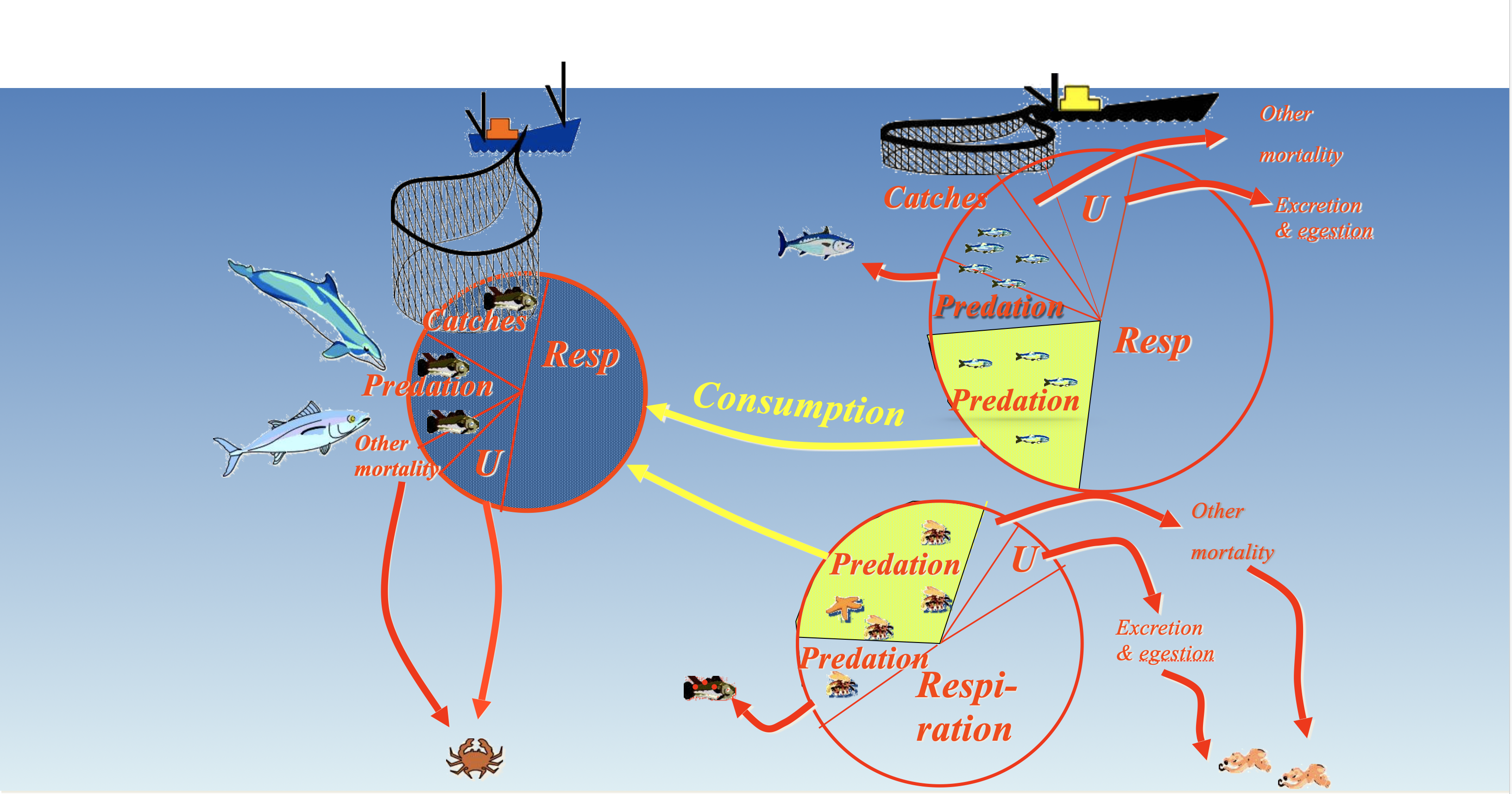
Figure 1. Representation of Ecopath mass-balance (Ecopath "pies"[1]) depicting how the consumption of an intermediary predator can be linked to the production of two prey groups.
Mass balance
Take a close look at Figure 1, it is key to understanding how Ecopath mass balance works. For three of the groups in the system, the intermediary predator, small pelagics and benthos their consumption is represented by a "pie", which size is proportional to the consumption of the group. The predators consumption includes small pelagics and benthos in the proportion dictated by the diet composition of the predator – here that's perhaps 55% for small pelagics and 45% for benthos. Within each of the three groups, the consumption is broken into pieces of the pie, using Equation 1,
latex, with tag: [latex]\text{Consumption = production + respiration + unassimilated part}\tag{1}[/latex]
Begin equation, with tag: [latex]\begin{equation} \text{Consumption = production + respiration + unassimilated part}\tag{1} \end{equation}[/latex]
Begin equation, with label: [latex]\begin{equation} \text{Consumption = production + respiration + unassimilated part}\label{1} \end{equation}[/latex]
Double dollar signs, with tag: $$\text{Consumption = production + respiration + unassimilated part}\tag{1}$$
Result in PDF:
- Label doesn't work in PDF
- Tag does work in PDF but the tag overlays with the text, which makes it hard to read
where on Figure 1, Resp represents respiration and U the unassimilated food. This equation is in line with Winberg[2] who defined consumption as the sum of somatic and gonadal growth, metabolic costs and waste products. The main differences are that Winberg (along with many other bioenergeticists) focused on measuring growth, where we focus on estimating losses, and that the Ecopath formulation does not explicitly include gonadal growth. How about predation then? On Figure 1, predation is split into its components, i.e.,
These two equations are so fundamental for understanding Ecopath that we call them "Master Equations". Check out Figure 1, and consider what would happen if we don't know the biomass of the intermediary predator? We would still know its diet composition, and the production of each of the two prey groups, we could then estimate a biomass for the predator, and see how much they would consume of the two prey groups, and if this was feasible. In that case, production of the prey set constraints for how much the predator potentially can eat. Alternatively, if we didn't know the biomass of one (or both) of the prey groups, the consumption of the predator sets a demand for how much prey there has to be in order to meet the predators' requirements. So, consumption by the predator sets constraints for the minimum size of prey production. In summary, we use information about the predator consumption to provide constraints for prey production, and information about the prey production to set constraints for predator consumption.
The process that is implemented with the two Master Equations is called "mass balance", and is conducted for all components of the food web, see Figure 2.
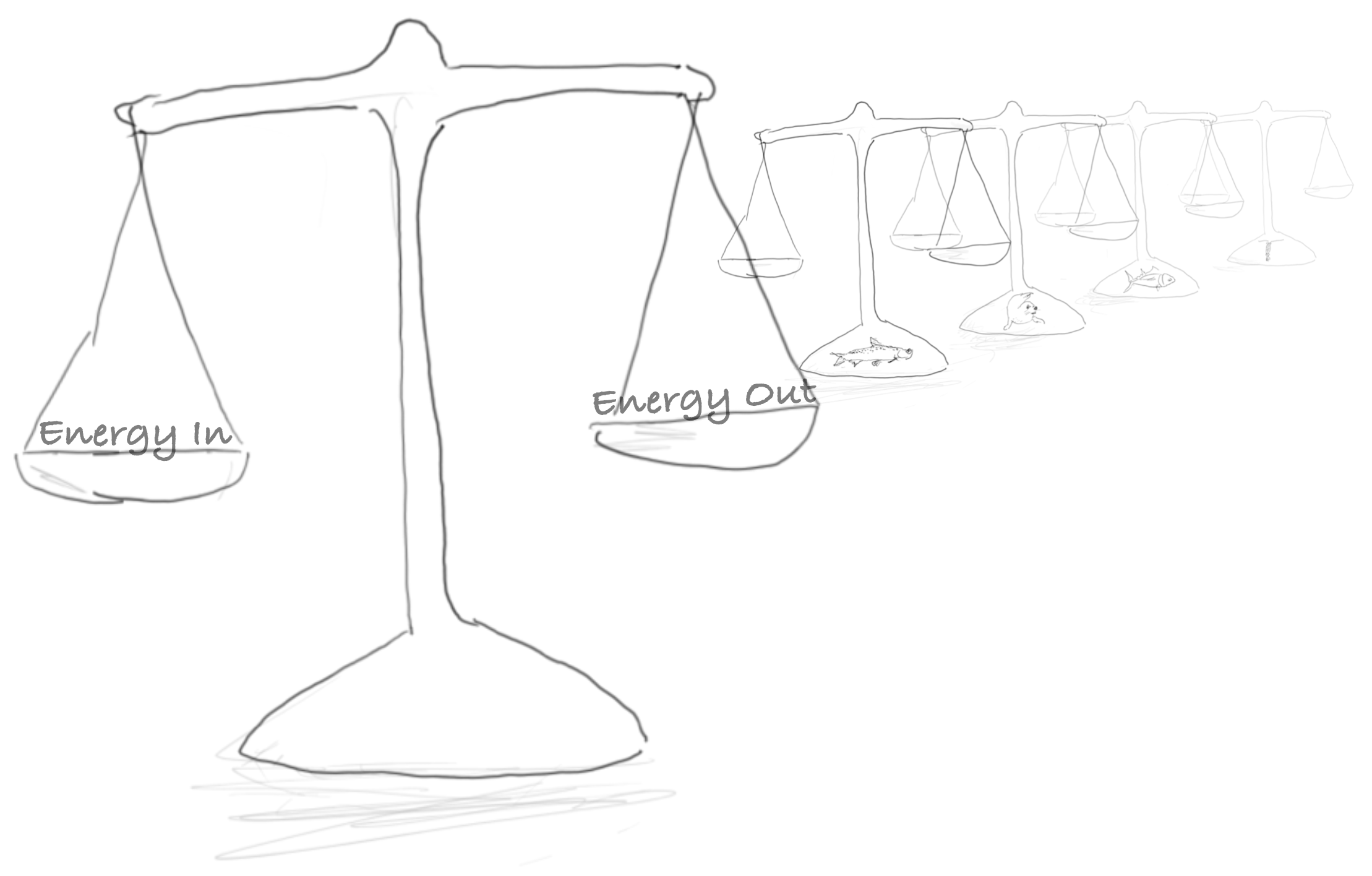
Figure 2. Ecopath is a mass balance model where energy in has to equal energy out for each groups in the system. Energy out for a prey relates to energy in for its predators, which links groups in the system and provides constraints for the mass balance.
Essington[3] evaluated Ecopath sensitivity to imprecise data inputs, and found that the mass balancing did not have any noticeable effect. The study used nine balanced Ecopath models, added parameter uncertainty and evaluated the degree to which the mass balance could retrieve the "true" parameters values. The study, however, did not recognize that the strength of mass balance is to weed out impossible parameter combinations, so when starting with balanced models those parameter combinations had already been excluded, and minor prediction errors (CV of 0.05 to 0.3) will not make the models sufficiently "unbalanced" compared to models developed from raw data, (which often have conversion errors that the mass balancing is good at pointing to). Our experience is clear, mass balance constrains the parameter space. The mass balance constraint implemented in the two master equations of Ecopath (Eq. 1 and Eq. 2) should not be seen as questionable assumptions, but rather as filters for mutually incompatible estimates of flow. One gathers all possible information about the components of an ecosystem, of their exploitation and interaction and passes them through the mass balance filter of Ecopath. The result is a possible (even plausible) representation of the energetic flows, the biomasses and their utilization. The more information used in the process and the more reliable the information, the more constrained and realistic the outcome will be. The possible representation of state variables and flows is all the Ecopath aims for. Once in the dynamic simulation modules, we can use routines to generate thousands of possible Ecopath models to evaluate impact of uncertainty on policy and research questions.
Parameters
The first Ecopath Master Equation (Eq. 1) can formally be expressed and values estimated from,
[latex]Q_i=P_i+R_i+U_i\tag{3}[/latex]
where the parameters are explained in Tables 2 and 3.
Notice that Eq. 3 uses absolute flow rates (t km-2 year-1), but in the actual implementation, we estimate the production and consumption as Qi=Bi (Q/B)i and Pi=Bi (P/B)i, respectively. The main reason for this is that the standing stocks (Bi) and instantaneous flow rates (Q/B) and (P/B) are those usually estimated, they are system size independent and therefore comparable between systems, and one can relate to them. That's much more difficult for absolute values. Once inside Ecopath, it is, however, the absolute flow rates that are used in the calculations, but that's a different story.
The production equation, aka Master Equation 2 (Eq. 2) can similarly be expressed as,
[latex]P_i=M2_i \cdot B_i+C_i+BA_i+E_i+M0_i \cdot B_i\tag{4}[/latex]
- This figure was made in the early 1990s, and we haven't updated it for sentimental reasons (even though it would look much better with current technology). It tells the story to be told. ↵
- Winberg, G. G., 1956. Ratę of metabolism and food requirements of fishes. Nauchnye Trudy Belorusskogo Gosudarst- vennogo Universiteta. Mińsk., 253 pp. (Transl. from Russian by J. Fish. Res. Bd Can. Transl. Ser. 194, 1960). https://waves-vagues.dfo-mpo.gc.ca/library-bibliotheque/38248.pdf ↵
- Essington TE. 2007. Evaluating the sensitivity of a trophic mass balance model (Ecopath) to imprecise data inputs. CJFAS 64: 628-637 https://doi.org/10.1139/f07-04 ↵
