Chapter II: Mineral Processing
1. Introduction
Mineral processing follows mining and is thus intimately connected with it. It is the business of physically treating mined ore to ready it for extraction. Usually mineral processing involves physical processes to prepare ore for metal extraction or to make concentrates. It is also called beneficiation and ore dressing. Usually there is some degree of mineral processing prior to the extractive process. It may be as simple as size reduction to as complex as forming concentrates by several particle-selection processes. In general, mineral processing involves size reduction, often coupled with size selection (e.g. screening) and production of one or more concentrates. As with any complex and multi-stage processing, the lines between mineral processing and metal extraction often blur. The term mineral processing often is used to describe the entirety of the beneficiation and extractive process, or the extractive process (or parts thereof) alone. In this course mineral processing refers to processes applied to the mined ore to prepare it for extractive metallurgical processing. Mineral processing techniques may also be applied to other industries, such as concrete production, civil engineering works (e.g. road building), recycling and waste disposal. Techniques used to make concentrates also find application in extractive metallurgy processes (e.g. separation of solid elemental sulfur from leach residues and magnetic separation of ferromagnetic metal for metal recycling). The mineral processing and extractive processes may overlap. For example, during milling (size reduction) of an ore chemical reagents may be introduced to get a head start on a leaching process. Mineral processing and metal extraction too are intimately connected. Thus it is important that the hydrometallurgist have a suitable understanding of mineral processing.
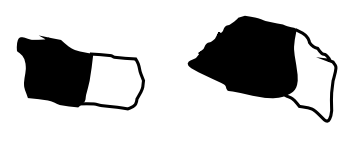
Ore particles typically contain a number of different mineral phases. These may be dispersed in a variety of ways. There may be individual grains (crystals), layered structures, rimmed particles (one phase surrounding another) and network structures. A classification scheme is shown in Table 1.1. In most instances of metal extraction some extent of size reduction is first required. Size reduction may have one of two goals. One is to simply expose the desired minerals. The ore is reduced to small enough particles so that mineral grains of interest can be contacted with a leach solution and made to dissolve. Rock may be broken up enough to open up mineral faces to the outside environment. This is called exposure. This may also include connection to mineral grains via cracks in the surrounding rock. The other objective of mineral processing is to make a concentrate. A concentrate contains the desired minerals, but at higher grade than in the original ore. The minerals are chemically unchanged. Separation is by physical processes that selectively capture one or more minerals and reject others. In order to achieve this it is imperative that the particles in the ground ore be substantially free of each other; the mixture is comprised mostly of distinct mineral grains. Otherwise physical separation is not possible. This is called liberation. In size reduction either exposure or liberation is the goal, NOT both. To make a concentrate, liberation must be achieved. In practice this is typically imperfect, but it is the goal. The figure below illustrates the two outcomes.
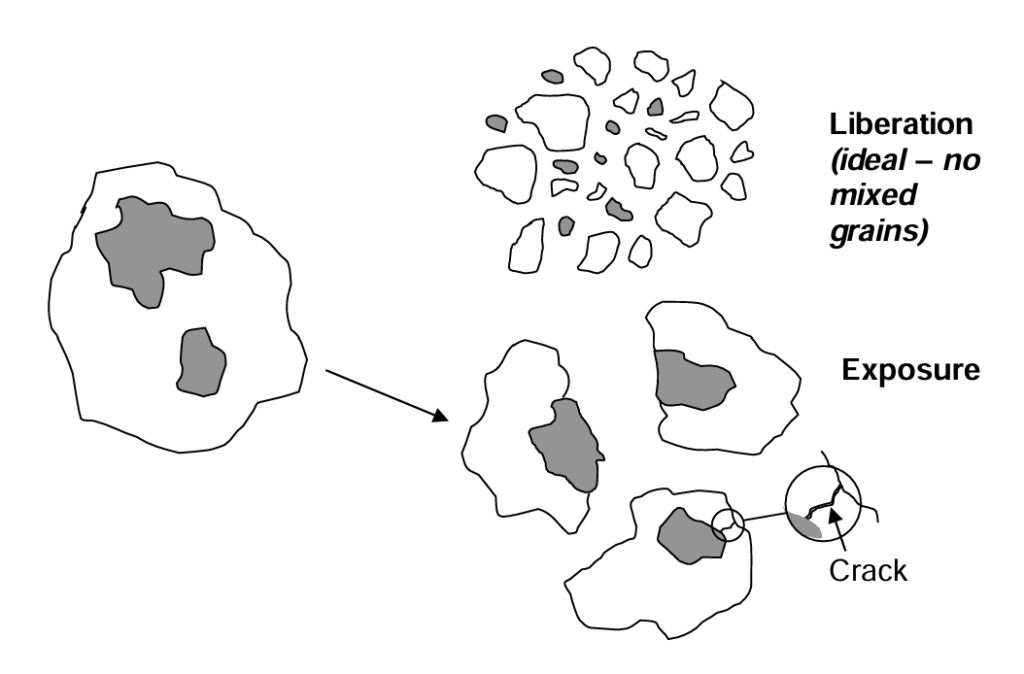
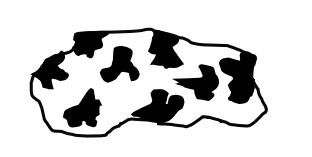
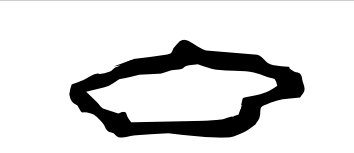
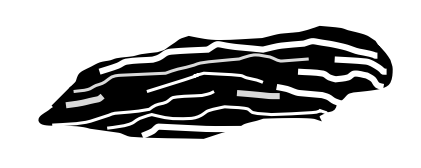
The way that phases of interest are distributed in an ore is critical to the processes used to liberate them. Table 1.1 illustrates a variety of mineralogies, many of which can make liberation difficult to achieve. Hence the need to do careful mineralogical studies. This may be quite a complex problem since ore bodies may be very large and quite inhomogeneous.
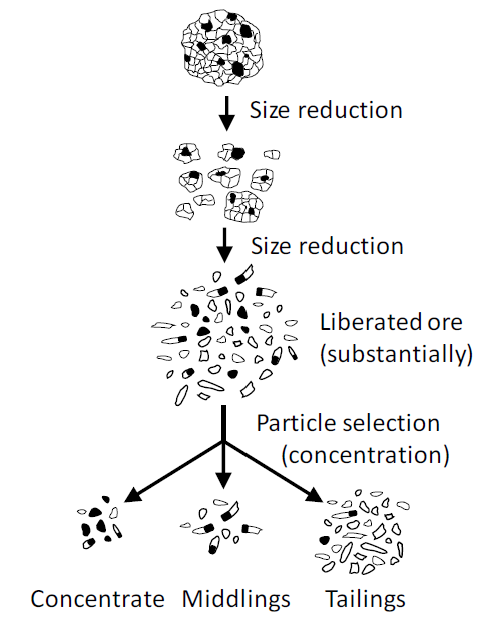
A somewhat more realistic picture of size reduction and liberation than the idealized depiction in Figure 1.1 is presented in Figure 1.2. The ore in this case contains two minerals (which in general is simplistic). Size reduction is conducted to a suitable degree. The particles produced will be a mixture of well-liberated grains of individual minerals and still composite particles comprised of both minerals. A physical separation process can then be applied and may produce two or three discrete streams. At a minimum a concentrate stream and a tailings stream are produced. The concentrate will contain the mineral of interest at higher grade, but it will also contain unwanted mineral (gangue) and composite particles. The tailings stream will contain mainly the gangue, but also some particles of the desired mineral and some composite particles. Some separation processes can produce a third stream called middlings. These are mainly the composite particles, but in practice will also contain particles of both the desired mineral and the gangue. No separation is perfect. Separation of mixtures, concentration, purification, upgrading -all go against the thermodynamic grain and require the input of energy.
Note: "tailings" here refers to the rejected stream from the concentration process, not necessarily the final waste stream!
Tailings from one step in a mineral processing operation may be fed to a subsequent operation for further recovery. It is important to understand the context in which the word "tailings" is being used.
| Table 1.1 - Geometric classification of mineral structures | ||
|---|---|---|
| Image | Description | Ease of Liberation |
 |
Coarse grains and simple shapes | Easy |
 |
Coarse grains and complex shapes | Moderately easy |
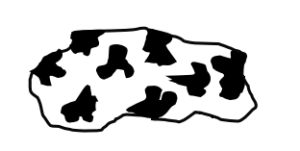 |
Fine structure; both phases continuous (not discrete grains) and complex shapes | Very difficult |
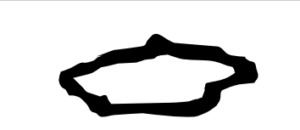 |
Fine isolated grains in a continuous matrix | Difficult |
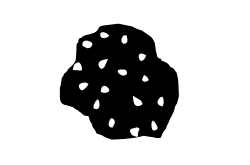 |
Rimmed particles | Difficult |
 |
Concentric layered structures | Difficult |
 |
Large veins; both phases are continuous | Moderately easy |
 |
Fines layers; both phases are continuous | Difficult |
 |
Fine, network structure; both phases are continuous | Difficult |
Important characteristics of an ore are listed below:
- Phases present and their chemical composition (related to the value of the ore and how it will be treated).
- Mass fraction (or perhaps volume fraction) of each mineral (related to the value of the ore and issues such as dealing with impurities).
- The sizes and size distributions of the grains - the individual mineral particles in the ore (e.g. very fine grains may be hard to get at; <10 m grains can be very difficult or impossible to liberate from an ore. Size is not easy to define for irregularly shaped grains, or ones that are plate-shaped or have a needle-like shape.)
- Shapes of the grains (may impact physical separation processes, e.g. long narrow grains may be harder to screen than cubic grains).
- Microstructure of the mineral grains.
- Distributions of grains within the ore (microstructure defines distribution of the phase within the grain. (e.g. is the phase of interest continuous or distributed as isolated particles? This will influence the physical and chemical properties of the ore and in turn affects the separation processes).
Analysis of polished sections of ore particles by microscopy is an important technique for determining the size and shape properties of mineral phases. This information in turn is used to determine processing schemes. Identification of gangue minerals is important since these may have significant effects on metal recovery processes. For example, arsenic-containing minerals are undesirable in concentrates to be processed by a smelter due to environmental pollution concerns. Careful sampling and mineralogical analysis over the extent of an orebody is vitally important. For instance an oxidized copper ore may be easily leached with dilute sulfuric acid. At greater depths though this may give way to a sulfidic copper ore that requires a different processing method.
Size reduction is key to mineral processing and not surprisingly, it has received a lot of attention. A simple model was developed by Wiegel and Li. Nevertheless, it illustrates some realistic features.
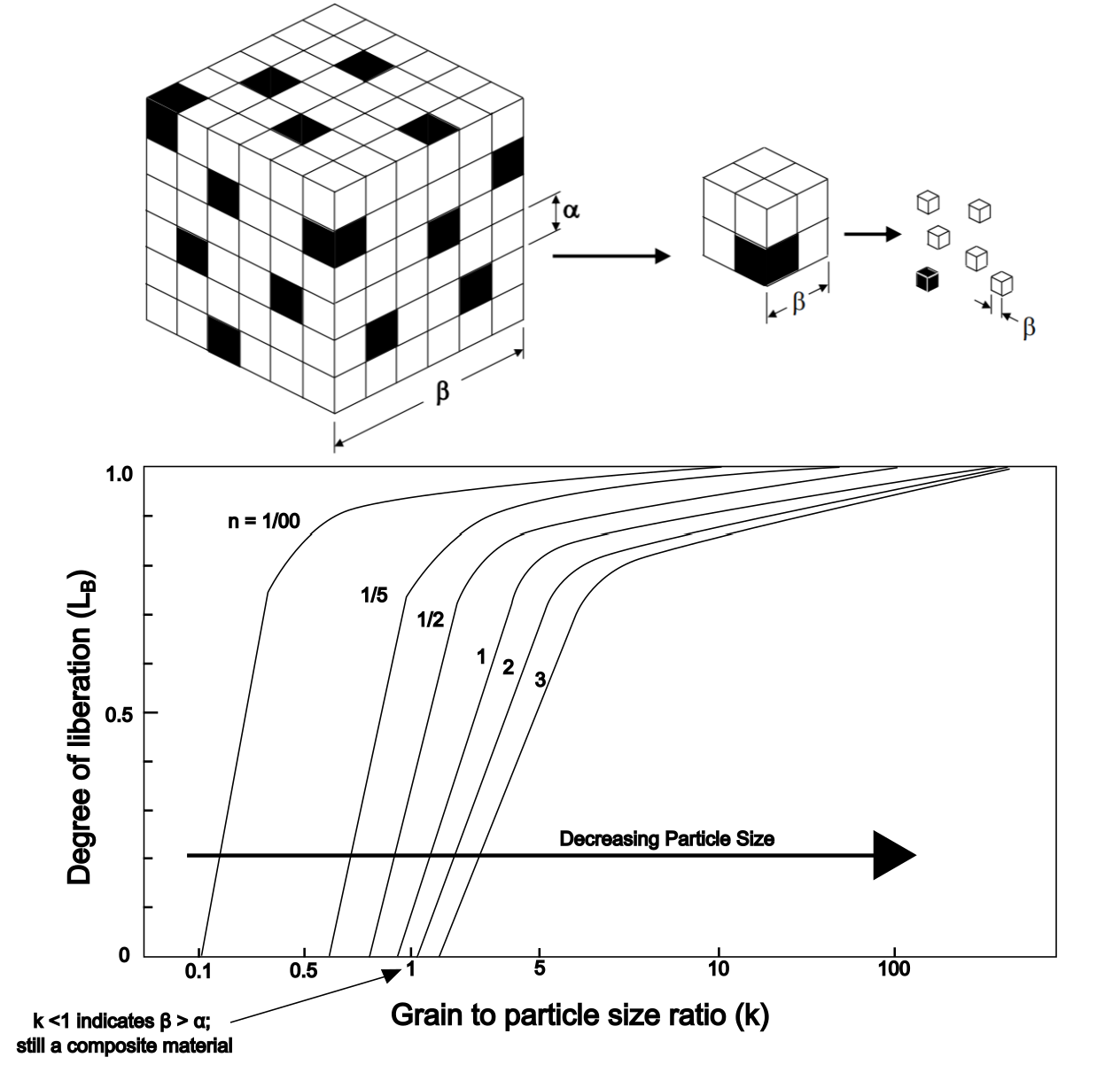
See Figure 1.3 (above). The model assumes cubic particles with cubic grains of just two phases A and B. The original particle is broken apart into uniform cubic particles (assumes a cubic fracture lattice for each grain). Individual grains of size a are broken up into cubic particles of size b. The term n is the ratio of volumes of A over B in the ore; n = 0.01 means the volume occupied by A is 0.01 of the volume occupied by B, and so on. Thus n is a measure of the grade of B; as grade of B decreases n increases. The term k refers to the ratio of the original grain size to the final particle size, i.e. a/b. It is a measure of the extent of size reduction. In the graph in Figure 1.3 (above) the model extent of liberation of B (LB = fraction of grains of B that have been liberated) is plotted versus k for a variety of values of n (grade), as per the model.
It can be seen that LB varies greatly with k. A value of k < 1 presumably means that the fracture process has produced a particle that is smaller than the original, but still larger than the grain size a; it is comprised of more than one grain.
The key points are:
- At low volume fractions of B (n = 10-100) liberation is almost independent of n, the grade of the ore. (The curves become practically coincident.)
- For large values of n (low grade), no liberation of B is obtained at k <1, and substantial liberation of B occurs only at high values of k. Hence for low grade ores, liberation of the desired mineral requires reduction of particle size to well below that of the grains in the ore.
The model is not representative of real ores, which are far more complex, but the key points still qualitatively pertain. Low grade ores are a very common (but not ubiquitous) situation; many metals of interest are present in the earth's crust at low grades. Good liberation of a low grade ore will require extensive size reduction.
Recall again that simple exposure of mineral grain surfaces may be sufficient for chemical leaching of the ore to dissolve the desired minerals. Of course, the greater the exposed surface area, the faster will be the rate of chemical dissolution. Exposure does not require the same extent of size reduction as liberation.
Media Attributions
- Ch2_F1_Exposure_v_Liberation © Bé Wassink and Amir M. Dehkoda is licensed under a CC BY-NC (Attribution NonCommercial) license
- Ch2_Table_F1_Coarse_Simple © Bé Wassink and Amir M. Dehkoda is licensed under a CC BY-NC (Attribution NonCommercial) license
- Ch2_Table_F3_Fine © Bé Wassink and Amir M. Dehkoda is licensed under a CC BY-NC (Attribution NonCommercial) license
- Ch2_Table_F2_Coarse_Complex © Bé Wassink and Amir M. Dehkoda is licensed under a CC BY-NC (Attribution NonCommercial) license
- Ch2_Table_F6_Concentric © Bé Wassink and Amir M. Dehkoda is licensed under a CC BY-NC (Attribution NonCommercial) license
- Ch2_Table_F4_Fine_Isolated © Bé Wassink and Amir M. Dehkoda is licensed under a CC BY-NC (Attribution NonCommercial) license
- Ch2_Table_F5_Rimmed © Bé Wassink and Amir M. Dehkoda is licensed under a CC BY-NC (Attribution NonCommercial) license
- Ch2_Table_F7_Large_Veins © Bé Wassink and Amir M. Dehkoda is licensed under a CC BY-NC (Attribution NonCommercial) license
- Ch2_Table_F8_Fine_Veins © Bé Wassink and Amir M. Dehkoda is licensed under a CC BY-NC (Attribution NonCommercial) license
- Ch2_Table_F9_Network © Bé Wassink and Amir M. Dehkoda is licensed under a CC BY-NC (Attribution NonCommercial) license
- Ch2_F2_Particle_Size_Reduction © P. Hayes is licensed under a All Rights Reserved license
- Ch2_F3_Size_Reduction_Model © R.L. Wiegel and K. Li adapted by Jeno Hwang is licensed under a All Rights Reserved license
Strictly speaking, a mineral is a naturally occurring, homogeneous inorganic substance of definite composition and crystal structure. Native elements (e.g. sulfur, gold) and compounds are included. A great many solid materials in nature fit this description. However, some solid materials have variable composition, e.g. pyrrhotite, FeS1−x, and pentlandite, (Fe,Ni)9S8, where, respectively, varying fractions of iron and sulfur and nickel and iron occur. These are still considered minerals. Finally, coal, which is not exactly an inorganic substance nor of definite composition, may also be considered a mineral, broadly speaking.
The mineral of interest in a more concentrated form than was present in the ore. A variety of largely physical process (as opposed to processes that chemically alter the mineral) may be used to separate the desired mineral(s) from the surrounding rock. The result is a concentrate in which the desired minerals are present, but without much of the unwanted material. Generally the minerals remain in the original form. A concentrate may go on to leaching or pyrometallurgical extraction. Note that a concentrate refers to something distinctly different (mineral processing) from purification/concentration.
This refers to the individual mineral crystals in a deposit or sample.
The solid residue left after leaching. If this has further value it may be processed in subsequent steps. Otherwise it is waste. Tailings solids are often associated with wash water. The tailings mixture is stored or impounded in a tailings pond.