Chemistry Review – Part 1
4. Brief Outline of the Chemistry of Elements
It is important that the hydrometallurgist have a good sense of the chemistry of both metals and non-metals. The periodic table is reviewed here. Being able to read this crucial piece of chemical information is also essential to a basic understanding of applied chemistry. Also in this section general trends in the chemistry of the elements are provided. Knowing the general chemical tendencies of the elements and their compounds is essential in dealing with them in hydrometallurgical processes.
4.1 The Concept of Valence
Valence is a modestly useful way of systematizing a lot of chemistry. The valence of an element can be thought of as the number of electron-pair bonds that that it forms in a given compound. For instance, CH4 (methane) involves a carbon atom surrounded by (bonded to) four hydrogen atoms. Each C-H bond involves a pair of electrons, one from C and one from H. The carbon is said to be tetravalent. Each hydrogen is monovalent. Multiple bonds are also possible. In CO2, which can be represented as O=C=O, each bond between O and C is a double bond; four electrons are involved, or two electron pair bonds. The carbon is again tetravalent. Each oxygen is divalent. In CO, carbon monoxide i.e., CºO, there is a triple bond. Each element is trivalent.
Where simple ions are involved the valence is equated to the charge of the ions (sign is unimportant). Hence both Na+ and Cl- in NaCl are monovalent. Iron chemistry is critically important in hydrometallurgy. A simple trivalent iron compound is hematite, Fe2O3; a useful disposal product for waste iron. The oxygens are each divalent. Ferric ion, Fe+3, is trivalent, while ferrous ion, Fe+2, is divalent. (This despite the fact that in aqueous solution these ions form hexaaquo complex ions, e.g. [Fe(H2O)6]+2.) Thus a single element may have multiple possible valence states. Another example is sulfur in SO2 (tetravalent), in SO3 (hexavalent) and H2SO4 (i.e. (H O)2S(=O)2, also hexavalent). Oxygen in each case is divalent; the hydrogens monovalent.
Homoatomic compounds, e.g. S8, P4, O2, etc. are said to be zerovalent. This does not mean the absence of chemical bonds. Each sulfur atom in S8 (a cyclic molecule) forms two electron pair bonds, i.e. -S-S-S-. Each oxygen in O2 also forms two electron pair bonds. Nevertheless, there are not bonds to other elements.
Finally, the idea of valence is of some value only for simple compounds. In large molecules and ions, non-stoichiommetric compounds, and compounds with unusual stoichiommetries the idea of valence becomes awkward and unhelpful. Thus, for example, there is little use in trying to assign the valence of copper and sulfur in Cu1.8S. And in Fe3O4 (magnetite) each iron has a nominal valence of 8/3, if the oxygens are each taken to be divalent. Fractional valences are not meaningful, since valence refers to electron-pair bonds in the first place. Valence is an old idea that is still in common use, so the hydrometallurgist cannot but become conversant with it.
4.2 The Periodic Table
The periodic table is the fundamental classification of the elements. Elements are grouped together in columns because they have similar chemical properties. They are also arranged in order of increasing atomic number (their number of protons and, equivalently, number of electrons). A depiction of the periodic table is given below, highlighting the group names and numbers.
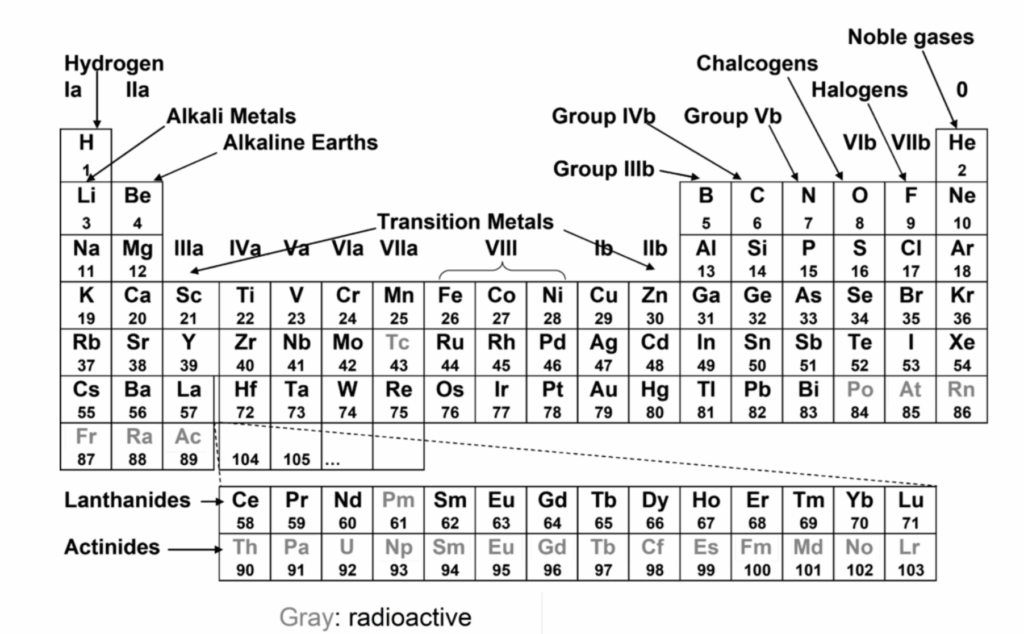
The number in each box is the atomic number. Each column has a number and some have names. The names are archaic, but still in common use. The Roman numerals identify the maximum valence that the element can exhibit in it compounds.
Does this Actually Matter?
Why should a hydrometallurgist care? Any extractive process involves ores, and ores are very complicated collections of minerals. Further, throughout a process the hydrometallurgist is dealing with various reagents and complicated solutions, containing many different compounds over a wide range of concentrations. An experienced hydrometallurgist understands how these compounds behave in the various parts of a process, and how they are likely to interact. Small amounts of some impurities can cause severe problems. The kinds of process options available depend on the valence states of the compounds of interest. These may differ in differing media (sulfate, chloride, ammonia, etc. solutions). The necessary knowledge can be picked up piecemeal, though this is painful and can leave one ignorant of newly arising problems. However, a good basic understanding of important chemical principles can be acquired by spending some time with the periodic table and understanding its principles and implications. It provides a lot of systematic and predictable information. Of course chemistry is more complex than the general principles used to understand the periodic table, but it is the best starting point.
The letter “a” simply indicates that starting from the left the numeral occurs first with the specified group. Hence The alkali metals are group Ia, and the Cu, Ag, Au column is group Ib. In group Ib Cu (copper) and Au (gold) may have valence states >1. The most common valence state for Cu is Cu(II) (or Cu+2, cupric), and Au can form Au(I) and Au(III) compounds (though not Au+ and Au+3 anions in aqueous solution). The scheme is not perfect.
To illustrate, hydrogen and the alkali metals (group Ia) can form only one single bond. Examples include HCl, CH4, NaCl, etc. Consistent with this, they form only singly charged cations, such as H+, Li+, etc. Group IIa elements form compounds with only two electron pair bonds, e.g. CaCl2, MgSO4, CaO (Ca+2 and O2-), etc. Similarly they form only +2 cations, such as Mg+2, Ca+2, etc. (They do not form +1 cations.) The transition metals are a block of 30 elements. Titanium, for instance can form up to four electron-pair bonds. Examples include TiCl4 (important in titanium metal processing) and TiO2. In TiO2 each oxygen forms two electron-pair bonds, for a total of four. Group VIIa can form up to seven electron-pair bonds. An example is MnO4-. This can be depicted as:
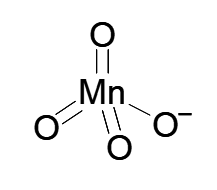
Each line represents an electron-pair bond. The manganese is involved in seven electron pair bonds, and one oxygen is negatively charged in order to satisfy its valence requirements (discussed below). Group VIII is a hodgepodge in the middle of the transition metals. The maximum valence exhibited within this group of three columns is eight. An example is OsO4. However, within the same family Fe exhibits a valence of up to only three, for example Fe2(SO4)3, Fe2O3, Fe+3, etc.
Note: Elements capable of higher valence states often also may exhibit lower ones. For example, Fe(II) and Fe(III) as in FeCl2 and FeCl3, respectively.
Note: As the valence state increases the possibility of forming a monatomic cation decreases. Thus +1 and +2 cations are fairly common. Several +3 cations are known, but less than the number of +2 cations. The +4 cations are very rare and exist in solution only under unusual conditions.
There are three broad groupings in the periodic table. Groups Ia, IIa and IIIb-VIIb and 0 are called the main group elements. The transition metals are a second grouping. The third group is comprised of the lanthanides and actinides. One aspect of the distinction is that transition metals exhibit a wealth of coordination chemistry, i.e. the ability to bind to small molecules and anions (ligands), where the metal ion is surrounded by (coordinated to) the ligands. Some main group elements exhibit this tendency as well, but overall, to a much lesser extent. In some respects main group chemistry is less complicated.
As we move across the transition metals and back into the right-side main group elements, we encounter group IIIb first. These elements all form three electron pair bonds. Examples include Al(O)OH, a constituent of bauxite, which is so important in the aluminum industry, Al+3, B(OH)3, etc. Group IVb can form up to four electron-pair bonds. Examples include CH4 (methane), SiO2, etc.
When we arrive at group Vb something new starts to occur. The elements can begin to form anions. This is not observed in any of the preceding groups. Thus we have nitrides, such as Mg2N3 and phosphides, such as Ca3P2, etc. While they are not all that important to hydrometallurgy, they mark the start of this new trend. Group Vb elements also form the indicated valence states. Thus we have P2O5, where each phosphorous is involved in 5 electron pair bonds and HNO3 (nitric acid), which can be depicted as:
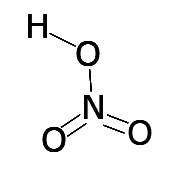
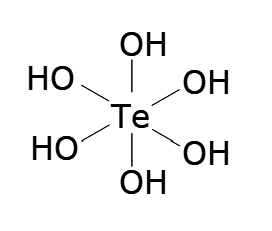
The group VIb elements now can form anions readily. Thus we have O2-, S2-, HS-, etc. And while oxygen cannot form hexavalent compounds, all the other chalcogens can. Examples include the all-important H2SO4, Te(OH)6, etc. Sulfur and tellurium form six electron-pair bonds in these examples. Structures for these compounds can be depicted as:
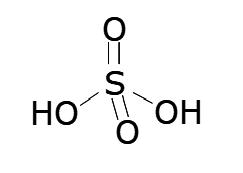
The halogens, or group VIIb can form up to seven electron pair bonds and -1 anions. Examples of the former include ClO4- and BrO4-, with structures analogous to MnO4-. Examples of the latter include F-, Cl-, Br- and I-.
Finally, the last group, group 0, is called the noble gases. The name arises from the fact that these elements form very few compounds, since they are so stable in themselves. Only xenon and krypton have known compounds.
4.3 Some Reasons for Group Valences
Atoms possess electrons that can be though of as clustered in shells around the nucleus. It is the outermost electrons, those said to be in the valence shell, that are responsible for compound formation. Compound formation has to do with sharing of electrons between atoms to form bonds. This occurs because the compound is more stable than the elements by themselves. But there is an overarching rationale for the numbers of bonds that elements can commonly form. This has to do with the number of valence electrons and the remarkable stability of the noble gases. The noble gases each have eight outermost electrons, and their valence shells are completely filled. This fully filled valence shell possesses significant stability. All the other elements in turn exhibit a tendency to achieve that noble gas valence electron configuration.
Thus, if an alkali metal loses one electron though forming a bond to another element, then it attains to the preceding noble gas configuration. So if Li loses one electron and forms Li+, or if it shares that electron with another element in an electron-pair bond, it attains to the He electronic configuration. Likewise all the other alkali metals. And therefore the alkali metals do not give up a second electron, nor do they form two or more electron-pair bonds. Hence the Group I designation. The alkaline earths, similarly, tend to lose two electrons (e.g. Mg+2, Ca+2), or participate in two electron-pair bonds (e.g. CaF2, MgO), and achieve or move toward the preceding noble gas configuration. Hence the group II designation. The simplistic rationale for electron-pair bonds is that by sharing electrons an element can at least partially, or part of the time, achieve the nearest noble gas configuration.
Hydrogen is unique. In losing one electron to form H+ it has no electrons. If it gains one electron, either forming H- (as in CaH2) or participating in one electron pair bond (as in H2 and CH4) it attains the He configuration.
As we move across the transition elements up to group VIIa the loss or sharing of the group number of electrons yields the preceding noble gas electronic configuration. Thus in group IVa, Ti in TiO2 formally loses four electrons to the oxygens and attains the Ar configuration. With group VIII things are a bit messier. Mainly Ru and Os can form octavalent compounds, such as RuO4 and OsO4.
Group IIb elements (Zn, Cd and Hg) each form M+2 cations, and divalent compounds, e.g. ZnO, HgS, HgCl2 etc. Why would they not form 12 electron-pair bonds, since they are in the twelfth column? For one thing, it would be too crowded. The transition elements have d-electrons in their valence shell. This shell can hold up to 10 electrons. Just as the noble gases possess stability due to filled valence shells, so also if the whole d-shell is full, this also results in stability. In one sense we can forget about the 10 electrons in the d-shell; they’re stable. In this respect the group IIb elements behave similarly to the group IIa elements; they can lose two electrons and form M+2 cations, and they can form two electron-pair bonds. The same analysis can be applied to the group Ib elements (Cu, Ag and Au). They all form compounds derived from one electron-pair bond (e.g. Cu2O, AgCl, Au-CN, etc.) although only Ag+ is a stable ion in water. (In water Cu+ is not very stable and Au+ is unknown.)
Boron and aluminum (group IIIb examples) can lose three electrons through bonding (e.g. B(OH)3, Al2O3) or to form ions (e.g. Al+3) and achieve the He or Ne configurations, respectively. Thus these elements do not usually form less than three bonds. Gallium (Ga) through to thallium (Tl) also have filled d-shells. By the same reasoning as for the Group IIb elements, they can lose three electrons and attain the preceding noble gas configuration (Ar for Ga(III), etc.). With group IVb and beyond the elements do not tend to form cations with the group’s valence number charge; e.g. there are no C+4, Si+4, etc. cations. The charge is simply too high. Rather elements formally lose electrons by participating in bonding.
With groups VIb and VIIb we are closer to the noble gases. Now oxygen, for instance, can achieve the Ne configuration by gaining just two electrons; likewise sulfur to attain the Ar configuration, etc. Hence oxides are very common, such as Fe2O3, SiO2, etc. The same applies for the remaining chalcogens (e.g. CuS, Cu2S, CuSe, CuTe, etc.). And for this reason they will typically accept only two electrons, as more, or less, would not achieve the noble gas configuration. Sulfur and the subsequent chalcogens can also lose up to six electrons through electron-pair bonds and attain to the preceding noble gas configuration (e.g. Ne for sulfur). Examples include SO3, H2SeO4, etc. Oxygen does not form hexavalent compounds; it has too strong a tendency to form oxides to lose that many electrons.
The halogens only need to gain one electron to attain to the nearest noble gas configuration and form F-, Cl- etc. Hence they readily form the anions and participate in one-electron pair bonds, e.g. HF, NaCl, CaCl2, etc. Note that in such compounds the halogen has a markedly stronger tendency to take the electron than does the other element. Similarly O in H2O or CaO. The halogens from Cl and below can also form up to seven electron-pair bonds, sharing seven electrons to attain to the preceding noble gas configuration. HClO4, or HO-ClO3, is an example. Fluorine does not lose electrons, for the same reason as oxygen.
4.4 General Trends in the Periodic Table
Trends in Bonding
The preceding discussion has already set the stage for this material. At the left side of the periodic table, the elements have a strong tendency to form cations, based on the noble gases stability. Since the alkali metals and alkaline earths (groups Ia and IIa, respectively) are so close to the noble gases (atomic numbers, hence numbers of electrons differ by only one or two), they readily form +1 and +2 cations, respectively. Further, they are therefore strong reducing agents; they are very easily oxidized. Among the elements Li is the strongest reductant, and the other alkali metals also are strongly reducing.
At the other end of the table, the chalcogens and the halogens have a strong tendency to gain two electrons or one electron, respectively. Again, this is due to their close proximity to the noble gases (atomic numbers differ by only one or two different from that of the nearest noble gas). Hence these elements are strong oxidizing agents; they have a strong tendency to be reduced. Fluorine is the strongest oxidizing agent of all the elements. Chlorine is the second and oxygen is the third.
This explains why most compounds of alkali metals and alkaline earths with chalcogens and halogens tend to be ionic (though not all). The elements are much more stable as ions. Hence compounds such as Na2O, CaCl2, NaOH (Na+, OH-), CaF2, etc. are either completely ionic, or have substantial charge separation. (Many fluorides and oxides have partially ionic and partially covalent bonds, the latter in part due to the small size of the anions. More on covalent bonding below.) Many of the halides of the transition metals are also substantially ionic.
Compounds formed by elements that are close to each other in the table exhibit covalent bonding. In a purely covalent bond the two atoms involved have identical tendencies to hold their electrons. In sharing the electrons a noble gas configuration is attained, but there is no charge separation; the compound is not ionic. Some simple examples are O2, F2, H2, S8, etc. Elements that are close to each other generally have similar tendencies to gain or lose electrons, so the bonds will be substantially covalent. Examples are SO2, CH4, Fe2O3, MnO2, ZnS, etc. The bonds have increasing ionic character as the elements come from further apart in the table.
Three Classes of Elements
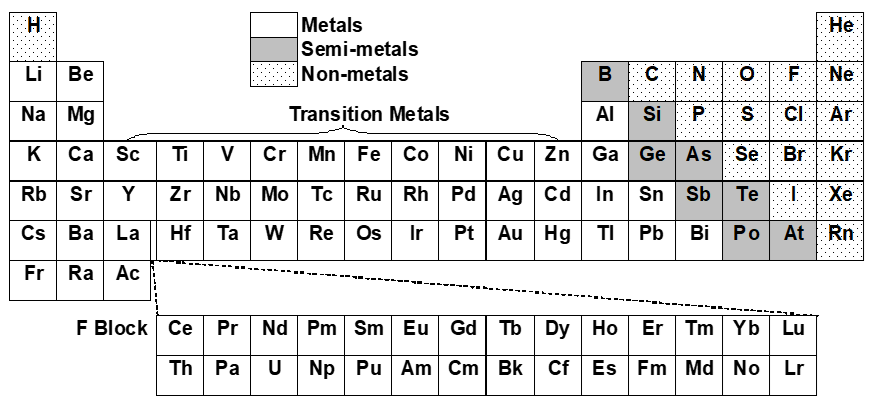
Another important trend in the periodic table is electric and thermal conductivity of the elements. A disproportionate number of elements are metals; about ¾ of them. Metals start at the left, are good conductors of heat and electricity and are ductile. The only exception is hydrogen, which is a non-metal. Moving to the right, the semi-metals are encountered, and after these the non-metals. Semi-metals have properties intermediate between metals (generally modest conductors and brittle). Non-metals are typically insulators (poor conductors), and the solids are brittle. Carbon in the form of graphite is an exception. It is a moderately good conductor. Carbon as diamond is an insulator. The three classes of elements are depicted in Figure 4.6.
Group Similarities
The elements of any particular column are chemically similar, though by no means identical. Further, there are distinct and different trends as one descends different columns. These similarities in properties for a given column, or family of elements will be discussed further in the Section 4.5.
Densities
There are a number of atomic properties that can be correlated with position in the periodic table. One that is relevant to materials engineers is density. The densities of the elements at room temperature are depicted in Figure 4.7. For the metals the densities range from 0.53 g/cm3 for lithium to 22.6 g/cm3 for osmium. For comparison, water at room temperature has a density of 0.998 g/cm3.
Densities increase as one descends a group. The trends are straightforward for the most part, as indicated by the grey lines in the figure for three rows. Gold metal has a density of 19.32 g/cm3; one of the highest. Aluminum, an important structural light metal has a density of only 2.70 g/cm3, whereas iron, the main component in steel, has a density of 7.87 g/cm3. The very lightest of the metals are the alkali metals, however, these are far too reactive towards air and water to be of use for structural applications. Magnesium, which is gaining interest as an alloying metal where strength-to-weight considerations are important, has a density of only 1.74 g/cm3. The trend across any given row is that densities start low, rise to a peak, then, generally, fall. The lanthanides add a measure of complexity to this.
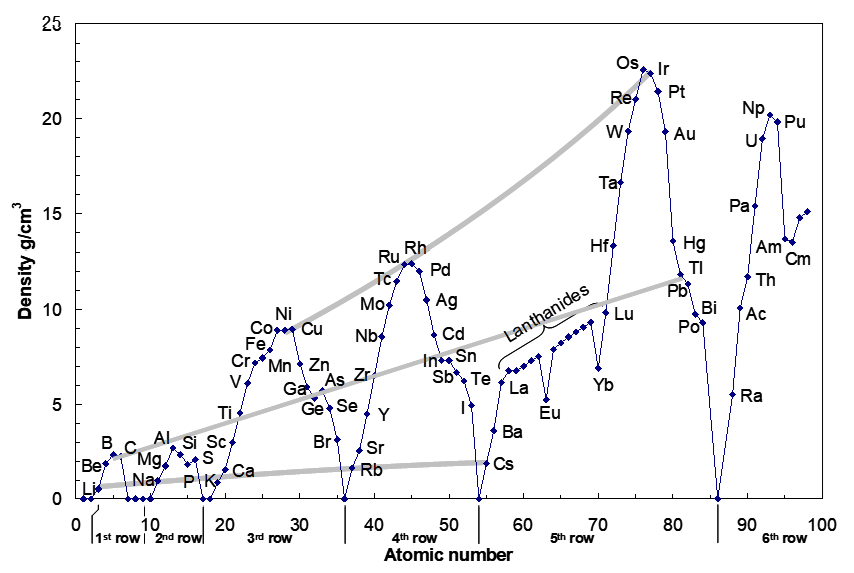
In a measure, the valence properties of the elements provide some basis for rationalizing the density trends. The alkali metals have just one valence electron. This lone electron is relatively far from the nucleus because the nucleus has the lowest number of protons (therefore lowest positive charge and lowest electrostatic attraction) and neutrons of any element in the row. For the alkaline earths there is one additional proton and increased electrostatic attraction, and the size of the atoms gets smaller; the density increases. In any given group the densities rise simply because of the increasing number of neutrons and protons.
Acid-Base Properties
The acid-base properties of the oxides and hydroxides are critically important in hydrometallurgy. An ore containing a valuable metal oxide will be treated much differently than one containing a metal sulfide, and generally the acid base properties of the oxides are readily employed for extractive processes. Thus the most important reagent in hydrometallurgy is sulfuric acid, i.e. H2SO4, or (HO)2SO2 to indicate its hydroxo- and oxo- formulation. And most metal oxides are readily dissolved (leached) in acid solutions.
Almost all of the elements, except most of the noble gases form oxides, i.e. element-oxygen compounds. Most oxides are only very slightly soluble. Exceptions include the alkali metal oxides (which fully convert to hydroxides) and some of the main group oxides on the right side of the table (e.g. SO2, SO3). There is a general trend from left to right that the oxides start out strongly basic (alkali metal oxides, M2O, e.g. Na2O) move to weakly basic (alkaline earth oxides, MO, e.g. MgO), then amphoteric (both weakly basic and weakly acidic), then weakly acidic (e.g. CO2 and P4O10) and finally strongly acidic (e.g. SO3 and ClO2). Most react with water, some very strongly, e.g.:
\[\ce{CO_2_{(g)} + H_2O_{(l)} -> H^+_{(aq)} + HCO_3^-_{(aq)}} \text{ (weak acid)} \tag{128}\]
\[\ce{P_4O_10_{(s)} + 6H_2O_{(l)} -> 4H_3PO_4_{(aq)}} \text{ (weak acid)} \tag{129}\]
\[\ce{SO_3_{(g)} + H_2O_{(l)} -> H_2SO_4_{(aq)}} \text{ (strong acid)} \tag{130}\]
Some oxides are neither acidic nor basic. Examples include CO(g) and NO(g).
Similarly, the hydroxides of the alkali metals and alkaline earths are basic; the former strongly so. The “hydroxides” of elements at the far right are acidic, some strongly so. Examples are H2SO4, HClO4, HNO3, etc. And again, most hydroxide compounds from the middle region of the table are amphoteric.
Phases of the Elements
Most elements are solids at ordinary temperature. Virtually all metals are solids except mercury (a liquid); gallium and cesium have low melting points (29.8°C and 28.6°C, respectively). The highest melting point for an element is 3675°C for carbon as graphite. The highest melting point for a metal is 3422°C (tungsten). There is great variability in melting points across the periodic table. The elements from the far right and upper rows are gases, and have melting points well below zero. As the right side groups are descended the trend is towards elements being solids, at room temperature and pressure. Hence H2 in row 1, N, O and F in row 2, and Cl in row 3 are all gases. Bromine in row 4 is a liquid. Iodine in row 5 is a solid. All the noble gases are, of course, gases.
4.5 Chemical Properties of the Elements
An outline of some of the more general trends in the chemical properties of the elements is provided in this section. This descriptive chemistry is helpful in understanding uses and limitations of common classes of chemical compounds.
Hydrogen
Hydrogen is the first element (atomic number = 1). It is unique. It has the same valence electron configuration as the alkali metals, but it is a gas at ordinary temperatures and pressures, and a non-metal. It can lose one electron to form H+ and in this respect it is similar to the alkali metals. However, it has only a moderate tendency to lose its lone electron, whereas the alkali metals are strong reducing agents. And whereas there are many alkali metal salts comprised of ions, there are no common H+ salts. Similarly to the halogens hydrogen may also be reduced to H- (hydride). But, again it is harder to reduce than the halogens, which have a strong tendency to form monoanions. Hydrogen is monovalent; it has only one electron, hence one valence electron and forms single bonds. In aqueous solution the proton forms H3O+:
\[\ce{H^+ + H_2O -> H_3O^+} \tag{131}\]
The proton per se does not exist in aqueous solution. H3O+ in turn is also strongly solvated by water, i.e. closely coordinated by a number of water molecules. H3O+ is, of course, the basis of acid chemistry in aqueous solutions, and acid-base chemistry is critically important in hydrometallurgy.
Hydrogen Bonding
Hydrogen is a small atom and has the smallest radius in its covalent compounds of any element. It also has a modest tendency to lose an electron and form H+. The elements F, O and N have a strong tendency to draw electrons to themselves in their compounds, and are the next three smallest atoms in their covalent compounds. Many compounds involving these three elements exhibit a degree of charge separation in their bonds due to their strong tendency to draw electrons to themselves. Where this occurs it lends a partial ionic character to the bonds, in addition to the covalent character. If hydrogen is also bonded to these elements, then the phenomenon of hydrogen bonding can occur. To illustrate, in water the molecules are oriented such that hydrogens of one molecule interact with oxygens of others:
The interaction varies greatly in strength and can in some instances be very strong, such as in H3O+ and aqueous HF, which exists as (H-F-H)+F-. It is responsible in part for the high boiling point of water compared to other H2X compounds (X = S, Se, Te), which are all gases at room temperature. Hydrogen bonding is most prevalent in compounds with F, O and N, and to a lesser extent Cl.
Alkali Metals (Group Ia)
The alkali metals come below hydrogen. Each is a metal. They are soft and have fairly low melting points. Each is a very strong reducing agent, tending to lose one electron to form M+ cations. The elements cannot be formed from their salts in aqueous solution; the metals react vigorously with water. The metals themselves have relatively few commercial applications. The salts are very important.
Alkali metal chemistry involves the monovalent state only. Oxides and hydroxides of the alkali metals (M2O and MOH, respectively) are strongly basic. The oxides react strongly and completely with water:
\[\ce{M_2O_{(s)} + H_2O_{(l)} -> 2M^+_{(aq)} + 2OH^-_{(aq)}} \tag{132}\]
No O2- ions survive; all are converted to OH-. In contrast the oxide of hydrogen, H2O, is both a very weak acid and a very weak base. Most compounds of the alkali metals are ionic in character, i.e. they tend to form salts, with discrete anions and cations, e.g. NaCl, K2O, Cs2CO3, etc. Sodium hydroxide is a strong base and important in hydrometallurgy.
Alkaline Earths (Group IIa)
All are metals. They are quite strong reducing agents (somewhat less so than the alkali metals). They tend to lose two electrons to form M+2 cations. They form salts with many anions, e.g. halides, with substantial ionic character. However, the Be+2 cation is not known and beryllium, like lithium, exhibits significant covalent character in its chemical bonding, even with the halogens. This is due in part to the small size of these cations. The metals are moderately soft with fairly high melting points. The oxides, MO, and the hydroxides M(OH)2, are basic, but less so than the alkali metals. Lime (CaO) is a very important base in hydrometallurgy. The oxides are sparingly soluble (dissolve to a small extent) in water. Again, the oxides in water form M+2(aq) and 2OH-(aq).
Calcium is abundant and there are large amounts of CaCO3 (limestone) in the earth’s crust. When heated CaCO3 loses CO2 to form CaO, the most important industrial base, and a key ingredient in Portland cement (for concrete). The metals are strictly divalent in their chemistry.
Group IIIb
Boron is a non-metal. elements aluminum through to thallium are metals. Aluminum metal is fairly strongly reducing, tending to lose three electrons and form trivalent compounds, i.e. Al(III), or Al+3 in salts. The remaining metals are moderate reducing agents. Boron has a high melting point. The metals have relatively low melting points: aluminum, 660°C; gallium can be melted in the palm of one’s hand; melting points for the remaining two elements increase with atomic number to 304°C for thallium. Each element exhibits the trivalent state; B, Al and Ga exclusively. Examples include B(OH)3 (boric acid; an important additive in Ni electrowinning) and Al2O3. However, in descending the group the monovalent state is known for indium and is more stable for thallium. Thus Tl+3 is a strong oxidizing agent, being reduced to Tl+. It is similar in oxidizing power to Cl2. Hence Tl(I) compounds are more prevalent than Tl(III). This same effect (an increasingly stable valence of the group number - 2 as the group is descended) is typical of groups IIIb, IVb and Vb.
Boron exhibits mainly covalent bonding. The metals exhibit varying degrees of ionic and covalent character in their compounds. The hydroxide of boron, B(OH)3, is a weak, triprotic acid:
\[\ce{B(OH)_3 -> B(OH)_2O^- + H^+} \tag{133}\]
\[\ce{B(OH)_2O^- -> B(OH)O_2^{2-} + H^+} \tag{134}\]
\[\ce{B(OH)O_2^{2-} -> BO_3^{3-} + H^+} \tag{135}\]
(Although H+ is present as H3O+, we write it as H+ for convenience.)
Al2O3 (the ultimate product of the Bayer process and the feed for aluminum metal production) is insoluble in water, but dissolves in strong base, making it a weak acid. The hydroxide, Al(OH)3, is amphoteric, which means both weakly acidic and weakly basic, e.g.
\[\ce{Al(OH)_3_{(s)} + OH^-_{(aq)} -> Al(OH)_4^-_{(aq)}} \tag{136}\]
Here Al(OH)3 is acting as an acid, reacting with OH-, a base.
\[\ce{Al(OH)_3_{(s)} -> Al(OH)_2O^-_{(aq)} + H^+} \tag{137}\]
And in this case it ionizes to release a proton, making it an acid. (The acid-base chemistry of Al(III) is more involved than the two reactions above suggest.)
The trihydroxides become more basic as the group is descended. TlOH, analogous to the alkali metal hydroxides, is a moderately strong base. Note then, the tendency to increasing basicity as the group is descended.
The Al+3 cation in aqueous solution, like most cations, forms a complex with water, i.e. [Al(H2O)6]+3. (A brief introduction to coordination chemistry will be provided in the section on transition metals.) Further, Al(III) has a strong tendency to hydrolyze, i.e. react with water. In the process, Al+3 acts as a weak acid:
\[\ce{[Al(H_2O)_6]^{3+} -> [Al(H_2O)_5OH]^{2+} + H^+} \tag{138}\]
There are numerous, and more complex hydrolysis reactions after the simple one above. Ultimately, in strongly basic solution [Al(OH)4]- forms; still Al(III). This is the basis for the Bayer process for leaching of bauxite ores:
\[\ce{Al(O)OH(s) + NaOH(aq) + H_2O(l) -> Na[Al(OH)_4} \tag{139}\]
\[\ce{Al(OH)_3(s) + NaOH(aq) -> Na[Al(OH)_4} \tag{140}\]
The acid-base chemistry of Al(III) is fundamental to the entire aluminum industry.
Group IVb
Carbon is a non-metal, although graphite is a moderately good conductor of electricity. Silicon and germanium are semi-metals. Tin and lead are metals. Lead is the 4th highest tonnage non-ferrous metal produced. The most important tin mineral is cassiterite, SnO2 and the most important lead mineral is galena, PbS. Note the transition from non-metal to semi-metals to metals as the group is descended. There are no +4 ions per se for these elements. The tetravalent state is common for all elements in this group. However, analogous to group IIIb, the divalent state becomes more stable as the group is descended. The divalent state is rare for germanium (GeO is known), common for tin (and moderately stable) and is most stable for lead. Thus solid PbO2, i.e. Pb(IV), is also a strong oxidant in acid solution (stronger than Cl2), as was the case with Tl(III).
Carbon dioxide, CO2, is a weak acid. Other group IV dioxides are water insoluble. SiO2 (silica) is soluble in very strong base and slightly soluble in strong acid, making it amphoteric. In aqueous solution there are a number of silicic acids, ranging from H2SiO3 to H10Si2O9. They are weak acids. Dissolve silica can cause serious problems in hydrometallurgical processes, due to its variable solubility depending on pH. Silica re-precipitation in process plants due to changes in pH can cause all kinds of problems.
Group Vb
Nitrogen is a gas under ordinary conditions, and obviously a non-metal. The other elements in this group are solids. Arsenic and antimony are semi-metals. Bismuth is a metal. The group exhibits mostly trivalent and pentavalent states. Relatively few pentavalent nitrogen compounds are known; the trivalent state is the more stable. Hence pentavalent HNO3, i.e. (O=)2N-OH, is powerfully oxidizing (also a strong acid). Trivalent nitrogen is much more common. This is in contrast with the preceding two groups, where the highest oxidation state was dominant. Nitrogen being small, and having now a higher nuclear charge than Al and C, holds on to its valence electrons more strongly. Hence sharing all five of them is difficult. as the group is descended phosphorous, arsenic and antimony favour the pentavalent state, although the trivalent state becomes progressively more stable. For bismuth, at the bottom, the trivalent state is the most stable and B(V) species in aqueous solution are powerfully oxidizing, forming Bi(III) species such as BiO+. This, at least, accords well with the behaviour in groups IIIb and IVb.
In forming compounds with oxygen (like HNO3) nitrogen is formally losing five electrons to oxygen to attain the N(V) valence state, and hence the He noble gas electronic configuration. On the other hand, nitrogen can also formally acquire three electrons through covalent bonding and attain the Ar noble gas configuration. In so doing we form trivalent nitrogen compounds. An example is NH3 gas, which is a weak base and an important compound in some nickel and cobalt extraction processes. However, there is an important distinction to be made, which will be developed further in the section on electronegativity of the elements. Nitrogen has a stronger tendency to draw electrons to itself than hydrogen, so in NH3 we think of the nitrogen as being present formally as N3-, and the hydrogens formally as H+.
Note: this is a formalism. There are not N3- and H+ ions per se in NH3; it involves largely a covalent bonding, with a degree of charge separation, but NOT to the extent of forming ions! In HNO3, the oxygens tend to hold the electrons more strongly, so we can think of nitrogen formally as N5+. (We refer to these formal charges as oxidation states. This will be discussed further I a later section.) Given these two extremes, it is not surprising then that nitrogen exhibits a wide range of these oxidation states.
The oxides of phosphorous are all acidic, e.g. P2O5, with P(V), which is readily water soluble and yields phosphoric acid, H3PO4. This is one of the world’s most important chemicals - the basis of the fertilizer industry and thence agriculture. Phosphoric acid is a weaker acid than nitric acid. Arsenic(V) oxide, As2O5, is acidic. Arsenic(III) oxide, As2O3, is amphoteric, dissolving in basic solution, or hydrolyzing with aqueous acid to form As(OH)3, a weak acid, while Bi(OH)3 at the bottom of the group is a base.
The Chalcogens (Group VIb)
Oxygen is at the top. It is strongly oxidizing. It tends to have a concentration of negative charge on itself in its compounds, i.e. draw electrons to itself. Sulfur is weakly oxidizing and selenium and tellurium are reducing. However, consistent with their proximity to the noble gases, these elements tend to form 2- anions or divalent compounds. Salts of these are called chalcogenides, and individual elements form oxides, sulfides, selenides and tellurides. The alkali metal chalcogenides are ionic. The divalent state for the dianions becomes less stable as the group is descended. Oxygen is almost exclusively divalent. There are no hexavalent oxygen compounds. Oxygen holds its electrons too strongly to share six of them. It is like nitrogen in this respect, only more so. All other chalcogens may be up to hexavalent, as in H2SO4. The hexavalent state exists even for Te, e.g. Te(OH)6. The tetravalent state becomes more stable as the group is descended, as per the preceding groups. Sulfuric acid, i.e. H2SO4, is a strong acid, H2SeO4 is a moderate strength acid, and Te(OH)6 is a weak acid. The latter also differs in structure, as indicated. Sulfur trioxide, correspondingly, is a strongly acidic oxide:
\[\ce{SO_3_{(g)} + H_2O_{(l)} -> H_2SO_4_{(l)}} \tag{141}\]
In water the acid dissociates as follows:
\[\ce{H_2SO_4_{(l)} -> H^+_{(aq)} + HSO_4^-_{(aq)}} \text{ (completely dissociates)} \tag{142}\]
\[\ce{HSO_4^-_{(aq)} -> H^+ + SO_4^{2-}_{(aq)}} \text{ (weak acid)} \tag{143}\]
Sulfuric acid is highest or second highest tonnage chemical produced in the World. It is crucially important in hydrometallurgy. It’s most common use is fertilizer production:
\[\ce{Ca_3(PO_4)_2_{(s)} + 3H_2SO_4_{(aq)} + 2H_2O_{(l)} -> 3CaSO_4·2H_2O_{(s)} + 2H_3PO_4_{(aq)}} \tag{144}\]
Until recently the wealth of a nation could be directly inferred from its sulfuric acid production.
The stable oxides for Se and Te are SeO2 and TeO2. Both are weakly acidic. Sulfur dioxide, SO2, is stable and a weak acid. The oxoacids H2SeO3 and H2TeO3 are weakly acidic.
The Halogens (Group VIIb)
All these elements form X2 compounds. F2 and Cl2 are gases. Bromine, Br2, is a volatile liquid. Iodine, I2, is a volatile solid. All readily accept one electron to form X- ions and hence are strong oxidants. Fluorine is the most strongly oxidizing element and chlorine is number two. Common salts are ionic (e.g. NaCl, MgBr2, etc.). Oxidizing strength decreases as one descends the group. All the hydrogen halides, HX, are strong acids in water, except HF (a weak acid). At first this may seem odd. But, all the pure hydrogen halides are molecular compounds (gases under ordinary conditions). They all involve substantially covalent bonding (Recall that hydrogen is unique, and not like the alkali metals in that it has a weaker tendency to form H+ than the metals do to form M+). Both H and F are small and so can approach each other quite closely in HF. The compound then has a significant degree of covalent bonding and it is a strong bond. Hence it is a weak acid in water. Although the alkali metal fluorides are mostly ionic, many compounds of fluorine have a significant covalent character. The hydrohalic acids and metal chlorides have some application in hydrometallurgy, notably for nickel and cobalt. Their main limitation is that they are strongly corrosive toward common materials of construction, such as steel. In processing of copper and zinc, for instance, only very low levels chloride or fluoride can be tolerated in the final metal recovery steps due to corrosion problems.
The hydrogen halides and many other halogen compounds are monovalent, forming a single electron-pair bond. The highest valence state for the group is 7, e.g. HClO4, i.e. HO-Cl(=O)3. Fluorine, like oxygen, cannot attain the heptavalent state. It is almost exclusively monovalent. The immediate proximity of the halogens to the noble gases and the resulting strong tendency to form -1 anions is consistent with the fact that all the heptavalent oxoacids (HXO4, X = Cl, Br, I) are powerfully oxidizing. They are also strong acids. Perchloric acid may react explosively with reducing materials, such as organic matter. Other types of oxoacids include HOX and HXO3. Names for the various acids and anions are listed in the table below.
| Table 4.1 - Naming of the Various Halogen Oxoacids and Oxoanions | |||
|---|---|---|---|
| HX | Hydrohalic acids | X- | Halides |
| HOX | Hypohalous acids | XO- | Hypohalites |
| HOXO | Halous acids | XO2- | Halites |
| HOXO2 | Halic acids | XO3- | Halates |
| HOXO3 | Perhalic acids | XO4- | Perhalates |
Some examples: HI = hydroiodic acid; HOBr = hypobromous acid; HOClO = chlorous acid; HClO3 = chloric acid; HClO4 = perchloric acid; Br- = bromide; OCl- = hypochlorite; ClO2- = chlorite; ClO3- = bromate, and; IO4- = periodate. Fluorine only forms HOF. Generally the oxoacids other than the HXO4 are weak acids. Hypochlorite (OCl-) is important industrially; NaOCl is commercial bleach, and a powerful oxidant (the source of its bleaching properties).
The Noble Gases (Group 0)
They are monatomic gases. These were once called the inert gases since no compounds of these elements were known to exist. Hence the group 0 designation. However, in the 1960’s fluorine compounds of Xe were formed for the first time here at UBC. A few Kr compounds have also been formed. Helium, neon and argon are, to date, inert. The reason for the great stability of the gases is their electronic configurations, as mentioned previously. Although the noble gases have important commercial applications (e.g. “neon” lights), they have little application in hydrometallurgy.
Transition Metals
(a) General Points
The transition metals lie between groups IIIa and IIb (columns from Sc-Zn). Many of the metals we are concerned with in extractive metallurgy are transition metals (e.g. Fe, Zn, Ni, Co, Mo, precious metals, etc.). They access the d-electronic energy levels, of which there are 5, each holding up to 2 electrons. Hence there are ten columns of elements. (The “transition” is from group IIa with 2 outer s shell electrons to group IIb, also with 2 outer s shell electrons and the d-electronic shell completely filled. All are metals. All tend to form cations or compounds in which the metal has actually or formally lost electrons. To varying degrees most are reducing agents. However, several elements near the lower right of the d-block are difficult to oxidize. These include Ir, Pd, Pt and Au. They do form compounds with the metal atom being formally positively charged, but they are often termed noble metals, because of the weak tendency for them to act as reducing agents, and hence their good resistance to corrosion. They are also very rare, and therefore costly.
Another notable feature is the capability of many transition metals to form numerous valence states. Most have at least two relatively stable valence states, e.g. Fe+2 and Fe+3 or Cu+ and Cu+2. Manganese, for instance, can form Mn(II, III, IV, VI and VII) compounds. This kind of behaviour allows for a varied and rich redox (oxidation-reduction) chemistry. The moderately strongly oxidizing Fe+3/Fe+2 couple is critically important in hydrometallurgical treatment of many sulfide minerals.
Transition metal cations (and even the neutral elements themselves in many cases) exhibit a rich coordination chemistry. They form complexes with small (and large) molecules and anions. This will be discussed in more detail later. (Many main group metal ions also form coordination complexes, though not as extensively as the transition metals.) In such cases the ideas of valence often become inadequate to fully describe what is going on. However, the terminology persists and the hydrometallurgist must be aware of it. So, for instance, Co+2, CoCO3 (Co+2 and CO32-), [Co(H2O)6]Cl2 and Co(NH3)4Cl2 are all considered to involve divalent cobalt, even though the latter two (complexes) involve six electron-pair bonds to cobalt.
(b) Hydrolysis of Metal Cations
In aqueous solution metal ions exist as aqueous complexes, for example, [Mg(H2O)6]+2, [Fe(H2O)6]+3, [Pd(H2O)4]+2, etc. Even the alkali metal cations are weakly coordinated by water. A very important property of aquocations in water is their tendency to hydrolyze. For example, ferric ion hydrolysis can be illustrated by the following reaction:
\[\ce{[Fe(H_2O)_6]^{3+} -> [Fe(H_2O)_5OH]^{2+} + H^+} \tag{145}\]
This preliminary hydrolysis (acid dissociation) reaction is very common for metal ions. However, the acid-base chemistry of aquo metal ions can be much more complicated. In the case of iron there are several subsequent steps, each involving an acid dissociation. This chemistry will be discussed in somewhat more detail in part II of the chemistry review.
For now, suffice it to say that hydrolysis of metal ions has significant implications for hydrometallurgy. For instance, it allows us to reject unwanted ferric (Fe+3) ion from aqueous solution as ferric oxides/hydroxides, even from acidic solutions. Separations of some metal ions can be made on the basis of their differing tendencies to hydrolyze and precipitate at different pH. Metal ion hydrolysis poses significant constraints on how we can use aqueous solutions of metal ions, and requires that we use either substantially acidic solutions, or strongly basic ones. The latter are often too expensive to be of practical use.
The most common, monatomic cations are +2 charged. There are also a number of +1 and +3 cations. Cations with a charge of +4 or higher are very rare, e.g. Th+4. Generally, the higher the charge the more prone the cation is to hydrolysis. As the valence state increases, the tendency is so strong that oxide and oxo compounds prevail. Thus Ti(IV) compounds in the presence of water tend to form TiO2, which is an insoluble solid. No Ti+4 ions exist in aqueous solution. For group Va, pentvalent vanadium in water is present as VO2+ or VO43-, at very low and very high pH, respectively (and a wide array of polyvanadates in between). For the tetravalent state there is VO2+, but no V+4. The same trends continue up to group VIII. Thus we have: Cr2O72-, MoO3 and MoO42- (group VIa); MnO4- (group VIIa), and; OsO4 (group VIII). Once past the Fe-Ru-Os triad, the transition metals mainly form lower valence states and simple +1 to +3 cations arise again, depending on the element. Once back in the main group elements, group IVb metals again in the highest valence state favour oxo compounds, e.g. SnO2 and PbO2, whereas Sn+2 and Pb+2 are stable cations in aqueous solution. And, for the non-metals and semi-metals we have the extensive oxoacid chemistry.
(c) Transition Metal Sulfides
These are extremely important compounds. In nature many elements are found as sulfides, and these have an extractive metallurgy all their own. Sulfides are treated in very different ways than oxides and hydroxides. All transition metals form sulfides, although some are not very stable (e.g. of Au and Pt). Most of the non-metals also form sulfides. The water solubility of sulfides varies enormously.
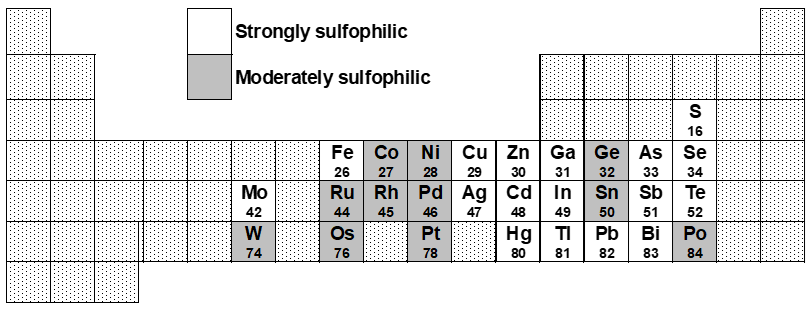
The alkali metal sulfides are soluble in water. Elements in valence states that form especially stable bonds with oxygen often have less stable sulfides that dissolve in, or react with water. Thus TiS2 reacts with water to form TiO2. Some metals (and semi-metals and non-metals) form especially stable sulfides. The figure above shows the sulfophilic elements. These often occur in nature as sulfides and have a very high affinity for sulfur. Sulfides of these elements tend to be very insoluble in water. Note that the majority of the sulfophilic elements lie towards the middle-right of the table, and are mostly from the lower rows (4-6).
Lanthanides and Actinides
These are the two bottom rows. They access the f-electrons and are also known as the f-block elements. There are 14 in each row, corresponding to the 7f electronic energy levels. Actually they fit in between the transition metals at the left side. There is still debate about whether La is a transition metal or a lanthanide, due to uncertainties in its electronic configuration. However, Ce and subsequent lanthanides certainly start to access f energy levels. The f levels become accessible only at row 5. A periodic table with these elements in their proper place would look something like that shown below in Figure 4.9, but this is difficult to represent on an 8[latex]\frac{1}{2}[/latex] X 11 sheet of paper, so the f elements are usually segregated to two rows below. The lanthanides are very strong reducing agents, more so than even lithium and sodium. The +3 state is common for the lanthanides. The few more highly oxidized cations, such as Ce(IV) are very strong oxidants. The actinides are similar in many respects to the lanthanides, but all are radioactive. Only uranium and to a lesser extent thorium occur to a significant extent in nature. The main use of uranium is as a nuclear fuel for electricity generation.
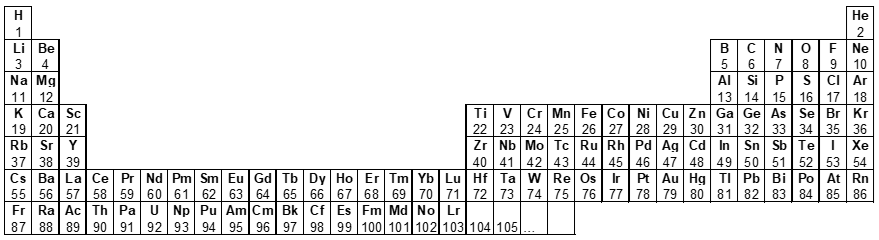
The lanthanides and actinides are highly oxophilic; much more so than the transition metals that manifest this property. Thus lanthanides and actinides will form strong coordination complexes with oxygen-containing compounds/ions that don’t have analogues in transition metal chemistry. For example, nitrate ion (NO3-) is very weakly coordinating towards transition metal ions, but forms complexes with lanthanides and actinides. An example is [Ce(NO3)6]2-, a Ce(IV) ion. This is exploited to good effect in the processing of uranium ores. Oxidation of solid U3O8 (pitchblende) in sulfate or carbonate media produces anionic complexes [UO2(SO4)2]2- and [UO2(CO3)2]2-, respectively. These are readily separated from leach solutions using anion exchange technology; many of the other metal compounds that are leached are present as cations and simply pass through this process. (Note that these complexes involve the UO22+, a U(VI) species.)
*quiz*
Media Attributions
- Ch0-1_F2_Periodic_Table © Bé Wassink and Amir M. Dehkoda is licensed under a CC BY-NC (Attribution NonCommercial) license
- Ch0-1_F3_MnO4 © Bé Wassink and Amir M. Dehkoda is licensed under a CC BY-NC (Attribution NonCommercial) license
- Ch0-1_F4_Nitric_Acid © Bé Wassink and Amir M. Dehkoda is licensed under a CC BY-NC (Attribution NonCommercial) license
- Ch0-1_F5_Telluric_Acid © Bé Wassink and Amir M. Dehkoda is licensed under a CC BY-NC (Attribution NonCommercial) license
- Ch0-1_F6_Sulfuric_Acid © Bé Wassink and Amir M. Dehkoda is licensed under a CC BY-NC (Attribution NonCommercial) license
- Ch0-1_F7_Metals_Semi_Non © Bé Wassink and Amir M. Dehkoda is licensed under a CC BY-NC (Attribution NonCommercial) license
- Ch0-1_F8_Element_Densities © Bé Wassink and Amir M. Dehkoda is licensed under a CC BY-NC (Attribution NonCommercial) license
- Ch0-1_F9_Sulphophilic_Elements © Bé Wassink and Amir M. Dehkoda is licensed under a CC BY-NC (Attribution NonCommercial) license
- Ch0-1_F10_F_Elements_Inserted_Table © Bé Wassink and Amir M. Dehkoda is licensed under a CC BY-NC (Attribution NonCommercial) license
Any ion or neutral molecule that involves one or more metal ions and one or more coordinated ions or molecules, e.g. [Zn(H2O)6]2+, [AuCl4]3−, [Cu(CN)3]2−, Ni(CO)4, etc. (See Chemistry Review Part II).
The ions or molecules that are coordinated to metal ions in complexes.
Electrolysis of a metal salt solution to produce metal.
Various processes are used to form a solid from solution. This may be a compound, such as Al(OH)3 after bauxite leaching and solution purification, or the metal itself, e.g. Cu metal produced from electrolysis of a CuSO4 solution.
The rare and highly valuable metals. Historically, Au, Ag, and PGM's. These also tend to be the metals that are less prone to corrosion. These in turn are known as the noble metals.
Metal elements that are not easily corroded; their simple cations have relatively high standard reduction potentials.