Chemistry Review – Part 1
5. Electronegativity and Oxidation States
5.1 Electronegativity
There are different ways of measuring the electronegativity. The first method was developed by Linus Pauling, and hence is called the Pauling scale. It is based on the observation that heterodiatomic molecules have greater bond strengths than the average of their constituent homodiatomic molecules. To illustrate, the bond energies for H2, Cl2 and HCl are listed below:
| Table 5.1 - Pauling Scale | |
|---|---|
| Molecule | Bond Energy |
| H2 | 435 kJ/mol |
| Cl2 | 243 kJ/mol |
| HCl | 431 kJ/mol |
The average for H2 and Cl2 is (435 + 243) / 2 = 339 kJ/mol. The bond strength for HCl is considerably greater than this average. This is simply attributed to the fact that Cl draws electrons to itself more strongly than does H. This results in a degree of charge separation or polarization:
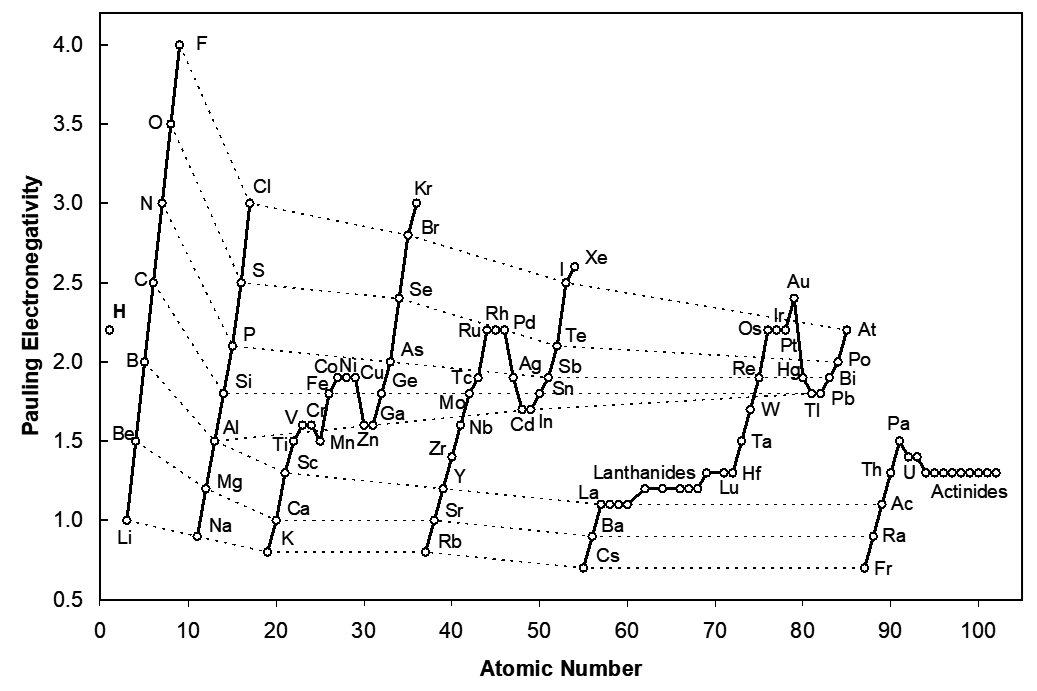
A number of significant observations can be made:
- No element has a zero electronegativity. The elements that tend to hold their electrons most weakly still have some tendency to do so in their compounds.
- The electronegativities generally increase from left to right along the rows of the periodic table. The trend is clear and simple for the second and third rows. For rows four and five the trend is not quite as simple, though in general it is still true.
- The alkali metals have the lowest electronegativities, consistent with their tendency to lose an electron and form M(I) cations and compounds. Elements with low electronegativities are said to be electropositive. The alkaline earths have the second lowest electronegativities as a group; they tend to lose two electrons and form M(II) cations and compounds.
- The halogens, as a group, have the highest electronegativities, consistent with their strong tendency to accept an electron and form X(I) anions and compounds.
- The second row elements have sharply higher electronegativities than their third row counterparts.
These observations allow us to rationalize some observations about the chemistry of the elements. (The correlations are by no means quantitatively perfect.) The halogens are strong oxidizing agents, consistent with their high electronegativities and fluorine, with the highest electronegativity is the strongest oxidant of all the elements. Oxygen is the second most electronegative element, and it too is a strong oxidizing agent, as is chlorine, the third most electronegative element. Nitrogen, which has very similar electronegativity to chlorine is, however, a weak oxidant. Nitrogen is three electrons removed from the noble gas neon; concentrating a 3- charge on a small atom like nitrogen is a lot more difficult than a single adding a single electron to a halogen.
The alkali metals especially and to a lesser extent the alkaline earths are strong reducing agents, consistent with their low electronegativities. Aluminum, manganese and zinc with electronegativities similar to beryllium (Be) are also fairly strong reducing agents. The lanthanides and actinides are mostly very strong reducing agents, on par with some of the alkali metals, and while they have low electronegativities (most similar to magnesium), the values are not as low as for the alkali metals. (Reducing power, for instance, does not correlate quantitatively with electronegativity.) Many on the transition metals have relatively low electronegativities. This roughly correlates with the fact that most metals are fairly easy to oxidize. This, of course, is a major factor in why corrosion of metal materials is such a serious issue.
Gold has the highest electronegativity of any metal, similar to selenium and sulfur (chalcogens) and iodine (a halogen). This is consistent with its strong resistance to corrosion. Of the Au(I) and Au(III) compounds that do form, many are strong oxidizing agents. The uncomplexed Au+ and Au+3 cations do not survive in water; they oxidize it to oxygen. (Iodine is a good oxidant, but much weaker than this.) Likewise the second and third rows of the group VIII metals (Ru, Os, Rh, Ir, Pd and Pt) also have high electronegativities. These metals also are more difficult to oxidize than most other metals.
5.2 The Oxidation State Formalism.
Whereas the valence state is only a measure of the number of electron-pair bonds an element forms in a compound, the oxidation state has to do with assigning where the electrons are, in the formal (not real) limit of complete charge separation. This is based on the electronegativity. The rules for assigning oxidation states are outlined below with reference to electronegativities. The basic idea is that the valence electrons involved in bonding are assumed to reside on the atom with the greatest electronegativity.
Note: It must be clearly understood that this is a formalism, i.e. charge separation may not be complete by any means. Thus some compounds are genuinely ionic and the oxidation state may reflect the actual charge of an ion. But the formalism is equally applied to covalent compounds, where charge separation is only partial. The formalism simply treats the charge separation as complete.
2. Rules for Assigning Oxidation States. The rules for assigning oxidation states are based on the electronegativities of the elements.
Step (a):
The oxidation state of an element in a monatomic ion is equal to its charge, e.g.:
| Table 5.2 - Oxidation State | |
|---|---|
| Element | Oxidation State |
| Cl-, F-, H- | -1 |
| O2-, S2- | -2 |
| H+, Na+, Ti+ | +1 |
| Fe+3, Cr+3 | +3 |
Note: This applies only to monatomic ions.
Step (b):
The oxidation state of any pure element is zero, e.g.:
S8, O2, P4, H2, Fe, Cu etc.
The difference in electronegativities for the element-element bonds is zero, so there is no charge separation.
Step (c):
The oxidation state of oxygen in its compounds or compound ions is usually -2, e.g.:
CO2, TiO2, Na2O, NaOH, SO2, Cr2O3, CO32-, HSO4-, ClO4- etc.
Oxygen is normally divalent, forming two electron-pair bonds. Since oxygen is the second most electronegative element, the electrons of the two single bonds are assigned to reside entirely on the oxygen atoms. Oxidation of metal sulfides and of ferrous ion by oxygen is crucially important in hydrometallurgy.
Exceptions include when oxygen is bound to itself, as in O2 (O.S. = 0) or in peroxo compounds e.g. H2O2 and O22- (O.S. = -1) and when oxygen is bound to fluorine, as in F2O (O.S. = +2). Hydrogen is monovalent and is less electronegative than oxygen. Hence in the single H-O bond the hydrogen is assigned the +1 oxidation state. If both H atoms in H2O2 are formally H+ then the two oxygens must have oxidation state -1, in order to satisfy the constraint that the compound is uncharged. Fluorine is more electronegative than oxygen and monovalent in its compounds, hence it is assigned a -1 oxidation state in all its compounds.
Step (d):
Hydrogen in most of its compounds or ions usually has the oxidation state +1, e.g.:
NaOH, H2O, HSO4- (i.e. H-O-S(=O)2O-), H2Se, HO-, etc.
Hydrogen has an electronegativity of 2.2, which is less than that of most of the elements with which it forms most of its compounds. And, since hydrogen is monovalent in its compounds, it is most commonly assigned the +1 oxidation state.
Exceptions arise when hydrogen is bound to a less electronegative element, e.g.:
NaH (formally Na+H-), MgH2, AlH3, LiAlH4 (formally Li+AlH4-) and SiH4.
In these cases H has an oxidation state of -1. Again, hydrogen is monovalent, and with higher electronegativity takes on the negative oxidation state.
Note: This illustrates a key difference between valence and oxidation state. Valence refers to the number of electron-pair bonds and element makes, while the oxidation state also takes into account electronegativity. Hence hydrogen in NaH and in HCl is monovalent, but the oxidation states are -1 and +1 respectively.
Step (e)
Halogens have an oxidation state of -1 in most compounds. For all but fluorine, an exception is when they are bound to oxygen. Then they have positive oxidation states. Oxygen is more electronegative than Cl, Br and I. Thus iodine in I2O5 has an oxidation state of +5 (O.S. for O = -2, as per above). For interhalogen compounds (XY, where X and Y are different halogens, e.g. BrCl), the element with the lower electronegativity has the positive oxidation state. In BrCl, O.S. for Br = +1; O.S. for Cl = -1. Interhalogen compounds, and particularly BrCl2- (Cl2 + Br-) have been seriously studied as oxidants for some copper sulfides in hydrometallurgy.
Step (f):
The guiding rule for calculating oxidation states is that the sum of the products of each atom’s oxidation state ´ the number of atoms must equal the charge on the ion, or 0 for molecules, i.e.:
\[\sum (\text{O.S.})_i\, n_i = \text{charge of ion or } 0 \text{ for neutral molecules}\tag{146}\]
for n atoms i with oxidation state O.S. Examples follow below.
Step (g):
| Table 5.3 - Nitrogen Compound Oxidation | ||
|---|---|---|
| Compound | Oxidation State | |
| NH3 | -3 | |
| N2H4 | -2 | |
| NO2 | +3 | (O.S. + 2 x (-2) = -1) |
| NO2 | +4 | |
| NCl3 | +3 | |
| HNO3 | +5 | (O.S. + 1 + 3 x (-2) = 0) |
| NO3- | +5 | (O.S. + 3 x (-2) = -1) |
Step (h):
| Table 5.4 - Further Examples | ||
|---|---|---|
| Element | Oxidation State | Description |
| Mn in MnO4- | +7 | (O.S. + 4 x (-2) = -1, or O.S. = -1 - 4 x (-2) |
| C in HCO3- | +4 | (-1 - +1 - 3 x -2) |
| S in H2SO4 | +6 | (0 - 2 x +1 - 4 x -2) |
| S in S4O62- | +2.5 | (-2 = 6 x -2 + 4 x O.S.) |
| S in H2S2O7 | +6 | (0 = 2 x +1 + 7 x -2 + 2 x O.S.) |
| Cu in Cu1.8S | +2/1.8 | (0 = 1.8 x O.S. Cu + -2) (Copper is less electronegative than sulfur and sulfur in most sulfides is taken to be divalent, hence -2 O.S.) |
| S in S52- | -2/5 | (-2 = 5 x O.S.) |
| S in S22- | -1 | (-2 = 2 x O.S.) |
| Fe and S in FeS2 | Fe: +2; S: -1 | (You would need to know that the sulfurs are present as S2 units in pyrite; sulfur is more electronegative than iron; normally S has an oxidation state of -2, but since it is bound to itself it is like O in H2O2, the sulfur O.S. is -1. The O.S. for Fe then is +2.) |
| C in C6H12O6 | 0 | (0 = 6 x O.S. + 12 x +1 + 6 x -2) |
Oxidation states for metal atoms in complexes can be complicated to calculate. The rules above can be used, but it may be simpler to recognize the neutral molecules or polyatomic anions attached to the metal. For example, in [Fe(H2O)6]Cl3, the water ligands are uncharged molecules. They need not be included in the calculation of the iron oxidation state. The oxidation state for ions is equivalent to that in FeCl3 then, i.e. +3. Similarly, for Fe in [Fe(CN)6]3-, the iron is coordinated by CN- ligands. Each is a singly charged anion. The oxidation state of iron can be found from,
This becomes particularly important when considering complicated complexes. For instance EDTA, i.e. [(O2CCH2)2NCH2CH2N(CH2CO2)2]4- is a large 4- charged anion. In the Cu-EDTA complex, [Cu(C10H12N2O8)]2-, the Cu oxidation state is found from,
What is the oxidation state for Fe in K4[Fe(CN)6]·3H2O? Alkali metals are monovalent and have low electronegativity, hence O.S. for K is +1. The “·3H2O” means that the three water molecules are present in the crystal, but not coordinated to Fe. The have no charge and can be omitted from the calculation. Cyanide is taken to be CN-. Hence,
There are a significant number of polyatomic anions (as listed in section 3.8). The same principles can be applied for these. For example, what is the oxidation state of Co in Co(NH3)5(SCN)Cl2? The NH3 ligands are neutral molecules and can be ignored. Both SCN and Cl are present as monoanions. The oxidation state is then,
\[ \text{O.S.}(Co) + (-1) + 2 \times (-1) = 0;\quad \text{O.S.}(Co) = +3\tag{150}\]
What is the oxidation state of Hg in [HgI(S2O3)2]-3? Thiosulfate is S2O32-; iodide is I-. The Hg O.S. is,
\[ \text{O.S.}(Hg) + (-1) + 2 \times (-2) = -3;\quad \text{O.S.}(Hg) = +2\tag{151}\]
Media Attributions
- Ch0-1_F11_Electronegativites_on_Pauling_Scale © Bé Wassink and Amir M. Dehkoda is licensed under a CC BY-NC (Attribution NonCommercial) license