Chemistry Review – Part 1
6. Coordination Compounds
A coordination compound, or complex, is typically comprised of a metal ion and one or more (usually more) ligands. Ligands are the ions or molecules that are chemically bonded to the central metal. Examples include molecules like H2O, NH3, CO (all of which have application in hydrometallurgy), etc., anions, such as CN-, F-, Cl-, Br-, I-, S2O32-, S2-, HS-, EDTA4-, etc. or even species which are not especially stable unless coordinated to a metal ion, like NS. The latter are no very important in hydrometallurgy.
There are a number of ways in which metal complexes are employed in hydrometallurgy. Sometimes minerals are leached to form particular complexes, such as [Ni(NH3)6]+2, [Co(NH3)6]+3, [Cu(NH3)4]+2. This may be because the complex can be selectively formed, or it may allow for a preferred downstream recovery process. Sometimes the complexes are simply adventitiously formed, as is often the case for aquo complexes, e.g. [Cu(H2O)6]SO4 aq. Sometimes a complex is used to facilitate solution purification. The example of uranyl sulfate and uranyl carbonate anionic complexes was cited earlier in the section on lanthanide and actinide chemistry. Another example is Cu+2 complexes of hydroxyoximes (this will be discussed in the material on solvent extraction), which form very selectively with Cu+2 over other metal ions, and are soluble in hydrocarbon solvents. This is extensively used in the copper industry as a way to purify copper leach solutions. Regardless, most metal ions in aqueous solutions will be present as complexes of one sort or another and this either aids or challenges the viability of processes.
6.1 Types of Complexes and Coordination Geometries.
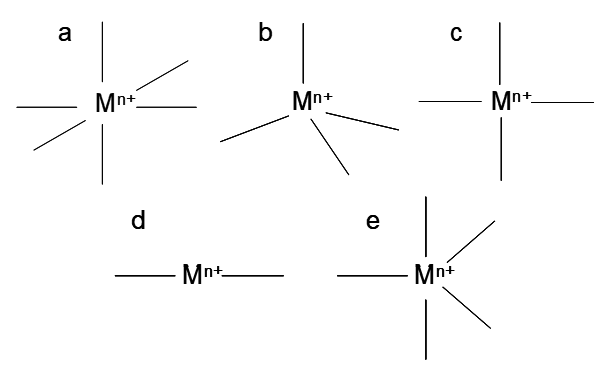
There are several common ways in which ligands may be arranged around a metal ion or atom. Some of these are illustrated in the figure below. Of these, octahedral, tetrahedral and square planar are about the most common. Examples include [Co(NH3)6]+2 (octahedral), Ni(CO)4 (a gas) and[ZnCl4]2- (tetrahedral), PtCl2(NH3)2 (square planar), [Au(CN)2]- (linear), and Fe(CO)5 (trigonal bipyramidal). Numerous other geometries exist, some of which are derivatives of those in the figure below. For example, take away one ligand from an octahedral complex and it becomes a square-based pyramid. Take one ligand from the tetrahedral geometry and it leaves a trigonal structure. Distorted variations of the above geometries abound.
A list of some of the more common complexes in hydrometallurgy is provided in Table 6.1. The most common type of complex is the aquo complex; water coordinated to metal ions. These are important in many leaching processes for dissolution of minerals from ores, right through to many of the final metal recovery steps, such as electrowinning (electrolysis for production of pure metals). All metal ions that are stable in water, as well as oxo cations (e.g. VO2+) are coordinated by water. This can have important implications for hydrometallurgy. For instance, aquo complexes as well as other complexes are involved in dynamic equilibria where the ligands come on and off the metal ion. Studies have shown that the rates at which this occurs for aquo complexes vary enormously, with half life times ranging from <10-9 sec (Cs+) to many hours (e.g. Co(III) and Cr(III)). Half life refers to the time required for half of something to react or change. Nickel(II) can be somewhat slow to undergo ligand substitution and this can make it difficult to remove it from complexes used in its separation from other metal ions. And this is especially true for Cr(III) and Co(III).
6.2 Metal-Ligand Bonding.
This is a complex subject and will only be touched on briefly here. The simplest type of bond is a single electron-pair bond between the metal and the ligand. Generally these involve two electrons being “donated” from the ligand to the metal. Examples include Mn+—Cl-, Mn+—OH2, Mn+—NH3 and M—CO. In each case a pair of electrons on the ligand is shared with the metal ion or atom. There are other aspects of metal-ligand bonding. One of these has to do with the ability of the ligand itself to act as an electron acceptor from the metal. Generally such ligands are small molecules and anions such as C≡O, C≡N- with multiple bonds. Such compounds tend to be weak to very weak bases toward H+, but may interact very strongly with many transitions metals.
Anions of some very strong acids (e.g. ClO4-, NO3-, PF6-, BF4- and to a lesser extent SO42-) form weak or very weak complexes. Perchlorate is among the most weakly coordinating anions. It forms complexes with only the most oxophilic metals, such as actinides. This stands to reason; HClO4 is one of the very strongest acids, hence ClO4- is very, very weakly basic. (Despite the strong acidity of the hydrohalic acids, the halide ions do form numerous complexes.) Modestly stable sulfate complexes occur for some trivalent transition metal cations, e.g. Fe+3. More stable complexes occur with lanthanides and actinides.
| Table 6.1 - A selection of some common complexes relevant to hydrometallurgy. | |||||||||||||
|---|---|---|---|---|---|---|---|---|---|---|---|---|---|
| L= | NH3 | CO | CN- | Cl- | F- | OH- | O2- | S2- | HS- | SO42- | CO32- | S2O32- | SCN- |
| Ag+ | [AgL2]+ | [AgL2]- | [AgL]2- | [AgL2]3- | |||||||||
| Al+3 | [AlL6]3- | [AgL4]- | |||||||||||
| Au (I) | [AuL2]+ | [AuL2]- | [Au2L2]2- | [AuL2]- | [AuL2]3- | ||||||||
| Au (III) | [AuL4]- | ||||||||||||
| Be+2 | [BeL3]- | [BeL3]- | |||||||||||
| Co+2 | [CoL6]+2 | [CoL6]4- | [CoL4]2- | [CoL4]2- | |||||||||
| Co+3 | [CoL6]+3 | [CoL6]3- | |||||||||||
| Cu+ | [CuL2]+ | [CuL4]3- | [CuL3]2- | [CuL3]5- | |||||||||
| Cu+2 | [CuL4]+2 | [CuL3]- | [CuL3]- | ||||||||||
| Fe+2 | [FeL6]4- | ||||||||||||
| Fe+3 | [FeL6]3- | [FeL4]- | [FeL6]3- | [FeL2]- | |||||||||
| Hg+2 | [HgL2]+2 | [HgL4]2- | [HgL4]2- | [HgL2]2- | [HgL3]4- | [HgL4]2- | |||||||
| Mn+2 | [MnL6]4- | MnL4- | |||||||||||
| Mo (IV) | [MoL8]4- | ||||||||||||
| Mo (VI) | MoL42- | ||||||||||||
| Nb (V) | [NbL7]2- | ||||||||||||
| Ni (0) | [NiL4] | ||||||||||||
| Ni+2 | [NiL6]+2 | [NiL4]2- | [NiL4]2- | [NiL6]+2 | |||||||||
| Pb+2 | [PbL4]2- | [PbL3]- | |||||||||||
| Pt (IV) | [PtL6]2- | ||||||||||||
| Sb (III) | [SbL4]- | ||||||||||||
| Sb (V) | [SbL6]- | ||||||||||||
| Si (IV) | [SiL6]2- | ||||||||||||
| Sn (IV) | [SnL6]2- | [SnL6]2- | [SnL3]2- | ||||||||||
| Ta (V) | [TaL7]2- | ||||||||||||
| UO2+2 | [UO2L3]4- | [UO2L3]4- | |||||||||||
| W (VI) | WL42- | ||||||||||||
| Zn+2 | [ZnL4]+2 | [ZnL4]2- | [ZnL4]2- | [ZnL3]- | [ZnL4]2- | ||||||||
6.3 Chemical Formulas for Complexes.
Metal complexes may be represented in various ways. Unfortunately there is no standard. Complexes in solution can be depicted simply by square brackets around the complex with the charge indicated as a superscript outside. The metal is shown first. Examples include:
\[
\ce{[Fe(H2O)6]^3+}
\tag{152}\]
\[
\ce{[Co(NH3)(H2O)5]^3+}
\tag{153}\]
\[
\ce{[Cu(CN)3]^2-}
\tag{154}\]
etc.
Whether the charge is written as, for example, +3 or 3+ is not important. Conventionally, oxoanions are written without square brackets, e.g. MnO4-, rather than [MnO4]-. For complex ion salts (solids) there may be countercations (for a negatively charged complex), counteranions (for a positively charged complex) and water of crystallization. Water may be present in a complex salt in two ways: as a ligand and/or as water of crystallization. The latter involves water present in the crystal lattice, but not coordinated to a metal ion. However, hydrogen bonding can be involved, and some anions have a moderate affinity for water due to this (e.g. sulfate). For counterions, cations come before the square brackets and anions after, e.g.
roper subscripts/superscripts:
\[
\ce{K3[Fe(CN)6]}
\tag{155}\]
and
\[
\ce{[Cu(NH3)6]Cl3}
\tag{156}\]
Water of crystallization should appear at the very end and separated by a dot (·), e.g.
\[
\ce{K4[Fe(CN)6]\cdot 3H2O}
\tag{157}\]
and
\[
\ce{[Co(H2O)6]SO4\cdot H2O}
\tag{158}\]
However, it is common for chemical formulas to be less informative, e.g.
\[
\ce{CuCl2\cdot 2H2O}
\tag{159}\]
and
\[
\ce{CoSO4\cdot 7H2O}
\tag{160}\]
These formulas do not indicate whether water or chloride are coordinated (from the preceding information we would not expect sulfate to be coordinated to a +2 metal ion.) Sometimes the water of crystallization is quite variable, especially where there are many of them. Then formulas such as the following may be written:
\[
\ce{[Fe2(SO4)3]\cdot nH2O}
\tag{161}\]
and
\[
\ce{[Al2(SO4)3]\cdot nH2O}
\tag{162}\]
For the iron example, the upper limit is 5, and for the aluminum case, n = 18 at most.
6.4 How to name coordination compounds (Nomenclature).
This can get complicated. Trivial and common names abound. Some complexes that have been known for a long time have traditional names. Some general rules for naming complexes systematically follow:
1. A common but archaic naming system, still much in use, involves modifying the end of an element’s name to indicate its valence state. The lowest ordinary positive valence state is designated by the suffix -ous. The highest normal valence state is designated by the suffix -ic. Hence:
- Cu(I) = cuprous, and Cu(II) = cupric (Cu(III) is known, though not common)
- Ni (II) = nickelous (Ni+2 is the only common valence state. But, other valence states are known, though less common e.g. Ni(0) in Ni(CO4) and Ni(III) in Ni(OH)3)
- Mn(II) = manganous (although the IV and VII valence states are well known, the term manganic is not commonly used.)
- Fe(II) = ferrous, and Fe(III) = ferric
- Ce(III) = cerous, and Ce(IV) = ceric
- Sn(II) = stannous, and Sn(IV) = stannic
- Hg(I) as Hg2+2 = mercurous, and Hg(II) = mercuric
It does not matter if the valence states differ one or more, and the system is not restricted to monatomic ions. The obvious problem with this simplistic naming scheme is that it does not adequately account for more than two valence states. Only the most common valence states are named by this means. While obviously lacking merit, this system is venerable and still in use, and the hydrometallurgist needs to be familiar with it. It is also common to name metal ions or valence states by the element name and a Roman numeral, e.g.
- Fe+2 = iron(II)
- Fe+3 = iron (III)
- Hg2+2 = mercury(I)
2. Names of complex anions (and oxoanions) end with the suffix -ate, e.g.
- MnO4- = permanganate (i.e. Mn(VII); the prefix “per” is used to distinguish it from manganate)
- MnO42- = manganate
- VO43- = vanadate
- PO43- = phosphate
- SO42- = sulfate
- [PtCl4]2- = tetrachloroplatinate(IV)
- [ZnCl4]2- = tetrachlorozincate
- [Fe(CN)6]4- = hexacyanoferrate(II)
- [Fe(CN)6]3- = hexacyanoferrate(III)
Note that in cases where the same formula but different charge arises (as in the hexacyanoferrates) it is essential that the metal ion’s valence state be indicated by Roman numerals. Properly, this should always be provided. But where no such designation is given, it is assumed that the normal valence state pertains. For example, zinc complexes are almost exclusively Zn(II), so that can be assumed. Common trivial names for [Fe(CN)6]4- and [Fe(CN)6]3- are ferrocyanide and ferricyanide, respectively.
3. Most ligands may be indicated by the prefixes -o and -yl. Some examples were listed previously, e.g. chloro complexes, referring to chloride complexes and cyano referring to cyanide complexes. Hence also the following examples:
- [Zn(SCN)4]2- = tetrathiocyanatozincate
- [Zn(CN)4]2- = tetracyanozincate
- [Hg(S2O3)2]2- = dithiosulfatomercury(II)
- [Fe(CO)5] = pentacarbonyliron(0)
- [Ni(CO)4] = tetracarbonylnickel(0)
An important exception is ammonia complexes. These are called ammines, in part to distinguish them from organic amine compounds. Examples include:
- [Co(NH3)6]+2 = hexaamminecobalt(II)
- [Co(NH3)6]+3 = hexaamminecobalt(III)
- [Co(NH3)5SCN]+2 = pentaamminethiocyanatocobalt(III)
Often simple complexes are named with the metal first, and using simpler terms, e.g.
- [Ni(CO)4] = Properly named tetracarbonylnickel(0), may be simply called nickel tetracarbonyl.
- [Co(NH3)6]+3 = Properly called hexaamminecobalt(III), may be simply called cobalt(III) hexaammine.
- [ZnCl4]2- = Properly called tetrachlorozincate(II), may be simply called zinc(II) tetrachloride.
4. Uncharged, or neutral complexes usually use the unmodified element name, rather than a suffix. An example is,
[Pt(NH3)2Cl4] = diamminetetrachloroplatinum(IV)
5. Normal numerical prefixes are used, such as di, tri, tetra, penta, hexa etc. But when formulas become complex it is sometimes necessary to use another system. For example, the complex [Co(H2NCH2CH2NH2)3]3+ involves a ligand called ethylenediamine. Naming it triethylenediamine cobalt(III) is confusing. In such cases a new level of numerical prefixes is used:
- bis = two
- tris = three
- tetrakis = four
- pentakis = five
- hexakis = six
etc.
The name for the preceding complex then is tris(ethylenediamine)cobalt(III). The valence state of the metal ion is indicated with Roman numerals.
6. For salts the name of a positive counterion comes first and that of a counteranion last, e.g.
- K3[Fe(CN)6] = potassium hexacyanoferrate(III) (The number of potassium cations need not be specified; it is implicit from the rest of the formula.)
- K4[Fe(CN)6]·3H2O = potassium hexacyanoferrate(II) trihydrate
- [Co(NH3)6]Cl3 = hexaamminecobalt(III) chloride
Media Attributions
- Ch0-1_F12_Common_Metal_Compound_Geometries © Bé Wassink and Amir M. Dehkoda is licensed under a CC BY-NC (Attribution NonCommercial) license