Chemistry Review – Part 1
8. Representations of Organic Compound Structures and Formulas
For organic chemical formulas it is customary to list the carbon, then hydrogen content, then other atoms in alphabetical order. Sometimes formulas are written so that they also give some sense of the structure, e.g. C12H25NaO4S indicates only atomic composition, whereas C12H25OSO3Na indicates both composition and something about the structure; that there are four oxygens attached to the sulfur. (This is an organic derivative of sulfate.)
A shorthand for organic chemical structures is common. This is outlined below.

The single C-C bonds are reduced to straight lines. Hydrogen atoms are usually omitted. Since the valence of carbon is almost always 4, the hydrogen atoms are understood to be present to satisfy this requirement. Benzene has the structure:
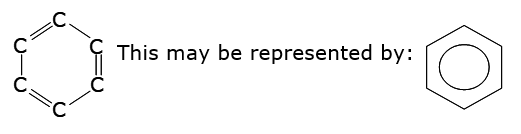
The arrangement of carbon atoms is represented by a hexagon. The alternating single and double bonds is represented by a circle. Hydrogens are omitted. This simplifies depiction of structures. Hence,
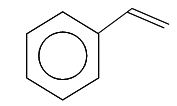
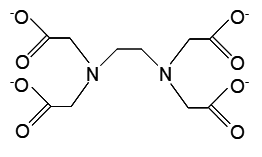
is the representation for styrene, C6H5-CH=CH2. Discrete double bonds are represented by double lines. The complexing agent EDTA, mentioned previously, can be represented as,
An important class of organic compounds in copper solution purification is the hydroxyoximes. A representative compound in this class is 5-alkyl-2-hydroxyacetophenone oxime,
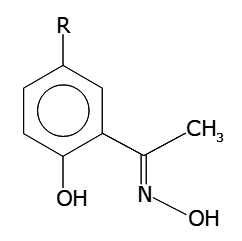
The alkyl group is indicated as R. It may be nonyl (C9H19–) or dodecyl (C12H25–). This and related compounds form stable complexes quite selectively with Cu+2, which enables it to be extracted from aqueous solution and thus purified of impurities.
Media Attributions
- Ch0-1_F13_Shorthand © Bé Wassink and Amir M. Dehkoda is licensed under a CC BY-NC (Attribution NonCommercial) license
- Ch0-1_F14_Benzene © Bé Wassink and Amir M. Dehkoda is licensed under a CC BY-NC (Attribution NonCommercial) license
- Ch0-1_F15_Double_Bond © Bé Wassink and Amir M. Dehkoda is licensed under a CC BY-NC (Attribution NonCommercial) license
- Ch0-1_F16_Complexing_EDTA © Bé Wassink and Amir M. Dehkoda is licensed under a CC BY-NC (Attribution NonCommercial) license
- Ch0-1_F17_Hydoxyoxime © Bé Wassink and Amir M. Dehkoda is licensed under a CC BY-NC (Attribution NonCommercial) license
Any ion or neutral molecule that involves one or more metal ions and one or more coordinated ions or molecules, e.g. [Zn(H2O)6]2+, [AuCl4]3−, [Cu(CN)3]2−, Ni(CO)4, etc. (See Chemistry Review Part II).