TEST
H5P Test
Question 1a
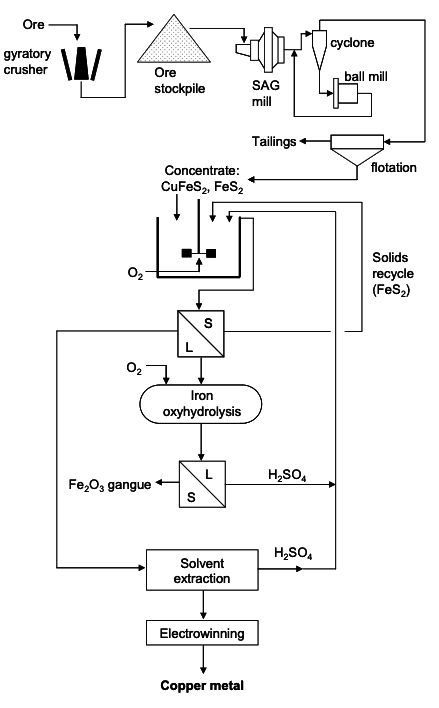
A simplified flowsheet for the Galvanox process is shown below. This process is being developed at UBC. Chaclcopyrite is the most abundant mineral of copper in nature. However, it resists leaching by conventional hydrometallurgical methods; the mineral rapidly passivates (after a short while it leaches very slowly) when leached in sulfate solution. In this process a copper concentrate is produced which contains pyrite and copper minerals, particularly chalcopyrite. If pyrite (FeS2) is present in the concentrate then chalcopyrite is readily leached. Pyrite, being an iron mineral, often occurs in sulfide mineral deposits. During leaching chalcopyrite is oxidized to form a solution of Cu+2, Fe+2 and solid elemental sulfur. Pyrite itself undergoes little reaction. (Mainly it seems to act as a catalyst for oxygen reduction.) After leaching the slurry is subjected to solid-liquid separation. The solids may be recycled to leaching to reutilize the pyrite. Much of the solution proceeds to solvent extraction, which is used to obtain a much purer copper solution. The details are not important here. Some of the solution also proceeds to an oxyhydrolysis step (this is done in an autoclave) in which ferrous ion is oxidized to form hematite (Fe2O3) and sulfuric acid. This acts as an outlet for iron and prevents its build-up in solution. Hematite is a very suitable iron product for disposal. The solvent extraction process also generates acid, which together with that formed by hematite formation can be reused in the leaching step. The concentrated copper sulfate solution from solvent extraction proceeds to an electrowinning step. Here very pure copper metal is produced by electrolysis.
Questions 1b
Referring to the generalized hydrometallurgical flowsheet, identify the parts of the flowsheet that correspond to mineral separation, leaching, solution purification and metal production. Use the flowsheet on the page below, circle and label the appropriate parts of the flowsheet. Hand this in with your completed assignment.
Question 1c – Generalized Extractive Metallurgy Flowsheet Route
Question 3a
A copper ore grading 0.70% copper (average) is crushed for heap leaching. A sample of the crushed ore (989.2 g) was passed through a stack of sieves to determine its size distribution. The data are shown in the table below. The mass retained on each screen is reported. A pan at the bottom of the sieve stack collects any fine material passing through the finest sieve.
| Tyler mesh number | Opening µm | Mass retained g |
| 1″ | 25400 | 10.9 |
| 0.75″ | 19050 | 61.3 |
| 0.5″ | 12700 | 280.9 |
| 0.375″ | 9525 | 114.7 |
| 0.25″ | 6350 | 128.6 |
| 6 | 3360 | 80.1 |
| 20 | 841 | 140.5 |
| 48 | 297 | 101.9 |
| 200 | 74 | 64.3 |
| 325 | 44 | 4.0 |
| -325 | 2.0 |
Question 4
A simplified flowsheet for a flotation process on a copper-nickel ore is shown below (p. 7). This process would produce two valuable concentrates, one containing primarily chalcopyrite and the other containing primarily pentlandite, i.e. (Ni,Fe)9S8 (the sum of Fe + Ni is 9 moles per 8 moles sulfur). The ore also contains pyrrhotite, i.e. Fe1-xS (x » 0.05) and other gangue minerals. The ore is crushed to -8 inch at the mine site, then transported to the size reduction/flotation plant. The ore after primary crushing is first screened; -1/2 inch undersize is directed to product. Oversize goes through secondary and tertiary crushing, with -1/2 inch size being the final crushed product. The crushed ore is directed to a two-stage grinding circuit. The ground ore is then sent to flotation for copper and nickel concentrates. There are many possible variations on this theme and actual flowsheets are more complex. Amyl xanthate is commonly used, but for this question assume ethyl xanthate is the collector.
As required briefly explain your answers. (Critical pH curves are provided in the Introduction to Mineral Processing course notes.) Include the relevant points as they apply to this question. For instance, to say that ethyl xanthate is a collector will not suffice. You also need to briefly explain the function.
Issues to Consider
- Inputting answers won’t work with H5P as students won’t have the tools to create the equations
- Are students required to hand this in? If so, it would be better to create a handout they can download and print as H5P is meant for self assessment and the download/tracking function is not available
- Complex tables and filling in answers is difficult to replicate (see slide)
- Questions, if you want to use H5P, will need to be written with the tools limitations – fill in a complex equation could be multiple choice or accordion view; etc.
- Interaction with images is limited – for example, drawing a route on a diagram is not possible. (1c)
Media Attributions
- Screenshot 2026-01-30 at 10.13.32 AM