Chapter V: Solid Liquid Separation
1. Introduction
This is a critically important operation in both mineral processing and at various stages in hydrometallurgical extraction. It is often quite costly, requiring large equipment and facilities. Poor liquid-solid separation characteristics can undo what would otherwise be a successful process. This requires careful attention.
Water may need to be reclaimed for a couple of reasons. First to adjust process stream characteristics so that they are suitable for subsequent treatment (applies to both tailings and other process streams). Second to recover or recycle water, which reduces consumption (very important in dry areas) and to prevent contamination of fresh water sources. On the other hand solids may need to be removed from a solution in order to obtain a pure metal product, or to further process the solids themselves.
Slurries, suspensions and tailings may contain from 10% to almost 100% water by weight. Dewatering is accomplished by four basic methods:
- Screening (larger particles retained on screens as water passes through)
- Sedimentation (decantation or thickening – relies on the same principles as
sedimentation classification) - Filtration
- Thermal drying (may be costly since the heat capacity of water is high)
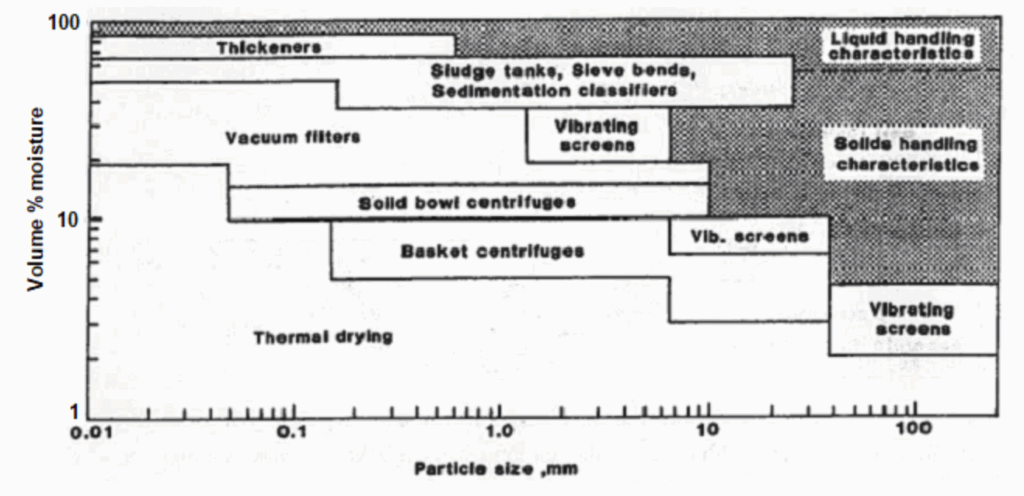
The effectiveness of water removal as a function of particle size (on a log scale) is shown in the figure below. The vertical axis lists volume % water retained in the dewatered product. There are numerous types of screens. Screening a slurry can very simply remove excess water from a desired size fraction. The smaller the particle size, the greater the total surface area per unit weight and the more water that is retained by the solids. A sieve bend is a type of screen that uses a curved surface. Slurry flows over the concave surface and in doing so experiences some centrifugal force due to the curvature. They are therefore somewhat more efficient than flat screens.
There are numerous types of classifiers. Classifiers have use in separating small particles from large particles or particles on the basis of density differences. They may also be used for dewatering. In this case the slurry may be fed into a long trough. Solids settle and are dragged up an incline by spirals, rakes etc. A disadvantage is that the aqueous phase may be significantly diluted. Very fine particles may also be deliberately removed from the pulp, with the aqueous phase (desliming). A thickener is a type of classifier. According to the figure a thickener can achieve about 75-80% water content by volume in the discharged underflow slurry. This seems rather large, but it should be remembered that minerals are much more dense than water. In many instances thickeners can achieve 50% water retention by weight. Relatively new paste thickeners use much deeper, narrower vessels and have solids (mud) zones that are several meters thick; much more than in conventional thickeners. This produces a much denser slurry (paste) that contains less water and exhibits non-Newtonian flow properties (rheology). An important type of classifier not indicated in the diagram is a hydroclone. These use centrifugal force to accentuate density differences. They are used for size separations, and for dewatering as well. Centrifuges are accelerated sedimentation devices that spin rapidly, also accentuating density differences. In a hydroclone, the machine stays fixed and the slurry is introduced tangentially into the cylindrical housing.
Filtration is commonly practiced in hydrometallurgy. Common types of filters are drum filters (explained later), belt filters and filter presses. Drum and belt filters employ reduced pressure on the underside of a porous membrane to draw off liquid. Filter presses use positive pressure on the side where the slurry contacts the filter cloth. Vacuum filters, for instance, are good at removing fine material and lower water content to as low as 10% by volume.
It is apparent from the figure that no matter what the particle size range, no mechanical dewatering system can removal all water. Further, as particle size decreases mechanical methods become less effective, due to the increased surface area per unit mass. Reduction in water content to low levels ultimately requires thermal drying. This is increasingly expensive as the cost of energy increases. Feeds to pyrometallurgical smelters may required thermal drying. In some instances this is also required for hydrometallurgical processes, but not commonly.
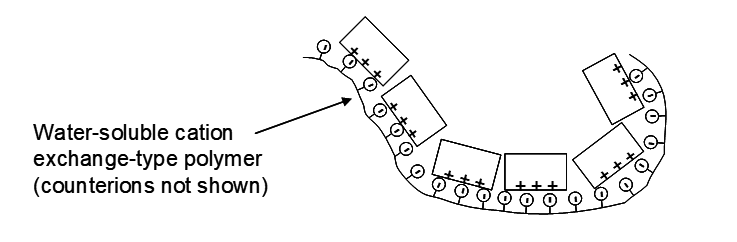
In sedimentation the settling rates of very small particles (a few microns in diameter) may be very slow under gravity alone. Flocculants may be added which act to agglomerate fine particles into more massive aggregates, which settle more rapidly. A wide variety of flocculants are available. Many are polymers with charged sites that attract oppositely surface-charged particles. This is illustrated in the figure below. This is an important technique in sedimentation. The objective now is not to separate one type of solid from another, but to separate all the solids from the water or solution. Thickeners are the most important type of sedimentation unit. They are similar in design and size to sedimentation classifiers. Diameters on the order of ~100 m exist. They are cylindrical and have conical bottoms. A variety of designs and types exist. They operate continuously. The overflow is the substantially clarified water/solution. The underflow slurry is higher in solids concentration than the feed slurry is, but is still quite high in water or solution content. A radially aligned rake turns, moving along the bottom to direct the solids to the discharge.
Media Attributions
- Ch5_F1_Dewatering_Methods © P. Hayes is licensed under a All Rights Reserved license
- Ch5_F2_Flocculant_into_Floc © Bé Wassink and Amir M. Dehkoda is licensed under a CC BY-NC (Attribution NonCommercial) license