Chapter VI: Solution Purification by Solvent Extraction (SX)
1. Process Overview
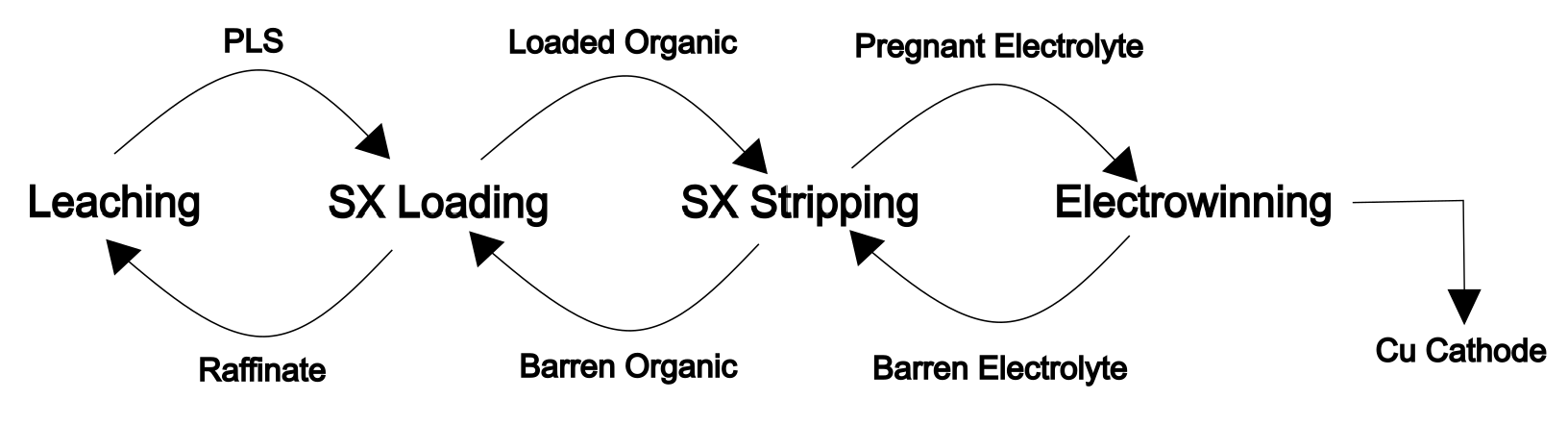
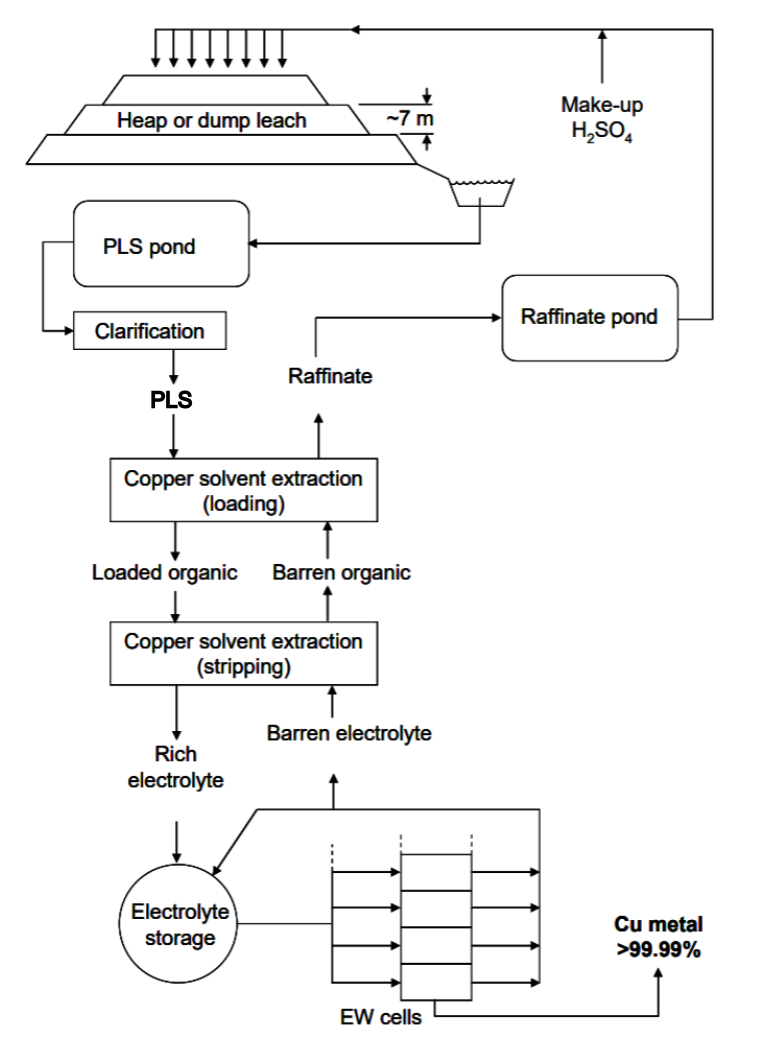
There are several solution purification methods. Very often in hydrometallurgy thorough solution purification is needed prior to metal recovery. Solvent extraction (termed SX) is a fairly common example. It is extensively practiced for purification of copper solutions prior to electrowinning (called EW). The Leach-SX-EW process can produce in excess of 99.99% pure copper metal without an intermediate refining process. This is a remarkable accomplishment given that ores may have <1% copper. About 2.5 million tonnes of copper was produced by electrowinning in 2002[1]. Two simplified, basic flowsheets for copper Leach-SX-EW are shown in Figure 1.1 and Figure 1.2. The following are the basic operations. Note that all conventional Leach-SX-EW plants are sulfate-based, i.e. they use sulfuric acid and form and use metal sulfate salts.
- A suitable ore is leached (usually a heap leach or a dump leach) and yields a copper-bearing leach solution (PLS). Ores may be sulfides like CuS, Cu2S, Cu5FeS4 and CuFeS2. The latter is chalcopyrite, the most common copper mineral, and also the most difficult to leach. Sulfides require both acid and an oxidant to be leached. Near-surface sulfides may also have become oxidized over time by contact with oxygenated water. Numerous minerals may then be produced. Some examples include genuine oxides like CuO and Cu2O. Other examples are CuSiO3·nH2O (n varies), Cu2(OH)2CO3, Cu2(OH)2SO4 and Cu2(OH)3Cl. Not all oxide minerals are true oxide; the term refers to oxidized sulfides in this context. Most “oxide” ores require only acid for leaching. However, minerals having copper in the formally Cu(I) state, i.e. cuprous, as in Cu2O, also need an oxidant.
- The PLS is stored in a PLS pond (for surge capacity).
- The PLS is then contacted with an organic extractant dissolved in a kerosene-type diluent. Metal ions (mainly copper in this case) transfer from the aqueous phase to the immiscible organic phase (loading). Since the extractant is quite selective for copper, most other metal ions are rejected. This effects purification.
- The copper-depleted aqueous phase (raffinate) is returned to leaching. In Figure 1.2 acid is shown to be added to the raffinate returned to leaching. In fact, acid may be added if the ore is acid-consuming, or acid may have to be removed (by neutralization) is the ore is acid-generating (e.g. contains significant amounts of pyrite, FeS2).
- The loaded organic solution is sent to the stripping operation. Here the organic is contacted with a strongly acidic solution from EW (the lean electrolyte). Copper in the organic transfers into this new aqueous solution.
- The copper-replenished aqueous solution then proceeds to electrowinning where pure copper metal is electrolytically plated.
- Copper-depleted electrolyte is returned to stripping to pick up more copper.
The advantages of solvent extraction for copper are:
An electrolyte of suitably high concentration and purity is produced from a dilute each solution.
Impurities in the leach solution are largely prevented from entering the electrolyte. This is due to the high selectivity for the extractant towards copper over other most other metal ions. This facilitates production of a high purity copper cathode product.
Note that SX is well integrated with both leaching and EW.
Media Attributions
- Ch6_F1_Cu_Leach_SX_EW_Operation © Bé Wassink and Amir M. Dehkoda adapted by Jeno Hwang is licensed under a CC BY-NC (Attribution NonCommercial) license
- Ch6_F2_Detailed_Leach_SX_EW_Flowsheet © Bé Wassink and Amir M. Dehkoda adapted by Jeno Hwang is licensed under a CC BY-NC (Attribution NonCommercial) license
- W.G. Davenport, M. King, M. Schlesinger and A.K. Biswas, Extractive Metallurgy of Copper, 4th edn., Pergamon, 2002. ↵