Chapter VII: Electrowinning
Metal recovery is the final step in most hydrometallurgical processes. This is commonly practiced for aluminum, copper, zinc, nickel, cobalt and gold. (Aluminum cannot be obtained by electrolysis from water; it is too strongly reducing. Molten salt electrolysis is used instead.) In all hydrometallurgical processes metals are present in solution as complexes of the metals in positive oxidation states, e.g. [Zn(H2O)6]+2. All metal recovery processes then necessarily involve reduction. Hence all these processes require a reducing agent. The process may be thermodynamically favourable (like hydrogen gas reduction of [Ni(NH3)n]+2 complexes (n = 2, for instance) or unfavourable (like electrowinning of copper in which water is forced to be the reducing agent). When the process is thermodynamically unfavourable (ΔE < 0, by definition) it is categorized as an electrolysis. Electrolysis for metal production is called electrowinning.
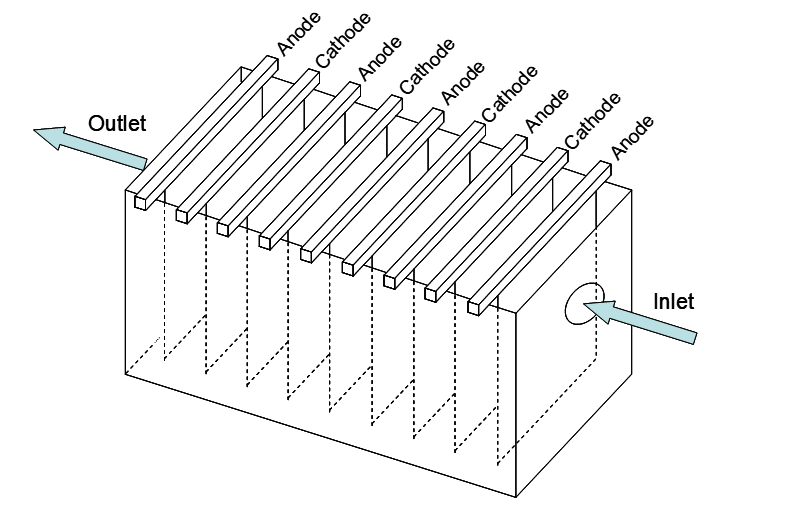
Briefly, a copper EW plant may have many cells (hundreds). Each cell is a little over 1 m wide, ~1.5-2 m deep and several meters long. They contain several dozen cathodes and the same number + 1 anodes. Metal is plated onto both sides of the cathode sheets, while water is oxidized to form O2 and H+ at the anodes. A schematic illustration of a cell is shown in the diagram below. Enriched electrolyte supplied from solvent extraction stripping is fed into the cells. It passes through a cell once and then is returned to SX stripping as the lean electrolyte. Once the copper has been plated to a thickness of about 0.5 cm, the cathodes are removed from the cell and the copper is prepared for sale.
Pyrometallurgically produced metals are often not sufficiently pure to be sold as high purity products. They are usually further refined and often using electrolysis. Molten, as-produced metal is cast into electrodes (~1 m x ~1 m) and these are interleaved with metal sheets in cells. The cast, impure metal electrodes are anodically polarized to electrochemically corrode them (a form of leaching), while the interleaved sheets are cathodically polarized to plate out the dissolved metal ions. A very pure metal product is formed. This is called electrorefining.
Media Attributions
- Ch7_F1_Cu_Electrowinning_Cell_Schematic © Bé Wassink and Amir M. Dehkoda is licensed under a CC BY-NC (Attribution NonCommercial) license