Time
There are 24 hours in a day. We all have a finite amount of time to get things done. What eats that time is different for everyone.
 Commuting takes more time than working from home.
Ordering food takes less time than cooking.
Putting in 40 screws with a screwdriver takes more time and energy than using a drill.
Engaging with inaccessible learning materials takes significantly more time than content that works for everyone.
Energy, Effort, and Hours
When asked how long it takes to find content in formats that work with his assistive technology, a former Langara and current UBC student stated:
"Maybe 10 minutes now, right? And just in contrast to 15 seconds if it were in a format that were accessible."
40x longer
Other students also expressed how much time inaccessible content costs them:
"And like as a sighted student could take maybe one or two hours. I take up to 4-5 hours to do 1 assignment or read a chapter."
- Former Langara and current SFU student
+4-5 hours
Students often noted how time spent finding accessible content or converting inaccessible content ate into the time needed to do the actual work:
"The time and stress involved with accessing and using the technological aspects of the courses was actually very huge. Like, it was like . . . you know, almost 50-50."
- Former Langara and current UBC student
50-50
"It took me two hours for something that it would take a student without accessibility needs 15 minutes because I had to relisten to my teachers saying it over and over again so I could draw it out and put into an accessible format. And then I had to figure out how I put that into an accessible format."
- Langara student
+2 hours
"[Another student], it takes 2 hours. Okay, you're someone with a disability, it already will maybe take you a bit longer just because of that, and then you're having to add on another hour or two just to try to access it."
- Langara Student
+1-2 hours
When asked "Do you think people know [how long things take]?", a former Langara student replied:
"No, no one. No one has a clue."
Choosing and creating inaccessible learning places an unfair burden of additional time, stress, and labour on students with disabilities. On top of life, school, and other demands students have on their time, inaccessible content forces students with disabilities to commit extra hours every week to finding or converting material. Or they may just end up being excluded.
Workarounds and Wasted Time
Several students noted the time needed to develop a system to effectively operate in an inaccessible system.
"So I'm literally, like, it's hours upon hours of trying to, like, learn how to. . . use workarounds, background, blah blah blah. And so it's like, oh, maybe the next semester it'll be a little bit better, because I've learned that, but then there's inevitably kind of another issue."
- Langara Student
"Two years at Langara before I figured this out . . . it took me two years of . . . banging my head and . . . ended up not accessing the content at all and just figuring it out through other ways of how I've navigated the entire world."
- Former Langara and current UBC student
However, the same student noted the positive outcome of that process:
"If I had not had this learning process here of like developing the competency and the mechanisms of like how to just like get my needs met and do it all for a couple years, UBC would not have been approachable."
- Former Langara and current UBC student
Ultimately, all the extra time needed to consume inaccessible content means students have less time and energy for learning.
"I spent a lot of hours in a lot of stress. All that time could have actually been used absorbing the knowledge and feeling confident."
- Former Langara and current UBC student
The formats you choose have a huge impact on learner success.
Activity
Consider sorting data as an example of how difficult tasks are when you don't have right format.
Please sort the following by last name, A - Z.
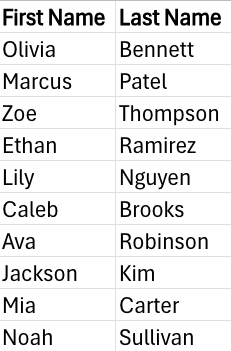
Potential solution:
- Manually copy the data to a new document.
- Or download the image and use optical character recognition software to convert image to text.
- Copy text to Word or Excel.
- Use Sort tools to sort column.
In contrast, please sort the following by last name, A - Z.
| First Name | Last Name |
|---|---|
| Marcus | Patel |
| Olivia | Bennett |
| Zoe | Thompson |
| Lily | Nguyen |
| Ethan | Ramirez |
When you have the right format, tasks take less time.
How to Improve the Learner Experience
Be explicit about instructions and expectations.
Provide content in accessible formats (Brightspace pages, Word, and PowerPoint not PDF).
Read the Accessibility Handbook for Teaching and Learning.
Contact assistivetech@langara.ca for direct support.
Move to the next page to consider potential solutions and better practice suggested by students.