Student Experience
 In addition to inaccessible formats there are others factors that can negatively impact students. The following explores some of the common experiences students noted as being significant hindrances to their learning.
The barriers experienced by students with disabilities, especially ‘invisible’ disabilities, can be difficult for others to understand.
“They did not take me seriously until I literally sat down [redacted] and showed them what I needed and how I accessed the world.”
-Former Langara and current UBC student
Inaccessible content and other barriers are tangible impediments to student success:
“I just got an e-mail from [school] saying, hey, your GPA is below 2.00. If you don’t get your GPA back up for the fall term, you’re gonna be on academic probation for a year. And I’m just sitting there going ‘not again.’ This is like the second time this has happened, right? It’s not really my fault. The material was just not accessible.“
– Former Langara and current SFU student
“That is so important when you think about cognitive load when writing an exam. What do I need to be attending to when I write that exam? It’s not calibrating. Try again. It’s writing the exam.“
– Former Langara and current UBC student
“The consequence of [inaccessible content is] . . . immense . . . I will misunderstand deadlines or not fully understand something.“
– Former Langara and current UBC student
One student pointed to a specific instance when deliberate choices actively excluded her, noting that the instructor:
“invented a barrier.”
Which lead to
“So much self-doubt . . . What did I do wrong? What did I miss? How did I **** that up? What did I, you know, like, where did I . . . It was so gross . . . being, like am I going crazy.”
– Langara student
The emotional response caused by negative experiences was explicitly named by several students:
“It’s me holding emotional space for institutions”
– Former Langara and current UBC student
“There’s a fatigue over the many, many, many different . . . microaggressions that that person experiences.”
– Former Langara and current UBC student
“It’s infuriating . . . your blood pressure goes up.“
– Former Langara and current UBC student
“It was really upsetting and frustrating.”
– Former Langara and current SFU student
“It was all exceptionally overwhelming because I didn’t understand how I was gonna access this content, and so having that added barrier . . . adds a a ton of emotional labour and work to just the process of school.”
– Former Langara and current UBC student
Lack of Support
Several students noted the lack of technical support and the technical barriers that often felt needless.
“Where is every . . . where is all the . . . people to support or interact with?”
– Former Langara and current UBC student
“These hoops that we’re talking about, they’re actually part of the course, because if you can’t do it you can’t actually complete the course.“
– Former Langara and current UBC student
“And the other thing is it’s lying. I feel like what happens is it’s all lies . . . it’s like… Come to Langara! We’re supporting you! We have all these things, da-da-da-da! But… but then . . . nobody there to actually… um, connect with and help you do that, and the only reason I connected with you is because I was in the accessibility department.”
– Former Langara and current UBC student
Even students that have developed a patchwork of tools to get the access they need note that it’s not perfect.
“A lot is really had to be self-taught . . . educating myself, googling everything, Reddit, how do you do it, figure it out, and so then I have that for the next time . . . and more often than not, I spend time just trying to figure workarounds or get it to work, and it inevitably doesn’t really.”
– Langara student
Ultimately, when learning material isn’t accessible, students are unable to fully demonstrate their learning and succeed.
“They’re the tragedies. They are what people think about when they think about someone that dropped out of university in because like I know people here that couldn’t access the institution the way that . . . the institution need[ed] to be negotiated and they just they just drop out.”
– Former Langara and current UBC student
“I was so upset with this process of continually not feeling I can get the content in the way I needed it . . . It’s more emotion, it’s more it cognitively. You… you’re demanding more effort just to get to what I’m supposed to be accessing and which is taking away from my the amount of cognitive energy and effortful attention I have to just do the work itself. Like so like in and of its that right there is more cumbersome and demanding than if it was accessible in a way that made sense.”
– Former Langara and current UBC student
“I wasn’t able to access as much . . . information. And confidence, as I feel like I am capable of.
– Former Langara and current UBC student
What is Assistive Technology?
While the technology they use is only a small part of the student experience, it is essential the technology students need works with the learning materials provided. Below are videos of assistive technology interacting with inaccessible content. Consider what is missed when material isn’t accessible.
Screen reader and alt text
The following recording demonstrates screen reader software reading three examples of alt text: one with no description, one with poorly written alt text, and one example of effectively written alt text.
Closed captions for videos
Consider the following video as an illustration of why captions are important. Note: ensure captions are turned on and do not adjust the volume on your device.
Screen reader reading URLs
Consider the following demonstration comparing screen reader software reading bare URLS, informative hyperlinks, and useless hyperlinks.
Hard to read fonts
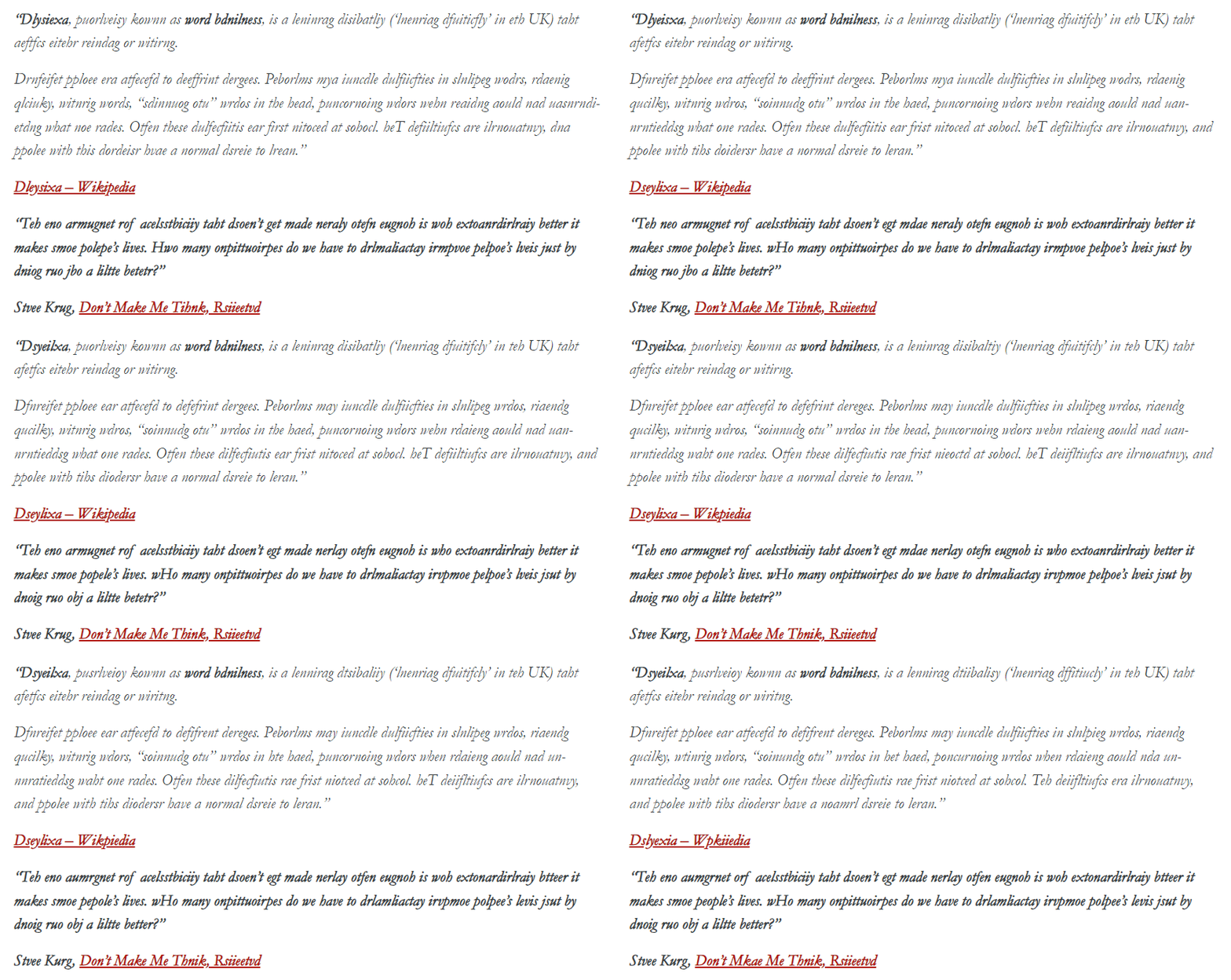
The following animation shows what dyslexia may look like to some individuals. Accessible font choices can minimize the effect.
Poor colour contrast
The following video demonstrates why colour contrast and use of colour is important.
How to Improve the Learner Experience
Review the Academic Accommodation Fact Sheets to understand the basics of academic accommodations.
Contact the Accessibility Services Office.
Make deliberate choices about the technology tools you require students to use and understand that students may not have access to the same tools you do.
Offer links to student technology support.
Be open and inviting to meeting students where they are at.
Read the Accessibility Handbook for Teaching and Learning.
Move to the next page to examine the extra time students need to spend navigating inaccessible content.