1 Landscapes of Liminality: Towards a Map
Jason P. Davies
Abstract
Liminality has been part of the threshold concepts discourse since the beginning but is usually defined rather impressionistically. This reflection considers what liminality is (and is not) and outlines how a framework from social anthropology (Cultural Theory) might enable us to think usefully about different liminalities.
Cultural theory posits that groups tend to form one of four types (‘solidarities’) depending on the depth of group loyalty (‘group’), and stratification (‘grid’). These solidarities all prioritise different ways of knowing, discovering, sifting, and concluding. One (and only one) aspect of liminality would logically include difficulties transitioning between different solidarities and their ways of working with knowledge (including the issue of what counts as legitimate knowledge in the first place) and understanding (including what counts as an explanation).
I close with an epilogue noting that that cultural theory is also useful in considering the role of the ‘Thresholds community’, with its own liminality changing over time, as an exemplar of how inter-solidarity encounters create different flavours of liminal experience.
Keywords: Liminality, threshold concepts, Cultural Theory, higher education
Liminality, a state of being ‘betwixt and between’, is a central theme in threshold concepts scholarship. It is usually referred to as a ‘space’, and is typically underdefined. Is it a disorientatingly open and landmark-free space? A tunnel? Are there different kinds? Does one return to the same place with a transformed perspective, or ‘cross’ the liminal space to a new world? A wide range of disciplines are also finding the concept of liminality useful (without reference to threshold concepts) and in some cases moving more deliberately towards definitions and typologies, analyses, and reflections (e.g. De Luca Picione et al., 2025; Tagliaventi, 2019; Andrews & Roberts, 2012) but for the most part within thresholds literature, ‘liminality’ is a vaguely monolithic and elusive matter.
All these understandings of liminality trace the origins of the idea to Turner’s formulation of Van Gennep (1960)’s scheme of initiation, whereby the middle phase of a three-fold initiation involves a liminal phase featuring a fundamental disruption of normality for initiates (Turner, 1967, pp. 93–111; Turner, 1969, pp. 94–130). It is followed by a final third phase of rejoining their society with a new status and/or perspective. For Van Gennep’s subjects, this experience was total: their whole physical and social being participated, and typically everything is changed: the physical landscape, the living conditions, the social norms – all are deliberately transformed.
As Turner explained, initiation was positively defined in time: it would end either after a fixed period or through the completion of a process. It was usually negatively defined in space: a confusing and unfamiliar landscape was often deliberately sought out rather than a ‘space’ where landmarks clarified orientation and participants knew where they were. Disorientation was usually intensified by unexpected or disturbing behaviours of elders and initiators. All of this deliberately induced liminality had a purpose – to effect a profoundly transformative change in the initiand. These were literal and usually intensely physical and cognitive experiences with implications for the social dimension.
Shifting Metaphors
It is therefore easy to see why liminality was useful as a metaphor for Meyer and Land as they put forward threshold concepts: disorientation and struggle are so often part of a learning transformation and thresholds gives that troublesomeness its rightful place in education. Given its ubiquity since then in thresholds literature, it is worth stressing that liminality appears only once (in the conclusion) in Meyer and Land (2003). In their second publication (Meyer & Land, 2005) it is already much more fully foregrounded, indeed central. Interestingly, Turner’s ‘state’ rather than ‘space’ appears in 2003; the metaphor makes an incomplete transition of its own, from ‘state’ to ‘space’, in 2005. Inevitably, metaphors involve a partial shift in emphasis in their new context: in particular, the physical totality of the initiate’s experience is largely irrelevant for us.
It is also worth noting at this point two shifts (or drifts?) from Meyer and Land’s original formulation: a liminal state was not a criterion for a threshold concept but was rather a likely consequence of encountering them. The first shift is that it is now generally treated as a criterion, or at least a likely indicator of a threshold being encountered. My second shift is about a changing centre of gravity away from the ‘objectified discipline’ to the self of the student in our discourse. For many years, disciplines with unified and universal threshold concepts were objectified as the immutable reality with which students grappled. Such framing naturally gives rise to the ongoing project of identifying threshold concepts in specific disciplines. Thus Meyer and Land (2003, p. 412) initially proposed a discipline-centred definition of threshold concepts (my emphasis):
A threshold concept can be considered as akin to a portal, opening up a new and previously inaccessible way of thinking about something. It represents a transformed way of understanding, or interpreting, or viewing something without which the learner cannot progress. As a consequence of comprehending a threshold concept, there may thus be a transformed internal view of subject matter, subject landscape, or even world view.
Within the wider focus across higher education on individuals, Timmermans (2024, p. 12) recently proposed a reframing of the original definition (my emphasis):
A threshold experience can be considered as akin to a portal inward, opening up a novel and previously unseen way of thinking about ourselves. It represents a transformed way of understanding, or interpreting, or viewing ourselves, clarifying identity and values and enabling us to progress with greater integrity. As a consequence of making sense of a threshold experience, there may thus be a transformed internal view of self, our inner landscape, or even world view.
What was once a literally external landscape with profoundly altered social dimensions (actual initiation) thus became an ‘externalised’ purely cognitive landscape (disciplinary) in the 2003 formulation; with Timmermans’ amendments, it has now become a fully internalised (and more emphatically affective) affair. Treating her proposal as a useful index and encapsulation of a more general move towards ‘personal threshold concepts’, this reflection will now mull over how we might think about these ‘landscapes’, how they are constructed, and whether we can discern any ‘geographical’ features. What are they an internalisation of?
What liminality is, and is not
Typically, liminality is evoked rather than described. For instance, du Plooy et al. (2025, p. 1062) offer: ‘an ephemeral space of destabilising, disruptive vulnerability, precarity, doubt, anxiety, discomfort, confusion and uncertainty’. Other common terms are aporia (not knowing how to even start to proceed), alienation, disengagement, dislocation, and ambivalence. These are very different states, though admittedly often overlapping. We also have the much-loved phrase ‘betwixt and between’ – neither one thing nor the other. None of these fully represent how ‘liminality’ is used in threshold concepts literature.
To begin with, aporia is a different scenario. Most famously associated with Socrates, it has its origins in the dilemmas and contradictions of pre-Socratic philosophers (Palmer, 2017). Aporia is a state that Socrates (in Plato’s recreation) would argue both himself and the speaker into, to the point they had no idea where to go next intellectually or even if there was anywhere to get to. ‘Aporia’ means ‘no path [to follow]’. Socrates’ project was to have people realise that actually they truly knew nothing, not to understand something that was difficult (though one could argue that Socratic ignorance is a threshold concept, of course).
Other discussions often evoke ‘between binaries’ (betwixt two things, ambi-valent, ambi-guous, etc) but we need more than that; ‘neutral’ stems from the Latin for ‘neither one thing or the other’ and that hardly comes to mind when we think about liminality. There is more than just betwixity here; there is also a temporary impossibility of being at either of the reassuring end points in the binary (i.e. in a state of preliminal naivety or fully postliminal understanding). If one could simply proceed across the threshold in a flash, liminality would not matter to us. Since we are dealing with more than an educational and existential ‘Mind the Gap’, there must be more to liminality.
There is of course also the affective (anxiety, disruptive vulnerability, etc.) but I suggest that this is a consequence rather than an active factor. Simply not understanding something does not in itself unsettle students; why does it matter? The answer, I suggest, is that it implicates them as social agents. Where do they stand in the class if they don’t understand? Do they still belong? How can they ask the teacher for clarification (which of course they are often loath to do in case it makes them look stupid)? Are they going to fail, and what will people think? How will they get a good job and find a place in society if they fail? The unsettledness of liminality is therefore a social matter as much as the cognitive one of understanding the subject and the troublesome implications of that understanding.
To continue this reflection on what kind of space or spaces liminality might be, we therefore need to consider if we can describe a ‘landscape’ defined by social as well as cognitive dimensions, with room for a variety of affective responses. We need a map.
Cultural Theory
As the dictum ‘map is not territory’ encapsulates, we cannot (and should not) capture all aspects of a landscape in a map; maps are useful because they select a particular subset of information. A road map, for instance, is sparing on details of river systems and subsurface geological features. If it tried to include all of those along with annual rainfall, average temperatures, and typical pollen levels, it would be unreadable. Certain features must be nominated for a specific use and others excluded. Accordingly, to consider liminality I propose using a map that narrows our focus to social and cognitive aspects.
As explained and contextualised by 6 & Richards (2017), Douglas (1970) put forward the first version of her framework that came to be known variously as Cultural Theory, ‘grid-group’ theory, and (more recently) the more precise but unpopular Neo-Durkheimian Institutional Theory. There are thousands of publications drawing on and refining this across a variety of disciplines. Seeking what she called a ‘parsimonious’ model (Douglas, 1999) that found a way between the accelerating relativism of her field of Anthropology and politico-social models that ignored culture and group interaction, she suggested that a useful framework could be had by exploring the extent to which groups dealt with situations (particularly anomalies) on two axes: the awkwardly named ‘grid’ (stratification, rules, ordering, restriction) and the more immediately self-explanatory ‘group’. Small decisions in response to everyday situations lead to habits and precedent, and four different ‘solidarities’ emerge based on these two variables of grid and group:
- hierarchy (high group, high grid): a group that has a strong set of loyalties, and is stratified by power, status, and authority. For example, an army or highly stratified company.
- enclave (high group, low grid): egalitarian groups who emphasise group membership as equals (perhaps with an exalted leader) who have a single shared purpose or priority. For example, a charismatic church or secular single-issue political group.
- market (low group, low grid): a competitive, highly pragmatic group erratically bound together by fleeting interactions. For example, an actual marketplace.
- isolates (high grid, low group): a collection rather than a community of people subject to many constraints, with little group loyalty. For instance, a factory where workers cannot communicate with each other over the noise.
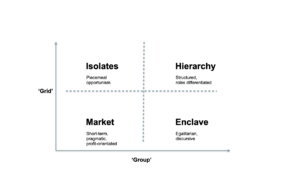
Figure 1. The four solidarities, with differentiating characteristics.
These are perhaps best described as ‘modes of interaction’ because it is stressed they are not psychological (individual) types, and people can move rapidly from one to another. For instance someone with a heavily circumscribed role in a company (hierarchy) might be employed to bid competitively against other similar representatives in a ‘market’ environment. In addition, no recognisable organisation is made up exclusively of one ‘pure’ type; a university might be structured hierarchically but the Vice-Provosts could function together as an enclave (closing ranks quickly to protect the group from outsiders), isolates (all working somewhat in the dark away from each other) or a market (constantly competing). When the Provost enters the room, hierarchy instantly reappears and temporarily banishes other modes to the shadows.
Once established, solidarities have a tendency to intensify as they apply their default approach to everything. A hierarchy meets challenges by organising them across time (‘we need to act – can everyone meet next Tuesday at 10?’) and roles (‘Geoff can chair, it fits his brief most closely’): thus we have more hierarchy every time something needs to be dealt with, particularly in the face of anomalies. An enclave examines each new challenge from the point of view of their key value: every new challenge to a local ecology, for instance, is directly related to the issue of climate change worldwide. Markets respond to all challenges by calling for further deregulation and treat every change as an opportunity. Fatalistic isolates will shrug off every new problem as ‘plus ça change, plus c’est la même chose’, reinforcing their powerlessness. Everything becomes another building block for the prevailing culture. Change is resisted: solidarities tend to change only when things break down to the point that the entire culture disintegrates as the result of a ‘surprise’ (Thompson et al., 1990, pp. 69-75). This framework is not interested in judging the content or value of the solidarity’s ‘thinking’ but rather stresses they are organised in similar ways whether they are a millenarian doomsday cult awaiting transport to another solar system or early Greenpeace.
This brief account gives a glimpse of some of the social aspects of Cultural Theory. It must be stressed that no solidarity is valued in this scheme over any other: there is a consensus in the scholarship that the best outcomes are achieved by ‘clumsy solutions’ – the inclusion of all four solidarities in any organisation (Thompson et al., 1990). Hierarchy provides order and planning; market thinking injects new energy and innovation; enclaves strengthen group cohesion and identify non-routine threats; the isolates bear witness to the organisation’s failings by their very existence, as well as providing a space for more random (and occasionally powerful) suggestions.
Cultural Thinking
Beyond the interests of political science and the like, Douglas’ framework is also very much concerned with cognition and paradigm formation (perhaps most systematically in How Institutions Think (Douglas, 1986)). In each solidarity, specific kinds of understanding are more plausible. This has been explored systematically with regard to how they respond to risk, for instance, by Adams (1995). Hierarchies are ill-equipped to deal with catastrophic risks such as climate change but very comfortable with moderate and definable risks such as traffic safety. Enclaves on the other hand are excellent at identifying catastrophic and immeasurable risks (or rather, ‘risk’ in the singular since they will focus primarily on only one which is constructed as overarching, urgent, and catastrophic). In fact, an almost obsessive focus on a specific risk in myriad forms is absolutely characteristic of an intensified enclave. It will usually be united by a sense of urgent danger.
When it comes to developing ideas, they will be equally distinct. Isolate ‘solidarities’, for instance, excel in generating unexpected and initially implausible ideas, since the group pressure is so weak that people can follow their curiosity wherever it leads. No one interrupts their thinking until they have developed it to maturity, essentially. This is the domain of conspiracy theorists but also the traditional lone scholar of the humanities on uninterrupted sabbatical. It is the natural home of much ‘blue skies research’. In a hierarchy, their unorthodox thinking would be challenged repeatedly and most likely be quashed early on. In a market, no opportunity would be seen in a half-baked idea that cannot yet be monetised – it would be quickly discarded. In an enclave, every idea must be related to the central theme – they will bring that theme into almost any conversation. To illustrate how hard a hierarchy has to work to obtain the ‘normal’ unanimity of much science, consider the periodic table of elements, ‘the bedrock of chemistry education’ (Lemonick, 2022, p. 4). Wikipedia’s ‘Types of periodic tables’ lists a dizzying range of proposed alternatives to the near-universally familiar table – triangles, cubes, helices, cones, globes, spirals, ‘unclassified’ (and even ‘freaks’ according to one cited authority, Tomkeieff). It is hard to imagine the familiar periodic table persisting without a strong hierarchy rallying around it. However the ‘fit’ of subject material and solidarity is not always exact: English Literature, unavoidably a highly interpretative field and therefore highly amenable to low-grid and low-group postmodernism, has also been subject to repeated hierarchisation through the creation and enforcement of canons (Moran, 2002).
In short, what counts as a good idea, and what will be given a chance to develop, will be very different depending on the solidarity. Even the language used for framing new understanding will drift into the values of a solidarity: hierarchies ‘discover’ knowledge while markets ‘create’ knowledge. Not only are these worlds different from one another, so too are the ways of navigating them.
In higher education, most of these will be encountered as ‘learning the hidden curriculum’ or ‘disciplinary norms’, and indeed this is the case. Part of that will be an inexorable consistency with certain tendencies of a solidarity’s modes of thinking. There are not just ways of knowing but also ‘knowing that you know’, and ‘knowing how to understand’. Anyone shifting disciplines will encounter this. For instance, most academic developers are accustomed to complaints about pedagogical literature from their (teaching) students: ‘I don’t understand their argument’; ‘it’s too waffly’; ‘this could have been much much shorter’, and so on. The hegemonic ways of knowing and learning from one’s home discipline will be anchored in a particular solidarity’s construction of knowledge. ‘Not even knowing where to start with something’ may mean ‘my cultural ways of tackling this anomaly do not work nor do they seem to lead to lines of thought that are considered legitimate’. Different disciplines will tend to different kinds of solidarity and to some extent this will be a dynamic blend of subject material being more or less suited to particular modes of thought.
I stress these aspects are from being the only factor in these experiences of liminality: as emphasised already, a map can only draw our attention and organise a particular ‘slice’ of material.
Unfamiliar solidarities
The application of this model so far implies two broad species of liminality might arise: intra-solidarity (where one feels disconnected and ‘evicted’ from a familiar solidarity, and wishes to rejoin it) versus the more variegated inter-solidarity (where one finds that tried and trusted methods and approaches simply do not obtain and one cannot see why). In fact, it seems likely that the first is an illusion: either someone has moved to a different part of their discipline which is differently ‘cultured’ (making this more a case of inter-solidarity) or they will experience frustration and alienation but not liminality in its fuller sense – one at least knows how things are supposed to work.
One aspect, then, of experiencing liminality in education will be linked to the shock of encountering an unfamiliar culture (solidarity). What kinds of culture shocks might we be talking about? Perhaps the transition from learning laws of physics (hierarchy) to designing a group project (enclave or market). Or it could be the clever student whose undisciplined but brilliant (isolated) learning has dazzled teachers thus far suddenly discovering that they must now defend their ideas every step of the way in a discursive enclave or justify why they are relevant in a pragmatic and competitive market. It might be someone leaving school, with its ordered and structured habit of knowledge, finding low-grid social sciences confusing and chaotic. I have frequently heard jokes about ‘name-dropping one’s favourite French philosopher’ but never one about a scientist ‘always going on about Einstein and quantum’ – interesting when we consider that factions are a notorious issue in egalitarian, low-grid enclaves.
It is worth noting that a traditional UK undergraduate degree exposed students to all four modes while learning: lectures are structured, regularising events; seminars and ‘flat’ group discussions are enclaves; individual interactions have the liquidity of a market; and studying alone gives experience of the ‘isolate’ culture and the chance to develop one’s own ideas (and mistakes). It was then, in many ways, its own clumsy solution.
Towards a map?
Has this brief reflection given us a map? If we take Douglas’ argument seriously, then we have not one but four possible conclusions. For a hierarchy, we need to document every logical implication, preferably in a dense diagram to provide an overview and order. With four basic types, we have twelve possible liminalities (three possible transitions for each solidarity, as there are only four in total). For a market, we need to identify pragmatically what we will do with this information. For isolates, it is (yet) another curiosity. For an enclave, with a central theme of ‘considering student well-being while learning’ (and I think that is what the Thresholds community is, even if quite loosely bound as a group), what counts as a legitimate conclusion is how this can be factored into our support of students.
My wholly inadequate sketch of some of the ways the solidarities work here does not permit a detailed foray into specific suggestions (more research is needed, and is planned for future publication) but they would include encouraging a mix in the curriculum to develop all four modes: room for free and blue-skies thinking, heavily structured and ordered study, wicked problems for egalitarian and enclavist thinking, and fast-moving, short-term elements such as games or low-stakes competition. There is much more that can be explored about mapping liminality along these lines, and this ‘map’ can be a part of reflecting on the ‘underlying game’ and ways of thinking and practising (WTP) that were discussed extensively in the early days of threshold concepts (e.g. Meyer & Land, 2003; Land et al., 2008). Familiarity with all four modes reduces student vulnerability to liminality caused by moving from one culture to another, at least. Culture shock as described here in no ways addresses all the kinds of trouble people can get into, but, just as explaining the framework of threshold concepts to students can equip them to learn with less liminality, noting that each solidarity tends to create certain habits can make crossing that threshold a less disruptive affair.
Implications for scholars
This reflection has barely been a beginning, and this is in part because liminality is so commonly invoked in different ways and yet rarely theorised or analysed. This is an interesting situation in itself and it is worth speculating why this is so. I suggest that paying attention to experiences of liminality is a useful way of signalling to others that holistic student well-being (not just success) matters; students struggling is not an inconvenience or an aberration. We (the ‘Thresholds community’) gather around that ‘flag’ that we keep replanting, and need to replant as so much of higher education rushes towards the market mode of working. Increasing (often illusory) choice under the guise of economic value, the introduction of quasi-consumer rights and obligations for students, ‘removing silos’ and ‘knocking down the walls’, and short-termism all intensify market solidarity specifically.
That makes the Thresholds community itself doubly liminal: the distaste for the ‘low group’ aspect of markets leaves us despairing at the march of neoliberalism and rallying ever more around our cause. In addition, academia (for sure in the UK, and varyingly so elsewhere) has in recent decades gone from being strongly hierarchical to weakly so. The hierarchies that remain, whether institutions or subjects, are now islands in a sea of market forces. We began as liminal (enclave encountering hierarchy) and are now doubly so (enclave also encountering market). This allows us to circle back to Timmermans’ proposed redefinition in my opening. Meyer and Land proposed a definition that assumed a hierarchy of reified and objectified knowledge. Timmermans has proposed one that instead looks at a market, where learning is a transaction of the self. What unites them is that both seek to introduce care of the student into what might otherwise be a rather bleak experience.
References
6, P., & Richards, P. (2017). Mary Douglas: Understanding social thought and conflict. Berghahn. https://doi.org/10.2307/j.ctvw04fw7
Adams, J. (1995). Risk. Routledge.
Andrews, H., & Roberts, L. (2012). Liminal landscapes. Taylor & Francis. https://doi.org/10.4324/9780203123164
De Luca Picione, R., De Fortuna, A. M., Balzani, E., & Marsico, G. (2025). Trajectories of the notion of liminality: Identity, border, threshold, affectivity and spatio-temporal processes of transformation. Culture & Psychology, 0(0). https://doi.org/10.1177/1354067×251315735
Douglas, M. (1999). Four cultures: The evolution of a parsimonious model. GeoJournal, 47(3), 411-415. https://doi.org/10.1023/a:1007008025151
Douglas, M. (1970). Natural symbols: Explorations in cosmology (2nd ed.). Taylor & Francis. https://doi.org/10.4324/9780203426623
Douglas, M. (1986). How institutions think. Syracuse University Press.
du Plooy, B., Albertyn, R., Troskie-de Bruin, C., & Belcher, E. (2025). Academic writing for publication: The experience and facilitation of liminality for developing higher levels of scholarliness. Innovations in Education and Teaching International, 62(3), 1060-1072. https://doi.org/10.1080/14703297.2024.2363899
Gennep, A. V. (1960). The rites of passage (M. B. Vizedom & G. L. Caffee, Trans.). University of Chicago Press. https://doi.org/10.7208/chicago/9780226629520.001.0001
Land, R., Meyer, J. H. F., Smith, J., Peters, M. A., & Freeman-Moir, J. (Eds.). (2008). Threshold Concepts within the disciplines. Sense Publishers. https://brill.com/display/title/37762
Lemonick, S. (2022). A periodic table of its own? ChemMatters, American Chemical Society. https://www.acs.org/content/dam/acsorg/education/resources/highschool/chemmatters/documents/a-periodic-table-of-its-own.pdf
Meyer, J. H. F., & Land, R. (2003). Threshold concepts and troublesome knowledge: linkages to ways of thinking and practising within the disciplines. ETL Project Occasional Report, 4. https://www.etl.tla.ed.ac.uk/docs/ETLreport4.pdf
Meyer, J. H. F., & Land, R. (2005). Threshold concepts and troublesome knowledge (2): Epistemological considerations and a conceptual framework for teaching and learning. Higher Education, 49(3), 373-388. https://doi.org/10.1007/s10734-004-6779-5
Moran, J. (2002). Interdisciplinarity. Routledge.
Palmer, J. (2017). Contradiction and Aporia in Early Greek Philosophy. In G. Karamanolis & V. Politis (Eds.) The aporetic tradition in ancient philosophy, (pp. 9-28). Cambridge University Press. https://doi.org/10.1017/9781316274293.002
Tagliaventi, M. R. (2019). Liminality in organization studies: Theory and method. Routledge. https://doi.org/10.4324/9780429031137
Thompson, M., Ellis, R., & Wildavsky, A. (1990). Cultural theory. Westview Press.
Timmermans, J. A. (2024). Failure as a ‘Native Informant’: A Potential Threshold Concept. In J. P. Davies et al (Eds.), Threshold Concepts in the moment (pp. 3-14). Brill. https://doi.org/10.1163/9789004680661_001
Turner, V. W. (1969). Ritual process: Structure and anti-structure. Cornell University Press.
Turner, V. W. (1967). The forest of symbols. Cornell University Press.
Wikipedia (n.d.). Types of periodic tables. Retrieved 23rd December 2025. https://en.wikipedia.org/wiki/Types_of_periodic_tables
Media Attributions
- FourSolidarities