2 Methodological Reflections on a Dialectical Approach to Understanding Threshold Concepts and Liminal Experiences in Mental Health Nursing
Justine Duranti
Abstract
This methodological reflection is based on an ongoing doctoral study investigating threshold concepts (Meyer & Land, 2003; 2005) and exploring associated liminality in mental health nursing. The threshold concepts researched here concern student preparation for an extended role (non-medical prescribing) with implications for professional identity formation. Key learning from undertaking this two-stage study is outlined, alongside a brief rationale for the research design and a summary of the methods employed. The research design integrates theory and adopts an overarching dialectical stance involving multiple perspective-taking. It explores the identification and perception of the threshold concepts, alongside related liminal experiences. This paper reflects on the experience of using the threshold concepts framework to shape the research design. Challenges and insights are shared relating to integration of the threshold concepts framework within both data collection and analysis. Practical difficulties encountered in studying student liminality using phenomenography are also explored, alongside learning from conference discussions regarding the nature of liminality and related research implications.
In this paper I reflect on the design of a sequential mixed methods study exploring threshold concepts relating to readiness to undertake an extended role in mental health nursing with implications for professional identity. I highlight emerging insights and challenges encountered in developing a research design shaped by the threshold concepts framework (Meyer & Land, 2003;2005). This is a threshold concepts methodology, in that it fully utilises the threshold concepts framework in developing research questions, in designing methodology, in employing research methods and in approaching analysis. Results will not be presented here prematurely as data analysis remains ongoing. Instead, I will share early reflections on my learning from undertaking this study which uses a dialectical approach (Johnson, 2017), juxtaposing communities of practice theory (Wenger, 1998) and variation theory (Marton and Booth, 1997) within an overarching threshold concepts framework.
Keywords: mental health, nursing, professional identity formation
Context
Recent workforce developments (NMC, 2018) require foundational preparation of student nurses for an extended role (non-medical prescribing) within the (already) liminal profession of mental health nursing (Evans and Kevern, 2015). Literature refers to the disturbing and ‘unsettling’ nature of mental health nursing (Evans and Kevern, 2015:5), where students prepare to join a profession ‘managing risk and uncertainty’ for patients who ‘oscillate between places of danger and possibility’ (Evans and Kevern, 2015:5). Mental health nurses are seen as practicing in ‘proximity to abjection’ (McSherry et al., 2015:82), therefore requiring ‘a cluster of capabilities’ and ‘a complex identity package’ (Hurley, 2009:382). Mental health nurses require knowledge intersections rather than steps in textbooks (Ford, 2020:352) to engage therapeutically with patients regarding their use of medicines. The threshold concepts framework is proving a helpful means of exploring these intersections and of addressing the liminal identity issue in relation to this extended role. It has also enabled a focus on key areas of learning in the context of concerns regarding an overcrowded and competency-based curriculum in the United Kingdom (Warrender, 2022). Review of the literature indicated some concern regarding the widespread and longstanding competency-based approach in nurse education. Unease has been expressed that the growth in competency-based nurse education offers ‘false reassurance’ with ‘reductionist and fragmented assessment of skills’ (Collier-Sewell et al., 2023:3). A nurse educator recently advocated for a greater depth of understanding of the nature of expertise, the integration of educational concepts, and situated learning within nurse education (Welch, 2025). There are growing calls for the creation of ‘dialogic spaces’ with a greater focus on critical thinking within a process orientated rather than content focused approach (Collier-Sewell et al., 2023:3). The following research questions used the threshold concepts framework (Meyer and Land, 2003) to explore this further.
1.Which threshold concepts do subject experts view as indicative of ability to provide high quality and role congruent medicines related interventions as a mental health nurse or independent mental health nurse prescriber?
2. How do student mental health nurses experience teaching/ learning in relation to the identified threshold concepts and what is their experience of associated liminality?
Research Design
A stage one Delphi study provided ‘a map’ of threshold concepts relevant to mental health nurse medicines interventions, and a stage two study enabled close examination of the detail of liminal ‘terrain’ as outlined by experts and experienced by students (see diagram below). A dialectical stance (Johnson, 2017) permitted multiple perspective taking, with examination of consonance and dissonance between differing participant perspectives, research paradigms and educational theories. This was an intentional approach (Hall, 2024), not implying a relativist ontology but capitalising on an interplay of ideas viewed as communicating partial understandings of a single truth relating to collective mental health nursing experience. Consistent with a dialectical approach, the aim was to give equal voice to all study participants and therefore to preserve data integrity at each stage (Hall, 2024) whilst also focusing on consonance/ dissonance and the development of joint displays of data (Creamer and Edwards, 2019). In this way, the expert and student voices are preserved, but learning is also maximised through the synthesis of data.
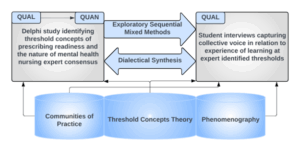
Methods:
Stage 1: Delphi
I undertook a mixed methods Delphi study with an exploratory sequential design to examine the nature of expert consensus in relation to research question one, which related to the identification of threshold concepts in mental health nursing. There is precedent for the use of Delphi methodology in threshold concepts research (Nicola-Richmond et al. 2016; Morley, 2020; Hatt, 2020) and it aligns well with the focus of this study on the nature of mental health nursing expertise in relation to medicines. Fifty mental health nurses based in the United Kingdom and Ireland from three subgroups, (educators, prescribers and researchers) completed a qualitative round one Delphi questionnaire. Panel membership was restricted and expertise carefully defined to ensure expertise whilst maximising heterogeneity (Linstone & Turoff, 2002). Questions were focused on field specific knowledge that the experts viewed as required learning for students to progress. Questions were also designed to evoke characteristics of threshold concepts, using language prompting discussion of areas found to be troublesome, transformative, integrative, bounded and irreversible (Meyer and Land, 2003). The panel were asked about concepts requiring the integration of skills and knowledge, and attention was paid to the neglected boundedness attribute (Barradell & Fortune, 2020) which supported the examination of professional identity formation. Questions also focused the panel on learning as part of a community of practice (Wenger, 1998) with learning situated in its social and historical context. A deductive thematic analysis was undertaken (Braun and Clarke, 2022) using all threshold concepts characteristics. In the spirit of a dialectical approach, minority views were considered with focus on group dissensus as well as consensus within the second round (Khodyakov, Grant, Kroger & Bauman, 2023:9).
Forty-eight of the panel members completed a quantitative Delphi round two. Responses were quantitatively analysed for panel consensus on the importance of candidate threshold concepts and differences between subgroups. Threshold concepts were identified based upon the predefined criteria of 75% strong agreement on a six-point Likert scale and an interquartile range of 1. 75% agreement is widely supported (Belton et al., 2019) and 75% – 80% agreement is also identified as an appropriate indicator of consensus in the widely cited CREDES guidance (Junger et al., 2017), developed in palliative care but with cross field applicability.
Stage 2: Phenomenography
In response to research question 2, sixteen semi-structured student interviews were then undertaken with pre-registration and post registration mental health nursing students in the United Kingdom and Ireland. I used phenomenography (Marton, 1981, Marton, 1986) to explore variation in student experience of liminality in progression towards threshold concepts constructed from panel responses. Phenomenography, developed within higher education in Sweden (Marton, 1981, Marton, 1986), aims to facilitate an understanding of the qualitatively diverse ways students experience a clearly defined phenomenon (in this case liminality in relation to the threshold concept). The voice of the Delphi panel (in the form of quotations) was used in articulating threshold concepts for the students at this stage. Phenomenography requires ‘parsimony’ in obtaining a ‘stripped description’ and ‘second order perspective’ of an experience (Marton & Booth, 1997). This enabled a tight focus on liminality in relation to Delphi panel identified threshold concepts. My intention in exploring student experience at the threshold was not intended to be confirmatory but capturing nuance in relation to, not only variations in liminal experience, but also in student conception of the threshold. The dialectical paradigm underpinning my methodology fits well with phenomenography in actively seeking variation and drawing out tensions.
Challenges and Insights
Delphi Study Design: Derailed by the ‘floating signifier’
(Brown et al, 2022 discussed in text)
My initial intention was to facilitate the Delphi panel in constructing the threshold concepts themselves, enabling researcher distance and limiting bias. However, this became problematic when the pilot study panel were derailed by threshold concepts theory, despite my written explanation with definitions of characteristics. They encountered what has previously been defined as a difficulty with shared definitions regarding threshold concept characteristics, or the ‘floating signifier’ (Brown et al, 2022:305). Both pilot panel members were educators, and neither could grasp the threshold concepts framework or characteristics with adequate speed. Although both said they would be interested in learning more, both thought that they would be less likely to take part in the study if I made learning more a requirement. They expressed that I was consulting them in relation to their mental health nursing expertise, but within the pilot questionnaire, their focus was not on this expertise but on an educational theory that was new to them. I therefore redesigned the questionnaire using language to elicit threshold concepts and associated characteristics without explaining the theory to the expert panel and keeping their focus squarely upon their own expertise. Language used within the questionnaire included invitations to comment on intersections of knowledge, links between aspects of practice, learning bottlenecks, and transformations. Integration of communities of practice theory (Wenger, 1998) within the questionnaire also facilitated articulation of the boundedness attribute. For example, the panel were asked how they found their approach to medicines management to have been shaped by others, influenced by history and becoming ‘future ready.’
Delphi Study Analysis: Threshold Concepts as ‘a Cluster of Interrelated Possibilities’
(Land, 2004 discussed in text).
I attempted a deductive thematic analysis of round one data, coding in a rule bound way for all threshold concepts characteristics. Again, this became problematic with the sense that I was breaking up the data and losing the bigger picture. An early attempt to re-connect elements of data, coded for various threshold concepts characteristics, into candidate threshold concepts also felt unclear. Land (2024) identifies that threshold concepts characteristics ‘are not universal requisites,’ instead, ‘indicating, illustrating and exemplifying’ (Land, 2024: 476). I tried the analysis a second time, viewing the characteristics, as suggested by Land, as ‘a cluster of interrelated possibilities’ (Land, 2024: 476). The second time I used open coding, looking more broadly for potential threshold concepts, searching for struggles, transformations in understanding and the crossing of conceptual boundaries. Themes were constructed and subsequently merged and cross checked against all threshold concepts characteristics.
Guarding against a Binary View.
My initial conception of the stage two student interviews was perhaps too binary in nature, but what emerged was difficult to access, messy, nuanced and non-linear. It helped to view interview data as a web of connections. Calduch and Rattray (2022) highlight the dangers of methodologies that take a binary view of threshold crossing and hence miss unexpected student transformations capable of illuminating and developing threshold concepts. They view threshold concepts as evolving and situated within communities of practice (Calduch & Rattray, 2022: 1454). In his keynote address at the Tenth Biennial Threshold Concepts Conference, Hokstad (2025) referred to problematic linearity in our support of student liminality. He noted a requirement in modern day education to support students in managing ‘a constant liminal state’ and to address ‘the challenge of teaching the unforeseen’ (Hokstad, 2025). This is helpful in considering the unpredictable settings and uncertain evolving roles for which we are preparing mental health nurses.
Integrating Variation Theory.
Meyer (2024) highlights the intentionality of ‘vague’ language such as ‘likely, probably and potentially’ in relation to threshold concepts characteristics, aligning this with the provisional nature of learning and of inherent variation in ways of experiencing threshold concepts. Parallels and complementarity between variation theory (Marton, 1986) and the threshold concepts framework have been highlighted with potential for alignment between variation theory at various stages of the student journey towards assimilation of a threshold concept (Meyer et al., 2008). Meyer et al. (2008) advocate the educational value in exploring ‘subliminal variation’ (general differences in ways of knowing and thinking), pre-liminal variation’ (differences in perception of the portal), liminal variation’ (differing experience of liminality) and ‘post liminal variation’ (variations in understanding of the threshold concept itself and forward trajectory) (Meyer et al., 2008: 68). Taking a phenomenographic approach, stage two of this project attempted to direct the lens of variation theory at the liminal experiences of mental health nursing students in relation to medicines related threshold concepts. It soon became apparent, however, that maintaining this focus would be challenging. In exploring their liminal experiences, students shifted between all four modes of variation, adding complexity, but with potential to inform learning.
Conclusion
This is a threshold concepts methodology with question, methods and analysis underpinned by the threshold concepts framework. Using threshold concepts theory in a truly integrated way, rather than merely as a tool or lens has been invaluable in exploring mental health nursing student learning experiences. Timmermans (2024) identifies that, ‘A threshold concept can be considered akin to a portal inwards.’ A focus on the neglected boundedness characteristic (Barradell, 2020) within the Delphi study, assisted the Delphi panel in focusing on their disciplinary knowledge and the professional identity they wished to portray to their students. This study assimilates other educational theories as part of a dialectical mixed methods approach. It therefore looks ‘outward’ in integrating theoretical and methodological perspectives, using a ‘plug and play’ approach (Wenger, 2013). There is a ‘looking towards’ students in attempting to capture the detail of their experience of carefully defined threshold experiences, and a disciplined focus upon the student’s experience of the threshold concept and associated liminal state. Key learning acquired through this study relates to the means of accessing all threshold concepts attributes in data collection and analysis but doing so in a flexible way to maintain a broader perspective in facilitating threshold concept identification. Additionally, the use of variation theory in exploring student experience of liminality, viewing liminality as non-binary, non-linear and potentially enduring, has added depth to this study on learning in mental health nursing.
References
Barradell, S. & Fortune, T. (2020) Bounded: The neglected threshold concept characteristic. Innovations in Education and Teaching International. Vol. 57. No. 3. 296-304
Braun, V. & Clarke, V. (2022) Thematic analysis: A practical guide. Sage
Brown, M. E. L., Whybrow, P. & Finn, G. M. (2021) Do We Need to Close the Door on Threshold Concepts? Teaching and Learning in Medicine. [Accessed at https://doi.org/10.1080/10401334.2021.1897598 on 12.05.21]
Calduch, I. & Rattray, J. (2022) Revisiting post liminal variation in threshold concepts: Issues of unexpected transformation and legitimisation. Studies in Higher Education. 47:7, 1453-1463
Collier-Sewell, F., Atherton, I., Mahoney, C., Kyle, R. G., Hughes, E., & Lasater, K. (2023). Competencies and standards in nurse education: The irresolvable tensions. Nurse Education Today. 125.
Creamer, E. & Edwards. C. (2019) Embedding the dialogic in mixed methods approaches to theory development. International Journal of Research and Method in Education. 42:3, 239-251
Evans, C.A. & Kevern, P. (2015) Liminality in preregistration mental health nurse education: A review of the literature. Nurse Education in Practice. 15(1) p.1-6.
Ford, H.U. (2020) What are the factors that mental health nurses use when deciding to give pro re nata medication for patient agitation? Doctoral Thesis. University of York
Hall, J.N. (2024) The dialectic stance: Navigating difference. In: Philosophical Foundations of Mixed Methods Research. Shan, Y. (Ed) Routledge
Hatt, L.E. (2020) Using the threshold concept framework to enhance entrepreneurship curricula in higher education, Durham theses, Durham University.
Hurley, J. (2009) A qualitative study of mental health nurse identities: Many roles, one profession. International Journal of Mental Health Nursing. 18 (6), pp. 383–390.
Johnson, R.B. (2017) Dialectical pluralism: A metaparadigm whose time has come. Journal of Mixed Methods Research. Vol 11(2) 156-173
Land, R. (2024) Getting into trouble: Twenty years of threshold concepts. In: Davies, J.P., Gironacci, E, McGowan, S., Nyamapfene, Rattray, J., Tierney, A.M. and Webb, A.S. (Eds) Threshold concepts in the moment. 475-482. Brill.
Lave, J. & Wenger, E. (1991) Situated Learning: Legitimate Peripheral Participation. Cambridge University Press
Linstone, H.A. & Turoff, M. (2002) The delphi method: techniques and applications. Addison-Wesley
Marton, F. (1981) Phenomenography: Describing conceptions of the world around us. Instructional Science. Vol. 10 No. 2. 177-200
Marton, F (1986) Phenomenography: A research approach to investigating different understandings of reality. Journal of Thought. Vol. 21. No. 3. 28-49
Marton, F., & Booth, S. A. (1997). Learning and awareness. Lawrence Erlbaum Associated Inc.
McSherry, T., Loewenthal, D. & Cayne, J. (2015). The implications of Kristeva’s notion of the abject in understanding the significance of therapeutic knowledge and practice in mental health nursing. Journal of Psychiatric and Mental Health Nursing. Vol 22: 82-88
Meyer, J. H. F., & Land, R. (2003). Threshold concepts and troublesome knowledge: Linkages to ways of thinking and practising within the disciplines. In: Rust, C. (Ed.) Improving Student Learning: Theory and Practice Ten Years On (412-424). Oxford Centre for Staff and Learning Development.
Meyer, J. H. F. and Land, R. (2005) Threshold concepts and troublesome knowledge (2): Epistemological considerations and a conceptual framework for teaching and learning. Higher Education. Vol. 49: 373–388
Meyer, J.H.F, Land, R. and Davies, P. (2008) Threshold Concepts and troublesome knowledge: Issues of variation and variability. In: Land, R., Meyer, J.H.F. and Smith, J. (Eds) Threshold concepts within the disciplines. 59-74. Sense Publishers.
Morley, C., (2020). Towards the co-identification of threshold concepts in academic reading. Journal of University Teaching & Learning Practice. 17(2). p4-
Nicola-Richmond, K.M., Pepin, G. & Larkin, H. (2016) Transformation from student to occupational therapist: Using the Delphi technique to identify the threshold concepts of occupational therapy. Australian Occupational Therapy Journal. 63, 95-104.
NMC (2018) Future Nurse: Standards of Proficiency for Registered Nurses. Nursing and Midwifery Council: London.
Timmermans, J. (2024) Failure as a native informant. In: Davies, J.P., Gironacci, E, McGowan, S., Nyamapfene, Rattray, J., Tierney, A.M. and Webb, A.S. (Eds) Threshold concepts in the moment. 3-14. Brill.
Warrender D (2022) NMC proficiency standards are an assault on mental health nursing. Mental Health Practice. rcni.com, 20 October 2022
Welch, S. (2025) Competence to expertise in nursing practice. Contemporary Nurse. Vol. 61 No. 2. 195-202
Wenger, E. (1998) Communities of practice: Learning, meaning and identity. Cambridge University Press.
Media Attributions
- Picture1