3 Licensing Your OER
Make Something And Give It a Creative Commons License
Open education is about sharing, collaborating, and increasing access. Copyright can be one barrier. Almost everything we make is protected by copyright or licensing or patents of some kind. Intellectual property is protected. That is why you can’t just look online and copy someone else’s work or use someone else’s photo or graphic or image. Collectively, we have developed procedures to indicate when we are using someone else’s words or ideas. We create an attribution. We create footnotes or a bibliography. But what do we do when we want to use someone else’s educational resource? Perhaps we know about a section or chapter in someone else’s course that would work well for a course we are teaching. Can we legally or even ethically use that content? We can, if that content has a license that allows for reuse, adoption or even adaptation.
Ultimately, it is this act of licensing and sharing that elevates a regular old educational resource to the grand status of OER! The most common way to signal a resource is openly licensed is through Creative Commons. With CC you, the creator, can set the conditions of usage.
Learn about the types of Creative Commons licenses here and use the Creative Commons Chooser tool to create your license.
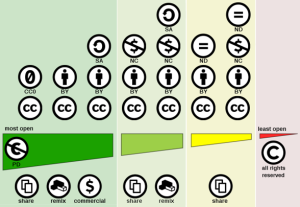
Below is a chart that shows the differences and degrees of “openess” related to different licences.
Media Attributions
- Private: making oer
- Private: CC-License-Scale