
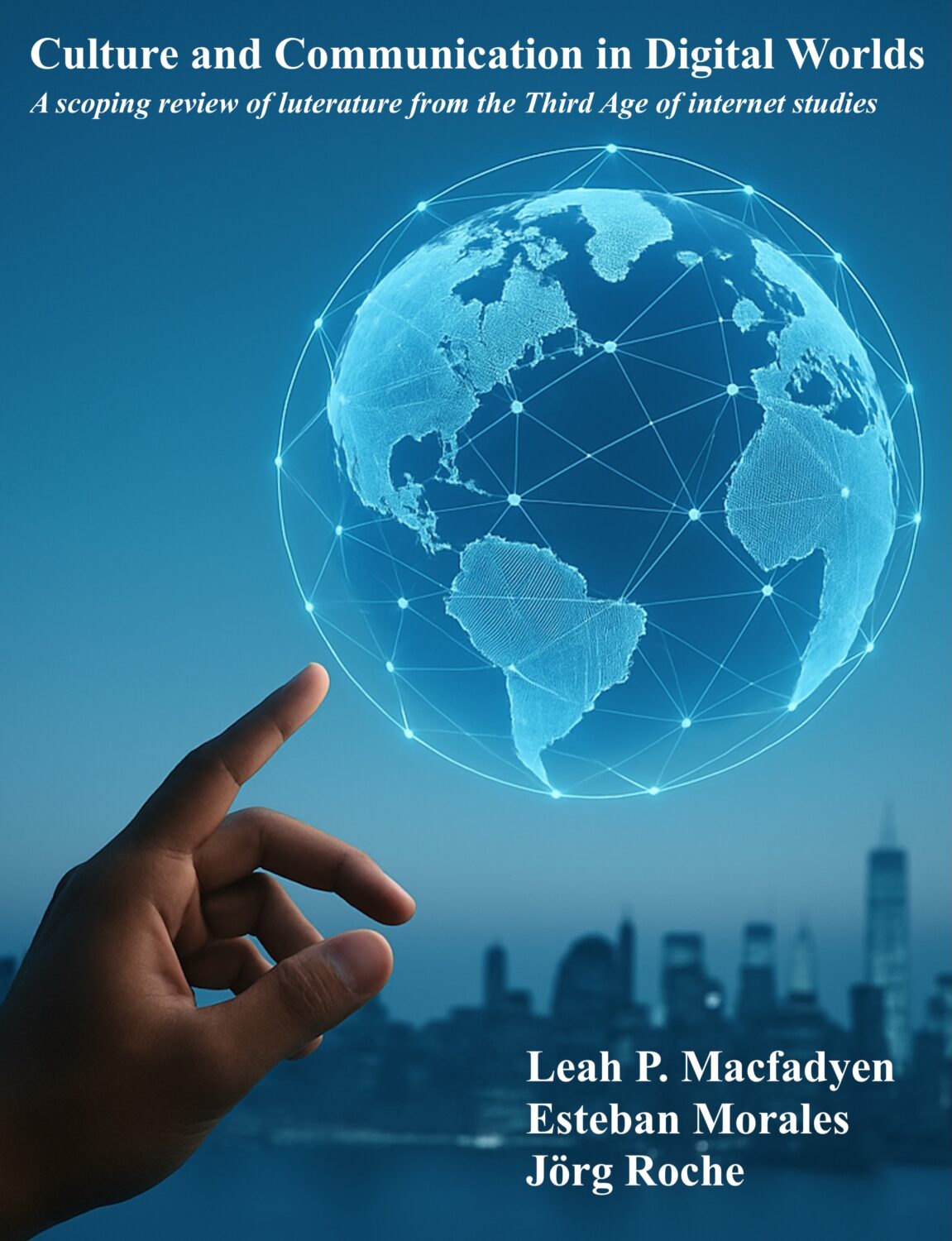
Book Title: Culture and Communication in Digital Worlds
Subtitle: A scoping review of literature from the Third Age of internet studies
Download this book
Book Description: What happens when people from different cultural backgrounds try to communicate using digital technologies? This review offers a roadmap and thematic analysis of literature we compiled from 2003-2023. In it, we consider what research is telling us about whether digital communication technologies represent new opportunities, new threats, or both, for human cultures.
Contents
Book Information
Book Description
In 2004, we surveyed the available literature on culture and communication in online environments (“cyberspace”) and attempted to delineate the extent and boundaries of this newly emerging field. We reviewed research and theory from multiple disciplines, including cultural studies, intercultural studies, linguistics, sociology, education, human–computer interaction, distance learning, learning technologies, and philosophy. Using the language and terminology of the era, we wrote about culture in cyberspace, cyberlanguage, cybercultures, and even cybereducation, to signal identities and practices shaped by digital, networked interactions and to capture the sense of novel, futuristic, digital and virtual meanings.
Our findings were published as:
- Macfadyen, L. P., Roche, J. & Doff, S. (2004). Communicating across cultures in cyberspace. A bibliographical review of online intercultural communication. Lit-Verlag.
Twenty years later, the landscape has shifted. In what Wellman (2011) calls the Third Age of the internet, participatory platforms such as blogs, social media, wikis, and user-generated video have transformed the internet from a place we “visit” into a space we inhabit. This signals a shift towards “technologies of life,” in which “a single technology or a group of technologies becomes an infrastructure to sustain (and therefore shape) a wide range of quotidian activities” (Gómez Cruz, 2022).
Between 2003 and 2023, we see a pluralization of voices in digital spaces, with users across the globe contributing content, shaping culture, and building communities. Building on our 2004 conclusions and recognizing this new sociotechnical reality, we asked whether research and theory emerging in the intervening years might offer new insights. We compiled relevant work from this era and reviewed its dominant themes, asking:
- How has the language of this interdisciplinary field changed over time?
- Have new definitions, enumerations, and observations of ‘culture’ arisen that may now allow us to effectively examine and make predictions about the complex interactions between culture and technology?
- Do we now have adequate theories of intercultural or transcultural communication in digital spaces?
- Which new trends and themes have arisen in the research literature as cultures and technologies have continued to co-evolve?
These questions guide our 2025 review of work published between 2003 and 2023. Moreover, we conclude by suggesting that 2023 marks a watershed for digital culture and internet research, catalyzed by the release of ChatGPT in November 2022 (OpenAI, 2022, November 30; Stokel-Walker, 2022, December 9). In what we call the Fourth Age, model-mediated communication is becoming routine, and AI and algorithmic cultures are emerging and shaping our digital worlds and encultured lives. Generative models (text, image, audio, video) are increasingly co-authors, translators, stylizers, curators, and interlocutors in everyday interaction, reshaping ideas of authorship, creativity, and identity. Content is now not only curated by algorithms but increasingly produced by them.
Continuing earlier discussions of “computer-mediated colonisation” (Ess, 2002), we must now also ask:
- Who creates knowledge?
- Who is represented in training data?
- Whose values shape AI-generated communication?
Language dominance, cultural references, and communicative norms are increasingly shaped by training corpora and platform values. These developments raise urgent questions for culture, communication, and digital worlds.
License

Culture and Communication in Digital Worlds Copyright © 2025 by Leah P. Macfadyen is licensed under a Creative Commons Attribution-NonCommercial 4.0 International License, except where otherwise noted.
Subject
Cross-cultural / Intercultural studies and topics
Metadata
-
Culture and Communication in Digital Worlds Copyright © 2025 by Leah P. Macfadyen is licensed under a Creative Commons Attribution-NonCommercial 4.0 International License, except where otherwise noted.