Theme 1: Theoretical and methodological foundations
Shifts in language and terminology
i. From cyberculture to digital culture
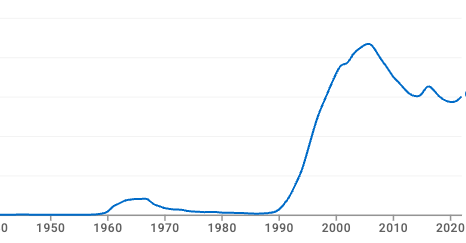
A high level first pass over our compiled works revealed some key shifts in the language researchers are using to described digital technologies and the virtual worlds and identities they support. Work we reviewed earlier (Macfadyen et al., 2004) made extensive use of the cyber prefix that was then in common use in both popular and academic discourse. Atay (2021) traces the origins of cyber to the mid 20th century, and the work of Norbert Wiener (1954). Originally associated with concepts relating to automation and computing, it was eventually embraced by those trying to describe the emerging digital landscapes of the internet. Terms like cyberspace and cyberculture gained prominence, as scholars tried to capture the essence of a new, virtual realm that was distinct from the physical world. This usage was heavily influenced by science fiction and academic discourse, which often framed the internet as a transformative and revolutionary space (Shires & Smeets, 2016). In the academic literature, cyber was central to the study of digital culture, identity, and communication. Scholars like Pierre Lévy (2001b) and Sherry Turkle (1995) explored the implications of cyberspace and cyberculture, framing them as new frontiers for human interaction and identity formation (Teixeira et al., 2017). By the early 2000s, however, usage of the cyber- prefix began to decline. Some argued that it had lost meaning through overuse (Shires & Smeets, 2016). More significantly, as the internet became more integrated into everyday life, the term digital began to replace cyber. The shift reflected a move away from the futuristic and abstract connotations of cyber toward a more practical and descriptive language (Quet & Dahdah, 2020), though some argue that the concept of cyberculture remains relevant in studies of online identity and digital communities (Teixeira et al., 2017). This decline of popular usage of the term cyberculture in digitized English books in recent years is demonstrated in Figure 1.
Instead, the broader notion of digital culture is highlighted as an area of research that requires greater understanding. This also includes the idea of diverse global digital cultures which are influenced by global networks and transnational communication giants, yet are also deeply rooted in specific cultural, social, and political settings (Goggin, 2016).
Similarly, a comparative analysis of usage of the terms cyberculture and digital culture in academic literature reveals the scale of the explosion of usage of digital culture terminology in the past decade (Figure 2).
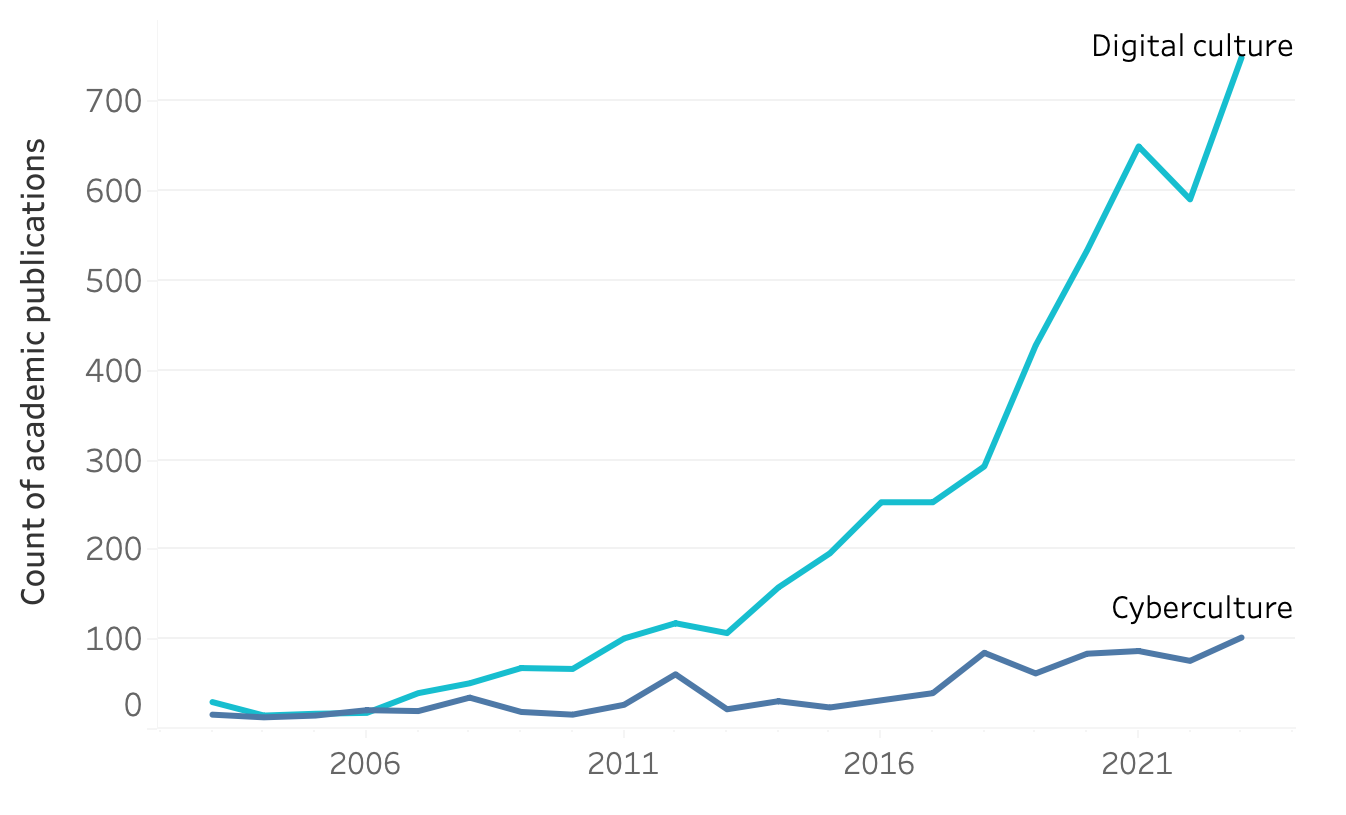
It is notable that only five works (3%) compiled in our 2025 corpus make use of the term cyberculture, and none more recently than 2014 (see for example: Fabrício, 2014; Köhl & Götzenbrucker, 2014), whereas 16 works (10%) employed digital culture (see for example: Christofi, 2020; Valtysson, 2020).
ii. From cyberspace to digital worlds
Similarly, academic and public discussions have moved toward naming specific technologies or concepts rather than relying on broader, less precise (Shires & Smeets, 2016) terms like cyberspace. Only thirty articles (18%) in our new corpus make use of cyberspace (see for example: Ess, 2008; Mulinge, 2022), while 128 (79%) discuss digital technologies, 102 (63%) discuss virtual spaces, 149 (91%) make use of online as the relevant descriptor, and 50 (31%) use networked to represent digitally-supported venues.
To some extent the term computer-mediated communication (CMC) may also seem dated and may not fully capture the complexities of contemporary communications, which increasingly encompass diverse technologies and processes beyond traditional computer interfaces. Indeed only 16 (10%) of our compiled works invoke this term, most published before 2018. Some may argue, however that the term computer-mediated communication (CMC) is evolving and remains relevant, with application and understanding shifting towards broader concepts of mediation rather than being strictly tied to computers (Carr, 2020).
In parallel, we investigated usage of the term Information and Communication Technologies (ICT). First used in 1997 (Deeson, 1999), it gained particular traction in educational settings and has been viewed as a broader term than IT, encompassing various technologies that facilitate communication and information management. Some 31 (19%) of our collected works make use of this term, especially in works relating to education (see for example: Eutsler & Perez, 2022; Winschiers-Theophilus et al., 2021).
iii. New tools and technologies
In 2004, we reported that the World Wide Web (WWW) was regular terminology used to refer to the global network and its resources, and that hypertext/hypermedia was routinely used in literature of the time to describe non-linear digital texts with interconnected nodes, highlighting what were then new forms of reading and writing.
Unsurprisingly, our 2025 corpus employs a range of newer terminologies when referring to digital technology and related concepts, reflecting its multifaceted nature in contemporary society. Digital media and digital communication are frequently used to describe the organic elements of a complex economic, social, and cultural reality (Koutsogiannis, 2015). Digital technologies are recognized for their role in intensifying global flows of people, discourses, and semiotic resources, often described as offering ‘shortcuts to globalization’ (Solmaz, 2020). Digital literacies are mentioned as a focus of studies, particularly concerning children’s literacy practices (Koutsogiannis, 2015). Digital games are discussed in relation to their usage in technology-assisted language learning (Park & Wen, 2016). Digital platforms are identified as sites for ‘text making’ and for materializing meaning in non-linear configurations. They also serve as a means for users to access information related to a particular digital technology (Domingo, 2014).
Digital tools and systems used to handle information and support communication, such as computers, networks, and mobile devices.
Non-linear digital text that is connected by hyperlinks, allowing readers to jump between sections or documents.
Linked digital content that can include text, images, audio, and video.
Content that is created, stored, and shared in digital form, such as websites, videos, and social media posts.
The different sign systems (such as language, images, sound, or layout) people use to make meaning.
Online services that host and organize user activity, such as social media sites, streaming services, or learning platforms.