Anticipating the Fourth Age: Generative AI and algorithmic cultures
Familiar themes and trends in the Fourth Age
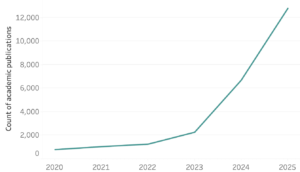
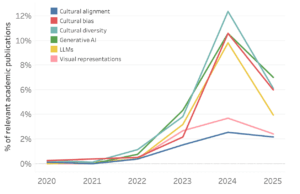
Data compiled using the Dimensions analytics platform reveals the explosive growth in number of publications located using the search terms ‘generative artificial intelligence’ AND ‘cultural diversity’ since 2020, in the extensive database of academic literature to which it has access (Figure 3). Meanwhile, a guided survey of recent literature relevant to AI or generative AI and cultural difference or cultural diversity using SciSpace shows jumps in related topic trends in academic work beginning in 2023 (Figure 4) (note that both data samples must be interpreted as indicative, and not exhaustive).
Perhaps unsurprisingly, a high-level overview of very recent publications (many still only available as preprints) reveals themes familiar to us from earlier decades of internet research when previous technological developments also brought about tumultuous change. Recent ‘alignment studies’, for example, have reported on misalignment of generative AI with national or cultural values (interestingly, Globig et al. (2024) report in their preprint that citizens in Western countries declare greater skepticism and perceive greater misalignment). LLMs are reported to exhibit systematic value orientations based on the dominant cultural signals used in their training (they are not ‘neutral’) (Agarwal et al., 2024; Fenech-Borg et al., 2025). Concern is expressed about the moral and cultural homogenizing force of generative AI tools, and their failure to reflect culturally diverse values (Kharchenko et al., 2024; Meijer et al., 2024). With relation to output, text‑to‑image and multimodal models are reported to miss cultural expectations frequently (Johnson et al., 2022; Nayak et al., 2025). Researchers observe stereotyping, exoticism, and erasure of nuance in LLM output (Nayak et al., 2025) and AI suggestions are found to steer writers toward Western styles (Liu, 2025). Recent work does also report some success with early mitigation efforts, for example, fine‑tuning with culturally relevant corpora, language‑specific tuning, iterative prompting, and culture‑aware pipelines to improve cultural alignment in targetted settings. Broad coverage remains challenging, however. As the literature of the Fourth Age matures, it will be interesting to discover whether these patterns hold.