
Application. Proposal for Development
FIRST NATIONS RESERVE PLANNING CASE STUDY
Assigned task
The McLeod Lake Indian Band (MLIB) is considering a proposal, with three options, from a non-member, off-reserve private developer to develop the McLeod Lake Indian Band Sas Mighe[1] IR32 (Bear Lake). The proposal has both benefits and costs to the Band.
The MLIB Land Management Committee is considering three options under which they would proceed with the residential subdivision. The Committee has hired you, as an external consultant with expertise in First Nations Reserve land use planning, to advise them. You are to review the options and present a report to the Committee.
In your professional report (not to exceed 1,000 words) you are to:
a) Identify advantages and disadvantages of each option. Consider the extent to which each option satisfies the interests of the developer, specifically in terms of tenure security and transaction costs, such that they remain an interested partner.
b) Recommend one of the three options, with a rationale for your decision. Present any conditions that you would add to your recommended option that you deem necessary to protect the Band’s interests while retaining the interest of the developer. Assume that any conditions will include trade-offs for both parties that must be considered from both parties’ perspectives (e.g., if MLIB asks for something more as part of the agreement, they must be willing to offer something in return to the developer)..
Demonstrate that your analysis of the options and recommendation are consistent with the McLeod Lake Indian Band Land Code, 2022 and McLeod Lake Indian Band 2021 Land Use Plan. Wherever appropriate, substantiate your views with specific references to sections of relevant land policies.
A private developer has approached the McLeod Lake Indian Band Council about developing residential units on Sas Mighe IR32 located at Bear Lake, as shown in Map 1. In the MLIB Land Use Plan, Sas Mighe IR32 is described, in part, as follows:
With access off the highway via Davie Lake Road, this site offers potential for highway commercial, residential, RV camping, cultural camps, tourism and agricultural uses such as a greenhouse or nursery.[2]
After the Land Use Plan was approved, a gravel pit was developed in the area designated for resource development.
According to preliminary designs based on current land designations, the development can provide up to 50 new housing units.
The Band is interested in the proposal because of two short-term needs.
- The Band needs 25 housing units, preferably at Sas Mighe IR32, to meet the needs of its members.
- The band is interested in commercial development on or nearby Sas Mighe IR32. Any commercial development will require at least a $4 million investment.
The MLIB Land Code includes rules and procedures for granting property interest on Reserve lands, but does not detail which tenure types will be administered or where. As no individual member of McLeod Lake Indian Band has claimed or been granted rights to Sas Mighe IR32 land, interest in the subject area is held communally. Currently, it is possible that a variety of tenures could be granted to facilitate the development of Bear Lake, with each tenure composed of different bundles of rights for the developer and the Band.
Map 1. Sas Mighe IR32: Land Use Designations
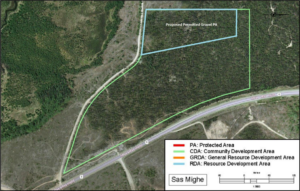
The developer, who is well versed in First Nations land tenure, has proposed three options for the Band Council to consider. All options are feasible. MLIB has experience with all the types of options proposed by the developer.
Sources of revenues for the Band from property taxes should be considered for each option.
Reserve Land Exchange
The Framework Agreement allows for alienation of MLIB Reserve lands where compensation is provided in the form of other land that is to become First Nation reserve land. Other compensation may include land that will not become First Nation Reserve land. The developer has submitted a draft terms of reference, which would include compensation in the following forms:
- The whole of the Sas Mighe Reserve lands would be exchanged for new reserve lands within the McLeod Lake Tse’Khene traditional territory, which would be appropriate for general resource development, but not suitable for residential designations; the area and value of the land satisfies conditions of the Land Code.
- A one-time settlement of $5 million.
- The Band will have first offer to purchase 25 housing units, followed by Band members, within a specified time period.
Long-term lease
The Band may negotiate a 99-year head lease for all or part of the Sas Mighe IR32 lands with the developer who may then issue leaseholds (subsidiary sub-leases) to potential renters. The draft contract for a head lease involves:
- annual lease payments for all the land paid to MLIB, set initially at $300,000 and subject to review at a future date; and
- 15 housing units available exclusively to the Band. The units will be given to the Band as part of the agreement; the units do not need to be purchased as an additional cost by the Band. The Band will determine how to make the units available to Band members.
Joint Venture
A joint investment in a $9 million residential/commercial venture between the developer and the MLIB. This business venture would take the form of a corporation-to-corporation agreement between the developer and one of MLIB’s existing corporations, with levels of ownership by each of the two parties to be determined.[3] The joint venture would operate under a head lease with MLIB. Important stipulations include:
- an initial investment of up to $8.0 million by the MLIB corporation, depending on level of ownership;[4]
- estimated return on the joint commercial investment of $800,000 annually from profits; and,
- 25 housing units being made available exclusively to Band members as part of the agreement (at no additional cost).
Resources
In addition to MLIB’s Land Code and Land Use Plan, the Framework Agreement, and Indian Act, the following resources provide relevant information.
Leases
Yeun, Jean (December 6, 2018). Conveyance of a Leasehold Interest in First Nations Lands. Boughton Law.
Pushor Mitchell LLP (2008). The Development Process On First Nations Lands.
Joint ventures
Fraser, Sara Jane (2002). “Joint ventures as a sustainable development tool for First Nations,” The Journal of Aboriginal Economic Development 3(1):40-44.
Media Attributions
- Map 1. Sas Mighe IR32: Land Use Designations © McLead Lake Indian Band is licensed under a All Rights Reserved license
- Pronounced as mee-way. ↵
- McLeod Lake Indian Band 2021 Land Use Plan, p. 47. ↵
- The legal form of the joint venture would be subject to the Business Corporations Act [SBC 2002] Chapter 57 or the Partnership Act [RSBC 1996] Chapter 348. The joint venture would operate under a headlease. ↵
- Assume that MLIB has the ability to finance this transaction. Also, recognise that this amount represents a major investment that requires careful consideration. ↵

Feedback/Errata