39 Readme Files
Previous Lesson
Lesson 10 of 17
A readme file is a plain text file that is included in a folder or directory to provide additional information about the contents.
When creating readme files to document your data, remember that the purpose of the readme file is to communicate any information that may be needed to properly interpret the data. Readmes may be used as documentation during data collection and in active phases of a project in addition to accompanying data for long-term storage, preservation, and deposit.
Consider including readme files in your top-level folders that explain your organization, naming, and storage practices.
Kristin Briney1 provides an example for an imagined chemistry project:
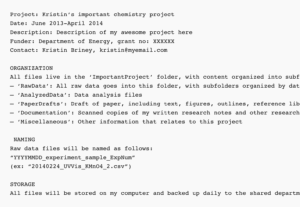
The above example provides enough information for someone to know what the project is and to navigate through the folders. If your organization is complex, you may include other readme files as necessary to further describe your data.
1. Briney, Kristin. (2014, February 25). Readme.txt. DATA AB INITIO: Managing data right, from the start. http://dataabinitio.com/?p=378(opens in a new tab). The original is licensed under a Creative Commons Attribution 4.0 International license.
A readme file for data deposit may need to follow recommendations from the repository you want to deposit with, and typically includes the following information:
Note that the above list was abbreviated from Cornell’s Guide to writing “readme” style metadata. Please refer to their guide for more in-depth explanations.
This template was created by Cornell University and is available to be re-used and repurposed under a CC0 1.0 public domain license.