Main Body
1
Learning Objectives
- Become familiar with study procedure and expectations
- Perform units conversions within SI and US Customary systems
Study Procedure
Delivery of this course is based on the Applied Strength of Materials for Engineering Technology textbook, by Dr. Barry Dupen. You have access to the textbook in electronic format and/or hard copy.
For best results I suggest following this sequence:
- Before commencing a new chapter, read the corresponding theory from the textbook and review the example problems. Some topics were already covered in Applied Physics but you will benefit from a brief review. Moving to a new topic will be announced in class.
- Classroom lectures:
- Instructor will review the theoretical concepts and answer questions
- Instructor will demonstrate solving selected problems. Hand notes of these solutions will be available through D2L.
- Students will solve assigned problems in small groups, with guidance from instructor
- Individual work
- Students will solve on their own assigned problems to self-evaluate their understanding.
- Instructor will provide guidance and feedback during posted office hours or Tutorial Sessions
- Evaluation – selected topics will be assessed through quizzes, announced in class
Strength of Materials is a “methodical” discipline. This means that it deals in general with standard/classical questions that usually have an established method of solving them. When solving problems students often follow steps and procedures that were previously demonstrated in class or in the textbook. These approaches are logical and never students would be expected to memorize them. However, it is important for students to practice solving questions on their own since this will help them see patterns in questions, provide them with problems solving experience and help them complete the exercise in the allotted time.
It is recommended to work at home between 2 and 3 hours for each hour of class lecture. This effort will be different for each student. For best efficiency consider attending the scheduled tutorials where you can reach to your instructor for help.
Units and Conversions
Like in many other engineering disciplines calculations may be performed in both systems of units, US Customary and SI. While Canada has officially adopted the SI (metric) system in 1970, economic cooperation with US companies requires engineering graduates to be fluent in both systems. Some computational software that you will use may be available only in US Customary units, being developed in US, and mostly for American users. It is therefore imperative to be able to complete calculations in both systems of units and to be able to convert between systems.
When solving problems, if the data is given in SI units, complete the solution in SI units. Similarly for US Customary units; there is not need to switch the system of units.
When performing conversions please observe the following.
In the metric system prefixes are added to base and derived units to form names and symbols that are multiples of SI units. A list of commonly used SI prefixes is given in Appendix A. For a complete list see Figure 1.
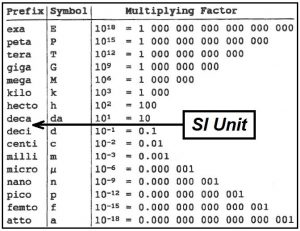 Fig. 1 – SI System Prefixes
1. Convert 0.2 km to cm

- When performing SI conversions it is easy to see if your answer is reasonable or not. For instance if you move from a large unit (kilo) to a smaller one (centi), the resulting value should be greater.
- Looking at Fig. 1, you may also consider moving the decimal point to the right, three steps from Kilo to base and two more steps from base to your final answer. This is an alternative approach to performing SI conversions.
2. Convert 50 000 cW to kW

- Note that some units may be presented with a less commonly used prefixes. For instance, while “centimeter” is frequently used, “centiwatts” not so much. However, you should be able to identify the prefix and the unit it applies to.
3. Convert 300 000 cm3 to dam3

- You may look at this conversion as follows:

- Pay extra attention when using powers, as in volume or area conversions.
For the purpose of this course most of the US Customary conversions will deal with linear dimensions. The conversion factors that we use are presented in Appendix A. At some point you are expected to remember the most used factors such as 1 ft = 12 in or 1 yd = 3 ft.
4. Convert 1.2 yards to inches

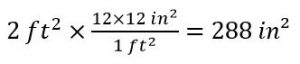
5. Convert 2 square feet to square inches
Exercises
- The hoop stress in a pressure vessel is calculated with the formula
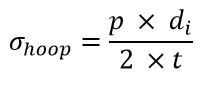 where p is the design pressure, di is the inside diameter and t is the wall thickness.
- If p = 4450 kPa, di = 1.8 m and t = 20 mm, determine the hoop stress in the wall, in MPa.
- If p = 645 psi, di = 6 feet and t = ¾ in, determine the hoop stress in the wall, in ksi.
- To determine the dead load on a foundation you are required to estimate the weigh of a spherical tank (V=4/3 πr3), full with a liquid of given density. Tank mass is negligible compared to the mass of the product. Determine its weight based on the following:
- Diameter = 200 cm, density = 1.12 g/cm3. Answer in N.
- Diameter = 80 in., density = 70 lb/ft3. Answer in lb.