2. PROFESSIONAL STYLE
2.3 Communicating with Precision
So far we have discussed the importance of being reader focused and on understanding how to select genres and rhetorical strategies that are appropriate for your reader and context. With these foundations firmly in place, we can explore more specific characteristics of the actual writing. Two key characteristics of professional technical communication are that it is precise and concise. Writing that is overly wordy, vague, or ambiguous can lead to irritation and confusion for your reader. If something is vague or ambiguous, readers may need to follow up for clarification, wasting time and resources. Or they may simply misinterpret, causing implementation problems or other issues. Readers of technical writing expect precision and concision to be evident at all levels, from the overall document design, to paragraphing, to sentence structure, to word choice, and even to punctuation (see Punctuation Matters!). You should be able to articulate a rationale for every word you choose.
The 7 Cs of Professional Writing
The 7 C’s are simply seven words that begin with C that characterize strong professional style:
- Clear
- Coherent
- Concise
- Concrete
- Correct
- Complete
- Courteous.
CLEAR writing involves knowing what you want to say before you say it, because often a lack of clarity comes from unclear thinking or poor planning; this, unfortunately, leads to confused or annoyed readers. Clear writing conveys the purpose of the document immediately to the reader; it matches vocabulary to the audience, avoiding jargon and unnecessarily technical or obscure language while at the same time being precise. In clarifying your ideas, ensure that each sentence conveys one idea, and that each paragraph thoroughly develops one unified and coherent concept.
COHERENT writing ensures that the reader can easily follow your ideas and your train of thought. One idea should lead logically into the next through the use of transitional words and phrases, planned repetition, sentences with clear subjects, and headings that clearly preview the content. Writing that lacks coherence often sounds “choppy” and ideas seem disconnected or incomplete. Coherently connecting ideas is like bridges between islands of thought so the reader can easily move from one idea to the next and see how they connect and build upon each other.
CONCISE writing uses the least words possible to convey the most meaning while still maintaining clarity. Avoid unnecessary padding, awkward phrasing, overuse of “to be” forms (is, are, was, were, am, be, being), long preposition strings, vagueness, and unnecessary repetition. Use active verbs whenever possible, and take the time to choose a single word rather than a long phrase or cliched expression. Think of your word count like a budget; be cost effective by making sure every word you choose does effective work for you. Cut a word, save a buck! As William Zinsser asserts, “the secret of good writing is to strip every sentence to its cleanest components.”[1]
CONCRETE writing involves using specific, precise language to paint a picture for your readers so that they can more easily understand and even create a mental picture of your ideas. If you have to explain an abstract concept or idea, try to use specific examples, analogies, and precise language to illustrate it. Use measurable descriptors whenever possible; avoid vague terms like “big” or “good.” Try to get your readers to visualize your ideas by using specific terms and descriptions.
CORRECT writing, in a technical context, generally uses Standard English punctuation, sentence structure, usage, and grammar; however, what is considered “correct” might change from one context to another (grammar and punctuation in texting might be different than in emails). Being correct also means ensuring that you are fact-checking and providing accurate information. Choosing an appropriate genre for your task and adhering to the conventions of that genre also qualify as correctness.
COMPLETE writing includes all requested information and answers all relevant questions. The more concrete and specific you are, the more likely your document will be complete as well. Review your checklist of specifications before submitting your document to its intended reader.
COURTEOUS writing entails designing a reader-friendly, easy-to-read document; using tactful language and appropriate modes of addressing the audience; and avoiding potentially offensive terminology, usage, and tone. As we have discussed in an earlier section, without courtesy you cannot be constructive. The APA’s Bias Free Language guide offers advice and examples for how to maintain courtesy in various contexts.
In some cases, some of these might come into conflict: what if being too concise results in a tone that sounds too terse, or an idea that seems incomplete or disconnected from the ideas around it? Figure 2.3.1 illustrates one method of putting all the 7Cs together.
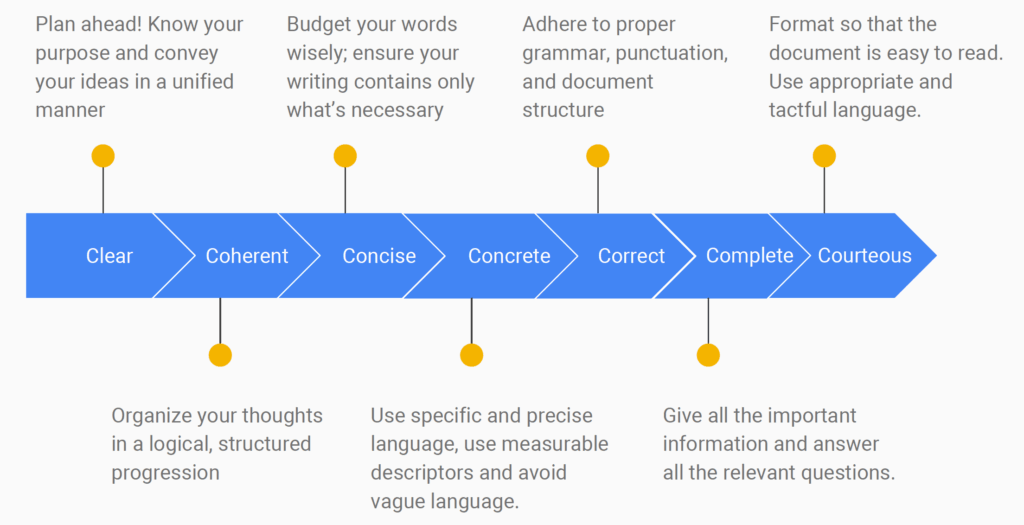
Be mindful of the tradeoffs, and always give priority to being clear: writing that lacks clarity cannot be understood and therefore cannot achieve its purpose. Writing that adheres to the 7 C’s not only communicates effectively and efficiently, but also helps to establish your credibility as a technical professional.
EXERCISE 2.6 Revise for clarity
Remember the librarian’s one-sentence memo from the Case Studies in Chapter 1.5? Try revising it so that it adheres to the 7 Cs; make it clear, coherent, concrete and concise, while also being complete, courteous and correct.
MEMO
When workloads increase to a level requiring hours in excess of an employee’s regular duty assignment, and when such work is estimated to require a full shift of eight (8) hours or more on two (2) or more consecutive days, even though unscheduled days intervene, an employee’s tour of duty shall be altered so as to include the hours when such work must be done, unless an adverse impact would result from such employee’s absence from his previously scheduled assignment.
Sentence Variety and Length
While variety makes for interesting writing, too much of it can also reduce clarity and precision. Technical writing tends to use simple sentence structures more often than academic writing does. That said, simple does not necessarily mean “simplistic,” short, or lacking in density. Remember that in grammatical terms, simple just means that it has one main clause (one subject and one predicate). You can convey a lot of information in a simple sentence.
The other consideration for precise writing is length. Your sentences should vary in length just as they can vary in type. However, you want to avoid having too many long sentences because they take longer to read, are often more complex, and can lead to confusion. Long sentences with multiple clauses may be appropriate in academic writing but are less so in technical writing. The goal is to aim for an average of around 20 to 30 words per sentence. Reserve the short sentences for main points and use longer sentences for supporting points that clarify or explain cause and effect relationships or comparisons. If you feel the sentence is too long, break it into two sentences. You do not want your reader to have to read a sentence twice to understand it.
When you make compound or complex sentences, ensure that you use appropriate coordinating or subordinating strategies to make the relationship between clauses perfectly clear. Sentence structures are not simply arbitrary grammar rules; these structures have a kind of built-in rhetorical structure.
Simple Sentences are often “declarative” and provide clear information in a straightforward manner. They are good for emphasizing a main point.
Compound sentences, made up of two independent clauses, combine two related ideas in a way that gives them roughly equal weight. This is an effective structure for discussing pros and cons. If you start a paragraph with a compound sentence, the reader will expect the paragraph to contain a balanced discussion of both ideas, without necessarily “taking a side.”
Complex sentences, which combine dependent with independent clauses (using a subordinating conjunction such as “while” or “although”), show a more complicated relationship between ideas, usually giving the idea in the main (independent) clause more weight or importance than the idea in the dependent clause. Starting your paragraph with a complex topic sentence will lead your reader to expect you to focus more on the idea in the independent clause.
EXERCISE 2.7 The Rhetorical Aspects of Sentence Structure
Think about ways of combining these two simple sentences into either a compound sentence (using a coordinating conjunction like “but”) or a complex sentence (using a subordinating conjunction such as “although” or “while”), and then consider what expectations these topic sentences might convey to the reader:
- Nuclear power plants can pose significant environmental dangers.
- Nuclear energy is a clean and efficient way to generate power and transition away from fossil fuels.
What do you expect the author’s argument will be based on this complex topic sentence:
“While nuclear energy is a clean and efficient way to generate power and transition away from fossil fuels, they can pose significant environmental dangers.”
The last clause is given more rhetorical power, right? It builds the expectations that the paragraph will focus on the dangers more than the benefits.
Note what happens to the rhetorical power of the sentence when you place the subordinate clause last:
“Our proposed solution will provide unique benefits for the target users, although two other organizations in the community are doing something similar.”
Does it undercut the power of the first clause? Does it seem like a bit of an unplanned after-thought? What happens when we switch them around?
“Although two other organizations in the community are doing something similar, our proposed solution will provide unique benefits for the target users.“
See Appendix E to review specific information on simple, compound, and complex sentence structures.
Precise Wording
Technical writing is precise writing. Vague, overly general, hyperbolic or subjective/ambiguous terms are simply not appropriate in this genre. You want to avoid choose words or phrasing that could be interpreted in more than one way. For example, if you asked someone to define what makes a “good dog,” you might get responses like obedient, hunter/retriever, well-behaved, affectionate, loyal, therapeutic, goofy, or “all dogs are good!” Similarly, if you asked a group of people what makes a “good salad,” you might get a variety of different responses, based on their personal tastes.
Choose words that most precisely, concisely, and accurately describe the idea you want to convey. Below are some guidelines and examples to follow for using precise wording.
1. Avoid clichés.
Clichés are expressions that you have probably heard and used hundreds of times. They are over-used expressions that have largely lost their meaning and impact. Try to replace them with something more original and specifically related to your context.
| Clichés | Alternatives |
| as plain as day | plain, obvious, clear |
| ballpark figure | about, approximately, estimate |
| few and far between | rare, infrequent |
| needless to say | of course, obviously |
| last but not least | finally, last |
| as far as ___ is concerned | what does this phrase even mean? |
2. Avoid cluttered constructions.
When speaking, we tend to emphasize ideas by adding in redundant words or phrases to make our point. In written form, however, these can just seem cluttered and unnecessary. Note where they can be deleted below.
| Redundancies | ||
| join |
unite |
|
| finish |
refer/return/revert |
emphasize |
| examine |
||
| rely/depend |
||
| plan |
protest |
|
| gather |
||
| years |
||
| in |
||
3. Use accurate wording.
Sometimes this requires more words instead of fewer, so do not sacrifice clarity for concision. Make sure your words convey the meaning you intend. Avoid using words that have several possible meanings; do not leave room for ambiguity or alternate interpretations of your ideas. Keep in mind that readers of technical writing tend to choose literal meanings, so avoid figurative language that might be confusing. For example, some people use the word “decent” colloquially to mean good (he makes a “decent” cappuccino!). Decent literally means “appropriately dressed” and is the opposite of “indecent.” So it would be more accurate to say he makes a delicious (or strong or authentic) cappuccino.
Separate facts from opinions by using phrases like “we recommend,” “we believe,” or “in our opinion.” Use consistent terminology, even it if seems repetitive, rather than looking for synonyms that may be less precise. Qualify statements that need qualifying, especially if there is possibility for misinterpretation. Do not overstate through the use of absolutes and intensifiers. Avoid overusing intensifiers like “extremely,” and avoid absolutes like “never, always, all, none” as these are almost never accurate (see what I did there?). Remember Obiwan Kenobi’s warning:
“Only a Sith deals in absolutes.”[3]
We tend to overuse qualifiers and intensifiers, so below are some that you should be aware of and consider whether you are using them effectively.
| Overused Intensifiers | ||||
| absolutely | actually | certainly | clearly | completely |
| definitely | drastically | extremely | fundamentally | highly |
| interestingly | incredibly | inevitably | indeed | markedly |
| naturally | of course | particularly | really | significantly |
| surely | totally | tremendously | utterly | very |
| Overused Qualifiers | |||||
| apparently | arguably | basically | essentially | generally | hopefully |
| in effect | in general | kind of | overall | perhaps | quite |
| rather | relatively | seemingly | somewhat | sort of | virtually |
For a comprehensive list of words and phrases that should be used with caution, see Kim Blank’s “Wordiness, Wordiness, Wordiness List.” [4]
4. Prefer the active voice.
The active voice emphasizes the person/thing doing the action in a sentence. For example, The outfielder throws the ball. The subject, “outfielder” actively performs the action of the verb “throws.” Conversely, the passive voice emphasizes the recipient of the action. In other words, something is being done to something by somebody: The ball was thrown (by the outfielder). Passive constructions are generally wordier and can often leave out the person/thing doing the action.
| Active | Passive |
| S →V →O | S ←V ←O |
| Subject → actively does the action of the verb → to the object of the sentence | Subject ← passively receives the action of the verb ← from the object |
| Subject → acts → on object | Subject ← is acted upon ← by the object |
The passive voice has a place, particularly if you want to emphasize the receiver of an action as the subject of the sentence, or the action itself, or you want to avoid using first person or identifying the doer of the action (“mistakes were made”). However, its overuse results in writing that is wordy, vague, and stuffy. When possible, use the active voice to convey who or what performs the action of the verb. Stress the doer, not what was done.
Precise writing encapsulates many of the 7 C’s; it is clear, concise, concrete, and correct. But it is also accurate and active. To write precisely and apply the 7 C’s, it is important to look critically at your sentences, perhaps in a way you may not have done before. You need to consider the design of those sentences, from the words to the phrases to the clauses, to ensure that you are communicating your message effectively.
Image descriptions
Figure 2.2.1 image description:
A priority list of the 7 Cs.
- Clear: Plan ahead! Know your purpose and convey your ideas in a unified manner.
- Coherent: Organize your thoughts in a logical, structured progression.
- Concise: Budget your words wisely; ensure your writing contains only what’s necessary.
- Concrete: Use specific and precise language, use measurable descriptors and avoid vague language.
- Correct: Adhere to proper grammar, punctuation, and document structure.
- Complete: Give all the important information and answer all relevant questions.
- Courteous: Format so that the document is easy to read. Use appropriate and tactful language.
- W. Zinsser, “Simplicity,” [Online]. Available: http://www.geo.umass.edu/faculty/wclement/Writing/zinsser.html ↵
- Figure 2.3.1 created by Alyssa Zicari and Jenna Hildemann; used with permission ↵
- Star Wars: Episode III - Revenge of the Sith (2005). [Film]. Directed by G. Lucas ↵
- K. G. Blank, “Wordiness list,” Department of English, University of Victoria [Online]. Available: http://web.uvic.ca/~gkblank/wordiness.html ↵