5. CONDUCTING RESEARCH
5.6 Public Engagement and Consultation
Suzan Last
An important area of primary research undertaken when embarking on any large scale project entails engaging or consulting with relevant and interested parties. Public engagement is the broadest term used to describe the increasingly necessary process that companies, organizations, and governments must undertake to achieve a “social licence to operate.” Engagement can range from simply informing the public about plans for a project, to engaging in more consultative practices like getting input and feedback from various groups, and even to empowering key community members in the final decision-making process. If you have been asked to complete a survey or provide feedback on a design or proposed project, then you have likely been part of a public engagement campaign.
For projects that generate social, economic, and environmental impacts, engagement and consultation is an increasingly critical part of the planning and development stages. Creating an understanding of how projects will affect a wide variety of people, organizations, and the environment is beneficial for both the company instigating the project and those who will be affected by it. Listening to feedback and concerns — especially from those with “lived experience” — can be helpful in identifying and mitigating risks that could otherwise slow down or even derail a project. For impacted parties, the consultation process creates an opportunity to both stay informed and be heard. They can inform the company about local contexts that may not be obvious to those from outside the community, raise issues and concerns, and help shape the objectives and outcomes of the project.
Who should be consulted?
When determining who you need to engage with, consider who (or what) will be impacted by the project, and who has the potential to impact or influence project decisions and implementation.
Consider using the Four I Framework (shown in Figure 5.6.1) for engagement and consultation:
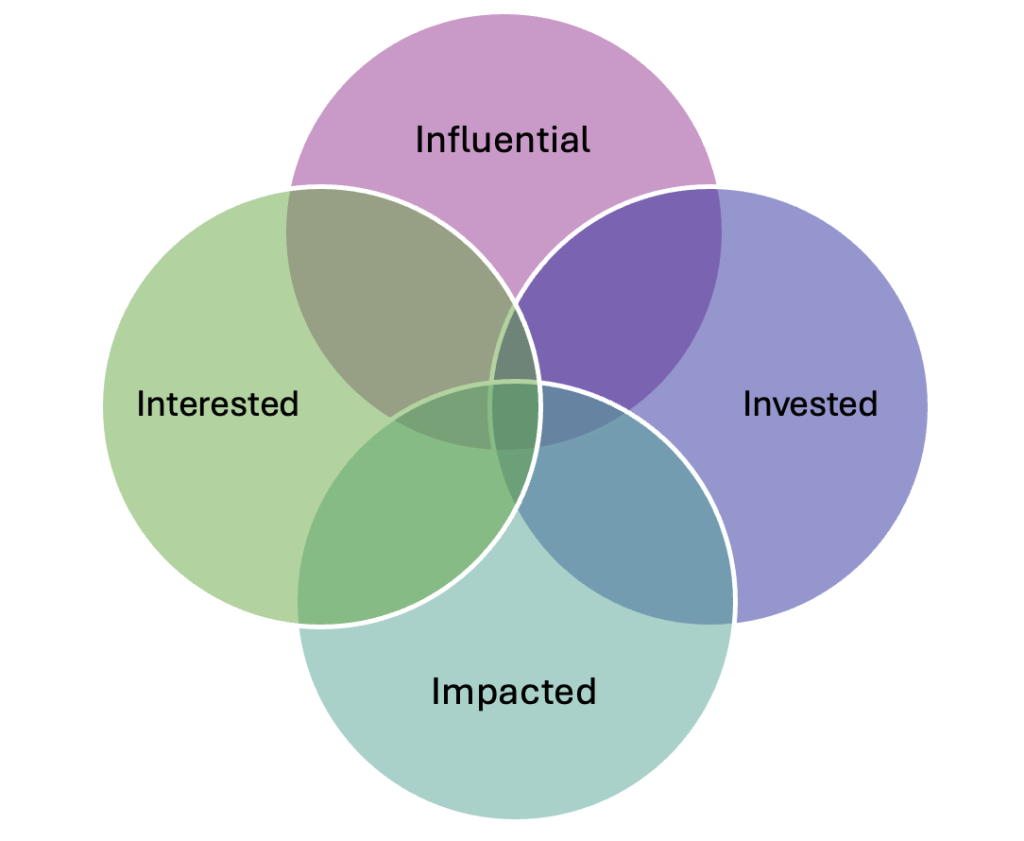
“Relevant parties” include individuals and groups who have the power to influence the project (decision makers, people with political or economic power), those who are invested (financially or otherwise), those who might simply be interested in the project, and those who will likely be impacted by the project, either positively or negatively. They can be internal – people from within the company or organization (owners, managers, employees, shareholders, volunteers, interns, students, etc.) – and external, such as community members or groups, investors, suppliers, consumers, policy makers, etc. Increasingly, arguments are being made for considering non-human parties such as wildlife and the natural environment as well.[1]
Historically, the term “stakeholder” has been used as a catch-all term to refer to any individual or group who may have a direct or indirect “stake” in the project. However, in the Canadian context, this term has come to be seem as problematic, especially in Indigenous contexts. Here is an explanation for why from the BC Government website on Terminology in Indigenous Content:
‘Stakeholder‘ is a common corporate term for partners which has negative connotations to many Indigenous Peoples. When land acquisition was happening, this term referred to the allotment of land to settlers. Settlers were given wooden stakes to claim their plot of land prior to any treaty or land negotiations with Indigenous Peoples. It’s more appropriate to refer to Indigenous Peoples as partners rather than stakeholders. Indigenous Peoples are not stakeholders; they’re Aboriginal rights holders whose rights are protected under the Constitution of Canada.
When engaging in projects, it is becoming increasingly important to engage and consult with a wide variety of relevant and interested parties, and this often includes Indigenous communities and organizations. Therefore, it’s wise to consider alternatives to the word “stakeholder” that you might use in various contexts to more precisely determine who should be consulted and what kind of engagement is needed.
Engaging and consulting with relevant parties can contribute significantly to the decision-making and problem-solving processes. People most affected by the problem and most directly impacted by its effects can help you to
- understand the context, issues, and potential impacts more fully
- determine your focus, scope, and objectives for solutions
- establish whether further research is needed into the problem.
People who are also attempting to solve the same or similar problem can help you
- refine, refocus, and prioritize solution ideas
- define necessary steps to achieving them
- implement solutions, provide key data, resources, etc.
There are also people who could help solve the problem, but lack awareness of the problem or their potential role to influence outcomes. Consultation processes help create the awareness of the project to potentially get these people involved during the early stages of the project.
Mapping the Social Landscape
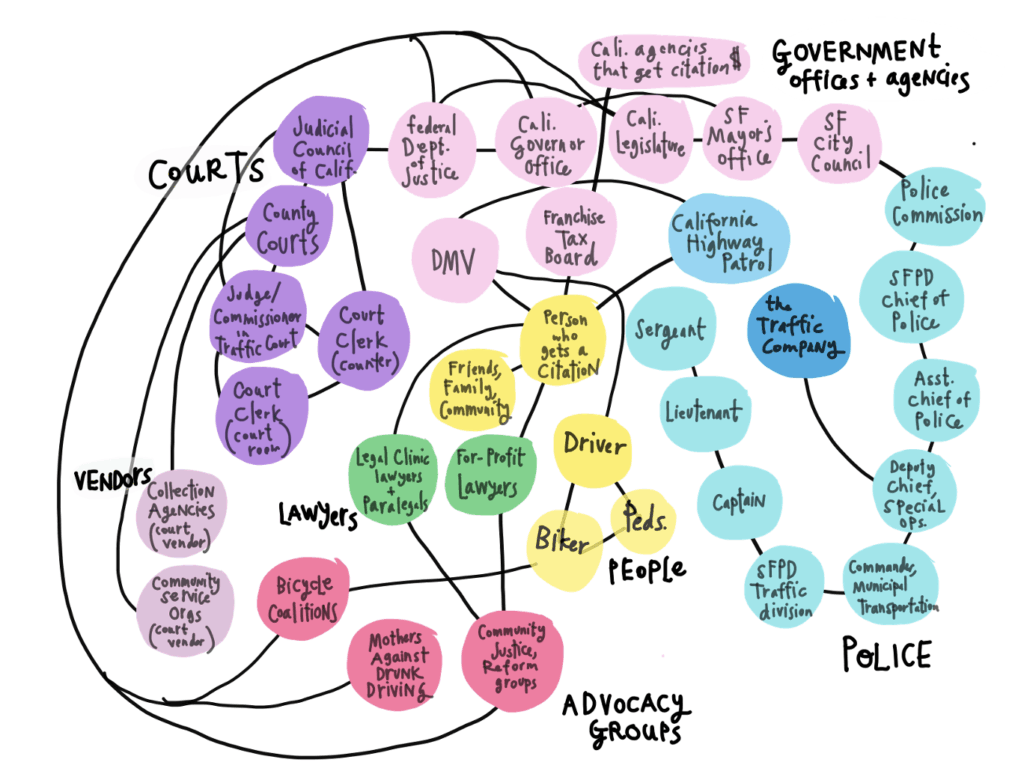
The more a group will be materially affected by the proposed project, the more important it is for them to be identified, properly informed, and encouraged to participate in the consultation process. It is therefore critical to determine who the various relevant parties are, as well as their level of interest in the project, the potential impact it will have on them, and power they have to shape the process and outcome. You might start by brainstorming or mind-mapping all the people and groups you can think of in the “social landscape” that might influence or be affected by your project. See Figure 5.6.2 as an example.
Social Landscape Map for Traffic Citation System
EXERCISE 5.3 – Map the social landscape for your project idea
- Brainstorm a list of as many people, organizations, groups, companies and other relevant parties that you can think of who might be impacted, invested, influential, and/or simply interested. Consider what values they might hold, their priorities, and potential “social capital” to help or block the change you are proposing to enact in this landscape.
- Organize your list into a visual “network” or map (perhaps like the one in Figure 5.6.2, but you can also use different formats) showing where connections may exist, or categorizing the parties into various groups with similar values or roles. This may take several tries and it may look messy — that’s fine. This map is for your team to use and analyze; it’s not meant for an outside audience.
- Analyze your map to see what you can learn from it. Can you identify areas where gaps exist that your project might help to fill? Opportunities to build partnerships? Tricky areas where you might run into opposition or competition? Alignments you hadn’t seen before?
Use this to help you understand your potential audiences and to determine who you might need to engage with and at what level.
Once you have identified the individuals, groups and organizations that may be impacted, interested and involved, you can then organize them into categories or a matrix. One standard method of organizing is to determine which ones are likely to support the project and which are likely to oppose it, and then determine how much power or influence each of those groups has (see Figure 5.6.3). For example, a mayor of a community has a high level of influence. If the mayor fully supports the project, they would go in the top right corner of the matrix. Someone who is deeply opposed to the project, but has little influence or power, would go at the bottom left corner.
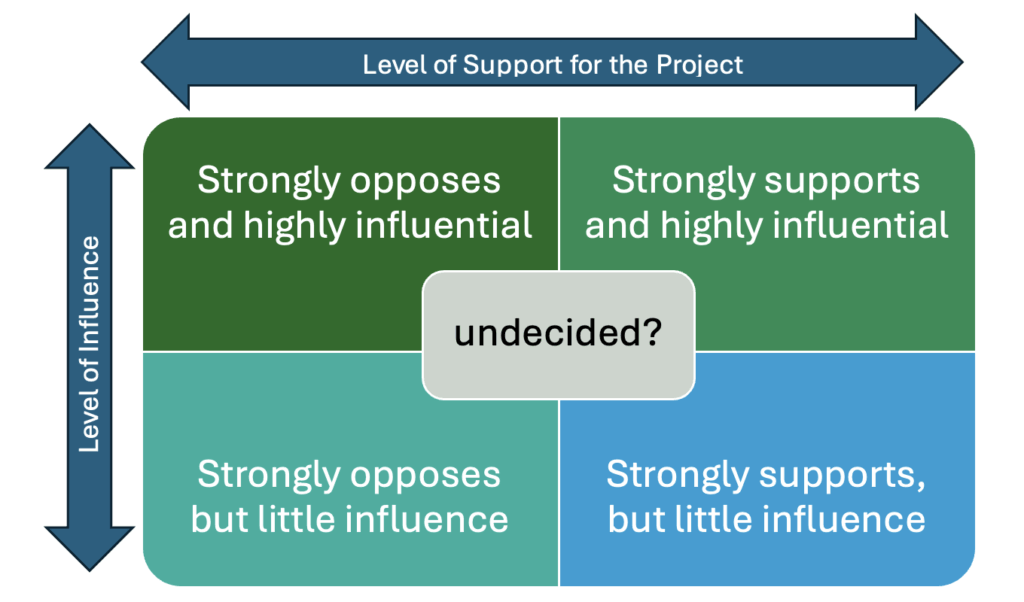
A matrix like this can help you determine what level of engagement is warranted: where efforts to “consult and involve” might be most needed and most effective, or where more efforts to simply “inform” might be most useful, or even where you might try to recruit volunteers. Also consider the level of knowledge each party has on the issue, level of commitment (whether in support or opposed), and resources available.
Levels of Consultation and Engagement
Levels of engagement range from simply informing people about your plan to actively seeking consent and placing the final decision in their hands. This range, illustrated in Figure 5.6.4, is typically presented as a “spectrum” of engagement from the lowest to highest level of engagement.

Depending on the type of project, the potential impacts and the needs of those involved, you may engage in a number of levels and strategies of engagement across this spectrum using a variety of different tools.
Consider how and why you might engage with various parties relevant to your project at each level of engagement:
Inform: Provide balanced and objective information to help people understand the project, the problem, and the solution alternatives. This level affords little or no opportunity for providing input or helping with decision-making.
Consult: Gather feedback on the information given. Level of input can range from minimal interaction (online surveys) to extensive (focus groups). These can be a one-time or ongoing/iterative opportunities to give feedback and have input considered in the decision-making process.
Involve: Work directly with interested and impacted parties during the process to ensure that their concerns and desired outcomes are fully understood and taken into account at each stage. Final decisions are still made by the consulting organization, but with well-considered input from those engaged.
Collaborate: Partner with relevant parties at each stage of the decision-making, including developing alternative solution ideas and choosing the preferred solution together. The goal is to achieve consensus regarding decisions.
Empower: Place final decision-making power in the hands of those being consulted. Voting ballots and referenda are common examples. This level of engagement is rare and usually includes a small number of people who represent highly invested community groups.
Many tools are available to help structure different kinds of engagement. Table 5.6.1 lists many options, categorized by where they tend to fall on the spectrum. Depending on how you use them, some strategies may fall in more than one category.
| Inform | Consult | Involve / Collaborate / Empower |
|---|---|---|
|
|
|
Planning an Engagement Project
There is no single “right” way to engage in consultation. Each situation will have different contexts and requirements so each consultation process will be context-specific and will require a detailed plan based on research and analysis. A poorly planned consultation process can backfire as it can lead to a lack of trust between those being engaged and the company doing the engagement. In such cases, the “engagement” can seem like a public relations stunt, or even an attempt to deceptively persuade. Therefore, it is critical that you carefully plan the process in advance, and do the preliminary work to determine the needs and goals of the process and the relevant parties involved. In particular, make sure that whatever tools you choose to use are fully accessible to all parties you plan to consult; an online survey is not much use to a community that lacks robust internet infrastructure.
EXERCISE 5.5 – Start Planning Your Engagement Strategy
Follow these steps to develop your engagement plan:
- Situation Assessment: Determine who needs to be consulted about what and why. Use the planning tools above to categorize them and determine their level of involvement, interest level, and potential impact. Identify the needs and conditions for effective engagement in each category. For example, what kinds of accessibility requirements do you need to consider in choosing a venue?
- Goal Setting: Define your strategic purpose for consulting at this phase of the project. Create clear understandable goals and objectives for the role of those participating in the consultation and decision-making processes. Determine what questions, concerns, and goals the participants will have and how these can be integrated into the process.
- Planning/Requirements: Based on situation assessment and goals, select engagement strategies that will best achieve your goals. How will you promote the engagement event to ensure appropriate participation? Ensure that strategies consider issues of accessibility and inclusivity and consider the needs of vulnerable populations. Consider legal or regulatory requirements, policies, or conditions that need to be met. Determine how you will collect, record, track, analyze and disseminate the data.
- Process and Event Management: Determine how you will keep the planned activities moving forward and on-track, and adjust strategies as needed. Make a plan for recording of responses of participants and tracking documentation.
- Evaluation: Design an evaluation metric to gauge the success of the engagement strategies; collect, analyze, and act on the data collected throughout the process. Determine how will you report the results of engagement process back to the participants.
As you can see, consultation and engagement processes require strong communications skills. Effective communication is the foundation for meaningful engagement, which relies on the following skills:
- Written and visual rhetoric: Create and disseminate useful written and visual information that will motivate relevant parties to participate in the consultation process.
- Interpersonal and intercultural skills: Relate to people in face-to-face situations to develop meaningful relationships and build trust. Actively listen to those being engage; make participants feel comfortable and secure; remain mindful of cultural factors that may affect interest level, trust, accessibility, impact, values, or opinions.
- Public speaking: Present information to large audiences in a comfortable and understandable way, u sing “natural language” to enhance understanding of complex information. Aim to create effective visual aids that assists the audience’s understanding by illustrating ideas clearly.
- Active Listening: Focus on the feedback from participants and react in ways that provide them with the time, space, and security needed to be heard and understood. Report back accurately and fully what you have heard from participants.
EXERCISE 5.6 – Develop and Practice Conducting a Focus Group with your Classmates
Take this opportunity to practice some engagement skills in a classroom setting and get some feedback on your team project that will help you refine and revise your work-in-progress.
1: Determine as a team what feedback you want to get and why:
Ask yourselves: What are we struggling with, unsure of? What do we want to “test out” or validate? How will we use this feedback? What kinds of changes are will willing or able to make at this point?
Create open-ended questions and neutral prompts that will help you elicit this feedback; avoid “leading” questions where you are trying to get a certain response. The kinds of questions you ask will, of course, depend on what you are getting feedback on. Here are some very general examples:
- What stands out in the design? What seems most/least important?
- What do you think is the purpose of element X? What does element Y suggest to you?
- Does this design seem intended for you? Relevant to you?
- Would you use it/ find it valuable/convincing/credible?
- What changes would you suggest?
2. Select Strategies, Technologies, and Roles
Ask yourselves: How can we get the feedback we want? What strategies and technologies will we use? Verbal Q&A? Electronic survey? Interactive digital space (Google.doc, Kahoot, Zoom white board, etc). How much time do we have? What can we accomplish in that time frame? How will we collect and save the feedback? Will we share the data with participants?
3. Plan your Structure
Engage: Start with an Engagement Question to gauge your participants’ familiarity with your subject (have you ever…? How many of you have…? Etc). Continue using engagement strategies throughout the activity.
Clarify Purpose: Explain the purpose of your design, going over the various component parts and your reasons for choosing specific design elements. Describe the intended audience/user and desired impact. Be careful not to spend so much time on this that you don’t have enough time actually get feedback from participants.
Elicit Feedback: Ask questions and record feedback accurately. You might do this continually (while going over your design and audience) or you might do this at a certain stage in the activity. You might also answer questions from your participants.
Wrap up: thank your participants for their time and contributions to your project.
Additional tips:
Depending on the context and who your participants are, it’s wise to avoid asking participants to “justify” their responses (avoid asking “why?”) as this might make them feel “judged” and discourage them from further participating. Instead, ask follow ups like “Can you say more about…”
Get as many people to participate as possible, so you get diverse perspectives. You can encourage a variety of voices by asking, “Who else has something to say? I would love to hear more from…” You might ask participants to share similar experiences or problems they have had and suggest ideas or solutions.
Don’t feel like you have to “stick to the script” – feel free to explore and pursue unexpected ideas that come up. Leaving room for creativity is how innovation happens!
Engaging Responsibly
Engagement and consultation activities in a university setting that involve gathering information from “human subjects” — people — require Human Research Ethics Approval, a complex process (see Ch. 5.7 Human Research Ethics for more details on this). Collecting data from human participants is a form of “human research” and you must be aware of and follow strict ethical guidelines as laid out by your academic institution. Abiding by these guidelines is part of your responsibility to maintain academic integrity. For example, if you plan to implement an engagement strategy such as conducting surveys or interviews with participants outside of your class, make sure you have explicit permission from your instructor before you begin, and that you are following the Human Research guidelines of your institution.
Please note: Engagement and consultation with certain groups and communities requires specialized knowledge and should only be undertaken by engagement professionals who have had the requisite training and who have developed the necessary relationships to engage respectfully with vulnerable or marginalized groups about sensitive issues. For more information, see the following resources:
Cana Uluak itchuaqiyaq: Equipping Organizations, Researchers, and Educators in Effective, Equitable, and Respectful Engagement with Marginalized Knowledges, Communities, and Issues
Brenden Boyd and Sophie Lorefice: “Understanding Consultation and Engagement with Indigenous Peoples in Resource Development.” The School of Public Policy Publications, vol. 12(22), 2019.
Pia Dimayuga, et al., “A review of collaborative research practices with Indigenous Peoples in engineering, energy, and infrastructure.” Energy, Sustainability and Society, vol.13(1), 2023. pp. 1–17.
Scott D. Neufeld, et al., “Research 101: A process for developing local guidelines for ethical research in heavily researched communities,” Harm Reduction Journal, vol. 16 (41), 2019. https://doi.org/10.1186/s12954-019-0315-5.
Example Engagement Plan
University of Victoria’s “Campus Greenway Engagement Plan.”[2] offers an example of an engagement project on a university campus.
A significant step in this plan — a Design Charrette — was implemented in the fall of 2018; the results of that engagement activity, presented in a Summary Report (.pdf) [3] resulted in changes and augmentation of the original plan based on participant feedback. Most notably, participants did not like the term “Grand Promenade” and the whole project was renamed the Campus Greenway.
- C. Driscoll and M. Starik, “The primordial stakeholder: Advancing the conceptual consideration of stakeholder status for the natural environment,” Journal of Business Ethics, vol. 49, no. 1, 2004, pp. 55-73. Available: https://doi.org/10.1023/B:BUSI.0000013852.62017.0e ↵
- University of Victoria Campus Planning and Sustainability, “Engagement plan for: The University of Victoria Grand Promenade landscape plan and design guidelines,” Campus Greenway [Online]. Available: https://www.uvic.ca/campusplanning/current-projects/campusgreenway/index.php ↵
- University of Victoria Campus Planning and Sustainability, "The Grand Promenade Design Charrette: Summary Report 11.2018," Campus Greenway [Online]. Available: https://www.uvic.ca/campusplanning/current-projects/campusgreenway/index.php ↵