7. COMMON DOCUMENT TYPES
7.1 Correspondence: Emails and Letters
Netiquette
A great deal of business communication takes place over the internet. Text messaging, emailing, and posting on social media in a professional context requires that you be familiar with “netiquette,” or appropriate etiquette for using the internet. We have all heard the news stories about people who have been fired for posting content online that contravenes company policies by being offensive, harassing, or discriminatory. There are also many examples of companies that have been boycotted for making social or marketing missteps. People have even gone to prison for illegal use of private messaging. The digital world may seem like a free-for-all, “wild wild west” with no clear rules or regulations; however, this is clearly a dangerous perspective for a professional to take, as the consequences for breaking implicit rules, expectations, and guidelines for professional communications can be costly.
We create social media accounts, post messages, and interact via online technologies as a normal part of professional communication. How we conduct ourselves online and represent ourselves in writing carries significant weight and can leave a lasting image, literally. Writing in an online environment requires tact, skill, and an awareness that what you write may be there for a very long time and may be seen by people you never considered as your intended audience. The photograph you posted on an Instagram page may have been seen by your potential employer or client, or that insensitive remark posted on X may come back to haunt you later. Avoid embarrassment by by following these “netiquette” guidelines.
Know your context
- Familiarize yourself with policies on Acceptable Use of IT Resources at your organization.
- If you are not yet familiar with your “workplace culture”, err on the side of formality.
Remember the human
- Avoid making assumptions about your readers; remember there is a person behind the words and ask for clarification if something seems “off.” Remember that culture, gender and age can play a significant part in how people communicate
- Check your tone before you publish; avoid (or use with extreme caution) jokes, sarcasm, and irony as these can often be misinterpreted and get “lost in translation” in the online environment
- Respond to people using their names
- Remember that people may not reply immediately. People choose to work at different times (late in the day instead of early morning) and to participate in different ways (some just by reading the communication rather than jumping into into the conversation).
Recognize that text is permanent
- Be judicious and diplomatic; what you say online may be difficult or even impossible to retract later.
- When working collaboratively, agree on ground rules for text communication (formal or informal, etc); seek clarification whenever needed
Avoid flaming: research before you react
- Accept and forgive mistakes; we all make them at some point
- Consider your responsibility to the group and to the working environment
- Seek clarification before reacting; what you heard is not always what was meant
- If you must respond to an upsetting message, try waiting 24 hours if possible, to let emotions subside. Ask a colleague or peer to review your response before you send it.
- Ask your supervisor for guidance.*
Respect privacy and original ideas
- Quote the original author if you are responding with a specific point made by someone else
- Ask the author for permission before sharing or forwarding the communication.
* Sometimes, online behaviour can appear so disrespectful and even hostile that it requires attention and follow up from qualified individuals. In this case, let your supervisor know right away so that the right resources can be called upon to help.
For further information on netiquette, check out this LinkedIn article: Email etiquette: Setting the tone for your professional communication

Email is familiar tool for most students and workers, and in the workplace, has largely replaced hard copy letters for external (outside the company) correspondence, and in many cases, it has taken the place of memos for internal (within the company) communication.
The tone and style of professional emails can vary, depending on the context, but keep in mind professional communication still requires attention to detail, respectful tone, and an awareness that your email communication reflects you and your company. Remember also that an email can be forwarded to other readers, so never write or send anything that you wouldn’t want read by other colleagues, your boss, or someone outside your organization. Follow the guidelines below to present yourself as a professional when sending emails.
Use Your Professional Email: Avoid sending business emails from your personal email, especially if your email address sounds unprofessional or does not clearly identify who you are. Recipients might hesitate to open an email from “hoodooman21@me.com”
Subject Line: Including a clear, brief, and specific subject line helps the recipient understand the essence of the message. For example, “Electrical specs for project Y” or “Elevator maintenance in MacLauren D wing.” Keep in mind that your email may be going out to all employees, but perhaps not everyone needs to read about the elevator being out of commission in the D wing of the MacLauren Building. If I never go into that building, I may see the subject line and delete the email without having to reading it.
Salutation: Beginning your message with an appropriate salutation, addressing your reader by name if possible, demonstrates respect and can avoid mix-ups in case a message is accidentally sent to the wrong recipient. For example, use a formal salutation like “Dear Ms. Xi” (external) or “Hello Mei” (internal).
Message Format: divide your message into clear paragraphs for ease of reading. Be as concise as possible. A good email should (a) convey the main point quickly, (b) add whatever details are necessary, and (c) indicate what actions you might expect from the reader.
Style: Use a formal style unless you are confident that the rhetorical situation allows for an informal approach. Explain abbreviations and acronyms unless you are sure your reader is familiar with them. Avoid sarcasm, irony, or humour that may be misinterpreted.
Close with a signature: identify yourself by creating a signature block that automatically contains your name, title, and business contact information.
Reread, review, and revise: catch and correct spelling and grammar mistakes before you press “send.” Make sure you have actually attached that document you said is attached; make sure any links you have embedded work and take the reader where they are supposed to go. It will take more time and effort to react to the problems caused by a hasty, poorly-written email than to proactively take the time to get it right the first time.
Reply promptly: comply with the standard reply time of your organization. Often, readers will expect a response within 24 hours (during the work week), even if your reply is simply to acknowledge the message and indicate when the reader may expect a more detailed response. Some contexts have faster or slower expectations for turn around times. When dealing with sensitive or emotional topics, try to maintain a calm and reasonable tone and stick to factual information; never reply in anger.
Use “Reply All” sparingly: do not send your reply to everyone who received the initial email unless your message absolutely needs to be read by the entire recipient list.
Understand CC and BCC: CC stands for carbon copy; you can CC someone on an email to keep them in the loop, but not necessarily expect a response from them. BCC means “blind carbon copy” — if you use this, your main recipient will not know that you have also sent this message to the BCC recipient. It can be seen as deceptive to BCC, so be careful how you use it.
Avoid using ALL CAPS: using all capital letters in an online context tends to suggest emphatic emotion or “yelling” and can be considered rude.
Test links: if you include a link, test it to make sure it works.
Email ahead of time if you are going to attach large files: audio and visual files are often quite large; be careful to avoid exceeding the recipient’s mailbox limit or triggering the spam filter. If possible, send a link to where the reader can access the file online.
Follow up: if you don’t get a response in twenty-four hours, email or call. Spam filters may have intercepted your message, so your recipient may never have received it. Don’t assume they are ignoring you.
Pro Tip: Add the email address of your recipient last, after you have written and proofread your message. This will prevent you from sending prematurely. Take the time to do a last review of what you’ve written, make sure links work, and make sure you’ve added the attached document, before adding the recipient’s email address and hitting send.
Letters
Letters are typically sent to recipients who are outside the organization. They are often printed on letterhead paper that represents the business or organization, and are generally limited to one or two pages (but can be longer). While email may be used more frequently today, the business letter remains a common form of written communication. A cover letter can serve to introduce you to a potential employer; a sales letter can announce a new product or service; a complaint letter can alert a company to a problem with its product; and a letter of transmittal can introduce a longer formal report.
There are many types of letters, and many ways to format them. The most formal way to format a letter is to use the traditional block style, illustrated in Figure 7.1.1, a sample letter of transmittal meant to introduce a technical report to its recipient. Block style means everything on the page (except perhaps the logo and/or letterhead) is aligned on the left margin.
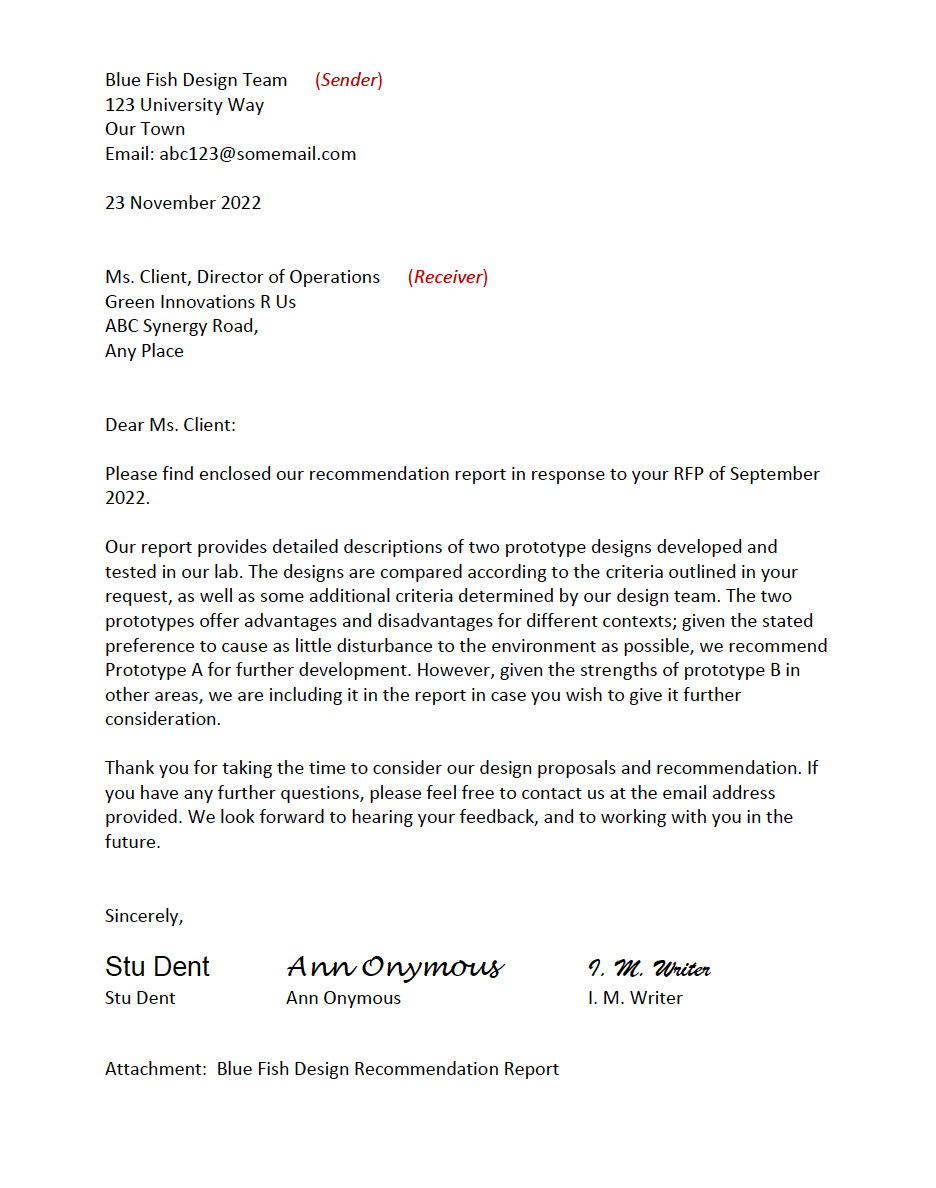
| Letterhead or logo | Companies typically have a standard letterhead that everyone uses when writing letters. This may or may not include a return address |
| Sender and Return address | Include your name and the address where replies can be sent (unless this information is included in the letterhead) |
| Date | Follow the standard date conventions used in your workplace (e.g. year-month-day is standard in Canadian government writing) |
| Recipient name and address | Include the name and title (if you know it) of the intended recipient, and the mailing address you have sent the letter to. |
| Re: | Some letters will include a subject line, like in a memo, indicating what the letter is in reference to (e.g. RE: your letter of August 12 requesting additional information…) or explaining the purpose of the letter. |
| Salutation | Formal letters generally start with “Dear” followed by first and last name, if you know them, or the title or position of the recipient, if you don’t know their name. Avoid assuming gender with terms like Ms. or Mr. |
| Message | Follow a logical structure by first indicating your purpose; then provide the details; and conclude by indicating what action or response you expect from the reader. |
| Sign off | Formal letters typically end with “Sincerely” followed by the signature of the sender(s), and their name(s) typed below. |
| Enclosure | If your letter introduces an attached document (form, report, or resume), use the word “Enclosure” (or ENC) followed by the title of the document, to indicate that the reader should find this attached. |
Letters with Specific Purposes
There are many possible reasons you might write a letter in a professional context. Here is a list of the most common kinds of letters:
Transmittal Letters: when you send a report or some other document, such as a resumé or brochure, to an external audience, you typically introduce it with a cover letter — called a letter of transmittal — that briefly explains the purpose of the enclosed document and a brief summary. Click the link to download a Letter of Transmittal Template (.docx).
Letters of Inquiry: you may want to request information about a company or organization such as whether they anticipate job openings in the near future or whether they fund grant proposals from non-profit groups. In this case, you would send a letter of inquiry, asking for additional information. As with most business letters, keep your request brief, introducing yourself in the opening paragraph and then clearly stating your purpose and/or request in the second paragraph. If you need very specific information, consider placing your requests in list form for clarity. Conclude in a friendly way that shows appreciation for the help you will receive.
Follow-up Letters: any time you have made a request of someone, write a follow-up letter expressing your appreciation for the time your recipient has taken to respond to your needs or consider your job application. If you have had a job interview, the follow-up letter thanking the interviewer for his/her time is especially important for demonstrating your professionalism and attention to detail.
Letters can have numerous additional purposes, such as communicating with suppliers, contractors, partner organizations, clients, government agencies, potential funders, and so on. See this resource on Business Letters for more detailed information and guidance on writing various kinds of business letters. As with any professional writing, your letter is most likely to be successful if you take the time to understand your audience, context and purpose.
- [Email icon]. [Online]. Available: https://www.iconfinder.com/icons/4417125/%40_email_envelope_letter_icon. Free for commercial use. ↵