7. COMMON DOCUMENT TYPES
7.4 Proposals
A proposal, in the professional writing context, is a document that tries to persuade the reader to implement a proposed plan or approve a proposed project or idea. Most companies and organizations rely on effective proposal writing to ensure successful continuation of their business and to get new contracts. The writer tries to convince the reader that the proposed plan or project is worth doing (worth the time, energy, and expense necessary to implement or see through), that the author represents the best candidate for implementing the idea, and that it will result in tangible benefits.

Proposals are often written in response to a Request For Proposals (RFP) by a government agency, organization, or company. The requesting body receives multiple proposals responding to their request, evaluates the submitted proposals, and chooses the best one(s) to go forward. Their evaluation of the submitted proposals is generally based on how well the proposal demonstrates a clear understanding of the problem and how well the proposed solution idea meets the requirements outlined in the RFP. Thus, your proposal must persuade the reader that you understand the needs, values and goals of your reader, and your idea is the one most worth pursuing. Proposals are persuasive documents intended to initiate a project and get the reader to authorize the course of action proposed in the document.
Proposals can have various purposes and thus take many forms. Depending on the kind of proposal you are writing, they may include some of the following sections:
- Introduction and/or background context
- Statement of problem to be solved (or opportunity to improve or innovate)
- Purpose/motivation/goal/objectives
- Definition of scope and approach (limitations)
- Review of the state of the art; market analysis
- Social Landscape Analysis
- Technical background
- Project description
- Schedule of work/timeline
- Validation plan; or Marketing plan
- Budget
- Qualifications
- Conclusion
A proposal in a business context might have sections that focus on market analysis, customer profiles, financial planning and promotional strategies. A technical proposal might place more emphasis on technical descriptions, reviewing the state-of-the-art technology, and creating a plan for validating the solution.
Four Kinds of Proposals
There are 4 kinds of proposals, categorized in terms of whether or not they were requested, and whether they are meant to solve a problem within your own organization or someone else’s. From the following descriptions, you will see that can they also overlap to some degree:
Solicited Proposals: an organization identifies a situation it wants to improve or problem that it wants to solve and issues a Request for Proposals (RFP) on how to address or solve it. The requesting organization will vet proposals and choose the most convincing one, using a detailed scoring rubric to determine which proposal best responds to the request.
Unsolicited Proposals: a writer perceives a problem or an opportunity and takes the initiative to propose a way to solve the problem or take advantage of the opportunity (without being requested to do so). This can often be the most difficult kind of proposal to get approved, especially if they require significant resources that were not budgeted for previously.
Internal Proposals: these are written by and for someone within the same organization. Since both the writer and reader share the same workplace context, these proposals are generally shorter than external proposals, and usually address some way to improve a work-related situation (productivity, efficiency, profit, etc.). As internal documents, they are often sent as memos, or introduced with a memo if the proposal is lengthy.
External Proposals: these are sent outside of the writer’s organization to a separate entity (usually to solicit business). Since these are external documents, they are usually sent as a formal report (if long), introduced by a cover letter (letter of transmittal). External proposals are usually sent in response to a Request for Proposals (solicited), but not always.
EXERCISE 7.3 Task Analysis
Identify the kind of proposals you are tasked with writing by placing them within the grid below. Given the kind of proposal you are writing and the rhetorical situation you are in, what forms will be most appropriate to use (memo, letter, short or long report, oral presentation, etc.)?
| Solicited | Unsolicited | |
| Internal | ||
| External |
Structuring Your Proposal
Each proposal will be unique in that it must address a particular audience, in a particular context, for a specific purpose. However, the following offers a fairly standard organization for many types of proposals:
| Introduction/ Background |
Clearly and fully define the problem or opportunity addressed by the proposal. You may need to include background to convince the reader that you fully understand the problem or “unsatisfactory situation” and can solve it. Rubrics that assess proposals generally place significant weight (~20%) on clarity and accuracy of the problem definition. Briefly presents the solution idea that you will describe in more detail in the following sections. |
| Project Description |
Detailed description of the proposed solution idea, including its scope (what it will and won’t do), and information necessary to understand how and why it should be implemented (implementation plan or methodology, potential obstacles, costs and benefits). This will likely be the most detailed part of the proposal and may be broken down into several sub-sections. |
| Credentials |
Establish writer’s qualifications and experience to pursue this project. |
| Timeline and Budget |
Provide a detailed timeline (often with a Gantt Chart) for completing the project. Provide an itemized budget for resources necessary to complete the proposed project. |
| Conclusion |
This is your last chance to convince the reader that your proposal has significant merit and can offer tangible benefits; sum up persuasively, but avoid hyperbole. |
| References |
List your research sources, including links. |
Language Considerations
All proposals must be convincing, logical, and credible, and to do this, they must consider audience, purpose and tone.
“An engineering proposal is not an advertisement. It must show, with objective language, clarity, and thoroughness, that the writers know what they are doing and will successfully complete the project.”[2]
Proposals are fundamentally persuasive documents, so paying attention to the rhetorical situation—position of the reader (upward, lateral, downward or outward communication), the purpose of the proposal, the form, and the tone—is paramount.
- Clearly define your purpose and audience before you begin to write
- Be sure you have done research so you know what you are talking about and can sound credible
- Remain positive, constructive, and solution-oriented: you are seeking to improve a situation, but avoid writing overly negative descriptions of the current “unsatisfactory situation” that might be seen as “blaming” or judging.
- Make your introduction very logical, objective, and empirical; don’t start off sounding like an advertisement making hyperbolic claims about “revolutionizing” anything; avoid logical fallacies and claims that damage your credibility.
- Use primarily logical and ethical appeals; use emotional appeals sparingly; appeals to values, pride, and compassion can be effective if used carefully.
As always, adhere to the 7 Cs by making sure that your writing is
- Clear and Coherent: don’t confuse your reader with unclear ideas or poorly organized information.
- Concise and Courteous: don’t annoy your reader with clutter, unnecessary padding, inappropriate tone, or hard-to-read formatting.
- Concrete and Complete: provide specific, precise and detailed information; avoid vague generalities and ambiguity. Provide all requested information, plus any additional information necessary to achieve your purpose.
- Correct: don’t undermine your professional credibility by neglecting the mechanics of style, or by including inaccurate information. Fact check and proofread!
The Life Cycle of a Project Idea
A great idea does not usually go straight from proposal to implementation. You may think it would be a great idea to construct a green roof on top of one of the campus buildings, but before anyone gives you the go ahead for such an expensive and time-consuming project, they will need to know that you have done research to ensure the idea is cost effective and feasible, and that it will be acceptable to the community and organizations involved. Figure 7.4.1 breaks down the various stages a project might go through, and identifies some of the typical communications tasks that might be required at each stage.
Most ideas start out as a proposal to determine if the idea is really feasible, or to find out which of several options will be most advantageous. So before you propose the actual green roof, you propose to study whether or not it is a feasible idea. Before you recommend a data storage system, you propose to study 3 different systems to find out which is the best one for this particular situation. Your proposal assumes the idea is worth looking into, convinces the reader that it is worth spending the time and resources to look into further, and gives detailed information on how you propose to “look into” this idea more fully.
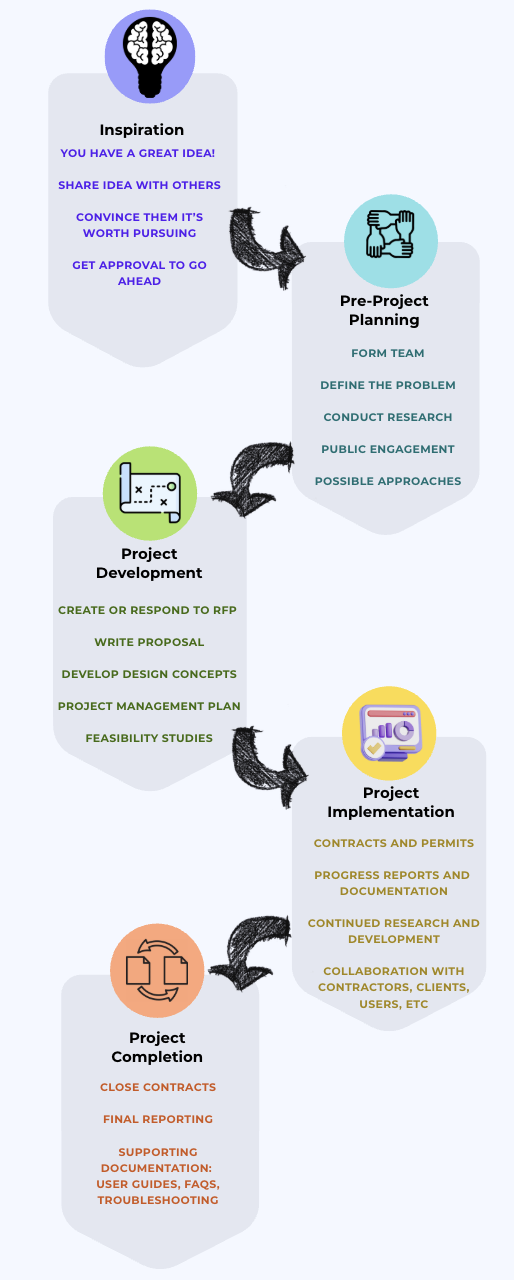
Once a project is in the implementation phase, the people who are responsible for the project will likely want regular status updates and/or progress reports to make sure that the project is proceeding on time and on budget, or to get a clear, rational explanation for why it is not. To learn more about Progress Reports, go to the next chapter: 7.5 Progress Reports.
Image descriptions
Figure 7.4.1 image description:
A project goes through a design process made up of five stages.
- Inspiration
-
- You have a great idea! Share it with others
- Convince them it’s worth pursuing. Get approval to go ahead.
- Pre-project planning.
- Form a team
- Define the problem
- Conduct research
- Public engagement
- Possible approaches
- Project Development.
- Create or respond to an RFP; write a proposal
- Create or respond to a request for proposals, evaluate proposals.
- Develop design concepts
- Project management plan
- Feasibility Studies
- Project Implementation.
- Contracts and permits
- Progress reports and documentation
- Continued research and development
- Collaboration with contractors, clients, users, etc.
- Project completion.
- Close contracts
- Final reporting
- Supporting documentation: User Guides, FAQs, Troubleshooting.
- [Proposal image]. [Online]. Available: https://pixabay.com/en/couple-love-marriage-proposal-47192/. Pixabay License. ↵
- R. Irish and P. Weiss, Engineering Communication: From Principle to Practice, 2nd Ed., Don Mill, ONT: Oxford UP, 2013. ↵