1. WHAT IS TECHNICAL COMMUNICATION?
1.3 Technical Writing Moves and Processes
Just as we employ specific strategies and use defined design processes to creatively solve complex problems, we use strategic writing moves and employ iterative writing processes to create complex documents. The sections below discuss these in more detail.
Technical Writing Moves
Whether writing for school or work, we tend to use certain recurring rhetorical strategies or “writing moves” to structure our ideas. The list of strategies below is not exhaustive, but covers many of the writing moves we frequently make, and offers some description and examples. Note that these are often used in combination and can overlap. Consider how you might use these in your upcoming writing tasks.
NARRATION: Telling a story can be an effective way to engage your reader and create a personal connection. The narrative usually comes from a distinct perspective, must clearly relate to your purpose, and presents a series of events (beginning, middle, ending) that are linked by cause and effect. Narrative can be a powerful tool to use in a need statement when defining a problem, or when describing user personas and their “pain points.”
DESCRIPTION: Technical descriptions use concrete, specific detail to help the reader imagine and understand the described object or process the way the author does. Measurable descriptors might include weight, dimensions, densities, distances, age, colours, materials, speeds, interactions. Descriptions can focus on the sensory experiences of sight and sound, but might also include feel, smell, and taste. You might even use figurative language (metaphors, similes, and analogies) to engage the reader’s imagination and help them understand an unfamiliar idea by comparing it figuratively to a familiar concept (“an algorithm is like a recipe”).
DEFINITION: Definitions can range in length from a short phrase or sentence (defining a term) to multiple paragraphs (defining a problem). You might define how you are using a word, how you are framing an idea, or treating a controversial idea. Problem Definition, as discussed in Chapter 1.1, may include a complex combination of writing movies such as narration, description, explanation, analysis, summary and synthesis.
SUMMARY: Summaries can have a variety of purposes, but are generally designed to help a busy reader understand large amounts of complex information in a condensed form. Abstracts offer a condensed version of an academic article; Executive Summaries provide the key information from a long report. In general, when writing a summary, you should prioritize important information and leave out minor details; you should also condense information accurately and objectively, without editorializing or evaluating; and of course, you should follow conventional citational practices to clearly indicate when you are summarizing someone else’s words and ideas.
ANALYSIS: Where a definition might explain what something is or does, an analysis tells you how it works. It focuses the component parts of a system and how they interact to perform the desired function. For example, a rhetorical analysis seeks to understand how the rhetorical strategies used in a persuasive text work together to appeal to the intended audience. An analysis of a complex machine will show how the various parts connect and work together to achieve the machine’s purpose. A process analysis might review the workflow to understand how tasks are completed and how efficiency might be improved. An analysis moves into an evaluation when you go from explaining “how” to evaluating “how well” it meets defined criteria.
COMPARISON: We often compare two or more items (or ideas), in terms of specific criteria, in order to understand more about them and perhaps select the most appropriate one for a particular purpose. Comparison focuses on the key similarities and/or notable differences between the items in order to help the reader make a choice or understand the compared items in more detail. Written comparisons often use specific structures such as “block” or “point-by-point” to organize the examination of the items being compared.
ARGUMENT: This is clearly a complex writing move that might include any or all of the above strategies. An argument is intended to persuade or influence the reader’s thinking or behaviour in some way. An effective argument should define a context or controversy out of which the argument arises, present a clear position or claim, explain why this position is valid, and provide compelling evidence to support all claims. In some cases, an argument must consider and try to refute opposing arguments. Strong arguments will make strategic use of rhetorical appeals (to emotion, logic, and credibility) to win the hearts, minds and trust of the audience.
SYNTHESIS: Synthesis entails combining and summarizing ideas from different sources and perspectives in order to enhance your own perspective. Like summarizing, synthesis must accurately and objectively represent the ideas of other, and should offer a comprehensive and proportional representation of the sources relevant to the topic. Synthesis might be used to show significant consensus on a topic, reveal the complexity and variety of perspectives on an issue, identify trends in the research, point to gaps in existing research, or even create new understanding by finding interesting connections between seemingly unrelated ideas.
EXPLORATION: you might engage in exploratory writing such as brainstorming, freewriting, concept mapping, making pros and cons lists, and so on, to help you gather your thoughts and generate potential ideas for further research. You might start with a hypothesis or question and see where your exploratory writing leads you. It can help you solidify your current understanding, test your ideas, and even change your own mind!
REFLECTION: this metacognitive move helps you look inward and understand your own motivations, assumptions, strategies, preferences and processes. Reflecting on experiences helps you learn from them, by considering not only what you did, but how and why you did it, and how it turned out. Reflecting on what led to success helps you repeat it; reflecting on what actions or assumptions led to problems or failure helps to figure out how to adjust strategies and mindsets to get better results in the future. Reflections can be for your personal use only, but they are also used in professional practice to evaluate current progress and conduct post project reviews.
Enhance your Learning and Performance by Building Reflection into your Processes.
“Life-long learning” is not just a catchphrase – it is a really important part of continual development and improvement. We are all learning at every stage of our lives. As students, parents, employees, managers, we continually need to learn and adapt. One of the most important elements of the learning process is reflection. If we don’t take the time to reflect on what we are experiencing and learning, we often don’t fully absorb or retain the learning. Reflection is an integral part of continual improvement and growth:
- It helps it determine what is working well (and what we should keep doing) and what is not serving us and needs rethinking.
- It helps us develop and adjust our strategies and processes
- It empowers us to develop greater self-awareness and set goals for ourselves.
You’ve probably heard the saying, “we learn from our experiences,” or “we learn from our mistakes.” This is only true, however, if we reflect on those experiences and mistakes. Failure can be one of the greatest teachers, if we take the time to reflect on what happened, why it happened, and what we might do differently next time to get better results.
We might give in to the tendency to “not dwell” on mistakes to try to “forget” them (and the accompanying embarrassment); however, if we do this, then we are likely doomed to repeat these mistakes and failures. Changing our mindset and thinking of mistakes and failures as learning opportunities helps us grow. As a wise kindergarten teacher once said, if you have a belly button, you make mistakes. We all make them, so let’s learn from them!
Remember to reflect on and celebrate the successes too! Reflecting on what went well and what you did “right” helps you to repeat and refine the strategies and processes you used to get there.
Exercise 1.5 Writing Moves in a Problem Definition
Consider how many of the above writing moves you might use when writing a thorough Problem Definition and use these to draft one for an upcoming task:
- Narration: When describing the “need” for a solution, you might tell the story of specific people who are impacted by the current “unsatisfactory situation.” The story might help establish empathy for those currently dealing with the problem.
- Description: you might describe the negative impacts of the current situation in measurable ways. You might also compare the current situation to the improved future situation once a solution has been implemented.
- Definition: While the entire thing is a definition, you might include smaller definitions within to define specific solution requirements (objectives and constraints that any solution needs to adhere to) or technical terminology that might be unfamiliar to your reader.
- Argument: In some cases, you might be need to persuade your reader that a problem actually exists that really needs to be solved. You may also need to convince them that the criteria you have chosen to evaluate potential solutions (your measurable objectives) are appropriate. You may need to justify your scope.
- Summary & Synthesis: a thorough problem definition will include research from a variety of sources to help identify the need for a solution and justify the evaluation criteria you will use to select a solution.
- Exploration: In planning your problem definition, you might engage in exploratory writing to help you brainstorm ideas (how to limit scope, define measurable objectives, structure content, etc).
Writing Processes
Using or developing an effective process helps us to engage in complex tasks. For example, a design process allows us to understand and solve complex problems in a systematic way. Without a clear process to follow, we would have a hard time developing feasible solutions. The same is true for complex writing tasks. Without a clear process, our writing might lose track of focus or purpose, go down a tangential “rabbit hole,” or meander incoherently. A writing process mirrors a design process in many ways in that we must understand our purpose and audience (define the problem), conduct research, design the content (or solution), and iterate (revise/edit) as needed.
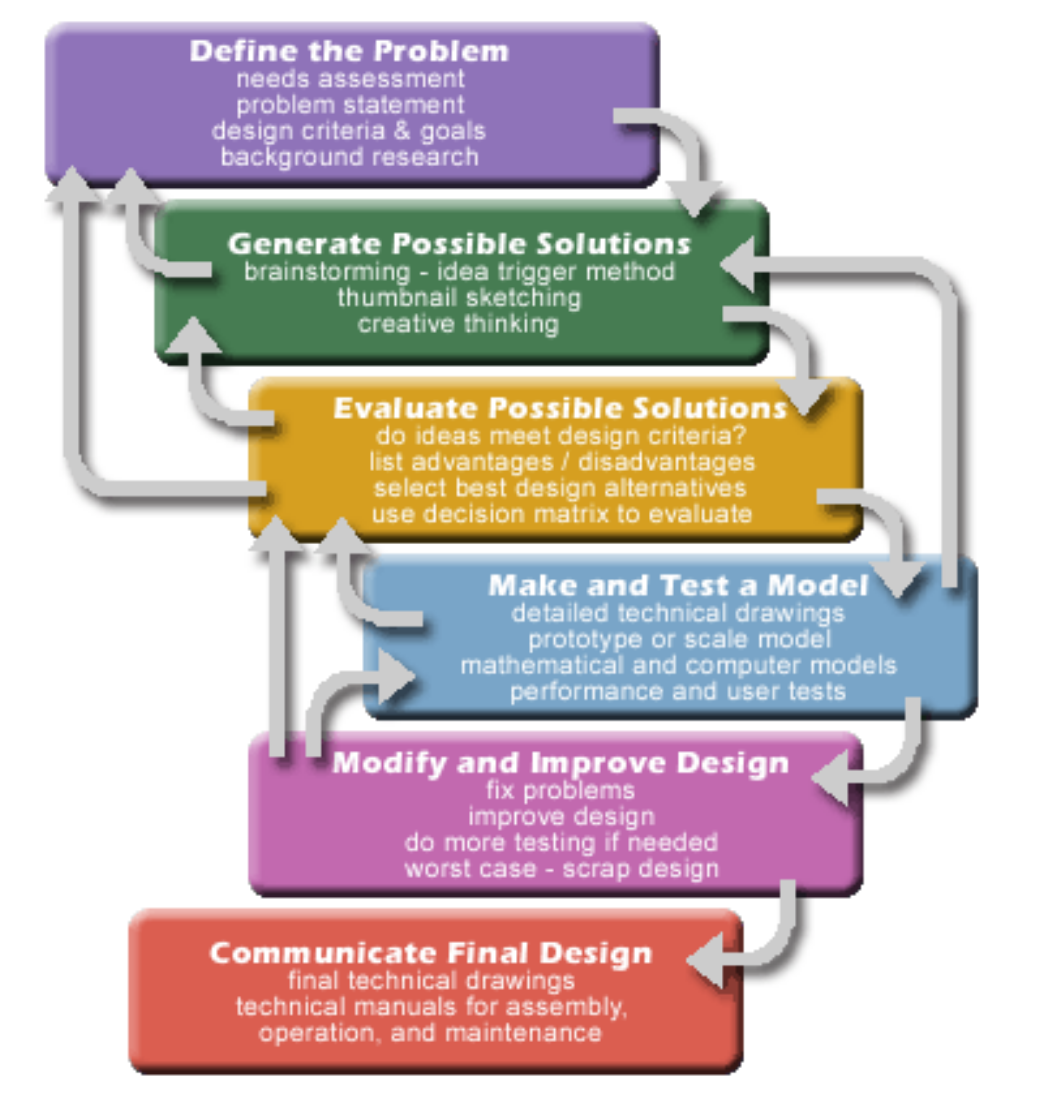
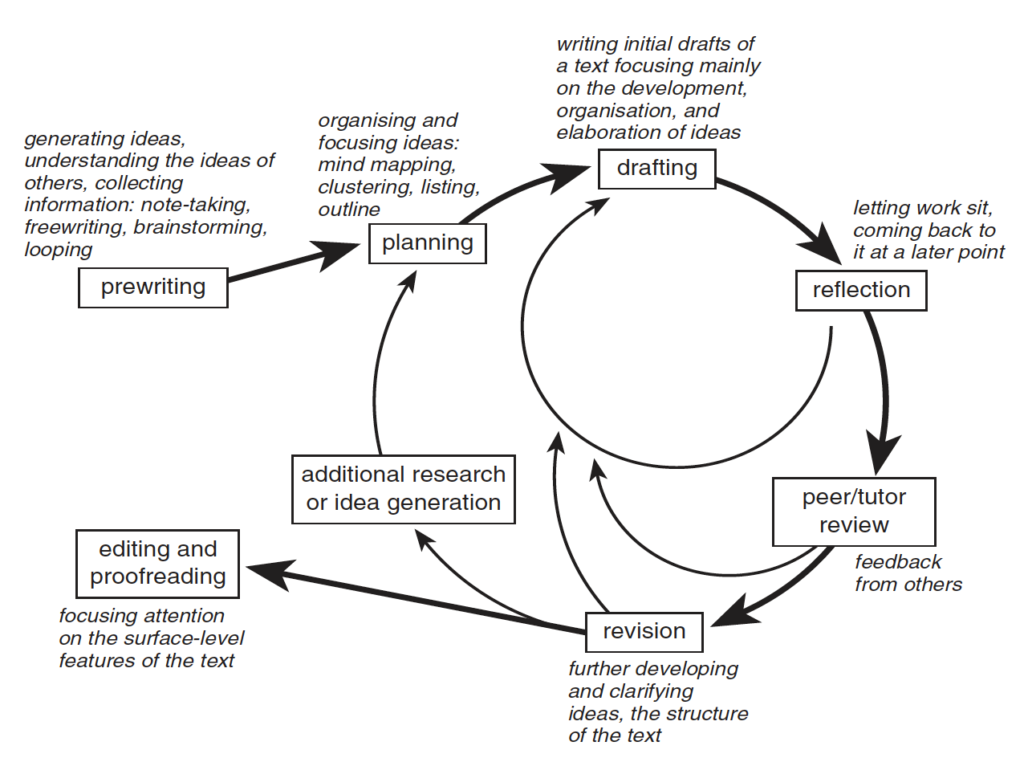
In both design and writing processes, there are steps or stages, but we don’t always proceed directly from one step to next in a chronological manner. These processes are often iterative, meaning we might return to previous stages in the process from time to time. The more complex the task, the more iteration might be needed. Examine the Design Process (Figure 1.3.1) and Writing Process (Figure 1.3.2) diagrams below. What similarities and differences can you see in these two processes?
You may have come across a “writing process” before, and it may or may not have worked well for you. There is no single process that works for everyone in every situation. The key is to recognize the various steps in a typical writing process and figure out how to use or adapt them most effectively for your situation.
For example, you may have come across the 40-20-40 writing process, which suggests that you should break up the amount of time you spend on the writing task into three distinct stages of planning, drafting and revising, and give each one a specific percentage of the time you have available.
40-20-40 Writing Process
Stage 1 – Planning: spend 40% of your time planning your document (task analysis, thinking, discussing, free-writing, researching, brainstorming, concept mapping, focusing ideas, outlining, etc.)
Stage 2 – Drafting: spend 20% of your time writing a rough draft (quickly getting all your ideas down in print, in more or less complete sentences and paragraphs, in more or less the right order, without agonizing over style or grammar choices)
Stage 3 – Revising: spend 40% of your time reviewing, revising, editing, and proofreading (polishing your draft, making sure the content is complete and well supported, ideas flow logically, formatting meets expectations, and the style uses the appropriate tone and vocabulary).
These percentages are a helpful guideline, as they emphasize the need to allot significant time for revision, but don’t always work for all people in all situations (think of a final exam situation!). It also does not clearly account for collaboration processes or the need to iterate; sometimes while revising your draft (stage 3), you may have to go back to the planning stage (stage 1) to do additional research, adjust your focus, or reorganize ideas to create a more logical flow. Writing, like any kind of design work, demands an organic and dynamic process that is appropriate for the situation.
To help you develop writing processes that you can use in a variety of rhetorical situations, consider the elements of the AWARE framework in Figure 1.3.3. It includes the need to analyze (the problem, the task, the intended audience) and arrange or outline potential ideas; write (draft content); assess what you have so far, revise based on your assessment, and edit the final version. Not every writing task necessarily includes all of these elements, but the more complex that task, the more you need to consider how you will work these elements into your process.
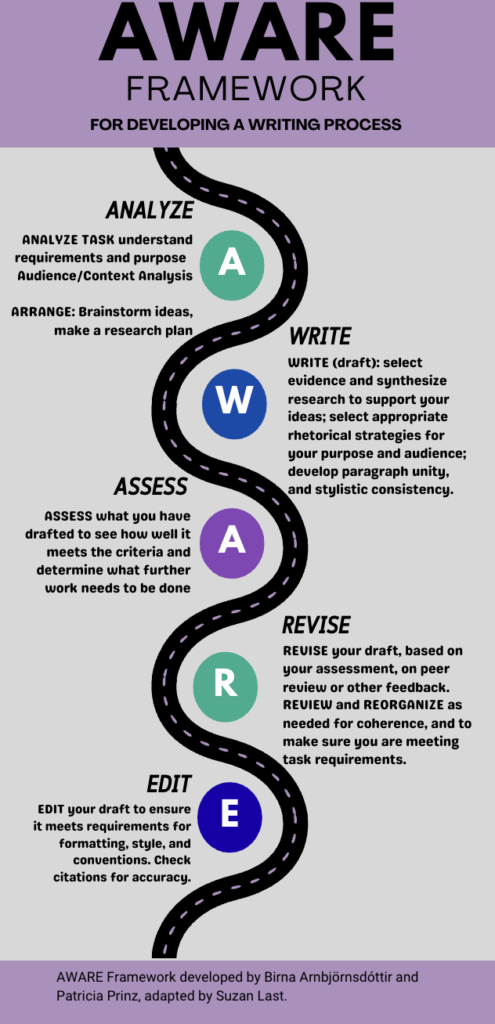
As with the design process, the writing process must begin with an understanding of the problem you are trying to solve and why you are trying to solve it. In an educational context, this means understanding the assignment you’ve been given, the specifications of that assignment, the objectives you are meant to achieve, and the constraints you must work within (due dates, word limits, research requirements, etc.). This is often referred to as “Task Analysis.” In professional contexts, you must also consider who your intended reader(s) will be, why they will be reading this document, and what their needs are, as well as deadlines and documentation requirements.
EXERCISE 1.6 Plan your process for writing an assignment
Consider an upcoming writing assignment or task you must complete. To avoid putting it off until the last minute (and possibly doing a poor job), try planning a writing process for this task, and build in milestones. Anticipate how long various sub-tasks and stages might take. Make sure to include time for “task and audience analysis” to fully understand what’s involved before you start. Consider the following:
- What is the purpose of the document? What are the specific requirements? Who will read it and why?
- How much planning is needed? What will this entail? Will you need to do research? Do you need to come up with a topic or focus, or has one been assigned to you?
- How complicated will the document be? Will it have several sections? Graphics? How much revision will be needed to perfect your document? Will you have time for a peer/tutor review?
Now try using the Assignment Calculator to see if it offers something similar to your planned writing process.
Image descriptions
Figure 1.3.1 image description:
A design process flow chart that encourages you to revisit previous steps as needed.
- Define the problem. This involves a needs assessment, problem statement, designing criteria and goals and background research.
- Generate possible solutions. Brainstorming using the idea trigger method, thumbnail sketching, and creative thinking. At this point, you may need to revisit your problem definition. Once you have a number of possible solutions, move on to the next step.
- Evaluate possible solutions. Do ideas meet design criteria? List the advantages and disadvantages. Select the best design alternatives. Use a decision matrix to evaluation. At this point, you may need to revisit your problem definition or brainstorm some more. Once you have evaluated possible solutions, move on to the next step.
- Make and test a model. Create detailed technical drawings, prototype or scale model, mathematical and computer models, Conduct performance and user tests. At this point, you made need to go back to brainstorming solutions or evaluating possible solutions. Once you have a model you are happy with, move on to the next step.
- Modify and improve design. Fix problems, improve design, do more testing if needed. In the worse case, scrap the design. You may need to go back to evaluating possible solutions to making and testing the model. Once you have a design you are happy with, move on to the next step.
- Communicate final design. Create final technical drawings, and technical manuals for assembly, operation, and maintenance.
Figure 1.3.2 image description:
A writing process diagram that encourages constantly revisiting previous stages.
- Prewriting. This stage is for generating ideas, understanding the ideas of others, and collecting information (note taking, free-writing, brainstorming, looping).
- Planning. Here, you are organizing and focusing ideas. This may involve mind mapping, clustering, listing, and creating outlines.
- Drafting. In the drafting stage you are writing initial drafts of a text focusing mainly on the development, organization, and elaboration of ideas.
- Reflection. In the reflection stage, you can let the work sit and come back to it at a later point. You may cycle back between drafting a reflection a number of times before moving on.
- Peer/tutor review. Now you can get feedback from others. This may require you to return to the drafting and reflecting stages.
- Revision. Here you are further developing and clarifying ideas and the structure of the text. This may require you to return to the drafting and reflecting stages. If the work requires additional research or idea generation, return to the planning stage.
- Editing and proofreading. Here the focus is on surface-level features of the text.