Introduction to the 2nd Edition
Since this textbook was first published in 2019, much has changed, and these changes have led to the revised and expanded 2nd (2026) edition. This edition contains updated information, links, and resources; has cut some out-of-date or no longer relevant content (e.g. references to “stakeholders”), and has added and expanded content throughout the text related to multimodality and accessibility. Specifically, this 2nd addition includes new content on Gen AI (1.4), visual rhetoric (3.4), leadership (4.4), source synthesis (5.4), and User Experience (ch. 6), some of which was added by other contributors. I’ve also added a “How to use this Textbook” section as a resources for instructors. I hope you find the 2nd edition useful.
Humans have engaged in technical communication for literally thousands of years. Palaeolithic cave paintings may have provided useful information about when to hunt certain animals. Stone tablets invented 5000 years ago provide our first examples of “writing” for transactional purposes like recording ownership of property. The Romans kept detailed technical information about aqueduct design, and so on. Over the centuries, innovations such as the inventions of paper and ink, the printing press, telegraph, radio, television and the computer allowed information to be disseminated more widely, and now instantaneously. Each of these innovations responded to the various communication needs of the time and developed specific patterns and conventions for communicating information.
In our increasingly technological and internationalized workplaces, communications and collaboration skills are among the most sought-after competencies employers require of job candidates. Indeed the educational framework for 21st Century Learning is based on 4 key skills: critical thinking, creativity, collaboration and communication. Every job posting you see will almost certainly ask for candidates with who can think critically and creatively, have excellent communications skills and can work effectively as part of a team. The ability to communicate clearly and effectively in written, verbal, visual, interpersonal and collaborative contexts is vital for success and advancement in the workplace, and developing these skills is the focus of this textbook.
You have probably learned the conventions for communicating in an academic context, and seen how these differ from the way you might communicate in social context. So you know that learning to read and write in a new context, using potentially unfamiliar conventions, can take some work. Some of that work entails reflecting on your experiences.
Questions for Reflection
Reflect on your experiences with learning to read and write in various contexts
- How did you first learn to read and write? Who influenced you?
- What do people in your culture and/or your family believe about reading, writing and telling stories?
- What are some of your most positive reading and writing memories?
- Describe some moments when you struggled with reading or writing. How did you react?
- How does your reading and writing for school differ from what you read and write outside of school?
- What do you see as your key strengths and weaknesses as a communicator?
- Do you believe that you are a good writer? Why or why not? Is your belief connected to how others have described your writing?
- Describe your writing process. How do you tackle writing tasks? What do you find most frustrating most rewarding in this process?
- Currently, how do you see this next step of your writing journey? What do you want to accomplish? What concerns do you have?
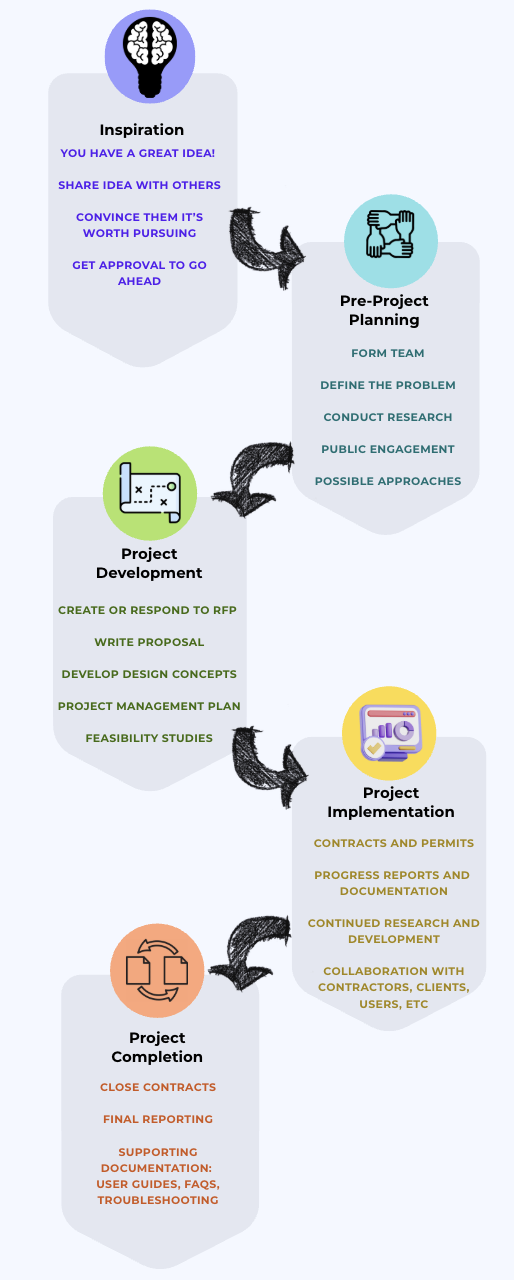
No matter how brilliant or innovative an idea may be, if it is not communicated clearly and promoted effectively to the right audience, it will likely not become a reality. For an innovative idea to move from concept to project to completion requires many stages in a design process (see Figure 1), almost all of which require clear communication and effective teamwork.
If the design and implementation teams cannot work and communicate effectively with each other, their final product will fail to meet its potential.
Technical Writing Essentials introduces the key elements of professional style, information design, collaboration, research, and presentation skills needed to design productive workplace communications for a variety of purposes and audiences.
Image Description
Once there is an idea, a project goes through a design process made up of five stages.
- Inspiration
- you have a great idea
- Share the idea with others
- Convince them it’s worth pursuing
- Get approval to go ahead
- Pre-project planning.
- Form Team
- Define the Problem
- Conduct Research
- Public engagement
- Possible approaches
- Project Development.
- Create or respond to an RFP
- Write proposal
- Develop design concepts
- Project management plan
- Feasibility Studies
- Project Implementation.
- Contracts and permits
- Progress reports and documentation
- Continued research and development
- Collaboration with contractors, clients, users, etc.
- Project completion.
- Close contracts
- Final reporting
- Supporting documentation: User Guides, FAQs, Troubleshooting