4.2 Phase 2 Staff
The second phase of research was a mixed-methods anonymous survey. Respondents (n = 7) answered Likert scale questions regarding their response to Lost in Translation with an option to provide an open-ended text response. From this survey, 71% of respondents found the resource extremely compelling, while 29% found the resource moderately engaging.
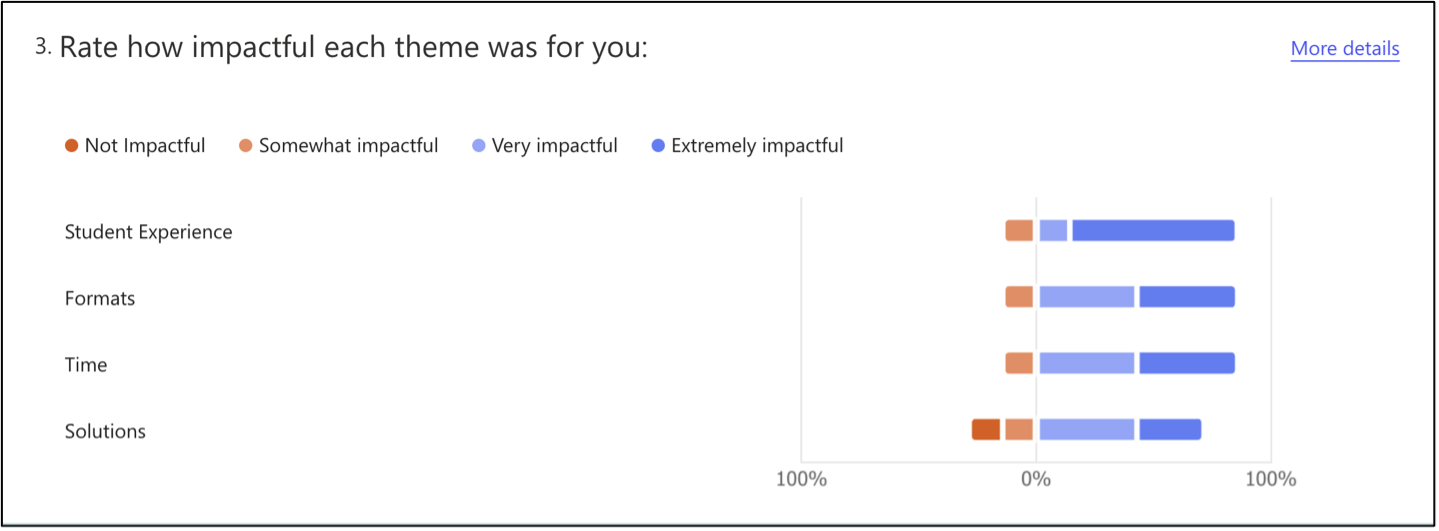
Of each theme, 43% found the Formats material extremely impactful with an additional 43% considering it very impactful and 14% indicating it was somewhat impactful. 71% considered the Student Experience content extremely impactful with 14% finding it very impactful and 14% considering it somewhat impactful. The Time theme had splits of 43% extremely impactful, 43% very impactful, and 14% somewhat impactful. For the Solutions theme, 29% considered it extremely impactful, 43% found it very impactful, 14% marked the Solutions as somewhat impactful, while 14% indicated it was not impactful. Solutions was the sole theme to be marked as not impactful by any respondent.
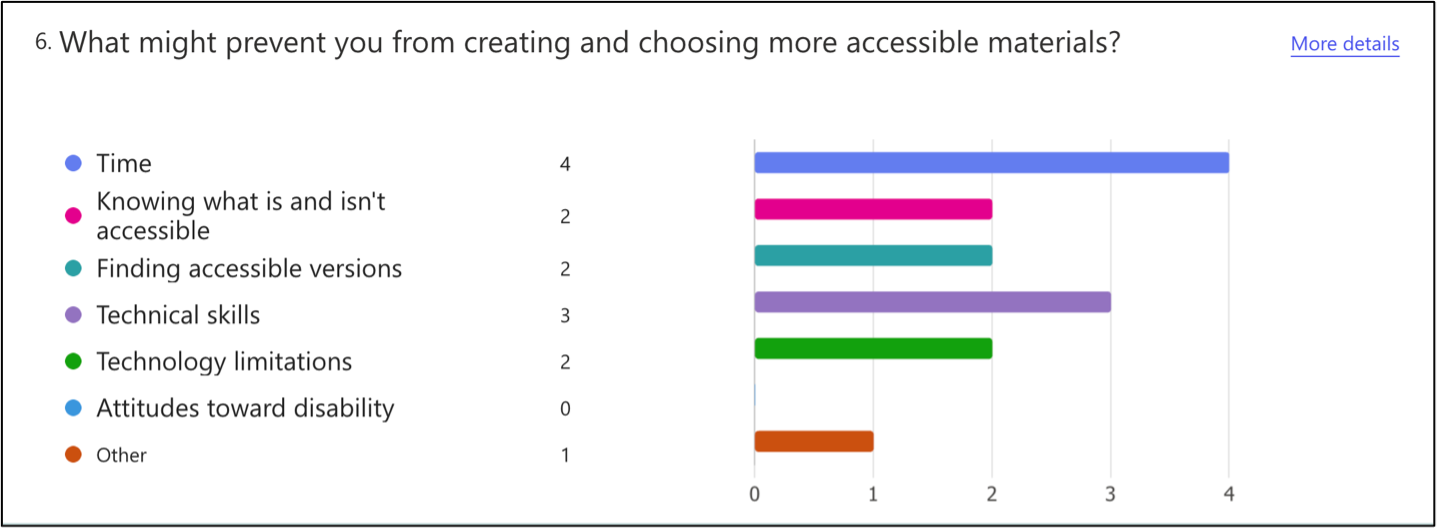
71% of respondents indicated that after viewing the resource their interest in choosing and creating accessible digital material increased significantly, with 14% reporting their interest had increased slightly, and 14% reporting their interest remained the same. When asked what might prevent employees from creating and choosing more accessible content, 29% indicated time, 14% noted not knowing what is and is not accessible, 14% indicated difficulty in finding accessible content, 21% noted they may not have the technical skills required, and 14% marked technology limitations as a factor. One respondent chose ‘other’ and included “limitations in protecting intellectual property” in their response.
Regarding the usefulness of the resource, 57% of respondents considered the resource extremely useful, while 29% found it somewhat useful, with 1 respondent finding it “not at all useful.”
Ultimately, 85% of respondents indicated their interest in digital accessibility increased after viewing the resource. This presents strong evidence that considering student perspectives influences post-secondary employees’ interest in creating more accessible content and experiences. Determining how to best assist post-secondary employees in creating and choosing more accessible digital learning material remains an avenue for further study.
4.2.1 Text Responses
Some (n = 3) survey respondents provided text in response to the final question: “Anything specific you’d like to see, an idea we missed, or something you’d improve?” One called the resource “extremely effective” noting that “saying [accessibility] is legislated doesn’t seem to have the impact reading [student] quotes definitely does.” According to one respondent the stories bring “a gravity to the need to provide more accessible documents.” Another respondent indicated their gratitude for the resource and expressed a hope that it would help “better accommodate folks with perceptual disabilities.” The first respondent also indicated that they were “pleasantly surprised to learn how effective Word is, which makes me feel the learning curve isn’t that steep.” These responses reflected the positive indicators to the quantitative survey questions.
One survey respondent provided a lengthy text response which, while in some places an emotional plea for additional support from the institution, also included troubling examples of academic ableism and lack of concern for student perspectives. The respondent wrote that they “found the tone of this resource condescending” and had “the impression that the authors think all instructors at Langara are lazy and do not care about students.” It is unclear if the respondent understood the resource was 90% direct quotes from current and former Langara students.
The respondent may have fixated on the quotes from Stella and Matt that used the word lazy when referring to some instructors. However, Stella’s full quote (included in Lost in Translation) also stated that “I don’t want to blame them because they’re underpaid and they’re overworked” while Matt said “Is that really their fault? The instructor? No, because they’re in a world where they’re not paid enough to do what they’re doing. They’re exploited . . . most of them.” While the respondent felt attacked by the term lazy, they failed to realize that the student co-designers empathize with them.
In the context of accessible digital learning material, the respondent may be under the impression that making content accessible is a significant extra burden as they state Lost in Translation is “without any acknowledgement of the added time on an instructor’s workload to make materials accessible.” While the remediation of inaccessible content is additional work that requires significant time and expertise, creating accessible content takes no more time than creating inaccessible content (Case & Davidson, 2011; Gifford, 2024). The respondent also puts forth that “there is NO institutional recognition of the additional burden this places on us and very little meaningful support.” However, Langara College has an Accessibility Services department dedicated to supporting students and staff with accessibility related issues, access to CAPER-BC (Centre for Accessible Post-secondary Education Resources) which offers remediation services, and an Educational Technology department that offers workshops and asynchronous resources on digital accessibility. As the survey was anonymous, the authors of this report could not confirm if this respondent had ever engaged with support services, or if they had, whether they found the support ‘meaningful.’
This respondent continued that “if the purpose of this is to help instructors, you may want to try an approach that recognizes that you are adding a similar burden on them to that you are describing for the students” [emphasis added]. As discussed above, the respondent may not be familiar with the differences between remediation and creating and choosing accessible content. However, it is troublesome to suggest that creating and choosing content to ensure no one is excluded from the learning process is the same burden as being excluded from learning. Accessibility is a key component to creating a welcoming and inclusive learning environment and will soon be legally mandated by the Accessible British Columbia Act. As discussed in section 2.1.3, academic ableism posits that asking to be included, or at least not actively excluded, is unreasonable. The ask of instructors to create and choose accessible content is, according to ableist thinking, as significant a burden as being unable to, for example, consume required reading or complete an assessment. To frame meeting this basic accessibility standard as equal to being ostracized, excluded, and unwanted shows there is significant work to be done in changing attitudes.
The respondent goes on to state that they are “at the point where I can share my slides as I do or I can not share them at all because to add descriptions to hundreds of slides would require me to stop sleeping to get everything done.” This attitude and practice places disabled students in the position of scapegoat, opposite to their peers. In this setup, if any student were to ask for a copy of the respondent’s slides and this respondent were to decline saying they do not share their slides because the content is not accessible, the existence of a disabled student becomes the cause of other students not having access to the material. However, the real cause is the respondent being unwilling to create accessible and inclusive learning experiences.
Based on the repeated mention of the institution, this respondent may have a particular grievance with Langara College. However, their comments regarding the tone, their hypothetical withholding of learning material due to the existence of disabled students, and positioning the work of creating and choosing accessible content as equal to being a disabled student suggests this respondent may hold a negative view of disability. As a final note, this respondent wrote, “I think those you are trying to convince it’s worthwhile will be more alienated – and those who are already trying, but are under-resourced, will be demoralized.” Thankfully the data from other respondents shows this is not the case. While legislation has its shortcomings, particularly in improving the accessibility of digital content as discussed in section 2.3.2, legislation may be a necessary evil to deal with the academic ableism that pervades post-secondary education in 2026.