5. CONDUCTING RESEARCH
5.1 Defining Your Scope
Often, when you are first assigned a project, the problem may be fairly general and open-ended. This allows you to approach the problem in a variety of ways, but also requires you to engage in critical thinking to decide which particular approach you will take and what limits you will place on what you hope to achieve. That is, most projects will require careful definition of scope.
Defining your scope is a foundational step in your project. This is where you outline specific goals you want to achieve, while also setting limits to determine what your project will not do. If you are tackling a large problem, you will likely not be able to solve it entirely; you might choose one slice of the problem pie to work on. Sometimes when students propose a research topic or project, they might not be aware of the range of issues involved and end up proposing a topic that might take an entire book to deal with! In such cases, aim to narrow your focus to a single chapter of that book. In short, while defining your scope will help you determine what kind of research you will need to do, you may also need to do some research to help you define your scope — because sometimes we don’t even know what we don’t know until we start doing research.
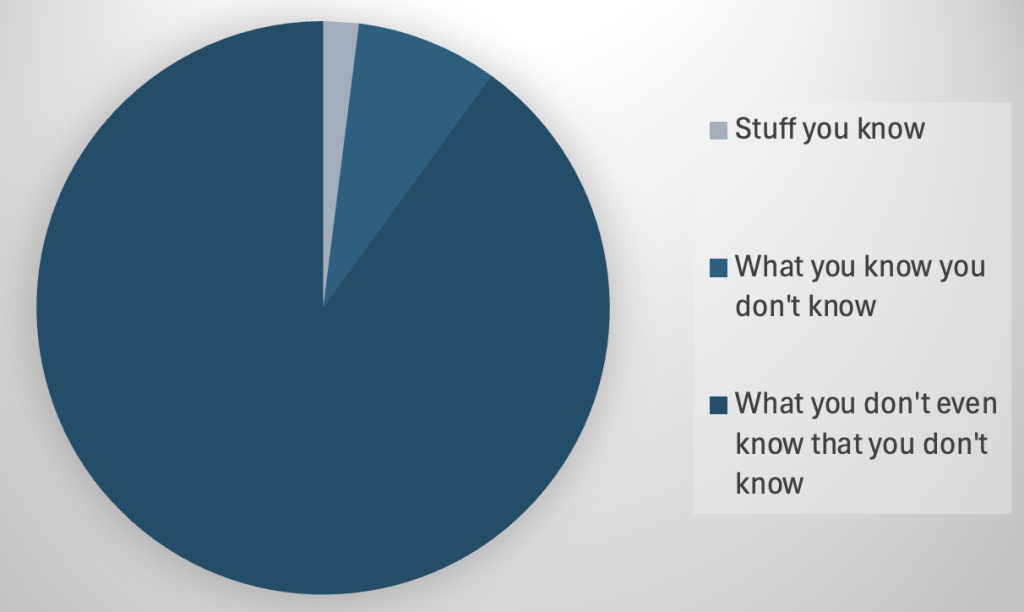
It is unlikely that a project will be relevant to or encompass all people in all places at all times. Limiting your scope means considering which people (or other entities), in which places, at which times or contexts. To ensure you come up with an appropriately narrowed focus, consider some or all of the following, depending on the type of project you are embarking on:
- Background research: what is the context in which you are working and how can you clearly define the problem you are tackling? How do you know there is a problem? What measurable impacts result from the current “unsatisfactory situation” you aim to address? What data will you need to prove that this is a significant problem that has negative impacts and needs to be addressed?
- Purpose: What is your goal? What do you want your project to achieve? What are the limitations placed on what can be expected or achieved? Are there expected goals or targets that any proposed solution is expected to meet? How will these be measured? What are the constraints (time frames, resources available, budget, regulations, etc) you have to work within? What solutions have already been tried unsuccessfully?
- Intended Audience: Who is your immediate intended audience? What do you know about them? What more do you need to know in order to effectively convince them to consider your idea? Where might you find this information? What is the best way to present this information to this audience? Who else might read this?
- Other Relevant Parties: Who else might read your report or be interested in your project? Will you need to engage or consult with people or groups who might influence or be impacted by this project?
- Environmental Factors: Are there limitations (or a potential to apply limits) in terms of geography, demographics, or available technology? Could you consider a Pilot Project or Beta-Test?
- Legal and Regulatory Issues: Are there legal considerations, patents, regulations, policies, and guidelines that must be taken into account?
The process of coming up with a focused idea for your research can take many forms. Some strategies for narrowing and focusing include the following:
- Free–writing: write for 10 minutes straight without stopping or self-editing. Then review what you have and circle any promising ideas. Use these key words or ideas as the basis of the next free-write.
- Mind-mapping or Concept-mapping: create a graphic organizer listing ideas and indicating how they are connected
- Questioning: ask who, what, where, when, why, and how about your topic. What do you already know? What do you need to find out?
- Brainstorming: list all ideas without censoring or rejecting any, no matter how ridiculous or irrelevant they might seem at first.
In engineering fields, projects most often take a Problem-Solution approach. This entails clearly defining the problem in as open-ended a way as is feasible, possibly considering its causes and effects, and potentially coming up with or evaluating solution ideas.
In presenting your solution, you will have to find research to provide support for the basic premise of your research question (is this idea feasible?) and prove your hypothesis (show that it will be effective/beneficial). You might do this by showing that similar ideas have been implemented and/or researched in other areas, or that the ideas you are presenting are based on sound evidence. Collecting your own primary data (such as conducting a survey, interview, or site visit) may also help show how your ideas are feasible in the local community context.
Using appropriate methods and finding the right sort of research allows you to convince people that your ideas have validity and merit, and that the knowledge you have acquired or created is evidence-based.
The first step in most projects is figuring out what you don’t know and what you need to know. Without this basic context work, it’s difficult to work your way to finding relevant sources that can help you apply and analyze information and data from sources, and synthesize them into your own argument or recommendation.
A problem-solving approach offers many ways to narrow your focus. Try creating a concept map like in Figure 5.1.2 to get a sense of the many ways you might approach your topic, and then narrow down your focus to one of those approaches. A mapping exercise like this will help you think of key words to use in your search for sources. The more you brainstorm, the more potential key words and synonyms you can come up with. The “mind map” below shows various ways to consider the larger context of your problem and find a specific area to focus on.
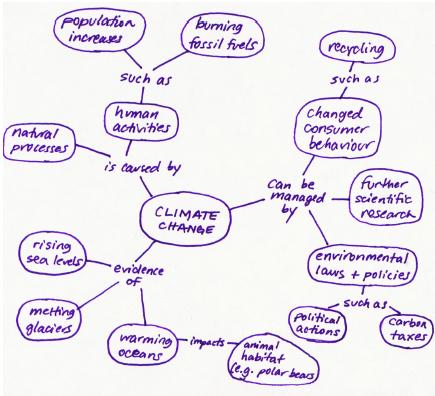
This kind of “graphic brainstorming” can help you consider many different ways your topic can be approached. You can ask questions such as how? why? what? who? to further extend this exploration. Your goal here is to narrow down your focus to one “bubble” (that is perhaps 3 or 4 nodes away from your central topic node) that can afford a promising topic while limiting the scope to something you can accomplish in the given time frame and assignment specifications (word count, research requirement, goal, etc).
Clearly you can’t solve the problem of climate change in one paper or project. And no reasonable instructor or employer would expect you to. However, you might be asked to explore effective ways to reduce carbon emissions in a specific industry in a given period of time and/or geographical region. Or you might investigate whether a particular form of alternative energy would be effective in a particular situation. Even then, you would have to consider approaches to further narrow your scope. For example, would you recommend changing a policy or law to try to address the causes of the problem? Providing incentives to industry or consumers? Innovating a current technology or process? Exploring a new technology or process? Evaluating a currently proposed solution?
Researching what other people working in this field have studied and written about can help you refine your focus and choose how you want to participate in this ongoing conversation. The goal is to sufficiently narrow your topic so you can identify key words and terminology that relate to your topic, zero in on a specific question, and find a clear trajectory to guide your research.
A good research question should be somewhat open ended; that is, the answer should not be a simple “yes” or “no.” The focus of your research question should allow you to provide a comprehensive answer that takes context into careful consideration.
Figure 5.1.3 shows a more specifically problem-based approach to concept mapping the general idea and finding areas of potential focus. A good focus for a paper or project will likely be 3-4 nodes away from the central problem box.
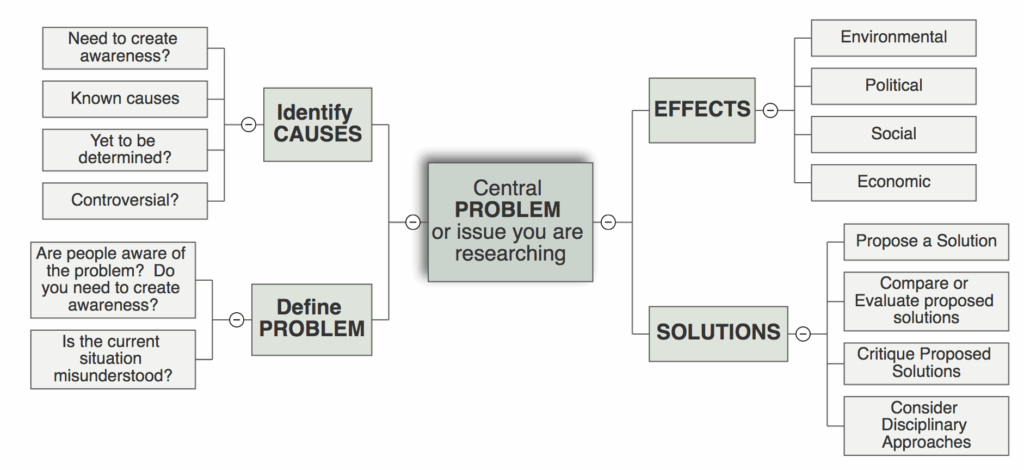
You generally cannot cover all of these issues in one paper or project. Try to narrow your focus so that you can research a specific aspect of the topic in-depth. Choose one specific focus (proposing a solution), and consider what other aspects must be included (defining the problem; choosing a specific demographic or geographical area to focus on).
As an example, consider the issue of Climate Change and how it might fit into each of these “narrowing your focus” categories.
Define the Problem
Initially, researchers focused on trying to define the “wicked” problem of climate change, then on trying to convince the general public, industries, and governments that a problem exists and is serious enough that we must start working on solutions immediately. Now, the vast majority of scientists and researchers (and the general public) accept that a problem exists: the climate is indeed warming and this is causing measurable impacts. Ongoing research might determine ways to convince people who are not yet convinced and ways to motivate people to take the problem seriously enough to consider changing their behaviour or policies.
Identify Causes
In the last few decades, significant controversy over the CAUSES of climate change has arisen. Is climate change a naturally occurring, cyclical phenomenon or “anthropogenic” (human-caused)? Research has convinced most people that climate change is indeed anthropogenic: that human consumption of fossil fuels is the main cause of climate change.
Research is ongoing about what kinds of activities (fracking, building dams, data centres, driving vehicles that run on fossil fuels, factory farming, etc.) might contribute to climate change. Research might also consider effective ways to modify human behaviour in order to slow down those causes.
Identify Effects
Much research currently explores the effects of climate change, as well as how we can determine which specific effects can be the direct effect of climate change. This can be done from many different disciplinary approaches. For example:
-
Social justice research explores the inequities in how certain groups of people (based on geography or socio-economic status) are impacted more severely than others.
-
Political theorists may explore how and why different government types create different kinds of policies in response to the problem.
-
In economics, researchers might try to predict how climate change may affect certain aspects of the global or local markets. Regenerative economics may propose ways to undo some of the environmental harms.
-
In psychology, researchers might explore how people respond to the idea of climate change (e.g.: stress, depression, motivation, etc.)
-
Environmental researchers explore numerous possible topics! For example, how is climate change affecting a particular species in a particular region? What impact might this have on the local ecology or human society? How should building standards in coastal areas be adapted to ensure resilience to climate change?
Explore Solutions
Research questions— such as “How should we adapt current designs for X in place Y to be more resilient to specific types of climate impacts? “Are Carbon Taxes and Caps an Effective Way to Reduce GHS Emissions?” or “Will aid from developed nations help developing countries generate low carbon technologies?”—analyze the effectiveness of proposed or currently implemented solutions. Some research compares the effectiveness of two possible solutions. Some propose new solutions (Tidal Power or AI controlled systems to enhance efficiency). Some might propose implementation of previous solutions in new contexts.
Why Project Proposals Might be Rejected
A proposal or recommendation needs research to convince the reader that the idea is worth pursuing or implementing. A project proposal could be rejected for any of the of following reasons related to insufficient research or poor scoping:
- Unclear Problem Definition: research problem is not clearly defined so research plan has no clear focus (the idea is too vague , lacks a specific scope or goal, or is not well thought out)
- Unnecessary Project: this issue is already well-known or the problem has already been addressed (or is in the process of being addressed). For example, proposing that the institution’s Food Services unit should replace plastic cutlery with compostable cutlery, when it has already done so, would result in a rejected proposal.
- Impractical Scope: access to information, resources, and equipment needed to complete your proposed study may not be available; or adequate conclusions cannot be reached in designated time frame and resources available. For example, if you propose to do a study that will take 2 years, but your project is due in 2 months, the proposal will be rejected.
As you can see, research will be needed in all stages and sections of your project.
EXERCISE 5.1 – Conduct Background Research
Think of a problem you have recently encountered on campus – something that caused inconvenience, unnecessary cost, or some other “unsatisfactory situation” for you. What kind of research would you have to do to prove
- that this is a significant problem that should be addressed?
- that it affects a large number of people, not just you?
- that this situation has tangible, measurable, negative consequences?
How would you convince a “decision maker” or someone in a position of authority that they should apply time and resources to remedy this situation? Where will you search for the information you need to make an evidence-based argument that will convince them?
Image descriptions
Figure 5.1.2 image description:
A concept map to brainstorm topics related to climate change.
Climate change
- is caused by
- natural processes
- human activities, such as
- population increases
- burning fossil fuels
- evidence
- rising sea levels
- melting glaciers
- warming oceans
- which impact animal habitat (e.g., polar bears)
- can be managed by
- changed consumer behaviour, such as
- recycling
- further scientific research
- environmental laws and policies, such as
- political action
- carbon taxes
- changed consumer behaviour, such as
Figure 5.1.3 image description:
A problem based approach to concept mapping.
What is the central problem or issue you are researching?
- Define the problem.
- Are people aware of the problem? Do you need to create awareness?
- Is the current situation misunderstood?
- Identify causes.
- Need to create awareness?
- Known causes
- Yet to be determined?
- Controversial?
- Identify effects.
- Environmental
- Political
- Social
- Economic
- Look at solutions.
- Propose a solution
- Compare or evaluate proposed solutions
- Critique proposed solutions
- Consider disciplinary approaches
- [Concept Map]. [Online]. Available: http://libguides.uvic.ca/c.php?g=256802&p=3906769 ↵