7. COMMON DOCUMENT TYPES
7.3 Technical Descriptions
Descriptive technical writing uses a combination of visuals and text to both “show” and “tell” the reader about the information being conveyed. Like more creative descriptions, technical descriptions sometimes draw on the “five senses” and figurative comparisons (similes, metaphors, and analogies) to allow the reader to fully conceptualize what is being described. More often, however, they rely on concrete, measurable descriptors. Technical descriptions can take many forms, depending on purpose and audience. Depending on the reader’s need, the description may range from a general overview requiring only a few sentences to a multi-chapter manual detailing every aspect of the mechanism’s parts and functions in order to troubleshoot technical problems and complete repairs. For a fun example of the latter, see the Star Trek: The Next Generation: Technical Manual (cover depicted in Figure 7.3.1), which provides detailed descriptions of all equipment and technology used aboard the fictional U.S.S. Enterprise-D.
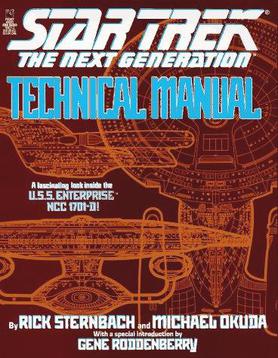
Figure 7.3.1 Cover Page of “Star Trek: The Next Generation: Technical Manual”.[1]
Technical product descriptions are often legally required in order to ensure safety and compliance. Poorly written technical descriptions can cause confusion, waste time, and even result in catastrophe! Attention to detail is critical.
Product specifications require detailed descriptions of design features; instructions often require specific descriptive detail to “show” the reader what to do and what something should look like at each stage of a process. Some general categories of technical descriptions include the following:
Mechanism Descriptions provide a detailed overview the physical aspects of a tool, machine or other mechanical device that has several parts and is designed to perform a specific function. These could be product descriptions for sales or manufacturing, documentation of design specifications, infographics, etc. This chapter focuses in detail on this kind of description.
Process Descriptions detail a series of events (natural/biological/ecological, mechanical, social, or psychological phenomenon) that happen in particular sequence in order to achieve a specific outcome. These can be categorized into non-instructional processes (such as a process analyses of how an internal combustion engine works, or natural processes like photosynthesis) and instructional process (such as recommended/required procedures and explicit step-by-step instructions to be followed). (See Section 7.3 for detailed information on Writing Instructions). A scientific lab report contains a description of the process, or methodology, used in conducting the experiment. The description must be detailed enough to allow the reader to replicate the process.
Technical Description of a Mechanism
Mechanism descriptions should provide a clear understanding of the object being described, including
- Its name (or general category of items it belongs to)
- Overall function/purpose
- General appearance and physical properties
- Component parts
- How the parts interact to create a functioning whole
- Any background information or warnings necessary to understand or operate the device.
The reader should be able to clearly picture, and therefore understand, the nature of the object being described, what it does, and how it works.
In order to achieve this clarity for the reader, the writer must choose which details to include and organize information logically. Consider which of the characteristics in the box below might be relevant to the mechanism you want to describe.
| colour | materials | texture, smell, taste |
| shape | component parts | finish |
| size, mass, weight | properties | patterns, designs |
| dimensions | principles at work | interactions |
Before you begin to draft your description, you must consider your purpose and audience: Why does your audience need this description? What will they use it for? Are you describing different types of solar panels for the average consumers to help them choose the one that best fits their needs or to electrical engineering students to help them understand how the technology works? Are you explaining a mockup for a website to client with little technical knowledge or to the IT person who must implement your mockup design? Are you providing schematics to technicians and installers to help them implement plans or to inspectors who need to make sure you are following code requirements? Your descriptions might differ depending on the audience and purpose.
Technical Description Worksheet
First, take notes that help you identify your purpose and audience. Once these are clearly in focus, take notes on each of the following typical elements of a technical description and use your notes to write a draft:
- Definition: Identify what the device is, what it’s called, and explain its purpose.
- Overview: Describe the mechanism’s overall appearance (“big picture” description of its overall size, shape, general appearance to give the reader a mental picture).
- Components: Describe the main component parts in labelled sections; consider the order of information carefully here. Create a logical flow that explains the connection between each component described. It should be clear why you describe component X before you describe component Y.
- Explanation: how do the parts work together to fulfill its function? What key principles govern its functioning? Consider how much detail is necessary here for your intended audience.
- Visuals: include graphics that clearly illustrate the mechanism as a whole and its relevant component parts. Will you use a photo or diagram? Consider showing specific details in expanded views, cut-aways, exploded views, or labelled diagrams. You may even embed or link to videos showing the device in action.
- Conclusion: depending on the purpose, you might review the product’s history, availability, manufacturing information, warnings, etc.)
- References: Cite any sources you have used in your description, or provide links to additional sources of information available (if relevant).
Sample Descriptions
Examine the description of the “Up Goer Five” in Figure 7.3.2 (click on image for larger version). Who might the intended audience be?
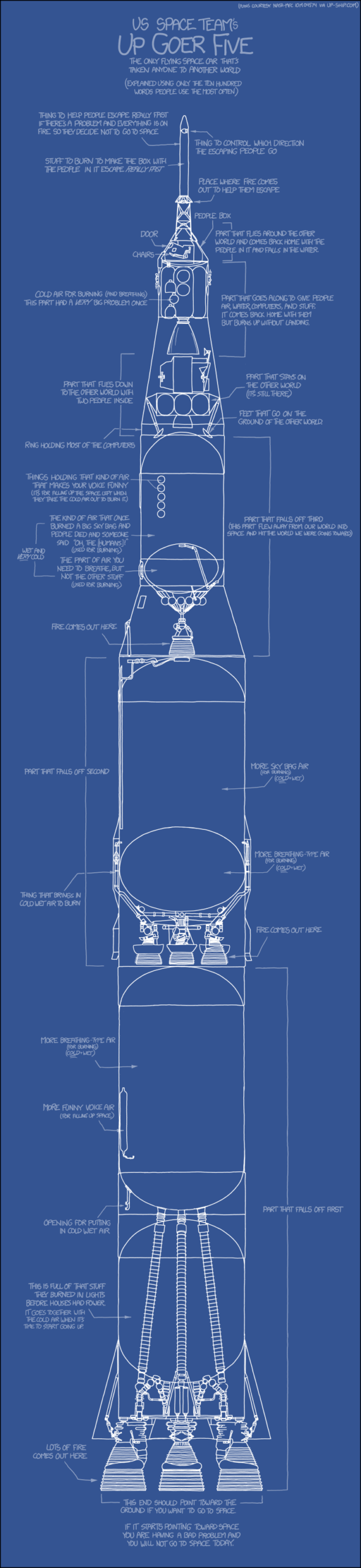
Compare the description in Figure 7.3.2 to the information given on the NASA website about the Mars Curiosity Rover.
Note the differences in the level of detail, vocabulary, and overall purpose of the descriptions. If you used the information on the NASA site to fill in the Technical Description Worksheet above, you might end up with something like the following chart.
| Definition | Curiosity Rover – a robot designed by NASA to explore Mars, collect data and send it back to Earth |
| Function | Launched in 2011, Curiosity travels around the Gale Crater on Mars, collecting information about the planet to send back to Earth. Its mission is to see if Mars could ever have supported microbial life, and to help determine if Mars could someday be inhabited by humans. |
| Overview | Car-sized, 6 wheel robot, about 7’ tall, with a roughly square chassis that has several appendages connected to it that house sensors of various types |
| Components |
|
| Visuals |
|
| Conclusion or Supplemental information | Information about lifespan? Travel speed? Energy use? |
| References | NASA Mars Science Laboratory – Curiosity Rover page |
You may find that some of these elements are not necessary; again, consider what your target audience already knows and needs to know. Strike a balance between unnecessarily stating the obvious and incorrectly assuming your readers have knowledge that they may lack.
In refining the details of your description and its component parts, consider your organizational strategy and language style:
Organization: Determine the most logical principle to organize your description:
- Steps in a process it completes
- Top to bottom (or foundation upward)
- Left to right (or right to left)
- Most important to least important features
- Central component to peripherals (or external frame to internal components)
- Material properties, etc.
Language: Use specific, precise, concrete terms – avoid vague or overly-general terms
- Use correct terminology, and define terms as necessary for your audience
- Use analogy to describe an unfamiliar thing by comparing it to a familiar thing
- Use concrete objective language, avoid subjective terms
- Use present tense, active verbs to describe how the device appears and what it does
- Use words that create vivid and specific pictures in the reader’s mind.
EXERCISE 7.3 – Practice technical description
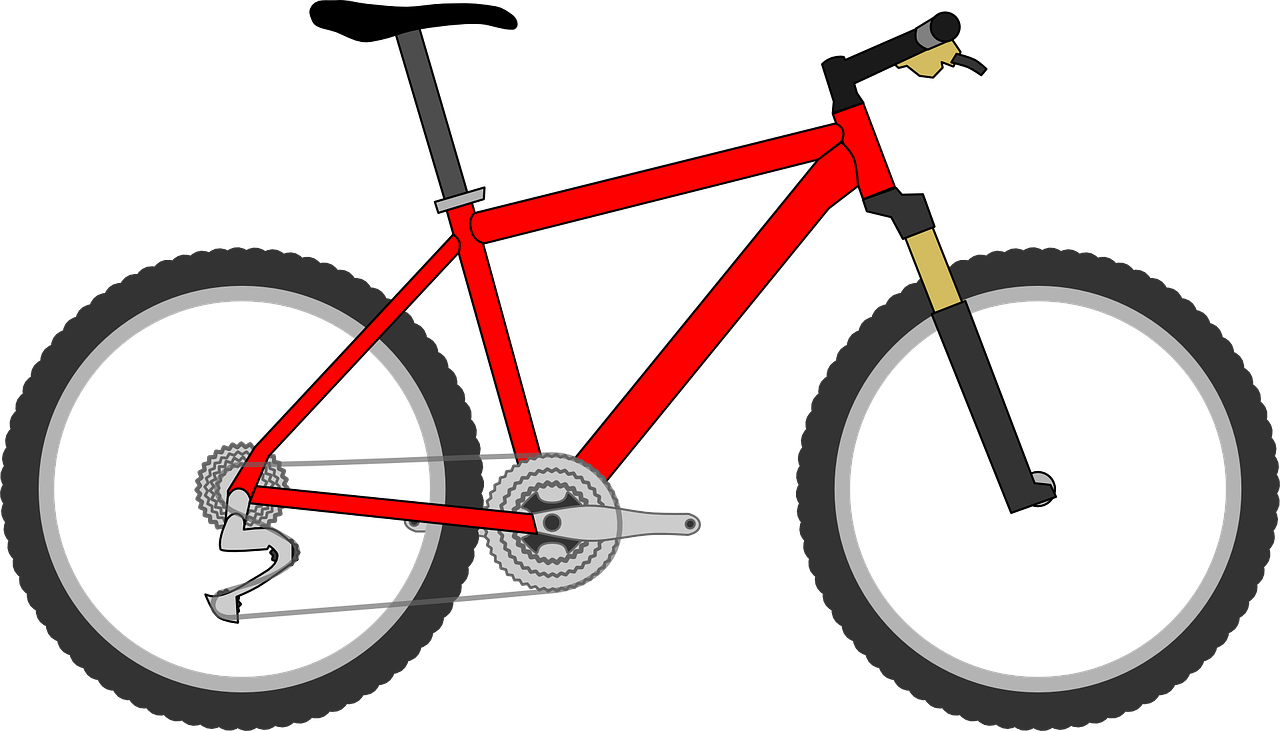
Choose a common, everyday object (such as the object below) and draft a technical description for an audience unfamiliar with this mechanism. Start by imagining a target audience and purpose, and then try filling in the Technical Description Worksheet with detailed information. Using the information in your worksheet, draft a short description of 1-2 paragraphs, and add properly-captioned visuals.
- R. Sturnback and M. Okuna, Star Trek: The Next Generation: Technical Manual. New York: Pocket Books, 1991. ↵
- R. Munroe, "Up Goer Five" [Online]. Available: https://xkcd.com/1133/ Also see "1133 Up Goer Five - explained," Explain xkcd wiki [Online]. Available: https://www.explainxkcd.com/wiki/index.php/1133:_Up_Goer_Five . CC-BY-NC 2.5. ↵