4. TEAMWORK AND COMMUNICATION
4.6 Peer Review Strategies
Suzan Last and Loren Gaudet
Peer review is a standard form of quality control and way to get feedback on your work in both professional and academic contexts. When you submit a paper in a course, or deliver a document to a client, you’re not usually sitting in front of the person while they read it. Even though your writing may make sense to you, there’s no guarantee that your reader will understand or engage with your writing in the way that you intended. In fact, different readers will have different lived experiences, knowledges, and backgrounds, and all of these can affect their reading experience. This is why having a colleague review your final draft before presenting it to the intended audience is common practice in both academic and professional contexts.
When writing collaboratively, you have built-in peer reviewers who understand the purpose, goals, and intended audience of your document. Even still, having an external reader give you feedback can offer a useful perspective. People who have been drafting and revising the same content for a while are sometimes “too close” to see something that might seem unclear or ambiguous to an outsider.
Peer review entails having a peer — a fellow student who is familiar with your assignment, or a colleague who understands your purpose — review and offer feedback on the effectiveness of your content and design and how you might improve it. While peer review ultimately benefits the intended audience as a form of “quality control,” it also has clear benefits for both the author and the reviewer:
Authors can get helpful feedback on how they can improve their content/organization/format,
Reviewers can learn from the content they are reviewing, reinforce the assignment and grading criteria, and come back to their own draft with a fresh perspective.
For both author and reviewer, peer review is a helpful way to assess content, structure, style and formatting before submitting your final document. Building in time for peer review also helps with time management, as you have a reasonably complete final draft well before the due date.
In order to attain the maximum benefits of peer review, both authors and reviewers should keep the following strategies in mind:
AUTHOR STRATEGIES
- Be prepared: provide your reviewer with the most complete and polished draft possible in order to fully benefit from peer review. A partial or very rough draft can benefit from some preliminary feedback on content gaps, structural issues, or general tone, but a completed draft can elicit more helpful and detailed feedback.
- Give reviewer some guidance: describe the concerns you have about your draft at this point. Alert your reviewer to areas where you would particularly appreciate feedback (or where you do not want feedback because you know what revisions are needed). Providing questions helps your reviewer give you targeted feedback that will be useful to you. If the reviewer is not familiar with your purpose and audience, fill them in.
- Be open to new ideas: avoid becoming defensive about the feedback; remember, your reviewer is trying help you improve your draft. Consider alternative viewpoints you may not have thought of before; listen before deciding what you will do with the feedback. You don’t have to follow your reviewer’s advice, but show gratitude for their efforts in trying to help you.
- Consider advice carefully: think critically about whether the reviewer’s suggestions will help you to improve your draft and if they are appropriate for your purpose and audience. What and how you revise is ultimately up to you; consider your reviewer’s advice carefully, and seek additional advice if you feel unsure about following their revision suggestions.
REVIEWER STRATEGIES
- Know the document’s purpose and audience: review the assignment description and/or grading rubric before reviewing the draft; know what the document is trying to achieve before you assess what revision it might need to achieve it.
- Provide balanced feedback: be honest and critical, but also point out strong areas where things are working well. Remember your purpose is to help the author find ways to improve the draft: identifying what is already working well helps the author to continue doing that. Identifying what could use further work will help them develop a revision strategy.
- Be courteous and constructive: be aware of your language and tone when giving feedback. Use positive, constructive tone to explain what could use improvement. Don’t gush (“your paper is so awesome!”) and don’t trash (“This totally sucks! Rewrite the whole thing!”). Remember that peer review is a collaborative exercise; avoid patronizing, belittling, or “talking down” to your peers when giving advice. Asking questions can be an effective way to provide feedback on what might the draft might be missing or what might be confusing for you as the audience. Follow the “golden rule” and provide feedback in a way that you would appreciate receiving it.
- Be specific: explain why a sentence, paragraph, or image needs improvement; explain why you as the reader are confused or bothered by a specific phrase or passage, or why the logic does not flow for you (be “reader centred”).
- Don’t edit: Your job is reviewer, not editor. Don’t fix errors or phrasing issues; just point out areas that need improvement. You might offer ONE sample correction to demonstrate what you mean, but do not engage in wholesale editing. A key purpose of peer review is for each person to learn how to edit their own work based on reviewer feedback.
- Be efficient: don’t overwhelm your author with too much detailed feedback. A page that has more feedback notes than content will be very difficult to process. Focus on a handful of the most important revisions that are needed to help improve the draft. For example, if there are numerous spelling errors, don’t point them all out; highlight one or two and then recommend that the author spellcheck carefully before submitting.
NOTE on Using AI: Some people use Generative AI to provide peer review, but please note that as a reviewer, you must obtain the author’s permission to submit their work to an AI tool. It is a violation of copyright to upload another person’s work to an LLM without their explicit consent. Some authors do not want their work being used as training material for LLMs. Also, keep in mind that Gen AI tools are designed to “flatter” the user and tell them what they want to hear, and thus do not necessarily provide effective feedback on ways for them to improve.
Methods of Giving Feedback
There are many ways to provide feedback on someone’s work; how you do this will depend on what form of work you are reviewing, the context, and the situation. For example, if you are doing a peer review in a classroom face-to-face, you might give feedback verbally, or you might put hand-written feedback directly onto their papers. In some cases, your instructor might give you a checklist or heuristic to use, which you must fill out as you are reading your peer’s draft.
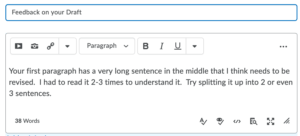
If working remotely, you might read your peer’s work in an online forum, and post a reply in which you write out all your feedback within the reply window, like the one below.
To offer more detailed feedback, you might download the author’s document and write inline comments on the draft – ideally using a different colour to make your comments standout more easily, as seen below.
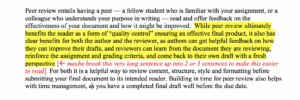
Then upload your revised document as a reply to the author.
Writing inline comments can affect the formatting of the document, so you may instead want to use the “insert comment” function.
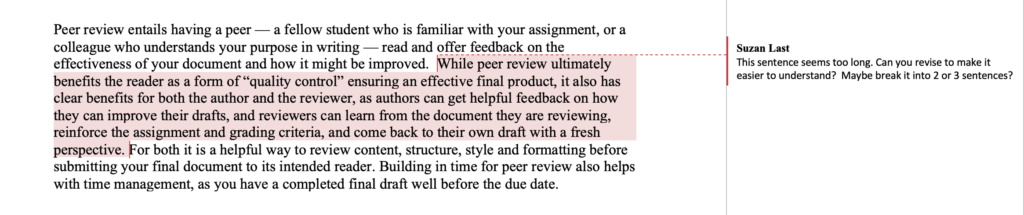 This will allow the document formatting to remain stable, and your comments can be easily deleted after reading.
Read Aloud Peer Review
Read Aloud is an highly effective method of peer-review that focuses on giving the content creator access to the reader’s direct experience of the draft. Rather than having a peer offer written feedback about the draft, the Read Aloud method invites the reviewer to express their experience as a reader. When a peer reads your work out loud, you can see how they are responding to your draft in real time. Sometimes a change from reading to hearing your work can help you catch writing issues that need attention, such as overly long sentences that trip up the reader, or needless repetition. When you’re reading a peer’s work out loud, you get practice expressing your experience as a reader and thinking critically about why and how different aspects of writing can shape your reading experience. These reflections are really helpful if you can apply them to your own work!
There are many ways of doing read aloud peer review, but here are some guidelines to follow.
- Find a suitable place where you can hear each other reading aloud, and you won’t disturb others. Consider working in pairs, taking turns reading each other’s drafts out loud.
- Try to make yourself comment on your experience after each paragraph, or even sentence!
- If you stumble, pause, or have to reread something, this is usually a good opportunity to reflect on why this happened and explain this to your partner. (did you simply lose focus, or was the sentence difficult for you to understand the first time through?)
- Remember to be kind, supportive, and compassionate.
If your draft is being read out loud, here are some guidelines for listening:
- Make sure that you have a copy of the draft for your partner and a copy for yourself on which you’re able to write comments as you listen. This could mean having 2 printed copies of your draft, using an online tool such as google docs, or simply having a laptop or tablet that you feel comfortable handing to your partner.
- While your partner is reading your work out loud, listen carefully. Sometimes, changing the medium of your words can help you to catch writing issues that need attention. (like maybe you’ve used the word “plethora” too many times!)
- Take notes on your reader’s reactions. Are there places where what you’re trying to say and what they’re communicating don’t match up? If so, highlight these places and return to them for revision.
- If your partner says, “I like this,” consider asking them to be more explicit about their reading experience. What do they like about it?
- If you have specific concerns about your writing, consider highlighting these for your partner. For example, you might ask your peer to focus on your argument and its supporting evidence; or you may be more concerned about the sentence structure.
Having your work read out loud can be uncomfortable, nerve-wracking, or even scary! Having said that, hearing the feedback put in terms of your reader’s experience can help. Practice and repetition can also help to make this less intimidating.
In order to make sure that you and your partner are commenting on the experience of reading — and NOT making corrections to the paper — the table below offers some guidelines for thoughtful ways to respond using “I statements” to describe the reader’s experience.
| Instead of saying…. | Try saying… |
| This paper has no thesis | I’m through the first paragraph, and I’m still not quite sure what the main claim of the paper is. |
| This word is wrong | I find this word choice to be confusing. It means something different to me. |
| This is a run-on sentence | I’ve lost track of what’s happening in this sentence. |
| This is unclear | I’m having trouble understanding this part. |
| This point doesn’t belong here | I’m struggling to see how this point relates to your argument. |
| This is really good | I found this idea interesting/this sentence easy to read because… |
Whichever method you use to provide feedback, keep in mind these essential guidelines:
- Be specific: give the author specific examples and details; avoid vague or overly general statements
- Be constructive: try to help the author improve the quality of their work in substantial ways; point out what is working well and where further attention is needed. If your not sure about something, be honest.
- Be courteous: remember the golden rule, and give feedback in a way that you would like to receive it yourself.