2. PROFESSIONAL STYLE
2.2 Writing To Persuade
Some people have the impression that technical writing is “unbiased,” neutral or purely objective, simply describing facts or providing instructions. While it’s true that the writing should be free from bias (see APA’s Bias Free Language guidelines), that does not mean that it never tries to influence the reader. Being persuasive and being biased are not the same thing. Persuading a client to choose the design that best meets their well-defined and objective criteria differs from encouraging them to select the option that will most benefit yourself — the latter is a kind of bias.
Technical writing typically arises from the need to solve a problem, and generally uses an “evidence-based approach” to persuade the reader to address the problem in a particular way. To successfully persuade, you need to select strategic rhetorical approaches based on the different kinds of audiences and situations. It is crucial to have an understanding of the rhetorical situation in order to determine the most effective way to frame your argument and convince your audience.
Understanding the Rhetorical Situation
It is common knowledge in the workplace that people generally don’t really want to read what you write, and even if they want to or have to read it, they may not read all of it. People don’t tend to consider technical writing as “recreational reading.” They must read it to help them do their job. So how do you get your reader to understand what you need quickly and efficiently? Start by doing a detailed Task and Audience Analysis — make sure you understand the “rhetorical situation.” Before you begin drafting a document, determine the needs of your rhetorical situation (See Figure 2.2.1).
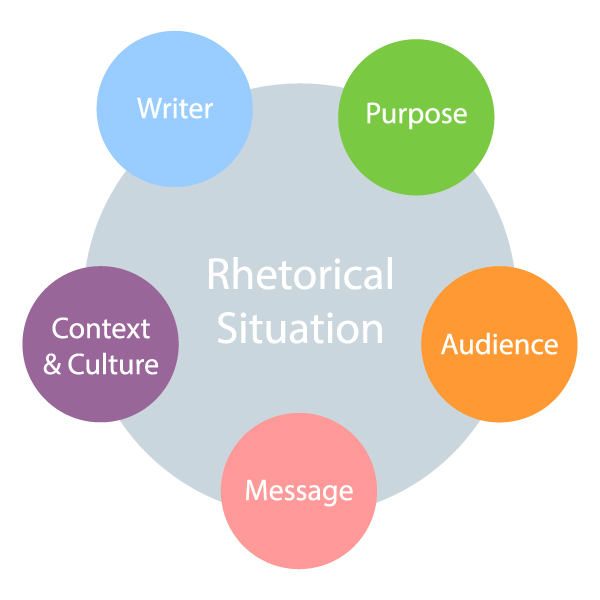
The “rhetorical situation” is a term used to describe the components of any situation in which you may want to communicate. To define a “rhetorical situation,” ask yourself this question: “who is talking to whom about what, how, and why?” There are five main components you need to consider:
- Purpose
- Writer
- Audience
- Message
- Context/Culture
PURPOSE refers to why you are writing. Determining your purpose requires that you engage in Task Analysis — that is, have a clear sense of what problem has instigated the need to communicate (sometimes called the “exigence”) and what you want to accomplish by writing this document. Ask yourself what you hope the reader(s) will do/think/decide or how they might behave differently as a result of reading it. For example, you may want to propose an innovative solution to a specific problem. In this case, you want the reader to agree to explore the idea further, approve funding for further research and development, or even hire you to implement the solution directly.
WRITER refers to you, the writer/creator/designer of the communication. Examine your own motivation for writing and any biases, past experiences, and knowledge you bring to the writing situation. These elements will influence how you craft the message, whether positively or negatively. This examination should also include your role within the organization, as well as your position relative to your target audience.
AUDIENCE refers to your readers/listeners/viewers/users. Audience Analysis is possibly the most critical part of understanding the rhetorical situation. Consider Figure 2.2.2 below. Is your audience internal (within your organization) or external (such as clients, suppliers, customers, other other interested parties)? Are they lateral to you (at the same position or level), upstream from you (management), or downstream from you (employees, subordinates)? Who is the primary audience? Who are the secondary audiences? Why are they reading this document? What do they need or want to get from it? These questions, and others, help you to create an understanding of your audience that will allow you craft a message designed to effectively communicate specifically to them.

Keep in mind that your different audiences may also have different purposes in reading your document. Consider what their various purposes might be, and how you can best help them achieve their goals. Considering what they are expected to do with the information you provide will help you craft your message effectively. Consider also that technical writing often has a long “life-span” – a document you write today could be filed away and reviewed months or even years down the road. Consider the needs of that future audience who might be less familiar with the current context in which you are writing.
| Audience | Purpose for Reading |
| Executives | Make decisions |
| Supervising Experts/Managers | Advise decision makers; direct subordinates |
| Technical Experts/Co-workers | Implement decisions; advise |
| Lay People/Public/Clients | Become informed; choose options; make purchasing decisions |
| Future Readers | Understand how things came to be as they are, how decisions were made, how something was designed, etc. |
Some companies develop audience profiles or even fictional “user personas” to help understand their audience and guide their communications. Here are some questions to consider as part of the audience profile:
Developing an Audience Profile
- Who are your primary readers? (specific names and titles, or general roles)
- What is their purpose or goal in reading this?
- Are they above you in the organizational hierarchy? Lateral, subordinate? Outside of your organization?
- Who else might read this document? (secondary readers)
- Do you know what their attitude towards the topic is?
- How might cultural differences affect their expectations and interpretations?
- How much technical background do the readers have?
- How much do they already know about the topic?
- What situation gave rise to this document?
MESSAGE refers to the information you want to communicate (and the medium or genre you use to present that information — because as Marshall McLuhan famously asserted, “the medium IS the message“). Align the content of your message, as well as the form it takes, with your purpose and audience. Consider the symbiotic relationship between your form and content. Selecting the appropriate format for your content ensures that you have presented your message in a suitable way that meets the expectations of the audience. Take the time to judiciously prune the content that your audience does not need or want. “Time is money” may be a tired old cliché, but wasting your audience’s time with information that is unnecessary or irrelevant to them will not win you any good will. Express your message in a professional and appropriate form and style for the audience, purpose, and context.
CONTEXT refers to the situation that gives rise to the need for the writing and the constraints you need to consider in responding. In other words, what has happened or needs to happen that creates the “exigence” or need for communication? The context is influenced by timing, location, current events, and culture, which can be organizational or social. Ignoring the context for your communication could result in awkward situations, or possibly offensive ones; it will almost certainly impact your ability to clearly and credibly convey your message to your audience.
Consider the subtle (and not so subtle) similarities and differences in the rhetorical situation when you offer feedback on Student Experience of Learning Surveys vs when you evaluate an instructor on Ratemyprofessor.com.
EXERCISE 2.4 – Identify the differences in the rhetorical situations
| Learning Experience Survey | Ratemyprofessor.com | |
| Purpose | ||
| Audience | ||
| Writer | ||
| Message | ||
| Context |
EXERCISE 2.5 – Task and Audience Analysis
Download Task and Audience Analysis Exercises (.docx)
The table below contains a collection of details about a research project you have just completed on rising sea levels. Imagine that you are writing documents for each of the 5 following audiences:
- Your supervisor/boss
- Scientists
- The general public
- Politician
- High school students
What information about rising sea levels might each audience be interested in? As you go down the list, consider which detail would be most interesting and relevant to each audience.
Consider what kind of document might contain that information for that audience.
| Interested Audience and Genre | Categories of Information on Sea Level Rise |
| The dollar damage caused by sea level increases each year. | |
| A literature review of previous research on rising sea levels. | |
| Descriptions of calibration procedures for your instruments. | |
| Some basic physics of how tides and currents work. | |
| How much your project costs. | |
| A log of all your measurements during the whole project. | |
| A list of people who worked on the project. | |
| Specifications of a new instrument to measure water conditions. | |
| A new result showing a connection between sea level and coastal developments. | |
| Procedures you used to avoid statistical biases in your data. | |
| Your plans for further measurements. | |
| Your recommendations for future research. |
Rhetoric as Problem Solving
Problem solving often requires a distinctly persuasive — or rhetorical — approach. Consider the various interlocking aspects of persuasion presented in Figure 2.2.3. You might first have to convince someone that a problem exists (exigence) and should be addressed. You will need to understand your audience in order to know what might motivate them. You will need to craft your message with an understanding of what genre will most effectively convey your purpose, and what rhetorical strategies will best appeal to your audience.
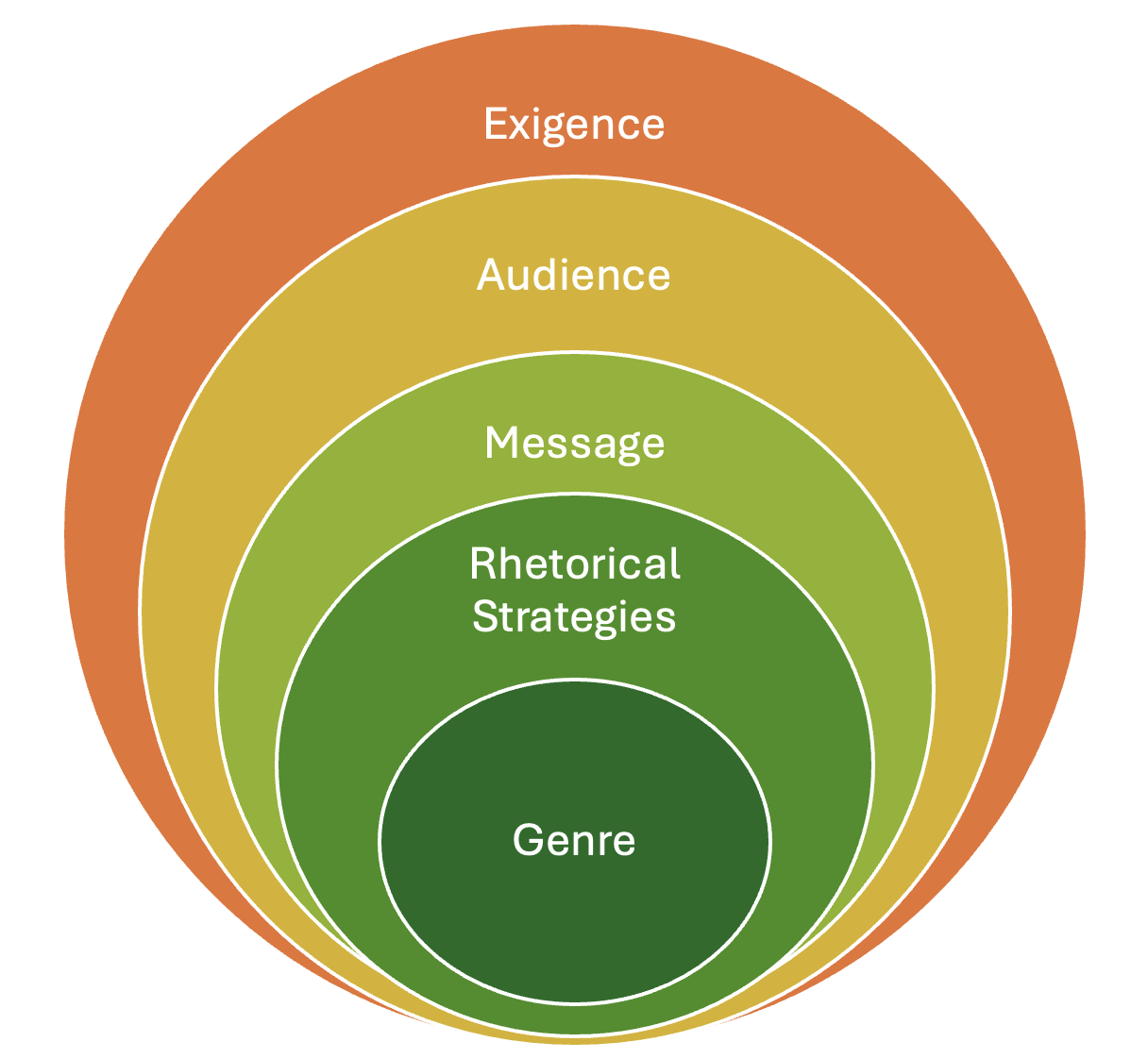
There is a wide range of tools to persuade your reader in a professional manner; these include choosing an appropriate genre to convey your message, using rhetorical appeals effectively to convince your intended audience, avoiding inappropriate language, and maintaining an ethical approach, all of which are discussed in more detail below.
Understanding Genre
The word “genre” is often used to describe and categorize standardized forms of communication. We think of poetic forms like a sonnet, musical forms like jazz, theatrical forms like tragedy or comedy, or movie genres like science fiction or romantic comedy. Each of these is made up of standardized conventions that people expect to find in each form (we expect to find horses in Westerns, not in Science Fiction). However, we can think of genre as more than that. Genres can describe conventionally agreed-upon guidelines for behaving or communicating in frequently recurring situations. In following the conventions of that situation, we are meeting the expectations of those with whom we are communicating.
For example, meeting a work colleague for the first time is a situation that recurs frequently, and so we have developed conventions for how to behave and communicate in that situation. Shaking hands is a standard Canadian convention; bowing is a standard Japanese convention. These conventions might vary depending on context. The COVID 19 pandemic resulted in a new convention: the elbow bump. A job application letter has standardized formats, but writing one is also the expected way of handling the situation in which you want to be hired, and the employer wants to hire someone. There are certain expectations about what content you should include and the style and tone you should adopt. If you fail to meet these genre expectations, you likely won’t be hired for the job.
Choosing the most appropriate genre to convey your message and negotiate your persuasive purpose, and then following the expected conventions of that genre, is important if you want to successfully convince your audience. To do this, you must have a clear understanding of the cultural context and the genre conventions that best apply to it.
Rhetorical Appeals
When we talk about Rhetorical appeals, we are classifying the various techniques we use to persuade people into specific types of persuasive strategies. Think about times when someone was able to get you to change your mind about something. How did they do it? Did they change how you felt emotionally about the issue (make you feel angry or guilty), or get you to care about the issue more than you had previously? Did they present you with startling statistics or a clear rationale? Did they refer to someone you respect or admire who agrees with their position? Did they select the right time and place when you would be most likely to agree with them?
Convincing your audience requires that you select the rhetorical appeals that you think will be most effective for your particular audience in the particular situation. Aristotle’s 4th century BC Treatise on Rhetoric defined rhetoric as the ability to see the available means of persuasion in a particular situation. He outlined a classification of rhetorical appeals that we still use today: the Greek words are ethos, pathos, and logos.
Ethos – Appeal to Credibility: this rhetorical strategy involves establishing your credibility, expertise, or authority to be making the argument. What experience or expertise do you have? What knowledge or skills do you possess? What’s your role within the organization, and/or in relation to the reader? Why should the reader trust you as a reliable, knowledgeable, authoritative, and ethical source of information? If you do not have inherent credibility (you do not yet have experience, expertise, or reputation), then you may need to “borrow” ethos by referring to reputable sources and including the perspectives of experts.
Pathos – Appeal to Emotion: this strategy involves appealing to the emotions, values, and/or interests of the reader. How does your proposal benefit them? Why should they care about it? How does it relate to the goals of the organization? How can you build “common ground” with your reader? What will make your reader feel “good” about your project? How can you evoke emotions such as pride or outrage that might motivate the reader?
Logos – Appeal to Logic: this strategy involves grounding your argument in logic, reason, and evidence — things that “make sense” to your your reader. What evidence supports your claims? On what facts and data is your reasoning based? Arguments grounded in reason and evidence are often considered the strongest. Government organizations and companies alike generally like to make “evidence-based decisions.”
A fourth appeal, Kairos, is often added. Kairos is the appeal to timeliness or appropriateness. Using this appeal means being aware of what is appropriate and timely in a given rhetorical situation. Sometimes, a well-crafted argument can fail because it comes at the wrong time or place. Kairos involves knowing what is “in” or “hot” right now, what is an important topic or issue, and how best to discuss it; knowing when it is the “right time” to broach a topic or propose an idea; knowing how to use the appropriate tone, level of formality and decorum for the specific situation.
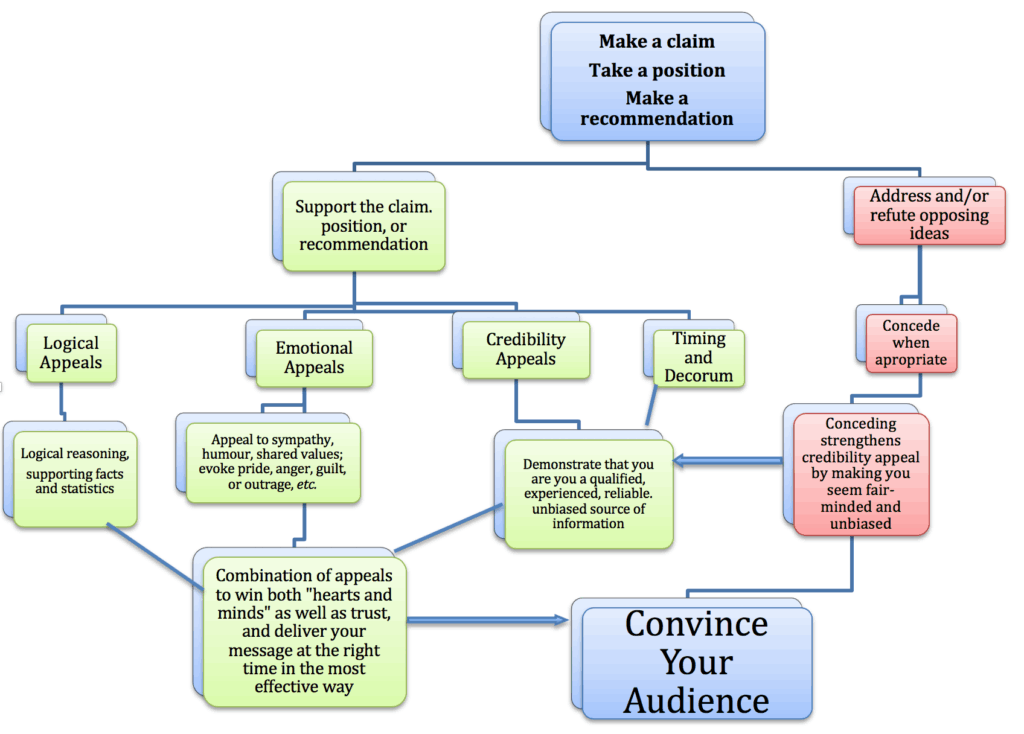
Finding the appropriate blend of rhetorical appeals is critical to making a successful argument. Consider that when making your case, you often have to “win the hearts, minds, and trust” of your audience. Thus, you’ll need to appeal to emotions, logic, and credibility to show the reader why they should care about the topic, why your idea is reasonable, and that you are a trustworthy source of information. In addition to these elements, you should also be mindful of the word choice and tone so that you are presenting your argument in a way that is appropriate for your intended audience. If you happen to be writing about rhetoric, for example, writing a rhetorical analysis, you might find this sample essay, Choosing Rhetorical Appeals for your Audience, helpful as a model for using this potentially new vocabulary. Figure 2.2.4 maps these appeals.
Avoiding Ad-Speak
“Ad-speak” refers to the kind of language often used in advertisements. It aims to convince consumers to buy something, regardless of whether they need it or whether it is effective, hopefully without thinking too much about it. Because we hear this kind of rhetoric all the time, it easily becomes habit to use it ourselves. We must break this habit when communicating persuasively in professional contexts.
Ad-Speak tends to distort the appeals described above by using strategies such as
- Emotional manipulation
- Logical fallacies
- Hyperbole, exaggeration, or dishonesty
- Vague claims
- Incomplete or cherry-picked data
- Biased viewpoints
- Hired actors rather than professionals or experts as spokespeople.
As a student in a professionalizing program learning the specialized skills and developing the sense of social obligation needed to become a trusted professional, you should avoid using “sensational” terms characteristic of marketing language. Instead, when trying to persuade your reader, make sure you use quantifiable, measurable descriptors and objective language in your writing. You cannot determine how many units of “amazing-ness” something has, or its quantifiable amount of “awesomeness,” “fantastic-ness,” or “extraordinariness.” Describing something as “incredible” literally means it’s untrustworthy (not credible). So avoid using the kinds of words shown in Figure 2.2.5.

Find measurable terms like “efficiency” (measured in time required or energy use), “effectiveness” at fulfilling a specific task, strength (weight limit), durability (lifespan), popularity (measured by survey results), and so on.
Communicating Ethically
When writing persuasively in a professional context, communicating ethically is critically important. Ethical communications involves communicating from a place of accountability and integrity. Ethical communication demonstrates respect for your reader, the organizations you work for and with, and the culture and context within which you work. Failure to maintain integrity and ethics can result in consequences ranging from damage to reputation, loss of work, lawsuits, criminal charges, and even tragic loss of life.
This is precisely why many professional associations have standards that govern the ethical behaviour of their membership. For example, the Faculty of Engineering and Computer Science at the University of Victoria outlines its expectations for staff, students and faculty in this document: “Standards for Professional Behavior.” Engineers and Geoscientists of BC also has a Code of Ethics. Take note of the portions of the Code of Ethics that relate specifically to ethical communication in the box below.
“Registrants must uphold the values of truth, honesty, and trustworthiness and safeguard human life and welfare and the environment. In keeping with these basic tenets, registrants must:
- Provide accurate information in respect of qualifications and experience
- Provide professional opinions that distinguish between facts, assumptions, and opinions
- Present clearly to employers and clients the possible consequences if professional decisions or judgments are overruled or disregarded
- Clearly identify each registrant who has contributed professional work, including recommendations, reports, statements, or opinions
- Undertake work and documentation with due diligence and in accordance with any guidance developed to standardize professional documentation for the applicable profession.”
It is important to become familiar with the standards of practice in your field, and to consider how they impact your communication practices in the workplace. Remember that you are communicating in a professional context, and that comes with responsibility. Failure to uphold these responsibilities can have grave consequences, both professional and legal.
Consider the different rhetorical situations diagrammed in Figure 2.2.6, one for a marketer and one for an engineer.
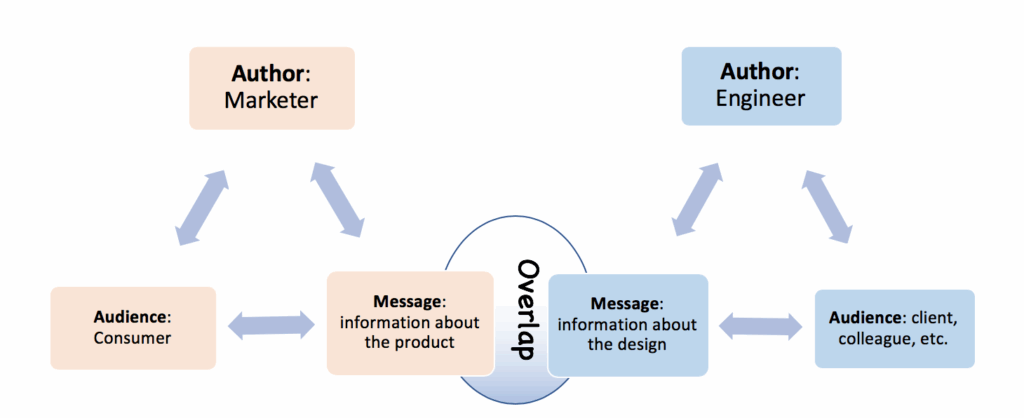
Clearly, there may be some overlap, but there will also be significant differences based on the needs and expectations of the audience and the kind of message being delivered. When an engineer provides information about a design, we expect accuracy above all. When a marketer provides information about a product, we do not necessarily have the same expectation. In fact, we are likely to be somewhat cynical about the veracity of the claims (will this shampoo really make me irresistible?). We hear marketing language so often that we easily slip into the habit of using it, even when it’s not appropriate. Be mindful to avoid using “ad-speak” when trying to persuade in a professional context.
Image descriptions
Figure 2.2.4 image description:
Use rhetorical appeals to convince your audience of a claim or recommendation you’ve made or a position you’ve taken. From there, you can support your claim using different types of appeals or address and refute opposing ideas.
To support the claim, position, or recommendation, you can use different types of appeals:
- Logical appeals: Use logical reasoning, supporting facts and statistics.
- Emotional appeals: Appeal to sympathy, humour, shared values, evoke pride, anger, guilt, or outrage, etc.
- Credibility appeals: Demonstrate that you are qualified, experienced, reliable, and an unbiased source of information.
- Timing and Decorum.
- Use a combination of appeals to win both “hearts and minds” as well as trust, and deliver your message at the time in the most effective way.
When addressing and/or refuting opposing ideas, it’s okay to concede where appropriate. Conceding strengthens credibility appeal by making you seem fair-minded and unbiased. You may need to draw on credibility appeals to show that you are qualified, experienced, and a reliable, unbiased source of information.
Supporting your position using different types of appeals and addressing opposing ideas will allow you to convince your audience.
Figure 2.2.6 image description:
When the marketer is the author, their audience is the consumer and their message is information about the product. When the engineer is the author, their audience could be a client or colleague, and their message is information about the design. There may be some overlap between the messages of the marketer and the engineer.