4. TEAMWORK AND COMMUNICATION
4.1 Understanding Team Dynamics
Team dynamics depend on innumerable factors, ranging from the size of the team, its overall purpose, the individual skills of the team members, their goals, and levels of commitment. In general, however, we tend to categorized teams either by function or by performance. For example, in terms of function, a “cross-functional team” combines people with diverse areas of expertise (such as mechanical, electrical, and software engineering) to all work on connected parts of the same project, while a “within-function team” is comprised of people with the same area of expertise.
Teams can also be categorized in terms of performance. Katzenbach and Smith inThe Wisdom of Teams[1] describe 4 categories of teams based on how well they perform.

Pseudo Team: a group of people not achieving what you would expect, based on their individual potential. They tend to work as isolated individuals rather than as a cohesive team, lacking strong communication with each other and commitment to the team’s goals. They either lack clear team processes, or do not follow them; team meetings lack focus and productivity; team members don’t feel accountable to each other; and there is little or no attempt to improve.
Potential Team: each team member performs at the level of the average team member, or maybe slightly above, developing some synergy and effective communication, but not reaching their potential as a team.
Real Team: A small number of people with complementary skills and compatible commitment levels maintain accountability to each other, their team processes, and overall goals to achieve a successful outcome through a high level of synergy.
High Performing Team: Few teams reach this level. A “high performing team” exceeds the abilities of individual team members and can accomplish far better results together than they could individually. Team members bring out the best in each other and see the interpersonal aspects of the team as just as important as the tasks. They establish team synergy through strong communication, clear team processes, and commitment to the project and to each other’s continual development. Building this kind of team synergy usually happens over time (and multiple projects) and takes consistent effort and commitment.
For a team to reach this level of performance, all members need to focus not only on the success of the project, but also on effective team dynamics and personal growth. To set your team up for success, consider the following:
SIZE: You need to be able to meet and communicate regularly. Typically, smaller teams work more effectively than larger ones, but that will depend on the kind of project or task you are working on.
SKILLS: team members should have adequate levels of complementary skills, and/or a willingness to develop skills required to complete the project.
PURPOSE & GOALS: all team members need to feel that the project is meaningful and important, and should have some agency in defining the purpose and goals. All team members must be able to clearly articulate the goals.
PROCESSES: the team needs to have clearly stated processes and approaches to completing work that all members understand and agree with; work is allocate equitably and fairly to each team member.
ACCOUNTABILITY: All team members need to feel accountable to each other and to the project, and the team needs to have mechanisms in place to ensure ensure accountability and to address lapses fairly.
EXERCISE 4.1 – Reflect on Previous Teamwork
Think of a time when you had to work with others to produce or achieve something – a design, poster, presentation, document, etc. You might have been working on a school assignment, been part of a sports team, work team, a club, or a musical band. Briefly describe what the task was and then consider the following questions:
- What was the team’s overall goal? Did you have a clear goal you all committed to?
- What was your job within the team? Were roles clearly defined?
- How were the jobs distributed? Was the workload fair?
- How well did your team function? How would you categorize this team based on the types described above? (Group, Pseudo-team, Potential team, Real Team, or High Performing team)
- Did anyone on the team hijack (take over) the project? Hitchhike (not contribute)? Isolate (work on their own and fail to communicate with the team?) What effect did this have?
- Was the outcome successful?
- Did your teammates teach you useful things and help you develop skills?
- Would you happily work with those teammates again on another project? Why or why not?
Becoming a member of a real or high performing team requires significant commitment — to both the project and to your teammates — as well as an understanding of team dynamics. The following sections provide some perspectives on team dynamics that you will likely come across in professional contexts to promote strong team performance and manage crises effectively; these include the GRIP model, the Tuckman model, the Lencioni model, the DISC model, and the Thomas Kilman Conflict Management model. Each of these models contains useful ideas that can help you design a strong team environment.
GRIP Model
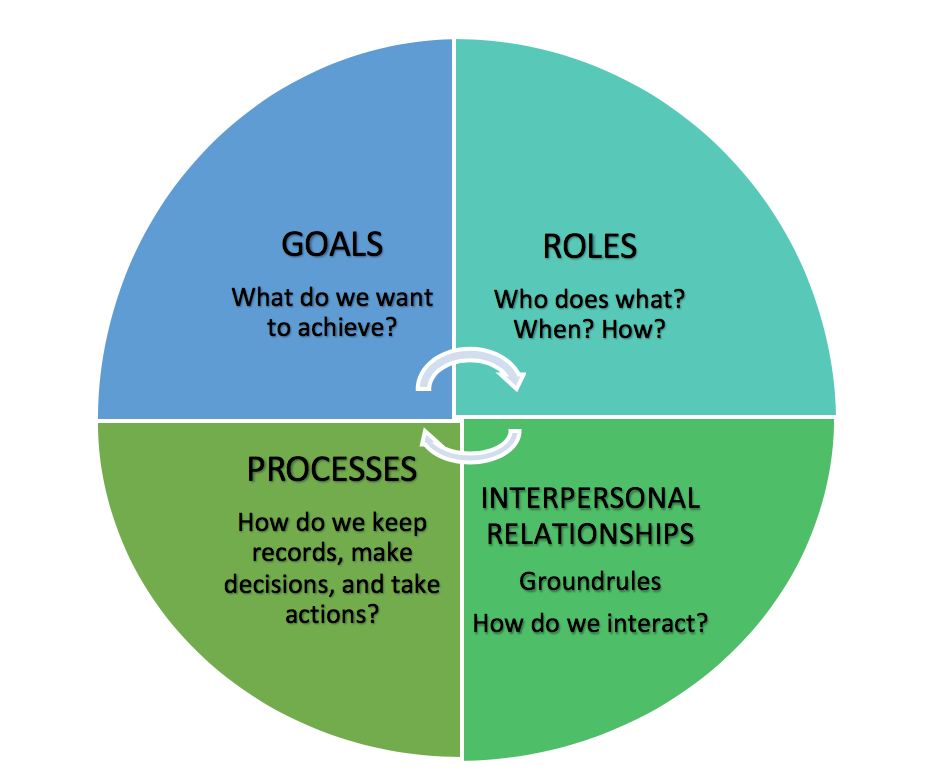
Richard Beckhard’s GRPI model,[2] originally developed in 1972, has been widely adapted in sports contexts as the GRIP model (see Figure 4.1.1), outlining four interrelated components of highly effective teamwork:
Goals: everyone must fully understand and commit to the goals of the team, and of the organization. Everyone’s goals must align in order to establish trust, make progress, and achieve desired outcome.
Roles: all team members must know what part they play, what is expected, and how they will be held accountable and responsible.
Interpersonal: constructive communication both requires and fosters trust and connection among team members, and helps to develop the sensitivity and flexibility needed to deal with conflict and make progress.
Processes: the team defines clear systems for decision-making, problem-solving, and conflict management. They also develop well-defined work flows and procedures to follow in completing the project.
Apply the GRIP Model to your team
Set a strong foundation for your team’s success by using the these GRIP principles to design some shared ground rules before you start your project:
DISCUSS GOALS: All team members should explicitly discuss and agree on the team’s goals as well as their individual commitment levels, to ensure they are aligned. Define some “big picture” goals for your project, but also consider goals that each team member would like to achieve. For example, if one team member’s goal is put in the extra effort needed to exceed expectations and achieve above average results, while another team member wants to simply produce work that is ‘good enough’, their goals and commitment do not align and this will lead to problems down the road if not addressed proactively.
CHOOSE ROLES: Team members should discuss their strengths and weaknesses related to the team task (clearly, you will need to do some task analysis first to ensure you understand what the task entails), and decide on who will take on which roles. Team members might “work to their strengths” – for example, someone who is very detail oriented might take on the role of editor; someone who has strong word processing skills might take on the role of document designer. However, you might also take a “growth mindset” approach, and choose roles that will allow you to strengthen weak areas, coach others, and build skills that you want to improve on. You might decide to alternate roles, so everyone has a chance to develop various skills. Consider how taking on roles integrates with the goals you have identified.
INTERPERSONAL: We all have different ways of communicating, and sometimes miscommunication can happen without us realizing it. One person might find it helpful to engage in some off-task “small talk” at the beginning of a team meeting as a kind of ice breaker or warm up, while another might find this annoying and inefficient. Discuss with each other what kinds of communication help to motivate you, and what kinds can trigger a “shut down” Determine how you can be sensitive to each other’s communication styles and preferred workflows.
DEFINE PROCESSES: Start defining some processes for how your team will communicate, make decisions, and ensure an effective workflow. For example, consider what communication channels your team will use for brief check-ins and questions, for more sustained collaboration and discussion, for sharing documents, etc. Will you create agendas to guide your meetings? Will you take minutes to record the decisions and progress made at meetings? How will you share them?
Using this GRIP process at the beginning of your project – in the “forming” stage – will help to set your team up for successful collaboration. You can refine the work you’ve done here and use it to create a Team Charter, as discussed in section 4.2 Project Management Tools and Teamwork Strategies.
The Tuckman Team Model
“Tuckman’s Stages of Group Development,” proposed by psychologist Bruce Tuckman in 1965,[3] is one of the most well-known theories of team development. It describes four stages that teams may progress through: forming, storming, norming, and performing (a fifth adjourning stage was added later). The stages move from organizing your team (defining goals, choosing roles, and developing processes) to collaborating on the results you are trying to achieve.
Although the stages appear linear, moving through them can be — like the design process — iterative and recursive. Teams may move back and forth through these stages, depending on events that may influence the team. For example, a new member may join an already established team, which will require the team to revisit the forming stage. Some teams can also stall in a stage and never fully realize their potential. Figure 4.1.2 outlines these stages described in more detail below. While reading about each stage, you will note how crucial clear and constructive communication is at each stage!
.
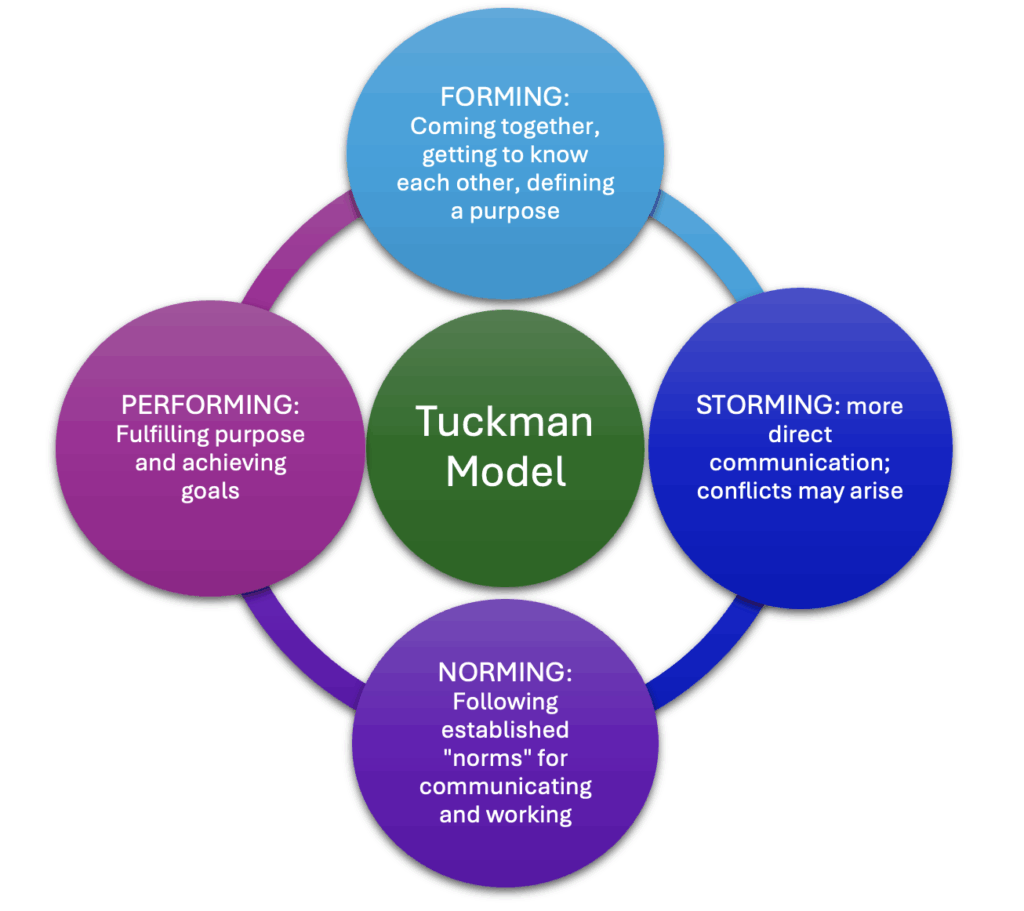
Figure 4.1.2 The Stages of the Tuckman model of team development
FORMING: During the team forming stage, everyone gets to know each other and tries to make a good impression. A fun team-forming activity can be a good way to help get to know each other and build trust. This is also a good time to create a set of shared expectations and guidelines in a Team Charter that defines how the team agrees to operate for the duration of the project. Team members should exchange contact and scheduling information and set up a communication channel. During this orientation stage, individuals start to establish preliminary boundaries and expectations of each other that will be explored more deeply in the storming stage.
STORMING: The storming stage is the one most often characterized by group conflict. In this stage, the preliminary boundaries and expectations are tested as individuals learn more about each other’s motivations, commitment levels, strengths, weaknesses, ideas, and strategies. This coincides with the “brainstorming” stage of the design process, in which each teammate contributes ideas to help define the focus and trajectory of the project. It is important to recognize that conflict at this stage can be productive, if managed effectively. While you may be tempted to remain polite and accommodating to avoid conflict, this rarely allows the team to reach its potential in developing innovative ideas and approaches. Sometimes the best ideas are forged in the fires of disagreement and animated discussion where all team members feel safe to voice their diverging ideas and perspectives. However, it takes work to get to this place of “safety,” and some teams get stuck at this stage, reverting back to working individually and becoming a “pseudo team.”
To help get through this stage successfully, you might agree on brainstorming rules (“no bad ideas!”), use pros and cons list, designate someone as the “devil’s advocate” whose official role is to poke holes and argue against. Commit to valuing the diversity of opinions and approaches in your team (see 4.3 Managing Team Conflict for additional tips). At this stage, team members may refine their goals and roles in the project. Learning to use a problem-solving approach to harness the constructive potential of conflict and compromise in this stage will help set your team up for a successful “norming” stage where you start to really make progress.
NORMING: During the norming stage, conflicts have been largely resolved, team members have proven flexible and supportive, each team member knows their role and works on their part of the project, follows the designated team processes and guidelines, and all is going well. Team members might do some work independently in this stage, but frequently check in with teammates to make ensure an efficient and effective workflow. For example, you will want to make sure you aren’t accidentally duplicating work or developing work that contradicts the work of other team members. If a teammate becomes ill and unable to meet a deadline, others agree on how to proceed. Group cohesion ensures that everyone is responsible for their task and accountable to the team; team members acknowledge and appreciate each other’s contributions. Gantt Charts or Work Plans help keep everyone on track during this stage. Problems might arise at this stage if a team member has been absent and has not caught up, or if team members do not fully understand their role, team expectations, or the overall goal. If this happens, the team may need to revisiting the forming or storming stage.
PERFORMING: Reaching the performing stage is the goal of high-performing teams. This usually only happens when teams have worked together well on several projects, have established a synergy, and have developed systems that make projects go smoothly and efficiently. The first time a team works together, they might not reach this stage; “performing” teams have established trust in each other, have well-defined roles and goals, and follow the strategies and processes they have chosen to achieve them. They can move quickly and efficiently, work interdependently, and understand how to best support each other when needed.
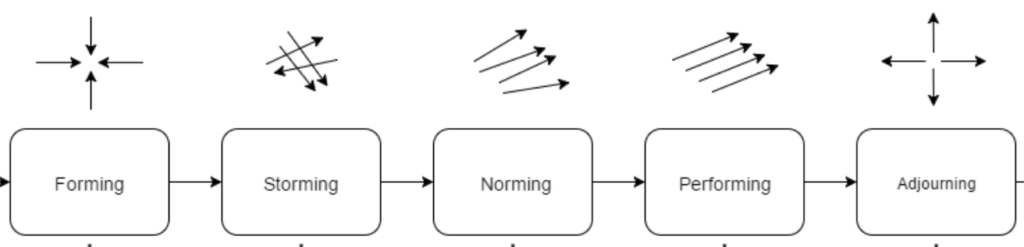
ADJOURNING: At the end of the project, team members celebrate their achievements, express their appreciate for each other’s contributions, reflect on what they have learned, and go their separate ways. If the team has successfully established trust and synergy, this parting can feel somewhat emotional (leading to what some have called a “mourning” stage).
Figure 4.1.3 [4] depicts the trajectory of each team member during each stage.
For an entertaining overview, watch this video on the Tuckman phases of team development, as depicted in The Fellowship of the Rings:
Lencioni Model
In his 2005 book, The Five Dysfunctions of a Team, Patrick Lencioni, [5] outlines five common problems teams experience that impact their effectiveness:
Lack of trust: if team members do not trust each other, they are unlikely to feel safe enough to speak honestly, take risks, or ask for help. A lack of trust means a low level of comfort that makes it difficult to communicate, commit, and perform effectively as a team
Fear of conflict: avoiding conflict can lead to an artificial “peace” at the expense of progress and innovation, or it can lead to unaddressed dysfunction that undermines the team. Shift the mindset to see conflict as a normal part of teamwork that, if managed constructively, can enhance productivity.
Lack of commitment: having insufficient control or ownership of team processes and decisions can lead to a lack of commitment, where team members fail to complete their assigned work or meet deadlines, do not follow through on decisions or tasks, and let their teammates down, ultimately affecting the success of the whole project.
Avoidance of accountability: if team members do not feel accountable to all other members of their team, they are less likely to care about not letting each other down.
Inattention to team results: when team members focus on their own personal goals instead of project goals, they lose sight of the expected results that actually measure the success of the project. Not focusing on the results during the process means that no one is actively planning how to improve those results.
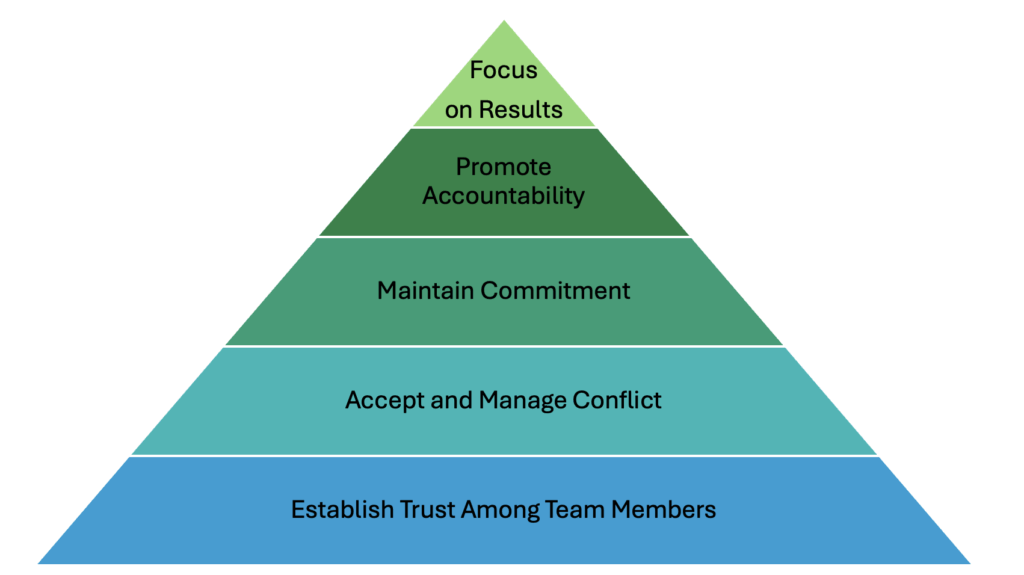
Lencioni designed a “pyramid” showing how each “dysfunction” connects to and builds upon previous ones. Figure 4.1.4 illustrates how to proactively address each of these issues, first and most importantly by establishing trust among all team members. Establishing trust, as the crucial foundational step, allows the team to move up the pyramid and manage conflict effectively, achieve commitment, create accountability and focus on team results.
DISC Model
DISC theory, developed in 1928 by Dr. William Moulton Marston (who also, as it happens, created the Wonder Woman comic series!), has evolved into a useful model for conflict management that predicts behaviours based on four key personality traits.[6] The names of these four traits have been variously revised over the decades, so you might find different terms used in different contexts, but they are often described as Dominance, Inspiring, Supporting, and Conscientious.
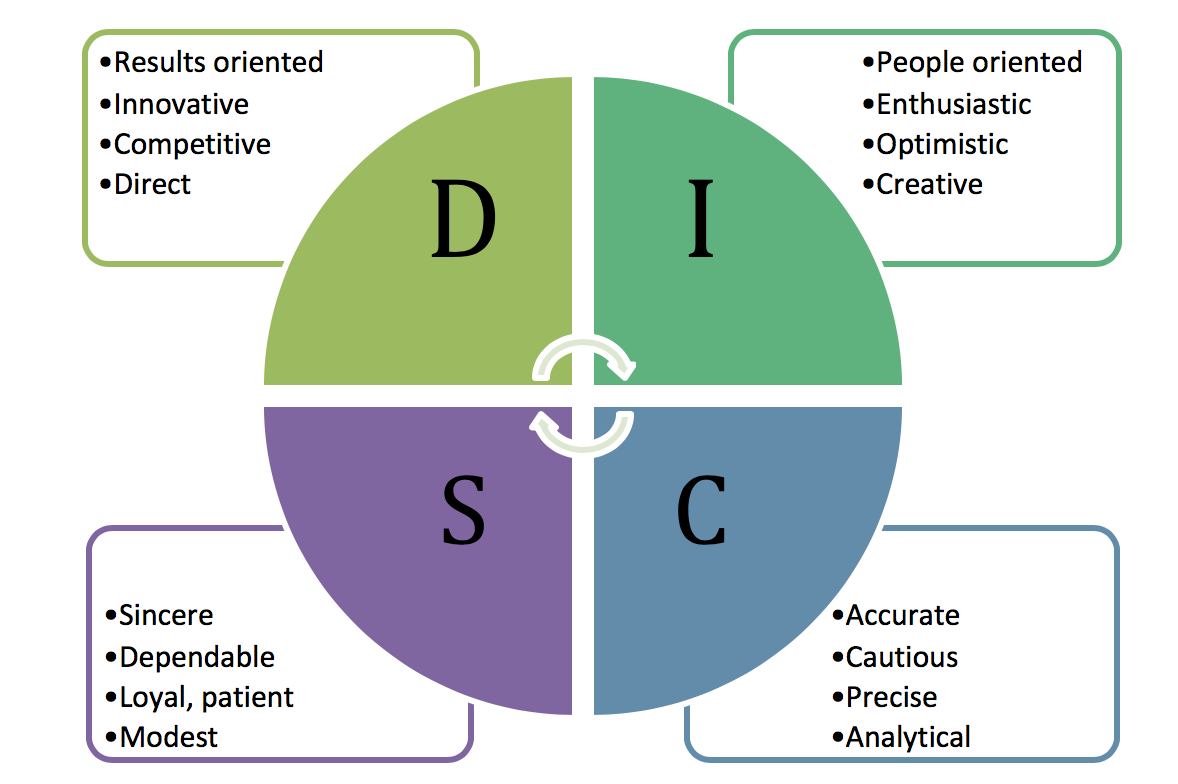
Industries often use DISC assessments in professional contexts. Having some insight into your teammates’ personality traits can help when trying to resolve conflicts. General characteristics of each trait are as follows:
Dominance: direct, decisive, ego-driven, problem-solver, and risk-taker; likes new challenges and freedom from routine; driven to overcome obstacles.
Strengths: great organizer and time manager; challenges the status quo; innovative
Weaknesses: can be argumentative, disrespectful of authority, and overly ambitious (taking on too much); can be blunt, stubborn, and aggressive
Inspiring: enthusiastic, persuasive, optimistic, trusting, impulsive, charismatic, influential, and emotional.
Strengths: creative problem solver; great cheer-leader, negotiator, and peace-maker; a real “people person”
Weaknesses: may be more concerned with popularity than tangible results; lacks attention to detail
Supportive: reliable, steady, predictable, friendly, good listener, team player, empathetic, easy-going, and altruistic.
Strengths: dependable, loyal; respects authority; has patience and empathy; good at conflict resolution; willing to compromise.
Weaknesses: may resist change; sensitive to criticism; difficulty prioritizing
Conscientious: has high standards; values precision and accuracy; analytical and systematic; even-tempered, realistic, and logical; methodical; respect for authority; cautious and compliant.
Strengths: great information gatherer/researcher; able to define situations precisely and accurately; offers realistic perspective
Weaknesses: can get bogged down in details; needs clear boundaries, procedures, and methods; difficulty accepting criticism; may avoid conflict or just “give in.” May be overly timid.
You might recognize yourself in one of these descriptions, or you might have characteristics of 2 or more “types.” Having the team consider where they might fall in this typology can help you assign roles based on your strengths, and give you insights into how to resolve issues.
Thomas-Kilmann Conflict Mode Model
The Thomas-Kilmann Conflict Management model[7] is used by Myers Briggs among others for understanding and managing conflict. This model, shown in Figure 4.1.6, outlines 5 main conflict styles or “modes” (competing, collaborating, compromising, avoiding, and collaborating), and places them in a matrix with two dimensions: Assertiveness (the degree to which one tries to meet their own needs) and Cooperativeness (the degree to which one tries to meet the needs of the other team members).
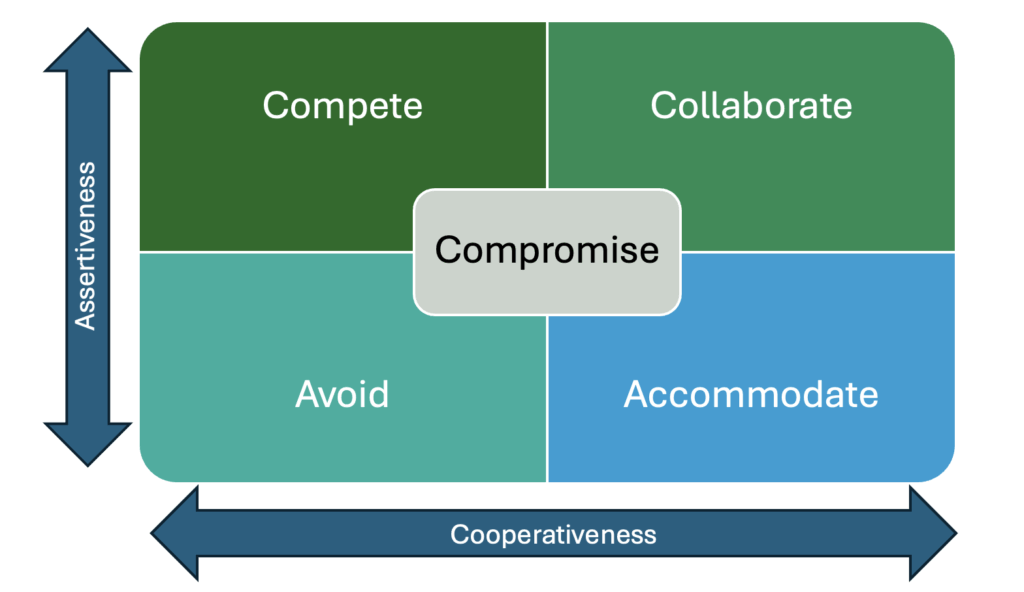
Each approach can have both positive and negative impacts:
Collaborating requires high level of both cooperativeness and assertiveness, but often leads to the best results. However, this may require persistence and effort for team members to successfully persuade each other and achieve consensus.
Compromising can seem a bit easier to achieve, but by definition, it “compromises” the quality of the final product. Everyone “gets a little” and everyone “gives a little;” everyone may feel somewhat happy, but also a bit unhappy with the final result.
Competition can drive excellence, but within a team, keep in mind that competition usually results in “winners” and “losers” – and this does not make for a constructive team.
Accommodating can also be a useful approach if someone feels very strongly about their position and there is no harm in giving them the win. However, this should not come at the expense of something you also feel strongly about that could have really helped the team.
Avoiding conflict can sometimes be a wise choice, if the issue is a small one and the outcome does not have a significant impact. The old adages “don’t sweat the small stuff” and “pick your battles” apply here. However, in many cases, avoiding a problem will not make it go away, and indeed, it may well get worse, leading to significant consequences. Consider the “cost-benefit” analysis of avoiding vs engaging with the conflict to solve the problem.
Applying the Models
Clearly collaborating with others can have its challenges! But consider the pros and cons of individual vs teamwork when working on a writing-intensive project:
| Individual Work | Collaboration | |
| Choosing a Topic and Approach | You are in control of the topic and approach; you have to make all the decisions, and you have to complete all the tasks yourself. | You must negotiate the focus of your work and the approaches you will use, but you share the work of making these decisions, relying on more than just your own knowledge and skills. |
| Task Analysis | You have to make sure you understand all the assignment instructions, project requirements, and evaluation criteria, as well as remember due dates, etc. | Teammates may interpret assignment criteria and project requirements differently, resulting in discussion and questions, and ultimately stronger task understanding. Teammates remind each other about due dates and requirements. |
| Research | You are solely responsible for devising research questions, choosing research methods, finding and integrating all the research needed to support your project, and citing sources properly. | You have a team to brainstorm research questions, compare approaches, divide up the work of reading and synthesizing sources to support your project; you have other eyes to spot citation errors and research gaps that need filling. |
| Writing | Writing on your own makes it easier to maintain a consistent “voice” in terms of purpose, style, and tone, | Collaborating requires the team to be aware of each other’s different styles, and aim for a consistent overall “voice” |
| Critical Thinking | You are solely responsible for coming up with and refining ideas, evaluating source material for credibility, constructing persuasive arguments that will appeal to your intended audience, etc. | Teammates can bounce ideas around, give each other feedback about choices and help refine ideas. They might have more nuanced ideas about what might appeal to (or offend) your intended audience. You might have different perspectives that will require negotiation. |
| Document Design | You make all the design choices, and it’s relatively easy to be consistent. But you are limited by your own word processing skill level and awareness of design choices. | When collaborating, you have to ensure that everyone uses consistent design features so that the document doesn’t end up in chaos, but you have more skills to draw up to enhance the look and readability of your document. |
| Reviewing | When reviewing and editing your own work, it can be easy to miss errors. Also, you know what you mean, and it can be hard to see where expression might be ambiguous or confusing to other readers. | Teammates understand your purpose in writing, and can spot your mistakes more easily. They can indicate when something you’ve written could be more clearly articulated. You can learn techniques by seeing how others revise and edit their own work. |
|
Accountability
|
You are only accountable to yourself, so you can work at your own speed and determine what quality you want to aim for. If you procrastinate, no one else is affected. | Being accountable to others makes you more likely to complete work on time, or even early to ensure time for peer review. However, one team member’s poor work habits or low commitment level can negatively affect the outcome of the project. |
Ideally, students can learn a great deal from their teammates – the more diverse the team, the more opportunities to learn! For example, your teammates can help you
- develop a greater awareness of many different perspectives and approaches
- combine your different knowledge and skill levels to fill in gaps and solve problems in innovative ways
- understand the assignment expectations more fully and know if you are on track
- learn different ways of communicating ideas, needs, and concerns
- develop ways of sharing the workload equitably and efficiently
- understand how to establish trust and accountability, how to support each other without overstepping, how to give constructive feedback, and when to compromise.
Seeing first-hand how others approach the project you are working on – how they do task analysis, research, brainstorm, and plan; how they write (draft, revise, give and receive feedback, etc) – can teach you more than any lecture!
EXERCISE 4.2 – Apply these models to your experience
Apply one or more of these models to your past or current experience of teamwork:
- Have you experienced a team project where misaligned goals or unclear roles had a negative impact? Alternatively, did your team have clearly defined roles and goals? How did the project turn out?
- Have you intentionally or unknowingly engaged in the Tuckman team development steps? What did that look like at each stage?
- Can you determine which of the DISC characteristics most closely matches your personality traits? How would you describe your “strengths and weaknesses” in this context? How might you apply these to your current project?
- Do you think learning about the Thomas-Kilman conflict modes or typical dysfunctions (Lencioni model) can help make your future team experiences more productive? How might you use them to address conflict or dysfunction?
- Could you propose an alternative model for promoting effective teamwork?
- J. R. Katzenbach and D.K. Smith,The Wisdom of Teams: Creating the High-performance Organisation, Harvard Business School, Boston, 1993. ↵
- R. Beckhard, (1972). “Optimizing team building efforts,” Journal of Contemporary Business, 1972, pp. 23–27. ↵
- B. Tuckman, "Developmental sequence in small groups," Psychological Bulletin, vol. 63, no. 6, pp. 384-399. Available: http://dx.doi.org/10.1037/h0022100 : ↵
- Dlogo Nicoleti. “Modelo de Tuckman.png”, Wikimedia Commons, https://commons.wikimedia.org/wiki/File:Modelo_de_Tuckman.png . CC BY-SA 4.0 . ↵
- P. Lencioni, Five Dysfunctions of a Team, New York, NY: John Wiley and Sons Inc., 2002. ↵
- W. M. Marsten, Emotions of Normal People. Keegan Paul Trench Trubner and Co. Ltd., 1928; republished London: Routledge, 2002 ↵
- K. W. Thomas & R. H. Kilmann, “Thomas–Kilmann Conflict Mode Instrument,” Tuxedo NY: Xicom, 1974. ↵