4. TEAMWORK AND COMMUNICATION
4.5 Collaborative Writing
Suzan Last and Candice Neveu
You have likely had at least one opportunity to work and write collaboratively, as this is an increasingly common way to work, both in school and in the workplace. Engineers and business professionals report spending a considerable amount of their time writing, and they frequently engage in collaborative writing (CW). A recent survey asked various professionals what portion of their work week was devoted to writing, collaborative writing, and international communications.[1] The results shown in Table 4.5.1 indicate that collaborative writing makes up a significant portion of overall writing tasks.
| Finance, Management & Marketing | Engineers | Programmers | |
|---|---|---|---|
| Time spent writing | 34 | 35 | 25 |
| Time spent planning and writing documents collaboratively | 20-25 | 19 | 12 |
| Time spent communicating internationally (across national borders) | not available | 14 | 18 |
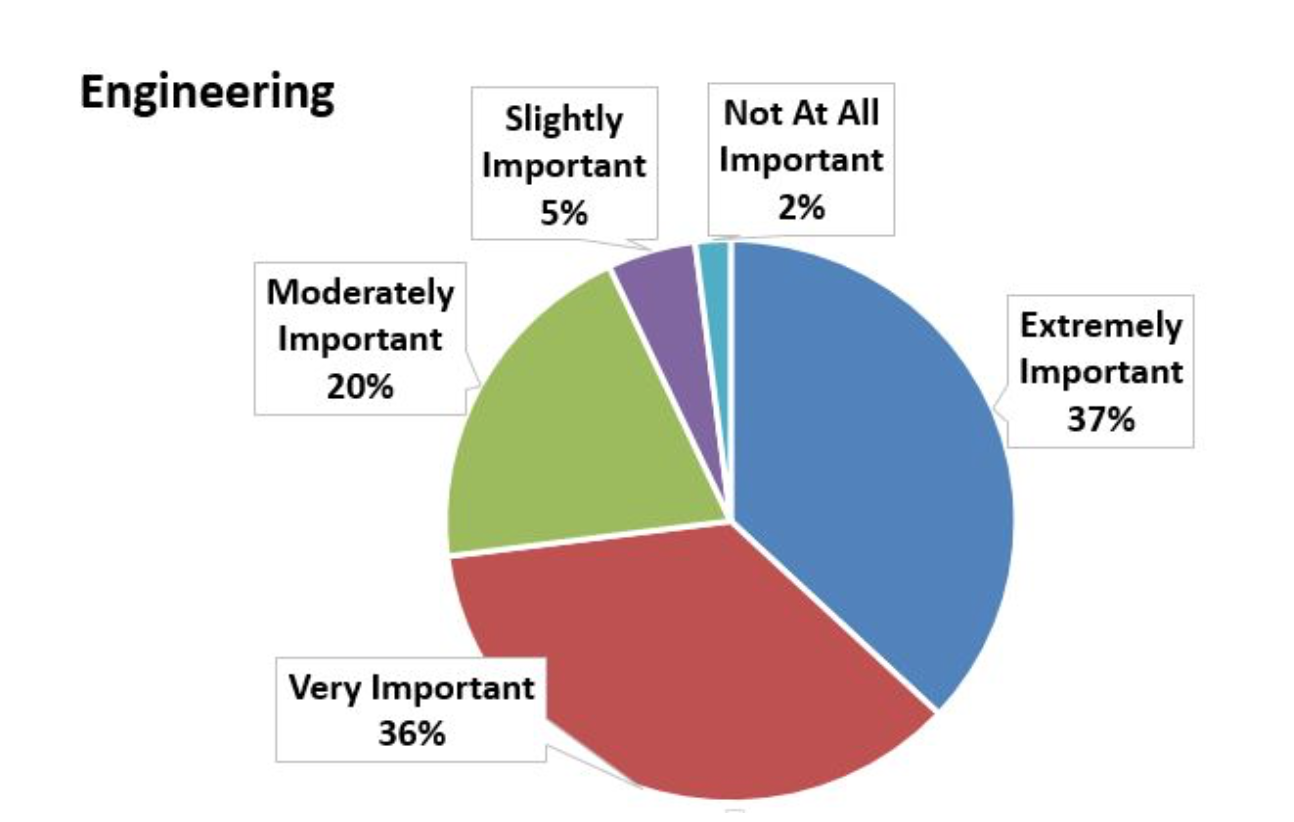
Research has shown that “writing in general and CW in particular have been recognized to be fundamental to most professional and academic practices in engineering.”[2] Figure 4.5.1 shows that engineers rate writing skills as extremely important to career advancement.[3]
Like any kind of teamwork, collaborative writing requires the entire team to be focused on a common objective; a strong team consistently “negotiates, coordinates, and communicates during the creation of a common document.”[5] The collaborative writing process, like the Tuckman team formation model, is iterative and social, meaning the team works together and moves back and forth throughout the process.
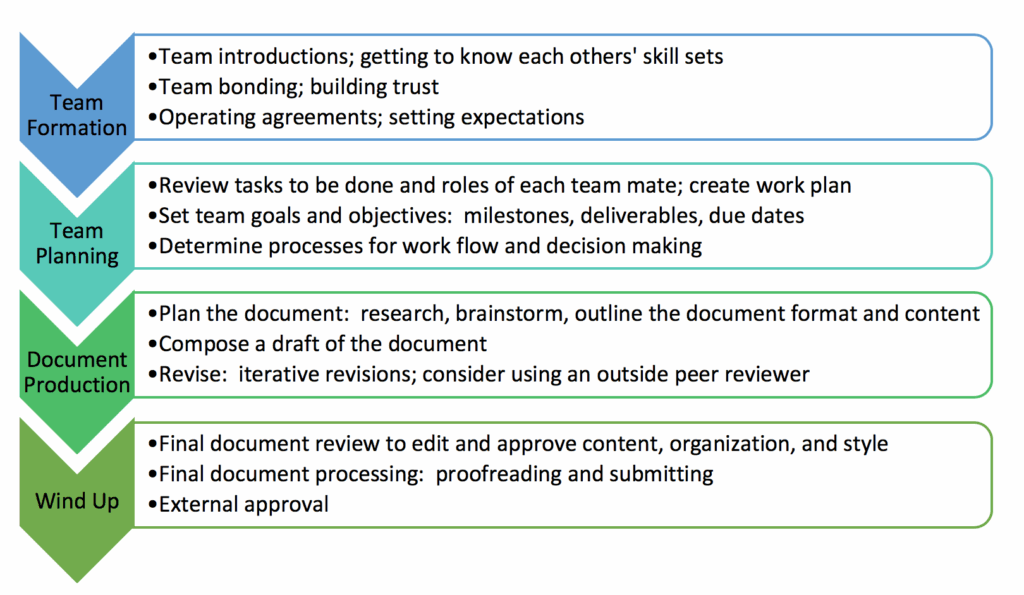
Successful collaborative writing is made easier when you understand the different strategies you can apply, how best to control the document, and the different roles people can assume. Figure 4.5.2 outlines the various activities involved at various stages of the collaborating writing process.
Teams can use a variety strategies to coordinate the writing of a collaborative document. There are five main strategies (see Table 4.5.2), each suited to different contents, and each having advantages and disadvantages. Can you think of additional benefits or limitations? Which strategy seems most appropriate for the collaborative document you plan to write?
| [Skip Table] |
|||
| Writing Strategy |
When to Use | Pros | Cons |
|---|---|---|---|
| Single-author
One member writes for the entire group |
For simple tasks; when little buy-in is needed; for small groups |
Efficient; consistent style |
May not clearly represent group’s intentions; less consensus produced |
| Sequential
Each member is in charge of writing a specific part and write in sequence |
For asynchronous work with poor coordination; when it’s hard to meet often; for straightforward writing tasks; small groups |
Easy to organize; simplifies planning |
Can lose sense of group; subsequent writers may invalidate previous work; lack of consensus; version control issues |
| Parallel Writing: Horizontal Division
Members are in charge of writing a specific part but write in parallel. Segments are distributed randomly. |
When high volume of rapid output is needed; when software can support this strategy; for easily segmented, mildly complex writing tasks; for groups with good structure and coordination; small to large groups |
Efficient; high volume of output |
Redundant work can be produced; writers can be blind to each other’s work; stylistic differences; doesn’t recognize individual talents well |
| Parallel Writing: Stratified Division
Members are in charge of writing a specific part but write in parallel. Segments are distributed based on talents or skills. |
For high volume rapid output; with supporting software; for complicated, difficult to segment tasks; when people have different talents/skills; for groups with good structure and coordination; small to large groups |
Efficient; high volume of quality output; better use of individual talent |
Redundant work can be produced; writers can be blind to each other’s work; stylistic differences; potential information overload |
| Reactive Writing
Members create a document in real time, while others review, react, and adjust to each other’s changes and addition without much pre-planning or explicit coordination |
Small groups; high levels of creativity; high levels of consensus on process and content; looming deadline means work must be done in a hurry |
Can build creativity and consensus |
Very hard to coordinate; version control issues |
Document management reflects the approaches used to maintain version control of the document and describe who is responsible for it. Four main control modes are listed in Table 4.5.3, along with their pros and cons. Can you think of any more, based on your experience?
| Mode | Description | Pros | Cons |
|---|---|---|---|
| Centralized | When one person controls the document throughout the process. | Can be useful for maintaining group focus and when working toward a strict deadline | Non-controlling members may feel a lack of ownership or control of what goes into the document |
| Relay | When one person at a time is in charge but the control changes in the group | Democratic | Less efficient |
| Independent | When person maintains control of his/her assigned portion | Useful for remote teams working on distinct parts | Often requires an editor to pull it together; can reflect a group that lacks agreement. |
| Shared | When everyone has simultaneous and equal privileges | Can be highly effective; non-threatening; good for groups working F2F, who meet frequently, who have high levels of trust | Can lead to conflict, especially in remote or less functional groups |
Roles refer to the different hats participants might wear, depending on the activity. Table 4.5.4 describes several roles within a collaborative writing team. Which role(s) have you had in a group project? Are there ones you always seem to do? Ones that you prefer, dislike, or would like to try?
| Role | Description |
|---|---|
| Content Creator | Responsible for drafting a portion of the content |
| Graphic Designer | Responsible for creating or coordinating visual elements to accompany and illustrate written content |
| Reviewer | Responsible for reviewing and suggesting revisions to content drafted by others (can be internal or external to the team) |
| Editor | Has permission to edit the content created by others |
| Writing Coordinator | Creates the initial shared document and coordinates the contributions of all team members into the team document to ensure all content requirements are met |
| Research Coordinator | Ensures that all research done by individual team members is complete, credible, effectively incorporated into the team document, and properly cited (meets integrity and documentation requirements). |
| Document Design Coordinator | Ensures that all contributions to the document follow the required Style Guide consistently in terms of layout, typography, use of headings, colour schemes, citation style, figure and table formatting, etc. |
| Task Coordinator | Ensures that the team understands the requirements (coordinates the team’s Task Analysis) and that all required tasks are distributed equitably. Also makes sure the team has a realistic sense of how long tasks will take to complete, and builds in time for integrating each team member’s contribution into the shared document. |
| Team Leader | Participates in authoring and reviewing the content, but who also leads the team through the processes, planning, rewarding, and motivating. |
| Facilitator | A person external to the team who leads the team through collaborative writing processes and may offer feedback on content and/or process. |
EXERCISE 4.8 – Follow up and reflect
Consider a collaborative writing project you have worked on in the past or are currently working on. Using the tables above, analyze your example to determine the collaborative writing strategy (Table 4.3.2) and document control mode (Table 4.3.3) that best describes your experience, and what collaborative writing role(s) (Table 4.3.4) you took on.
How effective was the strategy that you used? Would another strategy have been more effective?
Many of these collaborative strategies can be used when developing team presentations as well. See Ch. 8.4 Presenting as a Team for more details.
Image description
Figure 4.5.2 image description:
Four stages of collaborative writing
- Team Formation
- Team introductions, getting to know each others’ skill sets
- Team bonding, building trust
- Operating agreements, setting expectations
- Team Planning
- Review tasks to be done and roles of each team mate, create a work plan
- Set team goals and objectives: milestones, deliverables, due dates
- Determine processes for workflow and decision making
- Document Production
- Plan the document: research, brainstorm, outline the document format and content
- Compose a draft of the document
- Revise: iterative revisions, consider using an outside peer reviewer
- Wind Up
- Final document review to edit and approve content, organization, and style
- Final document processing (proofreading and submitting)
- External approval
- J. Swartz, S. Pigg, J. Larsen, J. Helo Gonzalez, R. De Haas, and E. Wagner, "Communication in the workplace: What can NC State students expect?" Report from the Professional Writing Program, North Carolina State University, 2018. ↵
- J. Gimenez and J. Thondhlana, “Collaborative writing in Engineering: Perspectives from research and implications for undergraduate education,” European Journal of Engineering Education, vol. 37, no. 5, 2012, 471-487. DOI: http://dx.doi.org/10.1080/03043797.2012.714356 ↵
- J. Swartz, et al. ↵
- J. Swartz, et al. CC-BY 4.0. ↵
- P.B. Lowry, A. Curtis, and M.R. Lowry, “Building a taxonomy and nomenclature of collaborative writing to improve interdisciplinary research and practice,” Journal of Business Communication, vol. 41, 2004, pp. 66-97. DOI: https://doi.org/10.1177/0021943603259363 ↵
- (adapted from Lowry et al. [5]) ↵