“I’d die if you weren’t here”: The Importance of a Network for Scholarship of Teaching and Learning Leadership
Kate E. Thomson; Sarah Nash; Julie Blackford; Frances Gray; and Timothy B. Davies
Abstract
This chapter explores the theoretical foundations of networking within the context of Scholarship of Teaching and Learning (SoTL) leadership. It examines why building and sustaining communities is essential for academic leaders, particularly in contexts where leaders are expected to solve complex problems, improve the quality of teaching and learning, and develop the educational capacity of their colleagues. It describes how these leadership networks contribute to professional development and the sustainability of SoTL initiatives, through the authors’ reflections on our own experience and selected literature highlights. Drawing on established theories and research, and using health professions education as the illustrative context, the chapter presents principles and practical strategies for establishing networks for SoTL leadership.
Building and Participating in SoTL Networks
In this chapter, we reflect on our experiences of building and participating in a SoTL network within the context of health professions education. Drawing on theory and literature, we highlight what we see as key elements of networks that support sustainable growth—networks in which ideas, practices, and the members themselves continue to develop. Although our examples are situated in health professions education, the principles underpinning our network are not discipline-specific and may be relevant to other higher education contexts where leaders aim to build and sustain SoTL networks.
As part of writing this chapter, we held a series of meetings to reflect on what has enabled our network to function well over time and how it differs from other groups in which we have participated. Our aim was to identify the key qualities of this network and connect these with relevant theories in an accessible way, generating a set of principles for building communities and networks that advance the scholarship of teaching and learning.
Our discussion centred on two main questions:
- Why is building a network essential for effective academic leadership in SoTL?
- How do networks contribute to professional growth, knowledge sharing, and the sustainability of SoTL initiatives?
Like Tierney (Case Study: Building a Community, this book), we value meeting colleagues who care deeply about teaching and who generously share their knowledge. Being supported to share problems, brainstorm ideas, and celebrate wins underpins the effectiveness of our network.
Tierney describes the role of a network in understanding SoTL, and we agree, while adding that our network allows us to apply SoTL. Like so many SoTL colleagues, our roles require us to solve problems with diverse stakeholders who have competing priorities, within the constraints of time, policies, and systems. This network is the reason that we can navigate those complexities. More significantly, it also enables us to ask thoughtful questions, design initiatives to improve teaching and learning, and provide peer support for our teaching staff, while brokering connections across disciplines and organisations.
Reflexivity statement
The five authors of this chapter each have a formal leadership role, titled the Health Professions Education (HPE) Lead – [Discipline]. This is similar to a Program Director or Degree Coordinator leadership role. We are situated within the School of Health Sciences at a metropolitan, research-intensive Australian university and represent a unique academic cohort tasked with overseeing student placements in five allied health disciplines (Exercise and Sport Science, Medical Imaging Science, Occupational Therapy, Physiotherapy, and Speech Pathology). Each discipline has multiple degree programs which produce health professional graduates through either undergraduate or postgraduate pathways.
Each of us brings a strong sense of identity with our individual professional backgrounds. These include allied health professionals in our discipline field or the field of education development. In the professional networks we have engaged with as clinicians and academics, both formal and informal, we acknowledge the benefits of mentorship, collegiality, learning and connection. The lenses we bring to our current roles are strongly underpinned by these as is the network we have formed. Like many SoTL communities, we bring different levels of experience in the field of SoTL and research in health and higher education. It is important to note that while discussing and writing this chapter, some of us were outside of our comfort zone – particularly those of us new to research and/or new to being a SoTL researcher. Becoming comfortable in this space is a work in progress; and we intentionally dedicated time to lengthy conversations as a group, as well as individual thinking and writing. We have also focused on making the writing and the ideas in this chapter accessible to all, including those without prior knowledge of SoTL – the same as within our network, we intentionally share knowledge. We appreciate that the title may feel a little dramatic, we feel confident that our ideas would die without a network.
Theoretical Foundations of Networking and SoTL Leadership
To better understand networks, communities, and the nature of leadership, we have drawn on five theoretical frameworks. Below, each is summarised and examples provided that are linked to SoTL.
Social Network Theory
Social Network Theory provides a foundational lens for understanding how relationships and connections among individuals influence the flow of knowledge, innovation, and professional growth. In the context of SoTL leadership, it is through networks that we share teaching practices, research findings, and pedagogical strategies.
For example, academic leaders benefit from cultivating diverse and robust networks that enable collaboration, mentorship, and dissemination of SoTL initiatives (Wasserman & Faust, 1994; Williams et al., 2013). Social networks contribute to the dissemination of SoTL practices and institutional change through informal faculty connections and collaborative structures (How, 2020; Pusateri, 2015; Williams et al., 2013).
Communities of Practice
Wenger’s Communities of Practice framework emphasises learning through participation in shared practices within a community. SoTL networks often function as Communities of Practice, where academic leaders engage in collective inquiry, reflect on teaching practices, and co-construct knowledge (Wenger-Trayner & Wenger-Trayner, 2015; Wenger, 1998). These communities foster a sense of belonging and identity, which is crucial for sustaining engagement in SoTL and promoting leadership development across disciplines and institutions (e.g., How, 2020; Lukes et al., 2024; Tierney et al., 2020).
Leadership-as-Practice
Leadership-as-Practice shifts the focus from individual traits to collective, situated actions (Raelin, 2016). In SoTL, leadership emerges through collaborative engagement and shared decision-making within networks. This perspective aligns with the distributed nature of academic development, where leadership is enacted through interactions and contributions rather than formal roles (Raelin, 2016). For example, Kensington-Miller et al. (2025) and Pusateri (2015) show how strategic leadership and brokering roles sustain SoTL initiatives; Simmons and Taylor (2019) highlight how educational developers and faculty enact SoTL leadership through distributed roles, bridging institutional gaps and fostering networks of practice.
Relational Leadership Theory
Relational Leadership Theory highlights the social and relational dimensions of leadership. Trust, reciprocity, and mutual influence are central to effective leadership in SoTL networks. For example, academic leaders who prioritise relationship-building, create environments that support open dialogue, shared learning, trust, sustained collaboration and co-creation (Epitropaki et al., 2018; Rahman et al., 2025; Stewart et al., 2025). Stewart et al. (2025) developed a relational pedagogy tool for leadership education, emphasizing co-creative learning and moral accountability in academic development. Stewart et al. (2025) and Rahman et al. (2025) demonstrate how relational leadership and pedagogy enhance academic development through trust-building, co-creation, and inclusive practices.
Actor-Network Theory
Actor-Network Theory offers a nuanced view of networks by including both human and non-human actors—such as tools, texts, technologies, and policies (Latour, 2005). This framework helps unpack the complexity of SoTL initiatives, showing how various elements interact to shape leadership practices, institutional structures and academic development (Mifsud, 2024; Mörtsell, 2020; Schwarz et al., 2025). If academic leaders understand these interactions, they can strategically utilise resources and relationships to advance SoTL goals.
Together, the theoretical frameworks presented above offer complementary insights into the nature and value of networking in SoTL leadership. The following section synthesises these perspectives into an integrated framework .
Summarising Theory to inform Practice: Networks for SoTL leadership
This section explores how networks support academic leaders in building and sustaining initiatives that advance SoTL. It synthesises the features of the theoretical foundations in the previous section; Social Network theory, Communities of Practice, Leadership-as-Practice, Relational Leadership Theory, and Actor-Network Theory. We have combined the strengths of these theories with insights from relevant literature to highlight what we see as key elements of networks that foster sustainable development in SoTL. It is important to note that in focussing on sustainable SoTL networks, we highlight the influence of relationships, ongoing change, and artefacts such as resources, tools, and shared practices. The literature discussed here includes several seminal contributions on SoTL and networks, alongside more recent studies. Collectively, these studies draw on Action Research, social network analysis, leadership theory, and organisational change literature, thereby creating a suite of mechanisms through which networks endorse professional development, knowledge dissemination, and systemic transformation in higher education. We have presented a summary of each article in Table 1 for those who would like to keep reading.
Networks as Dynamic Learning Ecosystems
Networks in SoTL are generative spaces where knowledge is co-created through inquiry, dialogue, and shared practice. Social network theory highlights how connections among individuals facilitate the flow of ideas and resources, fostering innovation and collective learning (Williams et al., 2013). This aligns with Communities of Practice (Wenger-Trayner & Wenger-Trayner, 2015; Wenger, 1998), which conceptualises networks as social learning systems where shared identity and meaning emerge (Tierney et al., 2020).
Naylor (2025) illustrates how cycles of reflection, planning, and action within collegial networks can drive cultural change. Informal conversations and distributed decision-making are shown to build trust and promote shared understanding (Roxå & Mårtensson, 2009, 2015). Blumenschein and Hannisdal (2024) use social network analysis to examine academic collaborations, demonstrating that well-connected individuals serve as bridges for new information, promote innovation, and help spread knowledge across disciplinary boundaries. Coppe (2024) similarly shows that teacher networks evolve from being catalysts for professional development to becoming a source. Van Waes et al. (2015) add nuance by showing that the structure and composition of faculty networks are closely linked to different stages of instructional development, suggesting that network engagement evolves alongside professional growth. Taylor et al. (2022) further identify the critical role of network hubs—centralised structures that connect dispersed actors and facilitate coordinated development in teaching and learning. These findings support the idea that SoTL leaders should intentionally cultivate networks as communities of inquiry and development —spaces for co-design, peer critique, and scholarly identity formation (Godbold et al., 2023).
Leadership as Relational and Distributed
Effective SoTL leadership emerges through collective action rather than individual authority. Leadership-as-Practice theory (Raelin, 2016) and Relational Leadership Theory both emphasise leadership as a social process rooted in trust, reciprocity, and shared agency. Networks enable distributed leadership by fostering inclusive structures and empowering diverse voices (Fields et al., 2019; Stewart et al., 2025).
Bull et al. (2024) highlight the role of mentorship and peer networks in shaping academic career trajectories, particularly in relation to teaching excellence. Their findings suggest that informal encouragement and sponsorship from trusted colleagues inspire academics to engage in SoTL work and assume leadership roles. London (2023) argues that adaptive expertise in complex educational settings depends on collective sense-making and shared agency rather than hierarchical control. Kensington-Miller et al. (2025) emphasise the importance of brokering and strategic leadership in establishing and sustaining SoTL cultures. Van Waes et al. (2015) reinforce this by showing that knowing who to connect with—the “know-who” dimension—is essential for navigating developmental transitions and accessing relevant expertise. These studies underscore the importance of relational trust and mutual accountability in sustaining SoTL initiatives. Leaders who embrace distributed leadership practices create resilient networks that can adapt to change and mobilise collective capacity (Simmons & Taylor, 2019). Positioning SoTL leadership as a collective responsibility instead of the domain of a few experts also makes space for those who may not hold formal leadership roles such as early-career academics and placement educators, to contribute to shaping the SoTL agenda.
Networks as Socio-Material Assemblages
Actor-Network Theory broadens the focus from people to include the material and technological elements that shape network functioning (Latour, 2005). Networks are socio-material assemblages, comprising not only human actors but also artefacts such as digital platforms, policy frameworks, assessment tools, and funding mechanisms that interact to enable or constrain scholarly collaboration (Fox, 2005; Mörtsell, 2020).
Clark et al. (2014) examine how institutional workload models, funding arrangements, and governance structures influence participation in interdisciplinary SoTL projects. Their work highlights the need for structural support—such as protected time, recognition frameworks, and administrative assistance—to ensure network sustainability. Digital platforms, shared repositories, and collaborative technologies also play a crucial role in extending the reach and inclusivity of networks, enabling asynchronous engagement across campuses and disciplines (Lukes et al., 2024; Xia et al., 2014). Taylor et al. (2022) reinforce this by showing how institutionally embedded hubs can act as socio-material anchors, linking human actors with enabling structures and technologies to support sustained collaboration. For networks to flourish, these socio-material conditions must be considered by SoTL leaders when designing environments conducive to ongoing scholarly work (Taylor, 2005).
Sustaining SoTL Through Networked Leadership
Sustainability is a common theme across the entire body of literature, with networked approaches suggested as a way to sustain SoTL beyond the tenure of any single leader or funding cycle. Embedding knowledge within communities—rather than relying on individuals—creates collective memory and supports continuous improvement (Knight & Trowler, 2000; Mårtensson et al., 2012).
Naylor (2025) notes the importance of aligning SoTL initiatives with institutional priorities to embed them within organisational culture. Blumenschein and Hannisdal (2024) show that networks with diverse membership and strong bridging ties are more adaptable and resilient. Mentorship networks and succession planning are also identified as critical for continuity, as they build capacity among newer academics and facilitate leadership transitions (LaFay et al., 2022; Rahman et al., 2025). Hill (2023) demonstrates how boundary-spanning leadership across institutions can advance SoTL by fostering cross-contextual learning and sustainability. These regenerative networks evolve over time, attracting new members and remaining relevant in changing contexts.
Networks are a strategic necessity for SoTL leadership as they provide the cognitive, relational, and material infrastructure needed to shift SoTL from project-based initiatives to institution-wide change. They enable collaborative learning, distributive leadership, integration of enabling tools and structures, and sustained educational transformation over time. We argue that the success of SoTL initiatives is closely linked to the strength, well-being, and deliberate development of networks. Leaders who focus on building and maintaining these networks are not only enhancing their own professional growth but also boosting the collective capacity of their institutions to provide high-quality, evidence-based education.
Networks for SoTL leadership – from microcultures to mega-networks
SoTL leadership operates across interdependent levels, from significant conversations to international communities. To support SoTL leaders at different stages, we identify four interconnected levels of network activity and offer level-specific insights into leadership development.
Micro-Level Networks: Trust and informal learning
Roxå and Mårtensson (2009) highlight that much of the real work of teaching development occurs in small, trusted networks. These “significant conversations” often not facilitated in formal structures, provide safety, authenticity, and intellectual stimulation.
- Leaders cultivate conditions where trust-based networks engaging in informal dialogue is valued—through mentoring, peer communities, and confidential discussion spaces.
- Networks at this level is where pedagogical innovation often begins.
Meso-Level Networks: Intentionally inclusive collaboration
Moolenaar (2012) shows that the pattern of relationships within departments or schools determines whether collaboration enhances or constrains practice. Network density, accessibility, and quality influence knowledge flow and collective capacity.
- Leaders intentionally design structures – such as learning communities and cross-disciplinary teams – that build social capital and foster inclusion.
- Networks at this level are where SoTL gains traction in everyday teaching culture.
Macro-Level Networks: Critique institutional structures and power
Clark et al. (2014) demonstrate how power dynamics influence the visibility and recognition of teaching-related work. Similarly, Bull et al. (2024) show that education-focused academics often face marginalisation when institutional networks privilege research outputs.
- Leaders engage critically with institutional politics, advocating for recognition of teaching and SoTL in promotion pathways, workload models, and governance.
- Networks at this level must challenge structural inequities and amplify undervalued voices.
Mega-Level Networks: Bridges to cross-institutional and disciplinary communities
Simmons and Taylor (2019) frame SoTL leadership as engagement, connection, collaboration, and advocacy. They emphasise networks that bridge local practices with disciplinary, national, and international communities.
- Leaders sustain SoTL through professional associations, conferences, collaborative projects, and publications.
- Networks at this level enable SoTL knowledge to circulate widely and influence academic culture beyond local contexts.
When considering how to cultivate and sustain networks at any level, it is worth noting that:
- Networks are multilevel and interdependent. Trust-based micro networks (Roxå & Mårtensson, 2009) feed departmental collaboration (Moolenaar, 2012), which interacts with institutional politics (Bull et al., 2024; Clark et al., 2014) and broader disciplinary movements (Simmons & Taylor, 2019).
- Networks are not neutral. They are shaped by power (Bull et al., 2024; Clark et al., 2014) and can reproduce inequities or serve as sites of empowerment.
- SoTL leadership is distributed. It resides not only in formal roles but also in everyday acts of connection, advocacy, and collaboration across all levels.
Taken together, these studies illustrate how networks can support the development of SoTL through shared inquiry, leadership practices, and collaborative knowledge building.
Table 1.
Networks for SoTL leadership – key points and principles
Link to downloadable PDF of Table 1
Sustaining SoTL leadership in a complex context: Solving time-sensitive, high stakes teaching and learning issues
Although our work is situated within health professions education, we offer this context as one example of how a SoTL network can operate in practice. The leadership lessons, processes, and principles we describe are intentionally transferable to a broad range of higher education disciplines. Our aim is for readers—regardless of field—to be able to draw on these insights to support their own SoTL communities, networks, and leadership practices. That said, some information about our context may be helpful to readers.
The authors of this chapter are situated within a School of Health Sciences and we each have a leadership role embedded within the school’s academic structure. These roles exist to ensure that the School provides high-quality placement experiences for students. Placements are essential to prepare students for their careers as registered health professionals as well as meet accreditation requirements of degree programs. Similar to Taylor’s (2005) conceptualisation of academic development work as institutional leadership, our success is determined by individual strengths, defined roles, strategies, and teaching context.
Our roles sit at the nexus of academic and placement education, acting as the bridge between program leadership, teaching teams, placement coordinators, and administrative staff. Our role is both integrative and facilitative: we provide strategic direction and academic oversight while ensuring seamless communication across groups. By working closely with Heads of Discipline and Program Directors, we align placement education with broader curriculum goals. At the same time, we collaborate with unit coordinators, placement officers, and administrative teams to translate these goals into practical, high-quality student learning experiences. An organisational chart is presented as Figure 1 – and the leadership network is presented in Figure 2. Serving as hubs, and at times, brokers and connectors, enables us to champion innovation, maintain academic and professional standards, and foster a culture of collegiality that connects educational vision with operational delivery.
Our educational leadership includes designing learning activities that provide preparation for placements, supporting on-campus simulation and off-campus placements. External placements occur in settings such as hospitals, private practices, schools, and community organisations. Each year, we collectively manage approximately 5700 student placements across 1000 placement sites. Placements are facilitated by external educators, who are often experienced clinicians with little formal education training. We provide support to both students and educators to foster meaningful, pedagogically sound experiences. Our work is shaped by multiple factors and influenced by multiple groups —e.g., students’ needs, expectations of educators, institutional policies, and regulations of national accreditation bodies. We need to navigate the intricacies of placement education while improving the quality of the student learning experience.
Figure 1.
Organisational Chart, noting the Health Professional Education Lead ‘HPE Lead’ role – the illustrative context for this chapter
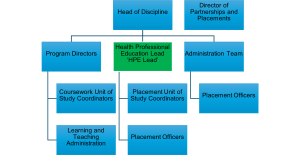
Figure 1 shows the organisational chart identifying our role, as Health Professional Education (HPE) Lead, representing the formal leadership structure that complements the networked leadership relationships shown in Figure 2. This structure also highlights that placements and coursework are somewhat siloed, as are academic roles and administrative or professional roles – contributing to the complexity of SoTL in this context and making good leadership more important.
Placement oversight is complex and unpredictable. Placements can be a stressful time for students (Rhodes et al., 2024; Zegwaard & Adams-Hutcheson, 2025) and so we need to be responsive to matters that are often time sensitive and high stakes for students.
To foster collaboration across the group, we constructed an informal, cross-disciplinary network. The informal structure grounded in trust, reciprocity, and mutual influence enables open dialogue and shared learning. Regular interactions result in collaborative engagement and collective decision-making. The network provides a conduit for sharing teaching practices, research findings, pedagogical strategies, and importantly offers a sense of belonging and space to develop a professional identity. Our experience is that the network is essential for sustaining engagement in SoTL and promoting leadership development across.
Figure 2.
Leadership Network (central) and each of us in our leadership role, noting that we have become hubs within our own discipline networks
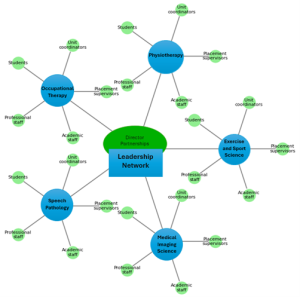
Figure 2 shows the networked SoTL leadership structure, where we broker connections across disciplines and to the Director of placement partnerships to form a central leadership network.
Principles for Networks in SoTL Leadership: Reflections from placement education
Academic leadership within SoTL often occurs in multidisciplinary environments where educators encounter similar challenges, such as program design, student support, and curriculum alignment. This section examines fundamental principles that elucidate the importance of building and maintaining networks for SoTL leadership, focusing on our experience at a large, research-intensive university in Australia.
Principle 1: Networks are Developmental Ecosystems
We work across disciplinary boundaries; however, encounter shared challenges such as ensuring high-quality experiences, supporting educators, and integrating placement into broader curriculum objectives, thereby fostering an environment conducive to networked collaboration. When we engage in regular dialogue, whether through informal conversations, structured communities of practice meetings, or collaborative curriculum development, we cultivate ecosystems that endorse both individual and collective growth.
Communities of Practice promote shared inquiry, mutual engagement, and the co-creation of knowledge (Wenger-Trayner & Wenger-Trayner, 2015; Wenger, 1998), conditions that are evident when we co-design educator workshops, exchange placement models, or collaborate on curriculum mapping. Coppe (2024) reinterprets teacher networks from a social capital perspective, emphasising that professional development is socially distributed and relationally embedded. In practice, this looks like convening to address common challenges, and developing solutions that are adaptable to diverse contexts.
Principle 2: Leadership Emerges Through Relational Practice
Our work is inherently relational, involving collaboration with program directors, unit coordinators, placement teams, and placement educators, often across disciplinary and institutional silos. Leadership in this context focuses on building trust, fostering a shared purpose, and enabling collective action, rather than relying solely on positional authority.
Leadership-as-Practice emphasises that leadership is demonstrated through daily interactions, such as conversations, decisions, and shared reflections. For us, this entails mentoring new academics into coordination roles, negotiating with external sites to redesign supervision models, or facilitating interdisciplinary learning activities.
The work of Hill (2023) on boundary-spanning leadership supports this view, demonstrating how SoTL leaders connect institutional silos and promote cross-boundary collaboration. We frequently act as connectors, linking educators, students, and external partners in ways that foster innovation and responsiveness. Investing in relational infrastructure, such as peer mentoring, interdisciplinary learning circles, and collaborative scholarship, strengthens these networks and integrates leadership into the daily fabric of academic life.
Principle 3: Networks are Leverage Points for Strategic Innovation
Teaching in higher education requires working within systems involving numerous stakeholders, including students, educators, placement sites, accreditation bodies, and institutional policies. We must navigate these systems strategically, often leveraging networks to influence and effect change.
Actor-Network Theory provides a systems-oriented perspective of networks, emphasising the interaction between human and non-human’ actors’ (such as people, tools, policies, and spaces) (Latour, 2005). In our context, this encompasses placement databases, curriculum frameworks, workload models, and digital platforms. Although these components are primarily administrative, they also play an active role in shaping pedagogical opportunities and limitations.
Blumenschein and Hannisdal (2024) employed social network analysis to illustrate how innovation propagates through informal structures and broker roles. Leaders with a comprehensive understanding of their network topology, including interconnections between individuals and influence, can strategically utilise relationships to expand SoTL initiatives. For us, this involves interdisciplinary coordination to pilot novel placement models, advocacy for educator training resources, or alignment of placement practices with accreditation standards.
Furthermore, strategic networking enables SoTL leaders to address institutional complexity. Although each discipline may adhere to its own pedagogical traditions and regulatory requirements, common challenges foster opportunities for collective action. Networks facilitate the identification of leverage points, the alignment of efforts, and advocacy for systemic improvements.
Principles for Networks: What we’ve learned about SoTL leadership
As described above, the informal structure of our network not only allows for knowledge-sharing and shared decision-making but also creates a safe and supportive space which contributes to our growth as academics and professionals. Our specific context presents some additional themes which we believe are crucial to the success and effectiveness of our network but have been explored less by the theories and studies described thus far.
Principle 4. Networks require mutual trust – to solve problems requires vulnerability
Similar to colleagues working across universities, our roles sit across complex systems; for us, it is the intersection of higher education and healthcare. The frequent and often competing demands from both the university and external partners can conflict with our efforts to deliver high quality experiences for students and our own professional satisfaction. A key contributor to the success of our interdisciplinary network is the safe and collegial space it fosters among us as educational leaders. In our network, trust has been built deliberately and over time – it is a process (Pleschová et al., 2025).
The understanding that conversations are confidential allows for vulnerability and mutual support and creates a sense of camaraderie, as described by Thomson and Barrie (2021). While our network has formal features such as a regular meeting cycle, shared work outputs and advisory responsibilities, the informal elements (like conversations to share and solve problems) are equally, if not more, significant.
Principle 5. Networks benefit from a balance of collaboration and individual agendas
Where resources are perceived to be unevenly distributed and disciplines are in direct competition for attention or funding, an environment of inter-disciplinary competition and jealousy could thrive. However, the strength of our network is that these competitive undercurrents are broken down. Rather than reinforcing silos, our collaborative approach creates a space of mutual respect and empathy. The collegiality that our network creates allows us to understand the unique challenges and strengths of each other’s disciplines, creating shared understanding rather than rivalry. We collaborate around common goals such as improving the student experience, promoting consistency and support for academic staff, as well as develop innovative solutions to common challenges.
Principle 6. Network members need opportunities to review roles and resourcing
Our formal and informal structures provide a space for open dialogue about role boundaries, differing expectations from within each of our disciplines, and the challenges of balancing academic responsibilities such as unit coordination, clinical responsibilities and the expectation to conduct research. Our network has supported the development of a shared and clearer understanding of our own responsibilities as well as of each other’s disciplines. Furthermore, we have been able to collectively advocate for the recognition and resourcing of our roles, as well as for the importance of student placements. The network also enables us to define our professional identity, which is essential for us to have credibility within our faculty and strengthens our capacity to lead and influence.
Conclusion
In higher education, networks are essential rather than optional. They are the space where shared challenges are addressed, serve as the relational foundation for practising leadership, and constitute the strategic framework for expanding innovation. For us, building and sustaining these networks was imperative. Drawing on the theoretical foundations provided by Social Network Theory, Communities of Practice, Leadership-as-Practice, Relational Leadership Theory, and Actor-Network Theory, networking in SoTL leadership can be understood as social, relational, distributed, and socio-material. Through active engagement in SoTL networks, SoTL leaders develop relational trust, reflective judgement, political awareness, and strategic alignment. Networks operate as learning ecosystems that generate knowledge, as relational spaces where leadership is shared, as socio-material assemblages that integrate tools and policies, and as mechanisms that support ongoing educational change. As SoTL continues to evolve, the challenge extends beyond participation alone to the deliberate design, relational leadership, and strategic use of these networks. Through such approaches, we can cultivate a scholarly teaching culture that is safe, collaborative, adaptable, and—given adequate resourcing and clear role clarity—responsive to the complexities of our educational context.
References
Blumenschein, D., & Hannisdal, B. (2024). Social network analysis and educational change: unravelling the role of innovative teaching staff in a higher education environment. Studies in Higher Education, 49(12), 2827-2843. https://doi.org/10.1080/03075079.2024.2324346
Bull, S., Cooper, A., Laidlaw, A., Milne, L., & Parr, S. (2024). ‘You certainly don’t get promoted for just teaching’: experiences of education-focused academics in research-intensive universities. Studies in Higher Education, 50(2), 239-255. https://doi.org/10.1080/03075079.2024.2333946
Clark, L., Rowe, A., Cantori, A., Bilgin, A., & Mukuria, V. (2014). The power dynamics and politics of survey design: measuring workload associated with teaching, administering and supporting work-integrated learning courses. Studies in Higher Education, 41(6), 1055-1073. https://doi.org/10.1080/03075079.2014.966071
Coppe, T. (2024). Teacher networks: From a catalyst for enactment of professional development to a source of professional development. Teachers and Teaching, 30(3), 380-393. https://doi.org/10.1080/13540602.2023.2263734
Epitropaki, O., Martin, R., & Thomas, G. (2018). Relational Leadership. In J. Antonakis & D. V. Day (Eds.), The Nature of Leadership (Third ed., pp. 109-137). SAGE Publications, Inc. https://doi.org/10.4135/9781506395029.n5
Fields, J., Kenny, N. A., & Mueller, R. A. (2019). Conceptualizing educational leadership in an academic development program. International Journal for Academic Development, 24(3), 218-231. https://doi.org/10.1080/1360144x.2019.1570211
Fox, S. (2005). An actor‐network critique of community in higher education: implications for networked learning. Studies in Higher Education, 30(1), 95-110. https://doi.org/10.1080/0307507052000307821
Godbold, N., Matthews, K. E. E., & Gannaway, D. (2023). Theorising new possibilities for Scholarship of Teaching and Learning and teaching-focused academics. Higher Education Research & Development, 43(1), 92-103. https://doi.org/10.1080/07294360.2023.2218809
Hill, L. B. (2023). Advancing SoTL through Boundary-Spanning Leadership: A Study of Four CIRTL Institutions. Innovative Higher Education, 48, 1033-1054. https://link.springer.com/article/10.1007/s10755-023-09667-4
How, Z. J. (2020). A Systematic Review of Scholarship of Teaching and Learning Research in Higher Education Institutes from 2014–2019. In S. C. Tan & S.-H. A. Chen (Eds.), Transforming Teaching and Learning in Higher Education: A Chronicle of Research and Development in a Singaporean Context (pp. 11-43). Springer Singapore. https://doi.org/10.1007/978-981-15-4980-9_2
Kensington-Miller, B., Webb, A., Maheux-Pelletier, G., Lewis, H., & Gansemer-Topf, A. (2025). Establishing and Sustaining SoTL: The Role of Brokering and Strategic Leadership. Teaching and Learning Inquiry, 13, 1–18. https://doi.org/10.20343/teachlearninqu.13.18
Knight, P. T., & Trowler, P. R. (2000). Department-level Cultures and the Improvement of Learning and Teaching. Studies in Higher Education, 25(1), 69-83. https://doi.org/10.1080/030750700116028
Kreber, C. (2002). Controversy and Consensus on the Scholarship of Teaching. Studies in Higher Education, 27(2), 151-167. https://doi.org/10.1080/03075070220119995
LaFay, V., Silberman, N., & Zeigler, S. (2022). A Model of Practices of Exemplary Clinical Education Leaders. Journal of Physical Therapy Education, 36(1), 17-24. https://doi.org/10.1097/jte.0000000000000206
Latour, B. (2005). Reassembling the Social: An Introduction to Actor-Network-Theory. Oxford University Press. https://doi.org/10.1093/oso/9780199256044.001.0001
London, M. (2023). Causes and consequences of adaptive leadership: A model of leaders’ rapid responses to unexpected events. Psychology of Leaders and Leadership, 26(1), 22-43. https://doi.org/10.1037/mgr0000136
Lukes, L. A., Abbot, S., Henry, D., Wells, M., Baum, L., Case, K., Brantmeier, E. J., & Wheeler, L. (2024). Impact of a regional community of practice for academic developers engaged in institution-level support for SoTL. International Journal for Academic Development, 29(3), 393-405. https://doi.org/10.1080/1360144X.2022.2135005
Mårtensson, K., Roxå, T., & Stensaker, B. (2012). From quality assurance to quality practices: an investigation of strong microcultures in teaching and learning. Studies in Higher Education, 39(4), 534-545. https://doi.org/10.1080/03075079.2012.709493
Mifsud, D. (2024). Exploring educational leadership and policy through Actor-Network Theory: on being ANTish in the ELMA field. Journal of Educational Administration and History, 56(1), 1-6. https://doi.org/10.1080/00220620.2023.2294548
Moolenaar, N. M. (2012). A Social Network Perspective on Teacher Collaboration in Schools: Theory, Methodology, and Applications. American Journal of Education, 119(1), 7-39. https://doi.org/10.1086/667715
Mörtsell, S. (2020). Actor-Network theory and a methodology for inquiring the online/offline of education. Twelfth International Conference on Networked Learning,
Naylor, R. (2025). Enacting transition pedagogy at a School level: An action research analysis of institutional change using Schein’s model of organisational culture. Student Success, 16(3), 93-104. https://doi.org/10.63608/ssj.3758
Pleschová, G., Sutherland, K. A., Felten, P., Forsyth, R., & Wright, M. C. (2025). Trust-building as inherent to academic development practice. International Journal for Academic Development, 30(1), 1-13. https://doi.org/10.1080/1360144X.2025.2454704
Pusateri, T. P. (2015). How SoTL Can Contribute to Faculty Development and Institutional Decisions. In R. A. Smith & B. M. Schwartz (Eds.), Using SoTL to enhance your academic position (pp. 81-88). Society for the Teaching of Psychology.
Quinlan, K. M. (2019). Emotion and moral purposes in higher education teaching: poetic case examples of teacher experiences. Studies in Higher Education, 44(9), 1662-1675. https://doi.org/10.1080/03075079.2018.1458829
Raelin, J. A. (Ed.). (2016). Leadership-as-Practice: Theory and Application. Routledge.
Rahman, N., Cobb, H., Giddings, L., Truglia, M. H., Dolan, S., Jhangiani, S., & Connor, K. (2025). Context Matters: Enhancing SoTL by Exploring Interpersonal Relationship Building in Higher Education. Teaching and Learning Inquiry, 13, 1–20. https://doi.org/10.20343/teachlearninqu.13.23
Rhodes, J., Gill, L., & Thoms, A. (2024). Promoting the Wellbeing of Physiotherapy Students on Placement:: The Placement Wellbeing Project. A Pilot Study. International Journal of Practice-based Learning in Health and Social Care, 12(1), 24-37. https://doi.org/10.18552/ijpblhsc.v12i1.952
Roxå, T., & Mårtensson, K. (2009). Significant conversations and significant networks – exploring the backstage of the teaching arena. Studies in Higher Education, 34(5), 547-559. https://doi.org/10.1080/03075070802597200
Roxå, T., & Mårtensson, K. (2015). Microcultures and informal learning: a heuristic guiding analysis of conditions for informal learning in local higher education workplaces. International Journal for Academic Development, 20(2), 193-205. https://doi.org/10.1080/1360144x.2015.1029929
Schwarz, B. B., Tsemach, U., Israeli, M., & Nir, E. (2025). Actor-network theory as a new direction in research on educational dialogues. Instructional Science, 53(2), 173-201. https://doi.org/10.1007/s11251-024-09669-5
Simmons, N., & Taylor, K. L. (2019). Leadership for the Scholarship of Teaching and Learning: Understanding Bridges and Gaps in Practice. The Canadian Journal for the Scholarship of Teaching and Learning, 10(1). https://doi.org/10.5206/cjSoTL-rcacea.2019.1.7995
Stewart, A., Anderson, V., & Cripps, E. (2025). A relational pedagogy teaching tool for leadership education and development. Journal of Leadership Education. https://doi.org/10.1108/jole-04-2025-0040
Taylor, K. L. (2005). Academic development as institutional leadership: An interplay of person, role, strategy, and institution. International Journal for Academic Development, 10(1), 31-46. https://doi.org/10.1080/13601440500099985
Taylor, K. L., Kenny, N. A., Perrault, E., & Mueller, R. A. (2022). Building integrated networks to develop teaching and learning: the critical role of hubs. International Journal for Academic Development, 27(3), 279-291. https://doi.org/10.1080/1360144X.2021.1899931
Thomson, K. E., & Barrie, S. (2021). Conversations as a source of professional learning: exploring the dynamics of camaraderie and common ground amongst university teachers. International Journal for Academic Development, 26(3), 320-334. https://doi.org/10.1080/1360144x.2021.1944160
Thomson, K. E., & Trigwell, K. R. (2018). The role of informal conversations in developing university teaching? Studies in Higher Education, 43(9), 1536-1547. https://doi.org/10.1080/03075079.2016.1265498
Tierney, A. M., Aidulis, D., Park, J., & Clark, K. (2020). Supporting SoTL Development through Communities of Practice. Teaching and Learning Inquiry, 8(2), 32-52. https://doi.org/10.20343/teachlearninqu.8.2.4
Van Waes, S., Van den Bossche, P., Moolenaar, N. M., De Maeyer, S., & Van Petegem, P. (2015). Know-who? Linking faculty’s networks to stages of instructional development. Higher Education, 70(5), 807-826. https://www.jstor.org/stable/43648907
Wasserman, S., & Faust, K. (1994). Social Network Analysis: Methods and Applications. Cambridge University Press. DOI: 10.1017/CBO9780511815478
Wenger-Trayner, E., & Wenger-Trayner, B. (2015). An introduction to communities of practice: a brief overview of the concept and its uses. Available from authors. https://www.wenger-trayner.com/introduction-to-communities-of-practice.
Wenger, E. (1998). Communities of Practice: Learning, Meaning, and Identity. Cambridge University Press. DOI: 10.1017/CBO9780511803932
Williams, A. L., Verwoord, R., Beery, T. A., Dalton, H., McKinnon, J., Strickland, K., Pace, J., & Poole, G. (2013). The power of social networks: A model for weaving the Scholarship of Teaching and Learning into institutional culture. Teaching and Learning Inquiry, 1(2), 49-62. https://doi.org/10.20343/teachlearninqu.1.2.49
Xia, J., Caulfield, C., & Ferns, S. (2014). Work-integrated learning: linking research and teaching for a win-win situation. Studies in Higher Education, 40(9), 1560-1572. https://doi.org/10.1080/03075079.2014.882302
Zegwaard, K. E., & Adams-Hutcheson, G. (2025). Sources of stress and students’ perceptions of their wellbeing during work placement. International Journal of Work-Integrated Learning, 26(1), 25-41.