Contextualising SoTL: Local Practices and Global Leadership
Huang Hoon Chng; Lee Kooi Cheng; and Tai Chong Toh
Abstract
This chapter explores issues related to the positionality of SoTL practice and leadership at both local and global levels. We argue that, beyond contextual factors, it is important to consider the barriers and risks associated with going ‘international’—particularly if we are committed to preserving the ‘I’ in an international society such as ISSOTL. We contend that developing a shared understanding and language between local and global communities is essential, and that this process should evolve organically rather than being imposed on any group. We propose three key strategies to ensure a balance between maintaining the ‘I’ and embracing diverse perspectives: fostering a mindset shift, enhancing accessibility, and pursuing intentional outreach through a networked community model. In summary, we believe that achieving a balance between locally relevant practices and inclusive global connections is integral to realising the vision of what is possible.
Prologue
Engagement in SoTL, while necessarily focused on local contexts, can at the same time transcend those contexts and become ‘cosmopolitan’ through international connections. (Geertsema, this volume)
We speak of two levels of local and global contexts in this paper.
1. Institutional teaching and learning: teaching as local practice; teaching support as global practice
The Geertsema chapter, SoTL, the Local, and the Global, notes the various tensions that characterise teaching practice in institutions of higher learning; that on the one hand, teaching is local, down to the department and even the individual instructor (Laksov & Sim, 2023). Geertsema further observes that in fact, “local departmental cultures can create conditions that make sustainable educational development hard” (Geertsema, this volume) as compared with Shulman’s “pedagogical solitude” (1993, p. 6-7). On the other hand, institutions have the tendency to homogenise practice and centralise resources to support teaching through the establishment of teaching and learning centres (Geertsema, this volume), preferring to provide institutional-level support instead of devoting resources to individual units.
2. SoTL leadership: departmental/institutional SoTL practice and culture; regional/international SoTL practice and leadership
The second kind of local-global contexts pertain to SoTL practices and SoTL leadership. At local levels, SoTL as “didactic inquiry” of classroom practices is contrasted in Geertsema and Felten’s paper with SoTL’s potential to address the urgent and enduring challenges facing the world (Felten & Geertsema, 2023). Context matters even more here. Not only must SoTL as pedagogical inquiry be sensitive to specific classroom practices within and beyond particular geographical locations, but the movement of SoTL practices across borders also requires careful attention. At the level of leadership, this includes fostering cross-border learning, collaboration, mentoring, and the exchange of ideas and policy in ways that take cultural sensitivities within specific domains into account. In short, context matters at all levels of SoTL practice and leadership.
As Geertsema puts it, educators as disciplinary experts are encouraged to share their work and exert influence both locally and globally. Such work should be subject to peer critique, be evidence- and literature-informed, and while such practices need to be understood in context, such engagement “can at the same time transcend those contexts and become ‘cosmopolitan’ through international connections” (Geertsema, this book).
This paper aims to discuss issues relating to the positionality of SoTL practice and leadership at both the local and global levels. We argue that in addition to contextual considerations, we need to be mindful about barriers and risks of going ‘international’ especially if we are invested in maintaining the ‘I’ in an international society like ISSOTL. We will suggest a number of key strategies that ensure a balance between maintaining the ‘I’ and yet not losing sight of divergent perspectives. In short, we believe that the fine balance between maintaining locally relevant practice and promoting inclusive global connections is a key part of the vision of the possible. As a SoTL leader, you may recognise these tensions in your own efforts to balance local relevance with global engagement.
Practising SoTL in context
We recognise that context is crucial, not just in teaching and learning but across all aspects of scholarship. Even in seemingly homogeneous classrooms, diversity exists in terms of background, experience, thinking, attitude, motivation, mindsets, and aspirations of both students and instructors. Similarly, we acknowledge that the interactions and relationships between students and instructors, as well as the interpretation of educational materials and assessment tasks, are distinctive to each classroom and cannot be easily replicated elsewhere.
Nonetheless, while these elements are rooted in local contexts and practices, sharing them involves considering their place within the broader framework of the institution, the local community, and the global context. This process of internationalisation is intriguing and requires a deep understanding of what can be effectively expanded to benefit the global teaching and learning community as a whole, and what should remain as an individual’s unique signature pedagogy (Shulman, 2005).
A straightforward way to address the local-global conundrum is to view classroom teaching and learning as local, while considering the literature that informs our pedagogies and approaches as global. Alternatively, we can look for commonalities that resonate with the global community. However, we contend that this process is more complex than it seems. Our view is that it is essential to develop a common understanding and language between the local and global communities, which should evolve organically rather than being imposed on any of the respective groups.
Figure 1 illustrates our conceptual representation of the local-global relationship. We consider individual instructors as the central focus. Their actions at the ground level have the most significant impact on student experience and learning. At the immediate outer circle is the department. As instructors associated with various disciplinary departments, our thoughts and approaches to teaching and learning may be shaped by the perspectives of our specific domains, as well as by our own educational experiences and philosophies. Chng and Looker (2013), referencing Poole’s quip on accents, remind us that everyone has an accent. This highlights the need for the international SoTL community to acknowledge the power dynamics involved, especially if internationalisation is viewed as a hierarchy instead of a two-way communication. Beyond the department at the outer circle is the institution. Instructors are influenced by institutional values, cultures, structures, practices, and norms. Because the influence exerted by the institution may be significant, we argue that a didactic approach might be preferred over a top-down approach. Similarly, at the outermost circle, at the regional and international levels where interactions with other stakeholders transcend hierarchical boundaries, a shift is crucial. It is especially important for those in this circle to recognise contextual differences and take the lead in engaging in dialogues with others to achieve harmonisation. This approach ensures there is enough common ground for effective conversations to occur while still maintaining the particularities of local practices.
Figure 1.
Conceptual representation of local-global connection
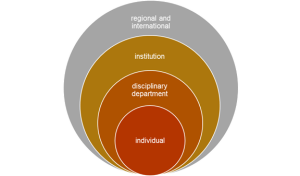
In the interest of diversity and inclusion in any internationalisation effort, we propose a shift away from the “orders of influence” depicted in Figure 1 to a flatter, networked community model. We aim to present strategies for gaining recognition of local practices by the global community while avoiding homogenisation but instead to appreciate and value distinct norms of practice across different contexts.
From orders of influence to a networked community model
What then is the shift we are envisioning here that can help to achieve a balance and an appreciation of distinct norms even as we internationalise? Figure 2 below captures what we are proposing as a vision of a possible future where local practices from all over the world form the points of this global network map, with each point having an equal voice in contributing to the global conversation on teaching, learning and scholarship.
Figure 2.
Networked community model
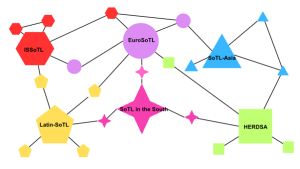
This networked community model expresses a flat structure that admits equal knowledge points or centres of influence. For purely illustrative purposes, each big circle, square, pentagon, triangle etc. represents the different geographical, cultural, and ideological sources of local practices, such as (clockwise from top left) ISSOTL (red hexagon), EuroSoTL (purple circle), SoTL-Asia (blue triangle), HERDSA (green square), SoTL in the South (pink star), and Latin-SoTL (yellow pentagon). Each of these are linked to other networks that are geographically closest to them and for which they, relatively speaking, may have much more intense interactions than with others due to the proximity. For example, SoTL-Asia has much more direct links to the local practices in parts of Asia like Japan (small blue triangle on top right) and Malaysia (small blue triangle on lower right). Similarly, ISSOTL has much more direct connections with Canadian SoTL (small red pentagon on the top left) and other organisations in the US, like POD (red pentagon on the top right). All these in turn are also connected to other practices, such as SoTL-Asia’s connection to Australian organisations like HERDSA (small blue triangle on far right). This form of mapping expresses the vision that no one point of influence is a dominant centre and no other points of influence are margins, thus avoiding a mindset that there are points in the network that are somehow more important than others, and also captures the different accents (and hence different local practices) across the globe. This global connectivity outlook then enables the possibility of partnerships and collaborations, and multi-directional knowledge flows based on mutual respect, that the concentric inner-outer circle mapping does not currently allow. We believe that once we have a networked community model in mind, we are all better placed to envision the international in the way we look beyond our shores, towards others in the global landscape, in developing our own expertise even as we contribute to enrich others. This model invites SoTL leaders to see themselves not as representatives of centres or margins, but as participants with equal responsibility for sustaining respectful, multi-directional knowledge exchange.
In the following section, we discuss a number of strategies that we hope will enable the shift from a concentric, orders of influence model to this networked global community model that embodies principles of collaboration and mutual respect.
Maintaining the ‘I’: Strategies for respecting local practices and promoting global Leadership
Mindset change
Before instituting change in any organization, it is crucial that the core team/ISSOTL Board should take the time to critically evaluate and review its vision and mission. It is important to ask ‘why’ – in this case, why do we want to have an international perspective, to maintain the ‘I’ in ISSOTL? It is helpful for the ISSOTL Board (and the membership) to be persuaded that going global will be consistent with its purpose and aspirations as an organization. Assuming that there is strong agreement that maintaining the “I” is consonant with its purpose, developing strategies to walk the “I” talk becomes a natural next step.
To adopt a global perspective means a commitment to an open-minded, inclusion policy that welcomes perspectives ‘not like ours’. One strategy to combat exclusions and to promote inclusivity is for all parties to critically undertake an honest review not just about what inclusion means but also to understand what inclusion really takes. Defining inclusion is oftentimes a lot easier said than done – it is all too easy to say we embrace everyone and to signal our commitment by creating partnerships with others outside our geographical and/or cultural and/or ideological frames. It is not as easy to practise and maintain the relationship on an equal footing as a matter of routine, because the three key barriers of geography, culture and ideology (Chng & Looker, 2013) remain hard barriers that require intentional effort to overcome.
As SoTL leaders, the questions we need to ask include: Why do you/we want to join or include others on a global platform? What do you/we want to learn from people beyond your/our shores? How can you/we congregate as equals, with mutual respect? While this suggestion to review at the level of vision and purpose may sound abstract, we believe that until each of us confronts what inclusion means, what it is really for and about, the ‘I’ in ‘International’ may remain an attractive feel-good theory rather than meaningful practice.
Apart from this frank review of vision and mission, a concrete step to take is to commit to countering any homogenizing tendencies by actively valuing difference and developing knowledge of distinct norms. Chng and Looker (2013) have iterated exclusionary practices that resulted from geographical distance between networks, methodological variations (i.e., views about what counts as valid methodologies), and ideological differences that have posed challenges to maintaining the ‘I’ in ‘international’. There are obvious merits and motivations for all practitioners sited at the centres and in far-flung locations to gather as one international community. For the centres, marginal communities are “unexplored audiences” (introduced by Nancy Chick and Gary Poole, cited in Chng & Looker, 2013, p. 137). We prefer “unexplored participants” (Chng & Looker, 2013: p. 137) as such communities not only possess great potential in terms of quantity, as knowledge takers/learners for the expansion of community networks, but they, as knowledge givers/educators also can be expected to bring with them quality practices that can enrich the global community in multivariate ways. At the same time, those situated at the ‘margins of SoTL discourse’, away from the predefined knowledge centres of influence, desire to be a part of global memberships not just for prestige and knowledge exchange but also to have their practice and leadership be recognised and validated through being associated with the pre-established centres of dominance. However, while becoming connected as a fee-paying, card-carrying member may be easy enough for some (i.e., the paywall barrier blocking access for some), there remains a troublesome feeling that one may be valued as a membership token count (i.e., margins enhance the ‘diversity’ profile of international associations) but not for their ideas as thought leaders in the field. There is sad to say, a homogenising tendency that raises its head in the relation between centres and margins that greatly dilutes the aspirations of a truly inclusive community. But if all of us were to adopt the networked community model proposed here, we stand a better chance of changing our own mindset; and re-orienting the way we view the different locations and sources of knowledge, not as centres and margins but as different and valued, as equals. The SoTL leaders located within the networked community mapped out in Figure 2 can and must take the lead in infusing this global mindset of give and take; and infuse this culture into their mission and vision plans, as well as think and talk from our specific locations with the wider world in view. We must speak the language and walk the talk of inclusion if we want to be global in outlook. Inclusion starts with each of us, especially those of us who lead.
One way in which we can actively avoid homogenising different practices that can result in unintentional exclusion is for key members in organizations like ISSOTL to engage in unconscious bias training, through intentional exposure to a wider range of different practices. We elaborate on this strategy in the segments below when we discuss how each of us could improve access and step up on outreach efforts. To summarise, what this section has tried to underscore is a simple call for key players in any organization that aspires to be “international” to broaden their own intellectual horizon and to intentionally embrace a truly inclusive mindset.
Improving accessibility
When the late Brenda Leibowitz founded the Journal of SoTL in the South in 2017, she compellingly argued that although “the geopolitics of knowledge is being opened up for questioning, there is continual deference to the globally renowned, and scant attention is given to institutional contexts and what these contexts mean for scholarship and for teaching and learning” (2017, p. 1). Even as South African universities were responding to students’ demands for the decolonization of higher education (Simpson & Looker, 2018), Leibowitz astutely raised a crucial issue concerning the accessibility of SoTL in both global and local contexts.
To cultivate an inclusive mindset, we think the first important step that all of us need to take is to understand that exclusion and lack of access are not just a matter of physical distance. Accessibility encompasses not only geographical and technological privileges and limitations but also cultural and ideological congruences and differences. Even if certain issues are more prominent in some local contexts (e.g., uneven wifi access and relatively lower device ownership in developing parts of Asia), fostering dialogues and discussions for members of both global and local communities can make it possible for the issue to be more broadly shared and deliberated, and that such an issue is not of low importance among identified SoTL ‘grand challenges’ or is (unintentionally) seen as bracketed within certain geographical zones. Student learning and support is after all a global concern for all of us as educators and SoTL practitioners. It is therefore imperative that platforms created for an enriched SoTL discourse allow for mutual exchanges of ideas and experiences, as well as diverse voices to be heard and recognised.
So how do we enhance accessibility? We suggest three concrete strategies.
The first strategy involves redistributing power within globally established and mature SoTL networks, such as ISSOTL, SoTL Canada, and HERDSA, to include those on the ‘margins,’ like China SoTL, SoTL Asia, EuroSoTL, Latin SoTL, and the Middle East and the Global South. This can be achieved through intentional outreach efforts and the establishment of more financially accessible and flexible membership options. Additionally, regular dialogues and sharing sessions can be organized for members of these communities to connect, exchange good practices, and discuss challenges within local contexts – SoTL Asia free zoom talk series led and hosted by the SoTL leaders at the National University of Singapore in recent years is a case in point. Furthermore, there could be more intentional conversations on how these local experiences and insights can be contextualized and made relatable and transferable to an international community.
While conceptually, this may appear straightforward, it is important to be mindful of Granovetter’s (1973) caution that the connection between micro and macro structures of organisations does not occur naturally; neither is it inherently linear. Granovetter (1973) argues that despite attempts to examine what happens at and between macro and micro levels, the connection between them and the evolution of smaller interaction networks into larger ones remain largely ambiguous. This relates to Roxå & Mårtensson’s (2014) contention that identifying the meso level is crucial to effectively connect the macro and micro levels in the context of an institution. However, we do not mean for the macro, meso, and micro structure to be hierarchical. Instead, it is an illustration of the relationship between and among these levels which underscores the importance of connection and accessibility. Consequently, this highlights the need for intentional and careful cultivation of trusting relationships within and among global and local SoTL and T&L communities.
In line with this is the following second strategy: Conferences can serve as an effective means to facilitate and enhance rapport-building community development. Traditionally, international SoTL conferences have predominantly been held in North America and English-speaking, Anglo-dominant countries. For instance, throughout its 20-year history, ISSOTL has consistently hosted its conferences in English-speaking, Anglo locations. Even when ISSOTL conferences have taken place outside North America, they have still been held in Anglo regions. While this trend does not necessarily indicate exclusivity on the part of ISSOTL as there are often real challenges in landing a host, it does highlight a pattern that could foster the perception, even if unwarranted, that established SoTL communities continue to reinforce their stature and validity, and perpetuating the continued marginalization of other communities. We propose either actively inviting scholars from less established communities to global gatherings as keynote speakers and featured panellists, both of which we are happy to acknowledge, have been more actively attempted and accomplished in recent years or hosting such conferences in locations outside the North American continent by more intentionally pursuing these as longer-term goals. Hosting an international conference is daunting for those of us located outside the centres of discourse – we suggest that enlightened SoTL leaders seeking inclusion as an explicit policy be prepared to appoint individual members as ‘conference mentors’ to guide and support such ‘non-traditional’ hosts just as we as educators are prepared to support students and faculty who are in need of additional support. We believe these gestures could encourage the development of newer, emerging networks and further enhance existing but lesser known ones. As noted by Granovetter (1973), there is strength in weak ties if they are carefully and actively nurtured.
Our third strategy focuses on developing a shared vocabulary and discourse that we argue must evolve through a dynamic process of continuous co-creation, rather than a top-down approach. Chng et al. (2020) have highlighted the challenges of embracing a truly international scholarship of teaching and learning, with a fundamental issue being vocabulary and discourse. Differences in linguistic habits, institutional cultures, and ideologies can lead to difficulties in understanding the language used within dominant SoTL communities. The concept of ‘scholarship’ central to SoTL, may not be inherently clear to every member of the global community (cf. the meaning of scholarship in Swedish SoTL communities, for example). Although there is explicit acknowledgment and tolerance of differences, there has not been any proposal to nuance the ‘S’ in SoTL. For instance, Felten’s (2013) five principles of SoTL practice are often used as the starting point for ‘doing SoTL’. It is important to remember that these principles, while accepted as the “SoTL canon” (similar to the SoTL Primer being considered essential starting points), have originated from the dominant SoTL community that has traditionally defined SoTL discourse and practice. What each of us can do is to actively make known through our talks and writing the ‘local’ vocabularies that define local practices and to explain to an international audience what our terms mean and how they relate to the global discourse. For example, in Singapore, we refer to our researchers and educators as “academic staff” (as opposed to administrative staff). But when we converse or write in a global setting, we are asked to or automatically default to terms like ‘faculty’ or ‘faculty members’, thus aligning ourselves to the dominant discourse without making effort to acculturate the global audience. We believe that by actively stating what we mean and being allowed by others to use terms that define local work and life are intentional acts that can evolve into a default practice that will enrich the SoTL vocabulary and discourse, and the community in myriad ways. Change, like inclusion, is intentional and starts with us.
Our critical stance on this issue should not be viewed as criticism. Rather, we aim to highlight the unintentional exclusions that arise when any community seeks to characterize its good work and form its identity, especially when striving for global reach. Despite being unintentional, such exclusions often result in outcomes contrary to what maintaining and sustaining an ‘I’ in an international context requires. If you are like us (i.e., the authors of this chapter) situated at the SoTL margins, the experience of having to accommodate norms not defined by ourselves, and to be subject to a form of translation is all too common as to have become ‘unremarkable’. Our aim in surfacing these critiques and suggestions is simply to help to redefine what being global/international entails. In short, deliberate efforts and shared intentions are necessary from both dominant communities and those on the margins to improve accessibility to SoTL. In the next section, we will expand on strategies for outreach efforts that aim to strengthen engagement, networking and global community development.
Connect, partner and collaborate: Intentional engagement and networking
With the advent of teleconferencing tools, especially post-COVID-19 pandemic, the geographical separation between SoTL colleagues has narrowed. The community has grown to be adept at using technology, such as recordings and webinars, to engage colleagues across continents and time zones. The challenge that needs to be addressed resides instead in the underlying cultural and knowledge barriers among SoTL practitioners of different backgrounds. Rather than allowing these pockets at the margins to spin off to “lead from different shores” (Chng et al., 2020), if we want to maintain a global community, we will need to be intentional in how we seek to redefine our terms and practice.
A key strategy is to place a renewed emphasis on creating inclusive and connected SoTL communities. SoTL leaders can achieve this by designating ambassadors in each of our communities to put time and work into crossing borders into less familiar or emerging SoTL communities. Such communities hold immense potential for the international T&L and SoTL movement. The ‘global South’, for example, has presented many important works which include the very important work of Brenda Leibowitz and her South African colleagues who front the journal SoTL in the South and Swedish colleagues like Katarina Mårtensson who started the Euro-SoTL conference series that bind the European community in its specific SoTL practices and leadership. Even informal communities that have been formed, including SoTL-Asia and emerging communities like Latin SoTL, all spoke to the richness of the global South movement. On one hand, these communities seek to find their own voice in the SoTL world; on the other, they are actively attempting to expand their expertise and connect with established SoTL leadership circles. The internationalisation of SoTL will largely entail active engagement with these developing pockets of SoTL activities.
Yet, these communities remain at the margins and it speaks of the way reality – locational, cultural, ideological – keeps us in our places. It also underscores the work the Centres have to do to admit such leadership from the South as legitimate in its own right. Among well-meaning colleagues and like-minded practitioners, there is indeed acceptance, even admiration. There have been good outreach efforts in recent years and some attempts at exchange and collaborations, with the capacity building effort via the hosting of collaborative writing groups as a means to build SoTL capacity and cross-borders collaborations (Marquis et al., 2017; Marquis et al., 2014) and the inclusion of Latin SoTL for instance in ISSOTL 2024. We do see a level of crossings that have materialised in terms of the diversity of keynote speakers at ISSOTL conferences (including Oscar Jerez at ISSOTL 2024-Indiana, Kasturi Behari-Leak at ISSOTL 2019-Atlanta, and Huang Hoon Chng at ISSOTL 2015-Melbourne) that have given voice to those situated in ‘the South’. Such engagements bring about a greater understanding of differing contexts and promote subsequent collaborations (e.g., Huang Hoon Chng joined ISSOTL Board as Vice President-Asia Pacific from 2017 and the Presidential team from 2019-2022 due in no small way to the exposure she got at ISSOTL 2015-Melbourne). However, collaborations are often sporadic and remain an individual effort as ‘the usual suspects’ team up with ‘the usual suspects’ within the primary networks of choice, much like the way people often collaborate and cite their nearest professional friends (Chick et al., 2021). The fact remains that the inequalities that come with differential resources in terms of funds, and importantly, the respect at the level of culture, practice, voice and partnerships; and improved visibility still require a lot of work.
Furthermore, as SoTL networks proliferate and diversify, we suggest that these organisations connect and engage with each other. Establishing a constellation of networks as depicted in Figure 2 above allows resources and information to be shared and partnerships to be forged organically across members in different networks. Such ‘networks of networks’ enable efficient use of resources by minimising overlaps and providing opportunities for collaborative work within and across networks. At the local scale, organisations can tap into their networks to develop their faculty (Garland & Alestalo, 2020). Globally, it facilitates international and cross-cultural collaboration in research and development, such as that offered by the World Education Research Association’s International Research Networks (WERA, 2024). SoTL and T&L journal platforms are particularly promising platforms for enriching such networked communities. For example, journals like IJAD have been known to explicitly pitch their special volume calls to scholars from outside the North American continent to add their voice to the knowledge exchange (e.g., the International Journal for Academic Development for a list; a good example is Volume 26, Issue 4, 2021, a special issue edited by Singapore colleagues Johan Geertsema and Mark Gan on “Strategic Academic Development in Asia” featuring scholars from Hong Kong, Malaysia, Pakistan, and Vietnam). Connecting these networks allows members to gain insights into the local context, which is critical in building a collaborative and inclusive SoTL environment. Unlike normative approaches that focus on connecting individuals, fostering engagement between networks promotes sustained partnership between organisations, especially after leadership renewals when representatives step down or leave the network. We strongly encourage the leadership teams in SoTL networks to prioritise engagement with other networks and explore avenues to create meaningful engagement with each other. For that matter, we urge every SoTL practitioner to look abroad to forge new ties and seek new avenues for ideas exchange (e.g., through visiting appointments or actively citing relevant works from further afield), so that at both the individual and leadership levels, the inclusion agenda is exhibited as a central tenet of SoTL scholarship.
Fundamentally, we are advocating for SoTL communities to go beyond merely connecting with others. We need to be more intentional in learning from and collaborating with each other to enrich our knowledge and practice of SoTL across cultures. Such an endeavour requires an open mind, a growth mindset, a sense of adventure, and intentional cultivation of relationships between networks, so that communities can make empathetic connections and provide mutual support. The dream of seeing an ISSOTL conference itself, hosted in Asia (not just Asia-Pacific) for example will require more intense work in persuasion, support, mentorship, and in acceptance from all parties.
Epilogue
We began this paper with Geertsema’s point that SoTL practice must necessarily consider its own context without fear of losing its potential for connecting with international practice. We iterated what we see is a hierarchical knowledge landscape that delineates a unilateral flow of expertise from pre-established centres to margins that underscores a form of practice that Bloch-Schulman (2012) has termed “transfer unfriendly” due to the neglect of contextual considerations. We advocated for a networked community model that we believe will open up a much broader range of possibilities for connection and collaboration, guided by principles of diversity, inclusion and respect. In short, we are calling for a way to position individual SoTL practices vis-à-vis the practices of others in the networked community in a manner that is contextual, collegial and collaborative.
The strategies of mindset shift, improving accessibility and intentional outreach can go a long way towards reviewing our ‘why’ as an international organisation; overcoming both the physical and psychological barriers we may experience; and the stance we may choose to adopt towards the expanded international community we are eager to work with. Going and maintaining the “I” in an international society as we have said at the start, requires an investment from all of us – in terms of time, energy, and political will. The balance we seek between holding on to local sensitivities and reaching out to enact a truly global community is admittedly not an easy task. But if we are committed to a shared vision, we have reason to believe and hope that such a vision of the possible can be achieved if we walk the talk of fostering an inclusive community of international scholars.
References
Bloch-Schulman, S. (2012). The Socratic method: Teaching and writing about Philosophy’s signature pedagogy. In N.L. Chick, A. Haynie, & R.A.R. Gurung (Eds.), Exploring More Signature Pedagogies: Approaches to Teaching Disciplinary Habits of Mind (pp.15-26). Routledge.
Chick, N. (n.d.). The SoTL Guide. https://nancychick.wordpress.com/sotl-guide/
Chick, N., Abbot, S., Mercer-Mapstone, L., Ostrowdun, C.P., & Grensavitch, K. (2021). Naming Is Power: Citation Practices in SoTL. Teaching and Learning Inquiry, 9(2). https://doi.org/10.20343/teachlearninqu.9.2.2
Chng, H.H., Leibowitz, B., & Mårtensson, K. (2020). Leading change from difference shores: The challenges of contextualizing the scholarship of teaching and learning. Teaching & Learning Inquiry, 8(1), 21-41. http://dx.doi.org/10.20343/teachlearninqu.8.1.3
Chng, H.H., & Looker, P. (2013). On the margins of SoTL discourse: An Asian perspective. Teaching & Learning Inquiry, 1(1), 131-145. https://doi.org/10.20343/teachlearninqu.1.1.131
Felten, P. (2013). Principles of good practice in SoTL. Teaching & Learning Inquiry, 1(1), 121-125. https://doi.org/10.2979/teachlearninqu.1.1.121
Felten, P. & Geertsema, J. (2023). Recovering the heart of SoTL: Inquiring into teaching and learning ‘as if the world mattered’. Innovative Higher Education, 48, 1095-1112. https://doi.org/10.1007/s10755-023-09675-4
Garland, M., & Alestalo, S. (2014). Faculty Mentoring in a Networked World. Syracuse, NY: Syracuse University.
Geertsema, J. (2026). SoTL, the local, and the global. Irma Meijerman & Andrea Webb (Eds.), Routes to change: Strategic leadership in SoTL. Pressbooks.
Granovetter, M. (1973). The Strength of Weak Ties. American Journal of Sociology, 78(6), 1360-1380. https://www.jstor.org/stable/2776392
Laksov, K.B., & Sim, K. N. (2023). Academic development as distributed cognition and practice. International Journal for Academic Development, 28(3), 235–239. https://doi.org/10.1080/1360144X.2023.2241221
Leibowitz, B. (2017). The significance of SOTL in the South. Scholarship of Teaching and Learning in the South, 1(1), 1-3. https://doi.org/10.36615/sotls.v1i1.7
Marquis, E., Mårtensson, K., & Healey, M. (2017). Leadership in an international collaborative writing groups (ICWG) initiative: Implications for academic development. International Journal for Academic Development, 22(3), 211–222. https://doi.org/10.1080/1360144X.2017.1291429
Marquis, E., Healey, M., & Vine, M. (2014). Building Capacity for the Scholarship of Teaching and Learning (SoTL) Using International Collaborative Writing Groups. International Journal for the Scholarship of Teaching and Learning, 8(1), Article 12. http://digitalcommons.georgiasouthern.edu/ij-sotl/vol8/iss1/12
Roxå, T., & Mårtensson, K. (2014). Higher education commons – A framework for comparison of midlevel units in higher education organizations. European Journal of Higher Education, 4(4), 303-316. https://doi.org/10.1080/21568235.2014.924861
Shulman, L.S. (1993). Teaching as community property: Putting an end to pedagogical solitude. Change, 25(6), 6-7.
Shulman, L.S. (2005). Signature pedagogies in the professions. Daedalus, 134(3), 52-59. http://www.jstor.org/stable/20027998
Simpson, Z., & Looker, P. (2018). Introduction to the special issue. Scholarship of Teaching and Learning in the South, 2(1), 1-3. https://doi.org/10.36615/sotls.v2i1.52
World Education Research Association. (2025). International Research Networks. https://weraonline.org/international-research-networks-irns/