Introduction
Getting On the Path
Irma Meijerman and Andrea S. Webb
You are involved in teaching and learning in Higher Education, and you might recognise this.
You have struggled with challenges in your students’ learning or wanted to try something new in your teaching, and decided to take a more grounded, evidence-informed approach.
You have developed a teaching activity and made an inquiry into the effect of your teaching on the learning of your students.
Perhaps without naming it as such, you have already begun to engage in what is commonly understood as the Scholarship of Teaching and Learning (SoTL).
Perhaps you are already a bit further along: you have presented your SoTL work at conferences, collaborated with colleagues across courses or programmes, or become part of a local SoTL community. But very often, without intention, your SoTL work begins to reach beyond your own classroom.
A colleague asks you to comment on an idea.
You are invited to explain what “counts” as SoTL.
You support colleagues in developing or sustaining their SoTL work.
You help create or sustain a SoTL community or space for shared inquiry.
You help shape priorities or directions for SoTL within a programme, department, or institution.
You join a working group, a project, or a committee because of how you think about teaching.
You notice connections across individual inquiries that others may not yet see.
None of this comes with a title.
And yet your work now involves others.
Is this leadership?
It may not be recognised as such—by institutions, by colleagues, or even by yourself. There is no formal role, no appointment, no explicit mandate. And yet influence is exercised, directions are shaped, and responsibilities are assumed.
When does engagement become leadership?
Who decides what counts as leadership in SoTL—and on what grounds?
And how can SoTL leadership create meaningful change across teaching, learning, and institutions?
In this book, we explore these questions to show how strategic leadership in SoTL shapes routes to change, even when leadership is informal or unrecognised.
SoTL Leadership in literature
The Oxford Dictionary defines leadership as “the action of leading a group of people or an organisation.” This is a useful starting point. However, it leaves important questions unanswered for SoTL, where leadership often occurs without formal groups, roles, or mandates. If this sounds familiar to you, you are not alone. Several scholars have explored what leadership means specifically in the context of SoTL.
SoTL thrives when passionate grassroots engagement is met with supportive and strategic institutional leadership. However, a common challenge is bridging the gap between these two crucial forces. Grassroots SoTL initiatives, born from faculty curiosity and commitment to student learning, can sometimes struggle for visibility, resources, and wider institutional impact. Conversely, institutional leaders may wish to foster a culture of SoTL, but lack clear pathways to connect with and empower on-the-ground practitioners.
This tension raises an important question: if leadership in SoTL occurs in the space between initiative and institution, what kind of leadership is required? Rather than a positional role, the literature increasingly describes SoTL Leadership as work that connects, translates, and mobilises across contexts. In this sense, a SoTL leader is not simply someone who directs others, but a scholar who enables movement—between people, practices, and levels of the organisation.
A SoTL leader is therefore a scholar whose activities involve innovation and development in curricular and pedagogical initiatives at a local, institutional, or national level. SoTL leaders influence change and implement initiatives to strengthen teaching and learning practices, communities, and cultures. Drawing on the work of Hannah and Lester (2009), Pyrko, Dorfler, and Eden (2019), and Ackermann, Pyrko, and Hill (2024), first, these individuals are catalysts within and between networks. They connect people and broker relationships across a department, institution, or discipline. Second, leaders promote the sharing of knowledge between these connectors within and across social networks by influencing both the structure and functioning of knowledge networks. The following perspectives do not offer competing definitions but illuminate different dimensions of this connecting work.
We see SoTL Leadership as the lever of change in higher education (McKinney, 2012; Webb & Tierney, 2019; Webb, et al., 2024). SoTL is an interdisciplinary field that contributes to solving the wicked problem of teaching in higher education which is, in and of itself, a social problem. SoTL Leadership requires leaders that feel connected (Sinek, 2013), authentic leadership (Lux, Grover, & Teo, 2019), and brokering across communities (Wenger-Trayner, et al., 2015). As systems convenors, these educational leaders work to create and hold spaces for conversations between people who would otherwise be separated by a boundary, for example, a disciplinary, organisational, or geographic boundary (Webb et al., 2024); Wenger-Trayner & Wenger-Trayner, 2015). Effective leaders are purposeful. Using their why (Sinek, 2009), as an anchor when choosing their activities and advocating on behalf of their team when there are challenges (Sinek, 2013). Authentic leadership demands leaders to be open and honest, know themselves, follow a moral compass, and appreciate their biases (Lux, Grover, & Teo, 2019). The candid, relationship-oriented approach of authentic leadership facilitates and encourages personal connections amongst the team. SoTL leaders build and nurture positive supportive relationships, and bring together effective teams creating collaborative opportunities to enhance teaching and learning. SoTL Leadership necessitates working as a broker; working at the boundaries to build connections between different practices.
Roxå and Mårtensson describe SoTL leaders as advocates who work in the space between disciplinary teaching practices and broader organisational change. Often, this work is carried out without formal authority. Their perspective helps explain why SoTL Leadership is frequently experienced as influential, yet not always visible or formally recognised (Roxå & Mårtensson, 2009).
Building on this view, Hubball and colleagues argue that SoTL Leadership extends beyond individual inquiry. They include strategic educational activities such as curriculum renewal, the evaluation of teaching, supervision, and faculty development. From this perspective, SoTL Leadership connects scholarly inquiry to institutional learning and improvement (Hubball, Clarke, Chng, & Grimmett, 2015).
More recent SoTL Leadership literature emphasises that leadership in this field is typically distributed and practice based. It emerges through sustained engagement, credibility developed through inquiry, and relationships grounded in shared commitments to teaching and learning (Webb & Welsh, 2021). Simmons and Taylor (2019), for example, conceptualise SoTL Leadership as operating through four interconnected practices: engagement, connection, collaboration, and advocacy. Together, these practices support leadership that bridges gaps between individual SoTL work and institutional culture.
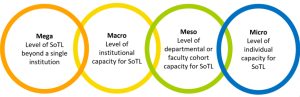
The 4M framework—micro, meso, macro, and mega (see figure 1) offers a complementary way of understanding this work. It makes visible how SoTL Leadership can be enacted at different levels: within individual teaching practice, across departments and faculties, at the institutional level, and within wider scholarly communities (Poole & Simmons, 2013; Simmons, 2016; Williams et al., 2013).
Taken together, these perspectives suggest that SoTL Leadership is not a single role that one either has or does not have. Rather, it is a constellation of practices through which individuals and groups create coherence, build connections, and enable change across contexts.
But do we see this in practice? To address this question, we begin with our own cases. These cases reflect everyday SoTL work as it is lived, negotiated, and enacted, and they form the starting point for the reflections that led us to write this book.
Figure 1.
The 4-M framework (Adapted from Simmons, 2016; Williams et al., 2013)
Our own cases
Irma
Trained as a toxicologist, I began working at the Department of Pharmaceutical Sciences at Utrecht University (UU), a research-intensive university in the Netherlands, in 2001 as an assistant professor. In addition to leading my own disciplinary research group, I was required to teach for half of my time. I was one of those people who thought, “Oh, I can give an excellent scientific presentation, so I will also be able to teach very easily,” only to discover that teaching presents its own unique challenges. This was the first moment I recognised education as a distinct disciplinary field, one that can be built upon theories and evidence.
During my participation in UU’s Educational Leadership Programme (2006-2007), we visited Gloucester University. It was there that I met Mick Healey and his colleagues, who were deeply involved in Inquiry-Based Learning (IBL) and had created an open, student-activating learning environment. Their evidence-informed approach inspired me to view teaching and learning in a more scholarly manner. This led me to a project where I embarked on my first experiences with qualitative research; I wrote my first educational paper, essentially my first SoTL project, about a course I had developed (Meijerman, Storm, Moret, & Koser, 2013). This was not always easy, as the institutional environment at the time was not open to a scholarly approach to teaching, let alone to sharing results through writing papers. However, I was fortunate to have a few colleagues experienced in educational research whom I could approach for help and support.
In 2010, I became the programme coordinator of the College of Pharmaceutical Sciences (CPS), a new bachelor programme in pharmaceutical sciences that needed to be developed and coordinated once it was running. This role allowed me to demonstrate scholarly leadership, as the programme was developed evidence-informed using, among other things, the principles of IBL that I had encountered a few years earlier (Meijerman, Nab, & Koster, 2016).
In the years that followed; while searching for literature about the development and support of teachers in relation to the CPS and other teacher development initiatives, I discovered literature about SoTL. It immediately resonated with me. I realized that I had been unconsciously engaged in SoTL for several years and recognised its importance not only for me but also for the quality of our teaching.
This realization inspired me to take my first step as an informal SoTL leader. On my own initiative, I started a SoTL course for teachers at our university, together with a colleague. Additionally, within the Faculty of Science, we integrated SoTL into a project that was aimed to create a network of teachers. The result of the initiatives was published and presented at the ISSOTL18 conference (Meijerman, Kirschner, & Prins, 2023). Attending this conference was a pivotal moment for me. Coming from an environment where scholarly teaching was barely known, let alone acknowledged, I found the conference to be incredibly inspiring. Meeting all these like-minded individuals, including Andrea, the co-editor of this book, motivated me to invest even more energy into promoting SoTL at our university.
In 2017, the Centre for Academic Teaching and Learning (CAT) of UU was established. I immediately approached the Academic Director of the Centre to discuss a role for SoTL. In 2018, I became one of the Senior Fellows (SF) of CAT, with SoTL as my project. This role significantly accelerated my development as a SoTL leader. As a Senior Fellow, I organized a SoTL course, initiated SoTL grants and a yearly SoTL conference at UU, and wrote the Utrecht University Roadmap for the Scholarship of Teaching and Learning—a practical tool for anyone interested in engaging in SoTL (Meijerman, Wijsman, & Kirschner, 2025). I also obtained a grant from UU to set up a SoTL Advocates programme. Together with a team, we organized supporting meetings for the SoTL Advocates, two from each faculty of our university. The aim of the SoTL advocates project was to make SoTL more familiar within their faculty and to ensure it is recognised and supported.
Over time, my involvement in SoTL gradually extended beyond my own institution. I served as Vice President Europe of ISSOTL for two years and chaired the ISSOTL 2023 conference in Utrecht. More recently, I have taken on the role of Chair of the EuroSoTL network, with the aim of engaging more colleagues across Europe in SoTL and creating spaces where people from different contexts can connect, share, and learn from one another.
Looking back, I now see this journey as a gradual shift—from SoTL as something I pursued largely for myself, to work that became shared with and shaped by others. It was not the result of a single decision or a formal leadership role, but of many small steps taken over time, often in response to opportunities that emerged along the way. Throughout this process, much of my SoTL Leadership remained informal and was not always fully recognised or rewarded within existing institutional structures.
What mattered most to me was staying curious, being open to new ways of researching and teaching, and having the courage to start conversations and initiatives, even when the outcomes were uncertain. Sustaining this work required perseverance, but it also prompted reflection on how and where this kind of leadership could best flourish. This reflection ultimately led me to establish my own consultancy and training practice, creating space to support others in SoTL and educational change in ways that felt both aligned with my values and responsive to the needs I was encountering.
Above all, this path has reinforced for me that SoTL Leadership is deeply relational and possibility-oriented—about noticing where energy exists, bringing people together, and creating conditions in which shared inquiry and change can grow.
Andrea
I have been an educator for more than twenty-five years in public school and higher education classrooms. Beginning in 1999, I spent nine years as a secondary school teacher. I taught courses in social studies and English, volunteered on the Professional Development Committee, and, for four years, served as the Social Studies department head; taking on an administrative position in addition to my teaching responsibilities.
In 2008, I was seconded to the Faculty of Education at the University of British Columbia (UBC). For three years, I taught, as an independent instructor in the Teacher Education Program, teaching several courses in Social Studies Education. For each of these courses, I designed the curriculum, delivered the instruction, and completed all of the assessment and evaluation. I also supervised teacher candidates on their practica, which meant that I worked one-on-one with the teacher candidate to develop their pedagogical and curricular practice in classroom settings. Working as a mentor teacher and teacher educator honed my skills in programme planning and education for adults. These two positions laid the foundation for my scholarly interest in teaching and learning in higher education. Then through a professional development programme, I was introduced, by my mentor, Professor Harry Hubball, to the SoTL. This experience was transformative for me and strongly influenced not only my practice, but also my future research into faculty development.
In 2011, enrolling in a Ph.D. programme in the Department of Curriculum and Pedagogy (EDCP) at UBC was four years of intensive professional development as a scholar and educator. Attending the 2011 ISSOTL conference in Milwaukee, WIS was a transformative experience. I felt like I had ‘found my people’. There were other scholars who were interested in transforming higher education through scholarship! Blending education and SoTL gave me a vantage point of working from a Faculty of Education towards other areas of the institution. Through the International Program for the Scholarship of Educational Leadership: UBC Certificate on Curriculum and Pedagogy in Higher Education (UBC SoEL Program), my teaching and research support programme participants as they contribute to the intellectual life of their discipline as well as the institution. The cohort participants come from across the UBC campus and around the world. I facilitate interdisciplinary conversations about teaching, learning, and educational research; spending a significant amount of time introducing the field of SoTL and acclimatizing participants to the literature and conventions that they will need to use throughout the programme.
After completing the Ph.D. in 2015, for three years I worked in a variety of positions in the Faculty of Education. I supported a departmental review, developed a proposal for a programme to support postdoctoral fellows, and designed, implemented, and administered cost recovery professional development programmes for students and visiting educators. These positions developed my personal leadership capabilities as an effective communicator and project manager, and my ability to develop and maintain collaborative relationships with faculty and staff across the faculty. I believe that the work of higher education is facilitated by the development and sustaining of a community of scholars. I believe that scholarship and service to the department, faculty, university, and profession create a working environment where each community member can fully contribute.
Making my research focused on SoTL and SoEL, has given me the platform to be an advocate for scholarship and leadership in teaching and learning in higher education. Taking over as the academic chair of the University of British Columbia Scholarship of Educational Leadership (SoEL) Program and sharing my research with others at UBC and around the world is the fulfilment of the spark that was lit in 2008. When I think back on the route that I have taken to this point in my career, it could be viewed as a haphazard meandering, however I see each move or temporary position as a specific choice to gather a broader perspective on education. Once I embraced my vocation as an educator, I embraced the opportunity to make my professional work an extension of my beliefs in encouraging, connecting, and serving others as a teacher.
My SoTL Leadership is intertwined in a professional identity that I liken to a Chimaera (Bennett et al., 2016; Kensington-Miller, Renc-Roe, & Morón-García, 2015). The three species of the Chimaera speak to a tripartite identity, and manifest in the need to be a generalist teacher of academic literacies, a disciplinary teacher, and a SoTL researcher. As a scholar in Education and SoTL, I have been able to engage in sustained scholarly activity, often in between traditional disciplinary cultures. As a result, my work reflects an eclectic range of partnerships and projects. These projects and presentations, at their heart, are emblematic of the diversity of work that is part of SoTL and SoTL Leadership.
Reflecting on our cases: why this book matters
Looking across our two cases—different in context, career stage, and geography—a shared pattern becomes visible. Neither of our routes into SoTL Leadership began with a formal leadership role or a clear intention to become a leader. Instead, leadership emerged through engagement: noticing questions about teaching and learning, acting on curiosity, and choosing to work with others around those questions. In both cases, SoTL Leadership began with small initiatives—starting a conversation, developing a course, supporting colleagues, or creating spaces where inquiry could be shared.
This is why we strongly believe that SoTL Leadership is for everyone. You do not need to be senior, formally appointed, or institutionally recognised to begin. Leadership can start with something as simple—and as courageous—as taking an initiative to work with others around teaching and learning. Often, leadership appears before we have the language to name it as such.
At the same time, our cases show that SoTL Leadership is not one thing. It takes many forms and unfolds in different ways, depending on context, opportunity, and personal inclination. At times, leadership was closely connected to our own teaching practice; at other times, it involved supporting others, building communities, shaping programmes, influencing institutional cultures, or connecting people across institutions and countries. These experiences resonate strongly with the different aspects of SoTL Leadership explored in this book and with the 4M framework, which highlights leadership at the micro, meso, macro, and mega levels.
Importantly, neither of our trajectories followed a single, linear path. Leadership shifted over time, moved between levels, and was sometimes visible and sometimes not. Informal leadership often carried responsibility without clear recognition or reward. Navigating these realities raised practical questions about how SoTL work can be sustained over time, how care for people and communities can be maintained, and how meaningful change can be achieved — questions that many engaged in SoTL will recognise.
This brings us to why we find this book important. This is not a book that tells you how to become a SoTL leader, nor does it offer a single model to follow. Instead, it shows a diversity of SoTL leaders and the many routes they have taken. Through cases, theory, and practical reflections, the book opens possible paths ahead, helping you to recognise where you are now and to imagine where you might want to go next.
Ultimately, this book is an invitation. It invites you to see yourself in the stories of others, to recognise leadership in practices you may already be engaged in, and to explore how your own SoTL work—at whatever level and in whatever form—can contribute to meaningful change in teaching and learning.
How this book is structured
This book is organised around the idea that SoTL Leadership develops in relation to context, people, and purpose—and that there are many possible routes into this work. Each section combines cases, theory, and practical reflections, allowing you to move between lived experience and conceptual insight as you read.
Together, these sections reflect an expanding scope of SoTL Leadership — from individual identity, to relationships, to institutional contexts, and finally to international engagement.
We begin by focusing on academic and SoTL Leadership identities. This section explores how individuals come to see themselves as SoTL leaders, often gradually and without a clear starting point. Practical chapters in this section attend to early steps in SoTL Leadership, including initiating projects, working with others, and building confidence and credibility over time. This section speaks particularly to readers who are just beginning—or who may not yet see themselves as leaders.
The next section turns to networks and communities, highlighting the central role of relationships in sustaining SoTL Leadership. Here, the case and chapters explore how communities of practice, local networks, and national or international collaborations are formed and maintained. This section emphasises that SoTL Leadership is rarely an individual endeavour and that change often happens through connection and collective effort.
We then focus on institutional cultures and SoTL Leadership. This section examines how institutional contexts shape what is possible for SoTL and how leaders navigate, influence, or sometimes work around existing structures. Contributors address both supportive and challenging environments, offering insights into how SoTL Leadership can be enacted even when recognition or support is limited.
The final substantive section explores SoTL Leadership in an international context. Drawing on conceptual discussion and reflective examples, it examines how language, culture, geography, and academic traditions shape the development and leadership of SoTL across different contexts. The chapter highlights the tensions between the local, practice-based nature of SoTL and its global scholarly exchange and considers how leaders can navigate these dynamics. In doing so, it invites readers to look beyond their own institutional or national contexts and to reflect on the possibilities and responsibilities of participating in a global SoTL community.
We conclude the book by returning to the central questions raised at the outset.
When does engagement become leadership?
Who decides what counts as leadership in SoTL—and on what grounds?
And how can SoTL Leadership create meaningful change across teaching, learning, and institutions?
Rather than offering a single model or prescription, the conclusion reflects on the diversity of SoTL Leadership practices presented across the chapters and invites you to consider your own position, possibilities, and next steps.
Taken together, the structure of this book reflects its central message: SoTL Leadership is not a fixed role or destination, and it is not reserved for a select few. Rather, it consists of evolving practices that you can take up in different ways, at different moments, and across different contexts. Whether you are just beginning in SoTL or have been engaged for some time, the chapters offer examples and reflections that can help you recognise your own practices and imagine new routes to change.
Conclusion
In this chapter, we have shown that SoTL Leadership is rarely a formal appointment and almost never a single, decisive moment. Instead, it emerges through practice—through curiosity about student learning, a willingness to inquire into teaching, and the courage to invite others into that inquiry. Whether through small acts such as supporting a colleague, or through wider initiatives that shape programmes, networks, or institutional cultures, SoTL Leadership grows from engagement. It is deeply relational and grounded in shared commitments to improving teaching and learning. The cases offered here illustrate how leadership can begin long before one names it as such, and how it is sustained not by title or authority, but by connection, purpose, and practice.
As we move forward in this book, we invite you to see SoTL Leadership as a dynamic and accessible endeavour—one that you may already be participating in. The cases, chapters, and reflections that follow will offer multiple ways to understand, explore, and enact SoTL Leadership across contexts, from the micro level of individual teaching to the mega level of international collaboration. Rather than prescribing a single pathway, this book opens space for recognising your own experiences and imagining new possibilities. In doing so, our hope is that you will not only identify leadership in your current work, but also feel empowered to cultivate it intentionally as part of a collective effort to strengthen teaching, learning, and educational cultures in higher education.
References
Ackermann, F., Pyrko, I., & Hill, G. (2024). Mobilizing landscapes of practice to address grand challenges. Human Relations, 77(5), 593-621. https://doi.org/10.1177/00187267221137884
Bennett, R., Hobson, J., Jones, A., Martin-Lynch, P., Scutt, C., Strehlow, K., & Veitch, S. (2016). Being chimaera: a monstrous identity for SoTL academics. Higher Education Research & Development, 35(2), 217–228. DOI: https://doi.org/10.1080/07294360.2015.1087473
Hannah, S.T., & Lester, P. (2009). A multilevel approach to building and learning organizations. The Leadership Quarterly, 20(1), 34-48. DOI: 10.1016/j.leaqua.2008.11.003
Hubball, H., Clarke, A., Chng, H.H., & Grimmett, P. (2015) The scholarship of educational leadership in research-intensive university contexts: Implications for promotion and tenure supervision. Asian Journal of the Scholarship of Teaching and Learning, 5(2), 92-107. https://doi.org/10.24112/ajsotl.53016
Kensington-Miller, B., Renc-Roe, J., & Morón-García, S. (2015). The chameleon on a tartan rug: adaptations of three academic developers’ professional identities. International Journal for Academic Development, 20(3), 279–290. https://doi.org/10.1080/1360144X.2015.1047373
Lux, A., Grover, S., & Teo, S. (2019). Reframing commitment in authentic leadership: Untangling relationship– outcome processes. Journal of Management & Organization, 1-19. doi:10.1017/jmo.2019.78
McKinney, K. (2012). Making a difference: Application of SoTL to enhance learning. Journal of the Scholarship of Teaching and Learning, 12(1), 1-7. https://scholarworks.iu.edu/journals/index.php/josotl/article/view/1971
Meijerman I., Storm, S., Moret, E., & Koster, A. (2013). Development and student evaluation of an inquiry-based elective course on drug discovery and preclinical drug development, 5(1), 14-22. https://doi.org/10.1016/j.cptl.2012.09.009
Meijerman I., Nab, J., & Koster, A. (2016). Designing and implementing an inquiry-based undergraduate curriculum in pharmaceutical sciences. Currents in Pharmacy Teaching and Learning, 8(6), 905-919. https://doi.org/10.1016/j.cptl.2016.08.001
Meijerman I., Kirschner, F., & Prins, F. (2023). Experiences with supporting teachers with Scholarship of Teaching and Learning at a research-intensive university: Lessons learned. Teaching and Learning Inquiry, 11 https://doi.org/10.20343/teachlearninqu.11.27
Meijerman, I., Wijsman, L., & Kirschner, F. (2025). Adding a scholarly analysis of teaching and learning to SoTL: The development of the hands-on Utrecht Roadmap for SoTL (UR-SoTL). International Journal for Academic Development, 30(4), 474-488 https://doi.org/10.1080/1360144X.2024.2361428
Poole, G., & Simmons, N. (2013). The contributions of the scholarship of teaching and learning to quality enhancement in Canada. In G. Gordon, & R. Land (Eds.), Quality enhancement in higher education: International perspectives (pp. 118-128). London: Routledge.
Pyrko, I., Dorfler, V., & Eden, C. (2019). Communities of practice in landscapes of practice. Management Learning, 50(4), 482-499. https://doi.org/10.1177/1350507619860854
Roxå, T., & Mårtensson, K. (2009). Teaching and learning regimes from within: Significant networks as a locus for the social construction of teaching and learning. In C. Kreber (Ed.), The university and its disciplines (pp. 209-218). London, UK: Routledge.
Simmons, N. (2016). The scholarship of teaching and learning in Canada: Institutional impact. New Directions in Teaching and Learning, 146, 95-102. https://doi.org/10.1002/tl.20192
Simmons, N. (Ed.). (2019). New Directions in the Scholarship of Teaching and Learning. Stylus Publishing, LLC.
Simmons, N., & Taylor, K. L. (2019). Leadership for the scholarship of teaching and learning: Understanding bridges and gaps in practice. The Canadian Journal for the Scholarship of Teaching and Learning, 10(1). https://doi.org/10.5206/cjsotl-rcacea.2019.1.7995
Sinek, S. (2009). Start with Why: how great leaders inspire everyone to take action. Portfolio.
Sinek, S. (2013). Leaders eat last. Portfolio.
Webb, A.S., Kensington-Miller, B., Lewis, H., Maheux-Pelletier, G., Gansemer-Topf, A., & Hoffman, A. (2024). The importance of autonomy and community for SoTL engagement: How six scholars embraced change to assert their SoTL values and identity. Becoming a SoTL scholar (Eds. Janice Miller-Young & Nancy Chick). (pp. 268-293). NC: Elon University Center for Engaged Learning. doi.org/10.36284/celelon.oa6
Webb, A.S., & Tierney, A.M. (2019). Investigating support for scholarship of teaching and learning; we need SoTL educational leaders. Innovation in Education and Teaching International. doi:10.1080/14703297.2019.1635905.
Webb, A.S., & Welsh, A.J. (2021). Serendipitous conversations: The 10-year journey in becoming SoTL scholars and educators. International Journal for Academic Development. (pp. 1-14). 10.1080/1360144x.2021.1964510
Wenger-Trayner, E. & Wenger-Trayner, B. (Eds.). (2015). Learning in landscapes of practice: Boundaries, identity, and knowledgeability in practice-based learning. Routledge, New York, N.Y.
Williams, A., Verwood, R., Beery, T. A., Dalton, H., McKinnon, J., Strickland, K., Pace, J., & Poole, G. (2013). The power of social networks: A model for weaving the scholarship of teaching and learning into institutional culture. Teaching and Learning Inquiry 1(2), 49-62. https://doi.org/10.20343/teachlearninqu.1.2.49