Reflecting on Our Journey Towards Building a SoTL Community Within and Across Disciplines: Six Lessons Learned
Anneke van Houwelingen; Roos de Jonge; Rianne van Lambalgen; and Veronique Schutjens
Abstract
This chapter examines the three-year interdisciplinary and interfaculty SoTL Advocates program at Utrecht University, the Netherlands: “Get started and keep going with SoTL!”, aimed at fostering Faculty-wide engagement with SoTL by establishing local networks, supporting Faculty staff and teachers to initiate SoTL projects, and embedding SoTL into Faculty policies and practices. At the end of the program, each SoTL Advocate brought an artefact representing their personal SoTL journey. Four of these artifacts served as a tool for further discussion and reflection from our perspective as SoTL Advocate. These symbolic objects, a metal spiral, a protractor triangle, a knitter’s work, and a Rubik’s Cube, visualized the tensions, vulnerabilities, collaborations, and learning processes that shaped our SoTL Advocates’ experiences during the 3-year journey. Our artefacts revealed patterns that helped to distill six practical lessons for introducing and expanding SoTL via SoTL Advocates, with an emphasis on timing and motivation, program structure, shared language, community building, alignment with disciplinary research cultures, and the interplay between bottom‑up and top‑down strategies. The six lessons offer a framework for educators, faculty staff members, and institutions seeking to develop sustainable and inclusive SoTL communities that are grounded in authentic scholarly inquiry. In the end, we discerned an unexpected seventh lesson, by realizing that in shaping and coloring the SOTL landscape, we unintentionally developed integrative leadership skills.
SoTL refers to a systematic, research-informed approach in which educators critically reflect on their teaching practices to enhance student learning and educational quality (Felten, 2013). Engaging teachers in SoTL has benefits for student learning, course experiences, student satisfaction, and the use of innovative, student‐activating teaching methods (Brew and Ginns, 2008). Globally, SoTL is recognized as a powerful tool for professional development and sustainable educational innovation. At Utrecht University (UU), SoTL has been embedded in strategic frameworks. However, until recently, UU support for teachers on SoTL was provided through specific courses and/or individual consultations. However, this did not start Faculty‐wide conversations about systematic inquiry into teaching and learning or promoting engagement of teachers in SoTL. Experiences with and outcomes of SoTL projects were shared, however, only within departments and among smaller groups of teachers within disciplines. As such, its lessons mostly remained under the surface. In this chapter, we demonstrate how an interfaculty SoTL network was built, what challenges emerged, and which practical strategies you can apply when developing an interdisciplinary SoTL community in your own context.
Around 2022, the SoTL Advocates program was started. To strengthen SoTL across the UU, that year the interdisciplinary and interfaculty project: “Get started and keep going with SoTL!” was launched. The project aimed to foster Faculty-wide engagement with SoTL by establishing local networks, supporting educators in initiating SoTL projects, and embedding SoTL into Faculty policies and practices. The approach was interfaculty and built on the principle of “teacher empowering teacher”. Each Faculty appointed two SoTL Advocates meaning that within the UU, 14 Advocates were appointed in 7 Faculties (including Utrecht medical school). University College Utrecht also joined the Advocate group with two Advocates. The (16) Advocates were to act as catalysts for change, role models, and creators and facilitators of Faculty-based learning communities (FBLCs).
The SoTL Advocate project was not designed as a traditional leadership program. Instead of developing individual leadership competences, the focus was on collective influence: educators enabling other educators to engage in SoTL. General leadership programs mostly focus on personal strategy and effectiveness and aim to develop individual competences to navigate complex management levels, influence team performance and often strategically impact hierarchical structures or positions (see for examples Organizational Culture(s) and SoTL Leadership by Mårtensson & Roxå, in this book). Therefore, leadership programs can be individual by nature. In contrast, the SoTL Advocate project was designed and, as this chapter shows, also perceived as a joint effort of 16 Advocates together travelling to reach the common goals. Although formal individual leadership skills were not the main aim of the project, some Advocate role components align with integrative leader characteristics (Working the Boundaries by Miller-Young, in this book). The three-year long road in the SoTL Advocate program was paved with discovery and inquiry, and SoTL Advocates were to collectively bridge disciplinary and Faculty differences, cross boundaries, and stimulate and enable peers to be involved in SoTL. Drawing on Latucca’s work, Miller-Young states: “In integrative collaborations, learning is both process and product as collaborators co-create their new understandings”, and that mirrors the perspective in the SoTL Advocate program about a less hierarchical and instead a more integrative form of leadership. Integrative leadership in educational and SoTL terms can then be understood as ‘leading of learning’ (Miller-Young, 2026) and requires skills not commonly associated with leadership in the traditional way. Individual capabilities related to exerting power, strategic and hierarchical positioning, and initiative taking as ”senior, mid-level and informal leaders” (Mårtensson & Roxå, 2026), make room for listening, being attentive to others’ needs and capabilities, sensitive to other participants’ drivers and barriers, and having and showing an eagerness to build, discover and learn together – to jointly imagine and explore new opportunities. In other words: a leader who is a learner as well – on equal footing with other learners. Here, building trust among participants and jointly developing strategies for meaningful shared influence is key.
Over the three years of the project, the Advocates worked to raise awareness, activate engagement, and ensure sustainable integration of SoTL within their faculties. The Advocates had dedicated time for their activities at their respective faculties, but also to participate in 14 structured meetings organized by the SoTL Advocates Project team. In these meetings, different topics were addressed with ample opportunities to discuss differences and similarities between faculties but also to share different challenges that they faced while trying to get the SoTL conversation started in their departments. The experiences of the Advocates in bringing the SoTL message across, the barriers and drivers they encountered, and the solutions and strategies arising from the interdisciplinary discussions, have led to the development of tailored strategies to meet the unique needs and structures of each Faculty.
The outcomes of the SoTL Advocates program
The outcomes are promising: several Faculties established active SoTL networks (e.g., Department of Pharmaceutical Sciences in the Faculty of Science), integrated SoTL into promotion criteria (e.g., Geosciences), and embedded it in funding and professional development procedures (e.g., Social Sciences). In addition, an online module was developed which is now part of teacher qualification programs and supports educators across UU. At the same time, the project revealed that long-term embedding of SoTL requires ongoing commitment, institutional support, and formal recognition of educational scholarship. Faculty contexts vary widely, and sustainable change demands both bottom-up community building and top-down policy alignment.
This project demonstrates that interfaculty collaboration, strategic support, and educator-led initiatives are essential for building a vibrant SoTL community across faculties and academic disciplines and that the first results are already visible. Furthermore, the networks, tools, and insights developed through this initiative provide a strong foundation for continued growth in educational scholarship at Utrecht University.
Between the set-up of the program and the outcomes, the SoTL Advocates undertook a three-year journey which was at times a bumpy road. Their experiences are insightful for groups of teachers in higher education thinking about introducing and expanding SoTL in their institutes through designing such a program.
In the last formal meeting of the program, all Advocates were asked to bring along an artefact representing their personal SoTL journey. Apart from a short explanation, there was limited time to elaborate on each other’s journeys. That is why we, four Advocates from four quite different disciplines, decided to share and discuss our artefacts (including a short description) and reflect on them in more detail. This process resulted in six hands-on lessons for future practitioners in higher education to build interdisciplinary communities of practice. Below, the artefacts and lessons are presented.
Artefacts visualising experiences from our journey as a SoTL Advocate
By translating our lived experiences into symbolic forms – in our case artifacts – we were able to reflect critically on them, each from our own perspective, as we had different starting points in our SoTL Advocates journey. Discussing our reflections created a deeper understanding of our individual lived experiences and allowed for the distillation of lessons for future practice. For this chapter, each of the contributors chose an artifact that represented their lived experience as a SoTL Advocate (see Figures 1-4).
Case 1 – Navigating Tensions Between Educational Practice and SoTL (Roos)
This case illustrates how SoTL leaders balance uncertainty, vulnerability, and peer connection when introducing SoTL in clinical and educational contexts.
Figure 1.
A metal spiral

The metal spiral symbolizes how I sometimes felt pulled in different directions between the theoretical knowledge that needs to be integrated into teaching and the practical delivery of education. In both aspects, I strive for high quality. Once the spiral is set in motion, it moves with great energy—like a train—but it remains delicate. If it gets tangled, it’s hard to unravel, and if it breaks, it’s difficult to restore it to its original form. This vulnerability represents my experiences with the SoTL program as I had to cope with and learn from these pulls from different directions and insecurities along the way. My listening and sharing skills, however, helped me to recognize and acknowledge fellow SoTL Advocates’ experiences, to focus more on overlaps and similarities than on differences, and to learn from them. Sharing and discussing pressing issues at the SoTL Advocate meetings helped to feel energized and to even pass this on to my (disciplinary) colleagues (Roos, University Medical Center Utrecht, Education Center).
Case 2 – Aligning Bottom-Up and Top-Down Change (Veronique)
This case focuses on policy alignment and institutional recognition, showing how SoTL leadership operates across organisational levels.
Figure 2.
The protractor triangle

The protractor triangle has three sharp angles or perspectives, but most of all: it is a transparent triangle with a broad base and small peak. The triangle thus visualizes the need for both a bottom-up and top-down approach in introducing and stimulating SoTL in the broad interdisciplinary Faculty of GeoSciences, which at the UU combines both natural sciences and social sciences academic fields. Furthermore, transparency of the triangle stands for (the need for) clarity of SoTL concepts, a shared recognition of SoTL-endeavors in academic professionalization, and clear and common understanding of educational research by both teachers, their supervisors, and students.
The three sharp angles stand for the three main achievements of the SoTL-Advocate program in Geosciences as I see them: increasing awareness, stimulating engagement in SoTL, and the structural embedding of SoTL in the Faculty. But also, the three sharp angles of the triangle stand in deep contrast with the ‘round’ and as such seemingly smooth Utrecht SoTL Roadmap picture. The process of embedding SoTL within the Faculties and academic disciplines can be and feel prickly – and sometimes even painful. During the program, I learned from situations, experiences, and strategies from other SoTL Advocates. Our honest discussions, especially when colleagues shared their painful struggles, disappointments, and less successful strategies to overcome (hierarchical) barriers, helped me to open my mind to other viewpoints and sometimes even solutions (Veronique, GeoSciences Faculty, Human Geography and Spatial Planning).
Case 3 – Building Shared Understanding Across Disciplines (Rianne)
Here the challenge was not policy but perspective: developing a shared language across disciplinary traditions.
Figure 3.
A Rubik’s Cube

A Rubik’s Cube, that looks different from every angle and at the same time asks for collaboration to complete the puzzle. The Rubik’s Cube represents the different perspectives that are there to research in general and to SoTL in specific. Being a SoTL Advocate at the Humanities faculties made me realize that different perspectives to SoTL need to be appreciated and need to be made explicit in conversation with colleagues. At the same time this cube represents the need for a collaborative goal; with the right combination of colours the Rubik’s Cube can be completed. Combining the colours together calls for cultivating collaboration at both the SoTL-project level and my (inter)disciplinary context. The 26 smaller cubes of the Rubik’s Cube illustrate different contributions that can be brought together in multiple ways depending on the collaborative goal. Looking at the changing combinations of colours, resulting from collaboration increased my feelings of ‘being in it together’ and co-creating the SoTL trajectory and its outcomes together (Rianne, Faculty of Humanities, Liberal Arts and Sciences).
Case 4 – Sustaining Community Through Care and Persistence (Anneke)
This case highlights the long-term relational work required to maintain SoTL communities.
Figure 4.
A knitter’s work
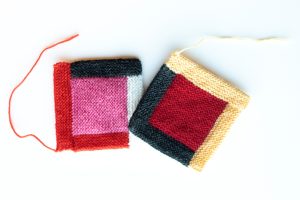
The knitter’s work shown above is one part of a larger work, in most cases a cozy cabin log blanket, and could reflect the outcome of the SoTL Advocates project. Each cabin log block resembles how every SoTL Advocate had to follow their own path on dealing with Faculty policy, members, and teachers. Besides overarching issues, SoTL Advocates had their own discipline-based issues on introducing and expanding SoTL, with some of us already had a lot of experiences with SoTL whilst others were just starting to engage with SoTL. The different colors used in this block are connected to one another, reflecting how we tried to relate and hold onto each other for support, within our discipline and across our disciplines. As SoTL Advocates we are not finished with exploring and expanding SoTL, on the contrary it just started. It will take time, resilience, continuous reflection, flexibility, creativity, and perseverance. This requires specific skills: being attentive and patient, carefully listening to the needs and expectations and hopes of potentially interested colleagues, recognizing energy and enthusiasm in them and quickly act on SoTL opportunities for all involved as they present themselves. If the blocks are stitched together to form a completed blanket, it will give warmth and coziness, much like home coming and feeling to be loved and cared for (Anneke, Faculty of Science, Pharmaceutical Sciences).
From the above mentioned artifacts and their descriptions, we distilled six lessons that served as a foundation for further expansion of each lesson into broader practical implications for setting up SoTL networks and communities. These distilled lessons contained themes within leadership, policy, and institutional organization of SoTL, which places our lessons in line with the observational framework of Myatt et al (2017).
Lesson 1. Engage the right people at their right moment
A key insight is that successful SoTL initiatives depend on inviting the right people at the right moment. The success of a Faculty-based SoTL initiative depends not only on institutional support but on identifying the right individuals—those who are intrinsically motivated to improve teaching and learning. These are often educators and teachers who have long engaged in reflective practice, even before they knew that it was SoTL what they were doing. By inviting them at a moment when they feel ready to act, we tap into a deep reservoir of energy and commitment. This calls for patience and attentively waiting for the right time and right moment – a typical skill of integrative leadership. All SoTL Advocates have witnessed that it is not the (SoTL) message alone that counts, but also the timing, phrasing, and intensity of getting this message across to the right colleagues. Only acting upon this careful evaluation is key.
“Although I did not know yet what SoTL was at that time, I already had a SoTL mindset; reflecting on my teaching, reflecting on how students learn in the classroom and how this could be improved by taking a research-based approach.” (Rianne)
Our reflections show that many Advocates had early experiences with educational innovation – whether through interdisciplinary course design, problem-based learning, or informal peer collaboration. These experiences often sparked questions about student engagement, learning outcomes, and the role of evidence in teaching. What united them was a desire to connect their disciplinary expertise with educational development, and a willingness to step outside their comfort zones.
“For years, I have wondered why university teachers do not use their research capabilities to improve their teaching, and why so many are focused on advancing their disciplinary research while neglecting their teaching and their students’ learning.” (Veronique)
We also learned that pairing junior and senior Advocates within faculties creates a dynamic learning environment. The difference in experience fosters mutual growth, echoing Vygotsky’s concept of the Zone of Proximal Development. Moreover, having at least one Advocate with direct access to Faculty leadership proved essential for embedding SoTL in policy and practice.
“Our community of practice was initiated by a senior SoTL leader to bring together SoTL-mined teachers. This diverse group has different SoTL experiences and skills but learn with and from each other. The community is very vulnerable in its existence due to the lack of allocated time for teachers joining the community” (Anneke)
Ultimately, engaging the right people at the right time is not just a strategic move – it’s a cultural intervention. It allows SoTL to grow organically within faculties, rooted in authentic questions and sustained by peer support. When educators feel seen, supported, and connected, they become powerful agents of change. For SoTL leaders, recruitment is therefore not an administrative task but a relational one.
Lesson 2. Design a clearly structured program directed at a common goal (even beyond program’s deadline)
Gathering motivated colleagues is only a first step. You also need a structure that helps them collaborate towards a shared goal. The program structure can be used to keep enthusiastic scholars motivated, right from the start. In the absence of external motivation, such as UU or Faculty recognition for the still relatively unknown SoTL activities and output, at the program’s start the SoTL Advocates had to rely on their own energy and enthusiasm. Although we think it was rather unintentional, the setup of the UU-SoTL Advocate program acknowledged the three basic elements from Ryan & Deci’s pivotal work (2000) on intrinsic motivation and self-initiated behavior: the need for autonomy, for competence, and for relatedness. The program and its activities throughout the meetings offered plenty of room for Advocates to freely and autonomously explore Faculty-specific goals, develop particular dissemination opportunities in their Faculty, engage in (inter)national conferences and debates, and find (creative) ways to get colleagues within our faculties on board. The relatedness factor was accounted for in the many opportunities for informal contact with colleagues from other disciplines during the Advocate project meetings. However, the program especially fulfilled the need for competence for the scholars involved, in two major ways: a structured program to commit us to being a SoTL Advocate and building competency by addressing SoTL specific themes and topics.
First, the program was not only highly structured in its set-up over three years, transparent in team (management) responsibilities, and had finite goals, but it made us commit to making it a success.
“Here I found that we could be part of a larger community within the UU, having the same goal of encouraging SoTL” (Rianne)
From the start, the SoTL Advocate program aimed at putting SoTL on each Faculty’s agenda and giving birth to Faculty learning communities that would survive the program’s end date. This implied that during the program, we would be learners and builders, but also that we would end up as experts of and maybe even leaders of the SoTL communities in our respective faculties. We were to work on a sustainable new type of scholarship in higher education that was meant to stay and to continue and to develop further – beyond the SoTL Advocate program’s border. Veronique characterized the program as follows,
“So using the project as “incubator” that would deliver energetic Faculty start-ups.” (Veronique)
The structured set up of the program gave us the opportunity to develop our competence, ‘freeing’ us of the need to be competent already at the start. We were learners with ample time and space to develop, which closely aligns with the learning aspect of integrative leadership.
Second, the SoTL Advocate meetings were clearly structured around specific topics, also inviting the Advocates to actively come up with their own topics. On time, a clear agenda was sent with ample opportunities for sharing. Often, we had to prepare small assignments, such as developing and designing a poster to advertise and invite colleagues to SoTL information meetings in our respective Faculties or Departments. We had both practical discussions about how to organize a SoTL workshop and more theoretical or reflective dialogues about ethical guidelines in the faculties and challenges of encouraging SoTL in the faculties. The presentation of our assignments at the SoTL Advocate meetings received positive feedback from both peers (other SoTL Advocates) and the program coordinators. This encouragement highly stimulated our work, ideas and -more hidden- also addressed our need for increasing our competence.
Building competence through these elements has helped our collaboration, also because we were SoTL Advocates from different disciplinary backgrounds. This required us to actively make the translation between our own disciplinary context and SoTL at a higher level. It allowed us to be very specific about what we would like SoTL to be within our disciplines, but also to reflect on the purpose of SoTL at the collective level. According to Anneke, this also benefitted newcomers:
“It needs a common purpose (or goal) and structured program that guides collective growth and learning opportunities – this proved to be important also when onboarding new members during the program” (Anneke)
One critical note, though. We believe that the SoTL Advocate program level would have benefited from a slow but persistent embedding in the UU institutional framework around teacher development, for instance in the UU SIG SoTL right from the start. Thus, although the clear articulation of common goals is key, securing it on or tying it into existing institutional educational programs would help justify the SoTL program for us and outsiders.
Lesson 3. Slow down to first create common ground and language
In this lesson, we would like to focus on the value we found in first creating a common ground amongst ourselves as SoTL Advocates about what SoTL is and how we can communicate the meaning of SoTL to others in the Faculty. Some of us were not familiar with the concept of Scholarship of Teaching and Learning but were practicing it in their context. We took the time to explore the different approaches to research-based teaching and to discuss in what context these would work. By explicitly addressing the language that we use, we could talk about the difference between SoTL and research-based education or disciplinary based educational research and how we would like to approach this in the different faculties. Language in this way was also the basis of a vision we created together.
“The concept of SoTL initially proved abstract and difficult to define for many. Through intensive dialogue, a shared language and vision emerged. This enabled the community to speak with one voice, significantly strengthening the positioning of SoTL within the university.” (Roos)
Next to our own Advocates meetings, in our Faculty context it is important to pay attention to the language of SoTL and educational research and to be explicit about the meaning of different concepts. It is not necessary to exclude initiatives that are not SoTL, but to be able to discuss the relation between different types of educational research and their purpose. This can be useful to make a start with a group of people who connect to a range of educational research activities. SoTL is not something opposite from these existing activities, but part of a range of valuable ways to encourage scholarly teaching.
“Especially in the early stages, finding a common language among the group of Advocates was challenging, but it also created a fruitful space for exploration. This growing awareness of the power of words and language proved highly valuable in subsequent communication with colleagues across the various faculties.” (Veronique)
It takes time to learn this new language. Webb (2016) and Tierney (2017) explain this with the idea of ´threshold concepts´ that students need to learn and adopt while encountering new disciplines. These concepts are specific to a discipline or research field. We as Advocates, but also our colleagues in the faculties need to interact with these new threshold concepts that belong to SoTL research – knowledge about the meaning of concepts and theories related to SoTL. To actively learn this new language and at the same time integrating it with the language of the discipline someone is already familiar with is an interesting, but challenging task.
“Finding a common language is challenging, as different disciplines use different terms for the same phenomena. Even engaging in SoTL takes time, as it brings together at least two disciplines: one’s own teaching discipline and the language of discipline-based education research. Discussing these differences in language is joyful and deepens our learning and development as a community of SoTL Advocates. It has also created opportunities for collaboration across disciplines to advance SoTL.” (Anneke)
Language is important and when language is not connected to the disciplinary context or context within the Faculty, it is difficult to encourage participation in the community. Concepts need to be made explicit, but also differences need to be discussed. Also, if there is a difference between preference in SoTL, or research-based education, there needs to be room for that as well and to shy away from the conversation that one of these methods is ‘better’ than the other. We had to learn about the other disciplinary languages and what is more, postpone and get rid of our judgments and prejudices. This requires listening and learning – typical integrative leadership skills, which we have developed during the program.
One SoTL Advocate meeting we were asked to bring in examples from SoTL literature in our own disciplinary practice. We found that having those, as well as showing examples of our colleagues doing SoTL helped to make the language of SoTL more accessible.
“We organized community meetings in which we invited colleagues to discuss their educational research, including SoTL. We intentionally included different types of research within Humanities higher education. These meetings proved valuable, as they demonstrated what educational research in the humanities can encompass and what SoTL can look like in humanities education.” (Rianne)
Finally, metaphors are helpful as well. Asking participants to bring an object (as we did at our last SoTL Advocates meeting) encourages them to actively reflect, slow down and have meaningful conversations that mobilize different perspectives.
Lesson 4. Organize formal interdisciplinary meetings which in time and place stimulate informally sharing experiences and exciting plans
In this lesson, we want to elaborate on the allocated time and activities that came with the Advocates program. As we experienced throughout the program, SoTL requires time, structure, and institutionally supportive culture to let SoTL flourish. Without support and dedicated time, SoTL often remains an additional task and therefore easily replaced by more immediate demands of teaching tasks. Time is one of the most critical resources in this context (Huber & Hutchings, 2006) and time pressure may hinder experienced autonomy (Ryan and Deci, 2000). On one hand, when hours for SoTL are explicitly reserved within formal workloads, staff gain the capacity to engage in SoTL and disseminate their findings. Such time allocation signals institutional recognition that SoTL is not a pursuit but an essential part of educational quality enhancement and a way to recognize and reward SoTL, and its Advocates and their integrative leadership development. On the other hand, time allocation also comes with challenges regarding the scheduling of the meetings. These meetings were arranged in such a way that they would interfere as little as possible with the teaching schedules of the Advocates, meaning that they were started in the late afternoon and ended at the beginning of the evening.
Veronique reflected on the challenges of the timing of the meetings,
“At the UU level, including within the SoTL Advocate program, it was sometimes difficult to maintain focus. Although time was formally allocated for all Advocates, the wide range of competing tasks in research and education hampered full engagement in the program. The timing of meetings, often at the end of the day, also posed challenges, as participants were frequently tired” (Veronique)
Equally important is how our SoTL meetings were organized. Our meetings had both formal and informal activities. The formal activities ensured progressing in the Advocates program and entailed shared planning, updates on ongoing projects, opportunities to exchange insights with the works of other SoTL Advocates within their Faculty or institution.
We all held positive experiences to the formal activities as illustrated by Roos, Veronique, and Rianne:
“Sharing experiences across faculties revealed key similarities and differences, which—together with expert input—were transformed into actionable SoTL research. Collaboration built strong connections and tackled urgent themes, made possible by dedicated time from the SoTL Advocates project.” (Roos)
“The main benefit of the USO SoTL Advocate program was the ease to share experiences and learn from both the best and worst practices of colleagues from other faculties and disciplines in introducing SoTL. During the program, we discussed, laughed, and designed new practices with each other during the 14 in-depth training sessions of 3 hours, guided and supervised by colleagues from UU Educational Support and Advice.” (Veronique)
“The structure of the SoTL Advocates meetings gave us the push to take action within our Faculty, while also providing the opportunity to reflect on what was happening and compare it with other faculties. Sharing practices helped us identify differences and similarities across contexts.” (Rianne)
Informal activities, however, give time and space for spontaneous and open interactions, which often sparks creativity, fun and laughter and a feeling of belonging to a community. It also gives opportunities to meet and learn from teachers outside your discipline, whom you normally do not meet. The lively pizza gatherings at the end of the day offered joyful and informal opportunities for SoTL Advocates to share their lessons learned, opportunities seized, and barriers encountered. The informal activities also ensures that relatedness is addressed (Ryan and Deci, 2000) as experienced by Anneke, Veronique, and Rianne:
“Our informal dinners added joy and space for meaningful conversations.” (Anneke)
“Informally, we also joined smaller workshops, panels, and presentations at UU and beyond. These interactions helped SoTL Advocates connect, support, and energize each other. Our program built a Community of Practice, which we later replicated within our own faculties.” (Veronique)
“Because SoTL Advocates were highly motivated to improve teaching and engage in educational projects, we quickly built connections and a shared practice that encouraged informal conversations. The meetings fostered openness, allowing us to share not only successes but also challenges.” (Rianne)
In summary, time allocation and informal activities are elements in building (inter)disciplinary SoTL communities that positively contribute to further extension of SoTL in our own disciplines. Making time for lunch or dinner is important as it functions as acknowledgement and contributes to a sense of belonging.
Lesson 5. Connect to disciplinary research practices
As SoTL Advocates, our task was to encourage SoTL in our faculties, which meant that we could leverage our existing network and connect to our own disciplinary background and disciplinary research practices. In this lesson we advocate for SoTL as something that strengthens disciplinary research rather than a choice teachers must make.
As SoTL Advocates, we often had conversations on how the disciplinary approaches within our faculties related to SoTL research, embedded in the social sciences. As Repko and Szostak (2021) state, disciplines are defined by their core elements such as epistemology (how the discipline approaches the truth), assumptions, concepts and methodology. These might be different from the core elements used within SoTL. This is also illustrated by research from Tierney (2017), who presented categories of “Troublesome Knowledge” for scholars from the life sciences engaging in SoTL, such as engaging with the literature, how to analyze data and understanding the paradigm.
As SoTL Advocates we encountered these challenges of dealing with a new research paradigm when doing SoTL as Veronique illustrates:
“(…) The (mis)conception among geo-colleagues that we geo-scientists lack knowledge and skills regarding educational theory and educational methods to fully engage in SoTL-projects – and that it would take much time to dive into this new field.” (Veronique)
Also, from the experience of Anneke, the narrative of opposing disciplinary research practices to SoTL research could be holding back colleagues to practice SoTL.
“We face several challenges: first, SoTL is often seen as an educational activity rather than research. Second, balancing the value of studying one’s own practice with the time required for SoTL projects. Third, overcoming disciplinary research paradigms and adapting to qualitative and quantitative approaches.” (Anneke)
When actively advocating for SoTL in different faculties, we found it is valuable to address these differences and challenges and to talk with the community of scholars about their hesitations with SoTL and by doing just that, acknowledge their reluctance. This was done by discussing existing SoTL research practices which also allow disciplinary groups to talk about where the connection to their disciplinary research practices might be. For example, within Humanities the SoTL roadmap that was developed at Utrecht University (Meijerman, Wijsman and Kirschner, 2024) was discussed with a humanities perspective, as Rianne reflects upon –
“I recognized the importance of connecting SoTL to colleagues’ disciplinary backgrounds, creating space for their preferred research approaches. I applied this when organizing a meeting to adapt the SoTL roadmap for the humanities. Together, we discussed how each element resonated with our context and adjusted it accordingly.” (Rianne)
Having a language that is understood by all (see lesson 3) helps, but also the ability of us as SoTL Advocates to connect to disciplinary research practices, because we are embedded in a disciplinary culture. Using integrative leadership skills, such as engagement and especially alignment (Miller-Young 2026), we actively used our own SoTL-ideas and even SoTL projects to show our disciplinary colleagues that these are complementary to instead of opposed to disciplinary research practices. In our SoTL Advocate meetings we then shared how this looks like in practice, for example by discussing different practices in ethics applications within the faculties. Here we specifically dedicated one session to sit down and look at different cases in SoTL to explain our ethical practices to each other. We used this to define the problem and possible solutions, actively taking these back to our disciplinary communities.
Finally, next to our own role, the social context of a Faculty is important as well in leveraging SoTL as something of value to your work as a scholar. As Roos reflects upon, this is not always the case:
“There is little structural support for reflecting on the impact of teaching on students and colleagues. Due to a shortage of teaching staff, decisions are often pragmatic: “Just teach, and if you do it this way, it’s fine” (Roos)
In contexts that are not as supportive of teaching innovation, connecting SoTL research to disciplinary practices could alter the perception of SoTL. The social context would benefit from having SoTL research recognized as a research activity (as also emphasized in lesson 6) at the level of the Faculty management. This is a good step to move towards a culture of valuing SoTL in the faculties.
As a SoTL leader, connecting SoTL to disciplinary identities reduces resistance and increases engagement.
Lesson 6. Combine top-down and bottom-up strategies in Faculty and disciplinary settings
During the SoTL Advocate program, we found that embedding SoTL in the respective Faculties was quite hard. We noticed that for encouraging SoTL it is valuable to connect SoTL to existing educational innovation initiatives in the Faculties or departments and to show our colleagues that this is not an element added to education or research, but that it is an instrument to innovate our education and reflect on its quality. As SoTL Advocates and (mostly) assistant or associate professors with many and various teaching tasks, we were standing quite close to our colleagues in education. Here, we could ‘walk the talk’; we were the living examples of people setting up and executing our SoTL projects, struggling with Ethical Board requirements, new types of research methods, and literature and outlets we were unfamiliar with the ‘lived experience’ Godbold, Matthews, and Gannaway (2024) talked about. In several cases, we as SoTL Advocates took other colleagues along in their project or encouraged and supported our colleagues who initiated their own projects to investigate the learning effects of their teaching. This led to some successful applications for funding and publications in an academic journal on higher education. In the end, we might conclude that putting energy into a bottom-up strategy came quite naturally for most of us.
However, for SoTL to become structurally and sustainably embedded in the faculties, the realization of its benefits for educational quality and educational innovation should be shared with the Faculty (or university) management as well. As Rianne put it:
“Sustainable change requires support from above and energy from below.” (Rianne)
The need for a simultaneous two-way approach (both top-down and bottom-up) to embed SoTL in the faculties was recognized and articulated by many SoTL Advocates. To encourage the bottom-up SoTL initiatives of colleagues it is important that they are valued by their managers and supervisors, for instance by including this in the assessment of their academic efforts and to allow SoTL to be part of someone’s research output (see also White & Mpamhanga, 2024). The process of setting SoTL on the Faculty agendas varied substantially; from quite natural to more regulatory. In the Department of Pharmaceutical Sciences, there was a renewed interest in a community of practice on SoTL due to a major curriculum renewal towards an integrated pharmacy curriculum before the start of the SoTL Advocates program. This renewed interest facilitated an energetic start and an increasing interest in evidence-informed innovations reflected by a rise in members and applications for funding these innovations. In the Faculty of Geosciences, more regulatory or institutional ‘top down’ support proved to be important to recognize SoTL as an important academic endeavor in two ways. First, initiated by the vice-dean of Education, SoTL has been introduced in formal reward and recognition (TRIPLE) criteria and with that, also in mindsets of HR managers and supervisors when issues regarding promotion are at stake. Second, the dean set up a specific program (2025-2027) to stimulate educational scholarship throughout the Faculty, with departmental ambassadors and support from UU Educational Advice & Support. Here it proved quite important that key persons at the Faculty (board) level were interested and believed in SoTL, and actively promoted SoTL (see also Kenny, Watson, & Desmarais, 2024). Also involving the HR and educational support officers was essential in adding educational scholarship criteria to calls regarding university or Faculty Education Stimulation Funds.
To summarize; as a bottom-up strategy is essential for getting colleagues acquainted with, interested in and motivated for SoTL, a top-down approach is necessary to keep SoTL alive and kicking, also after specific SoTL programs end. We recognize that dividing energy between both levels seems ineffective, but in the long run this pays off.
We have two extra recommendations regarding combining bottom-up and top-down strategies. First, and linked to the Pharmaceutical Sciences top-down experience mentioned above; try free-riding. Be keen on linking the introduction of SoTL or educational scholarship to existing or upcoming strategic (educational) strategies at the Faculty or university level. At Utrecht University for instance, the recently revised Educational Model offers ample stimuli to investigate (and research) educational innovations. Second, at the teachers (bottom-up) side, we experienced that the colleagues highly motivated to reflect on their teaching, often are the ones with temporary contracts and as such have relatively few research or career opportunities. This is reflected in the illustration of Rianne:
“A paradoxical situation as the genuinely motivated colleagues will in the end not benefit from embedding SoTL in Faculty (reward and recognition) regulations or criteria.” (Rianne)
As we have witnessed that junior teachers/colleagues can play a pivotal role in driving educational innovation, we suggest that this group of (temporary) teachers receive extra time for tasks in research on education – and that their efforts are rewarded in some way or another.
Summary and conclusion
From the set-up of the SoTL Advocates Program to its outcomes, our journeys unfolded by visualization of the artifacts and through sharing our experiences within and beyond our Faculties. We have identified several lessons from our experiences as SoTL Advocates. However, the overarching lesson perhaps is that the Advocate Community consists of people, structure, energy, flow, and joy. This means that our message can be eventually seen as ‘one voice’ and is therefore more powerful than the sum of each individual tone or part. By going through our experiences as SoTL Advocates, we created a similar mindset. All together, we illustrate how collaboration can work within disciplines and across disciplines leading to a network of SoTL Advocates.
Our interdisciplinary SoTL network eventually facilitated short communication lines and accelerated the achievement of our goals. The interfaculty collaboration and shared commitment create a dynamic and responsive environment where educational innovation can truly take place and expand.
Our approach serves as an inspiring example for other groups of people seeking to build a SoTL community: practice-oriented, interdisciplinary, and driven by lecturers and teachers themselves.
Maybe the most unexpected program outcome is that after its formal ending, we as SoTL Advocates still feel and act like Advocates. We are still energized and enthusiastic about collaboratively working on SoTL within and across our own disciplines. While the SoTL Advocate project did not start off as an individual leadership program, we as learners, brokers and builders of bridges between disciplines, management levels, and separate research and education domains, in the meantime rather unconsciously developed and trained some typical leadership skills we developed from being a “learner among learners” to a “learning leader of learners” along the way and started to colour the landscape of SoTL in our university. This hints at a seventh, more hidden lesson: integrative leadership skills can also be developed as an unintentional bypass of the SoTL journey.
Together, these lessons show that SoTL leadership is less about managing change and more about cultivating relationships, alignment, and shared ownership of educational inquiry.
Acknowledgement
We thank Harold van de Kamp for his support regarding the pictures and all our fellow SoTL Advocates and program leaders for their valuable discussions and energy during the Advocates program.
Authorship
Authors are in alphabetical order and have made an equal contribution.
References
Brew, A., & Ginns, P. (2008). The relationship between engagement in the scholarship of teaching and learning and students’ course experiences. Assessment & Evaluation in Higher Education, 33(5):535-545. https://doi.org/10.1080/02602930701698959
Felten, P. (2013). Principles of good practice in SoTL. Teaching & Learning Inquiry, 1(1):121-125. https://doi.org/10.2979/teachlearninqu.1.1.121
Godbold, N., Matthews, K.E.E., Gannaway, D. (2024). Theorising new possibilities for Scholarship of Teaching and Learning and teaching-focused academics. Higher Education Research & Development, 43(1):92-103. DOI: 10.1080/07294360.2023.2218809
Huber, M.T., & Hutchings, P. (2006). Building the Teaching Commons. Change, 38(3):24–31. DOI: 10.3200/CHNG.38.3.24-31.
Kenny, N., Watson, G.P.L., Desmarais, S. (2016). Building Sustained Action: Supporting an Institutional Practice of SoTL at the University of Guelph. New Directions for Teaching and Learning, 146, Wiley Periodicals, Inc. DOI: 10.1002/tl.20191.
Kern, B., Mettetal, G., Dixson, M., Morgan, R. K. (2015). The role of SoTL in the academy: Upon the 25th anniversary of Boyer’s Scholarship Reconsidered. Journal of the Scholarship of Teaching and Learning, 15(3):1–14. DOI: 10.14434/josotl.v15i3.13623
Mårtensson, K., & Roxå, T. (2026). Organizational Culture(s) and SoTL Leadership.
Myatt, P., Gannaway, D., Chia, I., Fraser, K., & McDonald, J. (2017). Reflecting on institutional support for SoTL engagement: developing a conceptual framework, International Journal for Academic Development, 23(2):147-160. DOI: 10.1080/1360144X.2017.1346511
Meijerman, I., Wijsman, L., Kirschner, F. (2024). Adding a scholarly analysis of teaching and learning to SoTL: The development of the hands-on Utrecht roadmap for SoTL. International Journal for Academic Development, 30(4):474–488. DOI: 10.1080/1360144X.2024.2361428
Miller-Young, J. (2026). Working the boundaries: Integration and learning as key aspects of SoTL leadership practice.
Repko, A. F., & Szostak, R. (2021). Interdisciplinary research: Process and theory. Sage publications, Thousand Oaks California.
Ryan, R. M., & Deci, E. L. (2000). Intrinsic and extrinsic motivations: Classic definitions and new directions. Contemporary educational psychology, 25(1):54-67. https://doi.org/10.1006/ceps.1999.1020
Tierney, A.M. (2017). Threshold concepts in academic practice: engagement with the Scholarship of Teaching and Learning. Practice and Evidence of Scholarship of Teaching and Learning in Higher Education. Special Issue: Threshold Concepts and Conceptual Difficulty, 12(2):165-184. https://www.pestlhe.org/index.php/pestlhe/article/view/167
Webb, A. S. (2016). Threshold concepts and the scholarship of teaching and learning. In Threshold concepts in practice (pp. 299-308). SensePublishers.
White, E., Mpamhanga, K. (2024). Building a resilient educational researcher community. Journal of Further and Higher Education, 48(7):727-739. DOI: 10.1080/0309877X.2024.2389145