How to Build a Scholarship of Teaching and Learning Network
Janet Lord
Abstract
This chapter is designed to support educators (including academics, learning developers and professional services colleagues) who are interested in building or developing a Scholarship of Teaching and Learning (SoTL) network. You might be thinking about starting from scratch or looking to strengthen an existing group; either way, this chapter offers you practical advice, always grounded in research, case studies, and lived experience. It explores different types of networks, including formal, informal, and Communities of Practice, and outlines strategies for establishing a structure, setting your goals, recruiting and retaining members, and obtaining institutional support. You will find guidance on ways of keeping your network active and inclusive; how to curate useful resources; and how to cultivate a sense of shared purpose. The chapter also reflects on the challenges of sustaining momentum over time and offers suggestions for maintaining engagement. A case study from a large UK university illustrates how a network can evolve from a successful grassroots initiative into a recognised part of an institution’s strategy. The approaches described can be tailored to suit different institutional contexts, from large, well-resourced institutions to smaller or more resource-constrained environments. At its heart, this chapter is about building communities that support collaboration, reflection, and innovation in teaching and learning. If you’re looking for a practical approach to SoTL networking, this chapter offers both inspiration and a clear way forward for networking in SoTL.
Scholarship of Teaching and Learning (SoTL) networks can have a significant role in enhancing scholarship of teaching and learning. The benefits of both formal and informal networks can be seen in ways such as sharing resources and enhancing professional development, and also in less obvious ways, such as fostering creativity and innovation.
In this chapter, the focus is on delivering practical guidance that will help you engage with or initiate the leadership, building and development of SoTL networks. The chapter is grounded in the current literature and relevant theories and clear guidance will be given on ways to establish and maintain these networks, offering examples and tips that can be applied in different institutional contexts. The various forms that networks can take will be explored, including formal and informal networks, Communities of Practice (CoPs), and other types of collaborative structures.
We will consider definitions of SoTL networks, different types of SoTL networks, and think about ways of establishing SoTL networks (including ways of developing and clarifying objectives). We will consider the membership of the network, securing institutional support and the structure of potential networks. Strategies for maintaining and developing a network will be considered, and some practical examples will be given. SoTL networks may look different in different institutional contexts, and this chapter will also consider those subtleties and nuances.
Defining SoTL Networks
What is a SoTL Network?
A Scholarship of Teaching and Learning (SoTL) network typically focuses on the systematic and ethical examination and development of teaching and learning practices. It provides a collaborative space for educators to explore, discuss, and apply evidence-informed approaches to enhance teaching and learning.
The key here is collaboration. Gale (2007) has suggested that:
…more mileage can be achieved when two or more scholars work collaboratively, and the distance that can be covered by collective approaches to scholarship (within the department, program, school, institution, and system) is certainly significant, if not “without limits”. (Gale, 2007, p. 40)
When SoTL practice and inquiry is conducted collaboratively, whether that be in collaboration with peers, students, or both, SoTL practice may be enhanced in several ways:
- There are advantages in collaborating with colleagues who may have more experience or different areas and levels of expertise, both in the scholarship of teaching and learning and in other areas.
- Collaboration is likely to bring richness to the work — for example by bringing in interdisciplinary and multidisciplinary expertise.
- As well as subject expertise, different colleagues are likely to have different technical skills, for example in artificial intelligence, digitally enhanced learning and teaching, statistical analysis, qualitative data analysis, survey construction, focus groups, and so on.
- Depending on the area of interest, you might find it helpful to have groups of students from different faculties, subject areas or different educational settings involved in the work. Involving students themselves in the work brings a different lens to the scholarship of teaching and learning; work that involves students as co-researchers often has more power and authenticity. For example, a study into the reasons for student non-attendance, which was conducted with students as leading researchers (who then presented their work at a national conference), demonstrated more authenticity and lacked the biases that similar work conducted by faculty members could well have had (study reported by Menendez Alvarez-Hevia et al., 2020).
- It can be helpful to have colleagues with whom you can engage in the reflective and reflexive process of SoTL and also, a network within which you can disseminate and share your findings. That depends on what your aims are – an issue we will consider below.
Types of SoTL Networks
Different institutions and aims support, and are more suited to, different types of networks, and institutions may support more than one type of SoTL network.
Formal Networks: some educational institutions have formal SoTL networks. Such institutionally supported networks are more likely to be structured with agreed or even imposed goals/objectives, hierarchies and resource allocation. There may be a requirement to report on the efficiency or effectiveness of such groups through the institution’s governance processes. These groups might include reading groups, seminar groups and communities of practice (CoPs).
Communities of Practice (CoP): A Community of Practice (CoP) is a group of people who share a concern or a passion for something they do and who learn how to do it better as they interact regularly (Wenger-Trayner & Wenger-Trayner, 2015). A CoP has an identity defined by a shared domain of interest in which the members pursue their initiatives in the domain, and engage in joint activities and discussions, share information and learn from each other. In Etienne and Beverley Wenger-Trayner’s (2015) introduction to Communities of Practice, they define the domain, community and practice as follows:
The domain. A CoP is characterized by a shared area of interest that defines its identity. Being part of the community reflects a commitment to this area, fostering a collective expertise that sets its members apart from others.
The community. In exploring their shared interest within a domain, members develop relationships that support mutual learning and collaboration. They value their connections and standing within the group. Simply having a website or holding similar job titles does not constitute a CoP – true communities emerge through meaningful interaction and shared learning experiences.
…members of a community of practice do not necessarily work together on a daily basis. The Impressionists, for instance, used to meet in cafes and studios to discuss the style of painting they were inventing together. These interactions were essential to making them a community of practice even though they often painted alone. (Wenger-Trayner & Wenger-Trayner, 2015)
The practice. A CoP goes beyond simply sharing common interests. Its members are active practitioners who build a collective repertoire of resources, such as experiences, stories, tools, and strategies for tackling recurring challenges. These can be physical resources, or maybe a virtual or conceptual network of resources, such as personal links and alliances. The shared practice develops gradually through ongoing collaboration and sustained interaction.
If you’d like to know more about communities of practice, there is a free downloadable book Communities of Practice Within and Across Organisations that I highly recommend.
Communities of practice is a term which is sometimes used as a term for a group of people coming together to discuss an area of interest. This group may or may not be a CoP as defined by the robust Wenger-Trayner conceptualisation (above), which is the one that this chapter uses. A CoP may arise quite naturally in organisational life, and in this case it is often this organic and voluntary nature that helps the CoP to thrive (Smith et al., 2016).
Anne Tierney’s Case Study: Building a Community (this book) explains the value of a CoP in her case study:
Looking at Wenger’s (1998) definition of a community of practice, the domain, the community and the practice are all vital components. This is what was on offer…a chance to spend time with other people who cared about teaching, who were knowledgeable about it and who wanted to share that knowledge and an opportunity to give back to the community…
When thinking about SoTL, and its intersecting elements (such as scholarship, teaching, learning and assessment), a CoP very often focuses both on shared practices in education and also on knowledge-building among CoP members. Entangling those focusses can be really useful – but complex to do. In Anne Tierney’s case study, and also through her other work (e.g. Tierney et al., 2020), you can see very clearly how Communities of Practice can be important to individuals’ professional development through collaboration, sharing and dissemination, and in supporting teaching practice. In turn, outcomes for students, and their experience, are likely to be positively impacted, as will individual members’ thinking and practice.
Other Collaborative Structures
Other collaborative structures, including study groups, mentoring circles, and partnerships can enhance SoTL in a variety of ways:
Study Groups can facilitate collaborative discussions and shared reflections on teaching practices, enabling participants to critically evaluate methods, share insights, and co-create strategies for improving learning outcomes.
Mentoring Circles can offer peer-to-peer or hierarchical mentoring opportunities, where experienced educators can guide others in developing research questions, designing studies, and interpreting results. These circles may facilitate and foster a culture of inquiry and growth.
Partnerships, whether between disciplines in the same institution or cross-institutional collaborations, can broaden perspectives and leverage diverse expertise. Partnerships can amplify the impact of SoTL projects by pooling ideas, resources, data, and methodologies.
Informal Networks
In many institutions there are informal SoTL networks. These are more likely to be flexible and often ad hoc groups which derive from connections driven by shared interests, rather than by formal structures set up or imposed by the institution. These networks are more likely to develop organically, based on shared areas of interest, in relation to SoTL or other subject areas. The organic nature of such networks means that they may fall into disuse; they may thrive and develop as informal networks; or they may result in the development of more formal networks and Communities of Practice.
Depending on context, all these types of structures can create supportive environments for SOTL practitioners and educators to engage in systematic, reflective, and evidence-informed exploration of teaching and learning practices. There are strengths and limitations to each type of network; there are obvious benefits to having institutionally supported formal networks, but the ad hoc flexible nature of informal networks can add a spontaneity and creativity to networks which is unlikely to be as prevalent in more formal networks.
Strategies for Establishing and Building a Collaborative SoTL Network
In this section, we will discuss selecting a network structure, clarifying network objectives and goals, identifying potential members and securing institutional support.
Selecting Network Structure
Choosing between an informal or a formal network structure will depend on the group’s objectives (see below) and available resources. Table 1 shows some of the advantages and disadvantages of formal and informal networks.
Table 1.
Advantages and Disadvantages of Formal and Informal networks
| Formal | Informal | |
| Advantages | Enhanced credibility and visibility within the institution.
Easier access to funding and institutional resources. More sustainable for large-scale projects and multi-department collaborations. |
Easier to launch with fewer resources.
Encourages experimentation and organic growth. Appeals to participants who prefer low-commitment involvement. |
| Disadvantages | May require more administrative effort and formal processes.
Potential for bureaucracy that slows down decision-making. |
May lack visibility and institutional buy-in without formal recognition.
Limited access to funding and resources. Harder to sustain momentum over time without structured accountability. |
Tip: You might want to consider starting an informal network to test interest and feasibility, then transition to a formal structure as the network gains traction.
Identifying network members
It’s always a good idea to identify diverse members with complementary expertise and to do this it’s important to highlight the value of that diversity, emphasising how a range of perspectives can enhance problem-solving creativity and impact in SoTL projects. The membership will of course depend on what your strategic aim is – is this the kind of network where you want to bring together experts or innovators in a particular and well- defined area, and if so, will the network be focussing on depth of understanding, bringing together colleagues with a variety of experience in a particular field? For example, this could be a network focussing on authentic assessment in a particular subject or set of cognate disciplines – a relatively well-defined and prescribed area. Alternatively, you might want to look at a wider area. As you will read in the case study below, one of the most successful Communities of Practice I worked with was on ‘digitally enhanced teaching, learning and assessment’ across the whole institution. This CoP brought together academics (with expertise both in teaching and in research), learning developers, assessment experts, digital education experts, colleagues from academic services, and external partners from organisations that developed teaching and learning software and applications, as well as colleagues from the University’s IT team.
It’s always interesting to consider whether you might want to involve students in your network. This can have obvious advantages, but also some disadvantages too. I’ve found it works well to bring them in as expert advisors, maybe only for some of the meetings, or to ask them for a part of each session.
It can be a good idea to showcase examples of interdisciplinary success stories in SoTL to encourage and inspire participation. I’d suggest that you think about your overall strategic aim and then specifically target multiple and appropriate disciplines and roles. Actively invite academics, professional services colleagues, learning developers, librarians and other colleagues with a range of expertise, and at a number of levels (including senior managers, middle leaders and more junior colleagues) to encourage cross-disciplinary fertilisation of teaching and learning experiences and challenges.
When you promote the network, it works well if you can emphasise its value as a collaborative space, where members can co-create resources, share teaching strategies and educational practices, and garner support for publishing research. It’s a good idea to highlight the opportunities for mentorship, professional development and leadership roles within the network, recognising the different forms of expertise that you will foster and develop (including practical teaching experience, curriculum design skills, data analysis and technical knowledge). I would also advise you to offer flexibility in how members can contribute, from being involved in the leadership of the network, to sharing resources to mentoring new participants.
You can also look around your institution and consider leveraging existing communities, and engaging with existing SoTL and other teaching and learning groups, research centres or mentoring programmes to recruit members with complementary skills.
For some networks, you might want to consider recruiting participants both within and beyond the institution. If you are starting a network just within your own institution, I would suggest that you approach teaching and learning centres, heads of department and members of committees that are focused on teaching and learning, curriculum or assessment. You may be able to use university communication channels by advertising in newsletters, announcements and intranet sites. It can work well if you can organise short workshops, webinars or information sessions to explain the purpose of the SoTL network and its benefits; some of these can be done online to facilitate maximum participation. If you can align with existing professional development programmes, faculty learning communities or leadership programmes to attract participants who are already invested in SoTL, this can work well too.
Beyond your own institution, you may wish to engage with alumni networks, perhaps inviting alumni who have experience in education or in instructional design. It can be great to build connections with neighbouring universities and teaching networks, both to recruit participants and to foster cross-institutional partnerships. I’d suggest that you think about tapping into professional organisations such as ISSOTL or EuroSoTL and the Professional and Organizational Development (POD) Network in Higher Education to connect with SoTL focussed professionals. You can also share invitations via LinkedIn, academic social networks and relevant teaching-focussed groups on social media networks.
By combining these approaches, your SoTL network can attract a dynamic and diverse membership base, and that in itself will help you to foster rich collaborations and to develop innovation in teaching and learning practice.
Network Objectives and Goals
Once you’ve got a group of interested people, you will want to start thinking about how you might set realistic (and possibly measurable) goals for the network. There is an interdependency between the structure of the network, its members, and its aims and goals, and probably these will be developed in parallel. This is also likely to be an iterative process. The membership may shift and change, and so might the structure, and hence the goals. Equally, changing intuitional imperatives or the external context might mean that your aims and goals may evolve over time.
Examples of common SoTL network goals include promoting research, sharing best practices, and working on collaborative grant applications. But it’s important to decide collaboratively what the aims, vision and goals might be.
When you initially decide that you are going to set up some form of network, whether that be formal or informal, you might already have very clear aims and objectives, or you might just have a more general idea that you would like to set up an SoTL network. It may be that you would like participants in the network to be involved in co-constructing the network goals, roles and responsibilities. If this is the case then you might wish to circulate a short survey ahead of time asking individuals for ideas about the purpose of the network, their suggested goals, the challenges and their own particular interests. You could do this for example on a Padlet or using an online survey via MS Forms and then use the responses to work collaboratively to frame an agreed and co-constructed purpose. Alternatively, you might want to send a more open invitation initially and then dedicate part of the first meeting to an open dialogue about the purpose of the network with prompt questions such as What issues in teaching and learning should we explore? or How can this network support your professional growth?
Once this initial work is done, it can be really helpful to identify core themes together; then based on initial input, distilling common themes into key priorities as a group, and then co-creating a mission statement or a set of guiding principles, ensuring that everyone’s voice is reflected.
By focusing on collaboration and shared vision-building, you can create an inclusive and purposeful foundation for the SoTL network.
Organising the initial meeting of the network can sometimes feel daunting! How might you start the network?
- It is worth considering whether your meetings should be online, face-to-face or hybrid. I would suggest that the first meeting might be better ‘in real life’ as it can be easier to facilitate the development of links and relationships in a face-to-face forum, but there are advantages and disadvantages of online/face-to-face/hybrid meetings that you will want to consider, depending on your institutional context.
- There are a number of ways of organising effective initial meetings that will help both to set the tone that you want and to build rapport. For example, you might want to start by sharing an engaging story from your own experience that highlights the impact of SoTL networks; this could be something that will inspire your participants and set a tone of excitement, purpose and possibility.
- It’s inevitable that participants in your network will have diverse experiences and contributions. It can be really helpful to acknowledge those contributions, possibly by getting participants to describe their own experiences in relation to SoTL., This can help support an atmosphere of mutual respect and the notion of shared ownership.
- It is unlikely just to be expertise which is shared; one of the key things about a network is the focus on shared values. The shared values in a SoTL network are likely to be related to improving student outcomes, fostering collaboration and promoting evidence-informed practice. You might want to make these values explicit and discuss them early on in the evolution of the network, or discuss them after a period of time, perhaps when you’re reflecting on the success of the network; or you might choose not to talk about values at all; it will depend on the aims and membership of your network.
- Icebreakers are sometimes suggested for events like this but in my experience, the majority of colleagues really do not like engaging with anything that is called an icebreaker. Instead, it can be helpful to facilitate small group conversations, encouraging brief structured discussions in twos or threes, about why participants are interested in SoTL and what they may hope to gain. In order to do this, you might want to use some thought-provoking or possibly provocative prompts such as:
- What inspires your teaching?
- What’s one challenge you’d like to explore more deeply?
- What’s the best teaching you’ve ever done, and how do you know?
Establishing Communication Channels
- Once the first meeting is over, it’s important to keep communication channels open so that colleagues can share ideas in between sessions. It is important to choose an agreed method of communication such as a virtual learning environment area for your network, or Teams channels, Slack or an email list, depending on whether your membership is entirely within your own organisation or if it includes external members. In my experience, a number of different channels operating simultaneously works in reaching as many people as possible. You may also wish to use social media such as LinkedIn or Instagram. Whatever you decide, regular communication is essential. It’s a good idea to agree that somebody will take control of the network’s communication channels and to decide to send something (say) every week or every fortnight; perhaps an interesting article to read, a biography of somebody who has done some impactful SoTL work, or a question for online discussion.
Curating Teaching and Research Materials
An important part of many networks is the development of resources and documentation. As part of your network’s online presence, it’s helpful to have shared folders and repositories of teaching resources. To establish shared digital platforms, you are likely to want to select collaborative tools using platforms such as Google Drive, Microsoft OneDrive, Dropbox or SharePoint for folders and document storage. You will want to create a clear folder structure, with coherent categories (for example, research methods, case studies, templates, etc). If it’s possible it can help to integrate your network repository into existing platforms such as Blackboard, Moodle or Canvas. You might want to use the following ideas in curating teaching and research materials.
- Labelling: tag and label resources carefully, using version control protocols as well as descriptive titles, metadata and keywords to make your resources searchable.
- Develop Templates and Guidelines: Provide templates for research proposals, surveys, and teaching plans.
- Gather Exemplars: Collect high-quality examples of SoTL studies, assessments, and curricula for reference. You may want to include examples of initiatives or studies that have been less successful as well as your flagship successes.
- Highlight Best Practices: Document strategies that have been effective in teaching and learning contexts, including reflections and evaluations.
- Include Multimedia Resources: Incorporate videos, podcasts, and interactive tools to diversify learning materials and to make them as inclusive as possible.
- Sustainability: If your library resource is to be sustainable, content must be regularly updated (you may wish to make this a role within your network for somebody) and you might want to formalise a policy for the library/repository.
- Contributions: It is a good idea to encourage contributions by inviting members to submit materials such as case studies and tools, and also to credit contributors to encourage their ongoing participation and collaboration. As well as successes, I found it helpful to document ‘lessons learned’ and to capture insights from projects that were less successful, which will help to build SoTL knowledge.
- Enable easy access and sharing: it is a good idea to use cloud-based platforms so materials are accessible at any time and from anywhere, and to integrate collaborative tools such as Miro, Padlet or Trello. You may want to think about sharing certain resources publicly to support broader teaching and learning communities or SoTL communities too.
- Support for using the resource: As your repository develops, you may want to offer workshops or develop online guides to help participants navigate the tools and resources effectively. It’s important that any resources are not static, and that you foster the continuous growth of your library or resource bank. You could schedule regular meetings to assess the usefulness of the resources and to identify gaps, and try and capture the impact of any shared resources on SoTL practice.
By implementing these strategies, a SoTL network can create a sustainable, dynamic, and collaborative resource hub that supports teaching innovation and research.
Securing Institutional Support
Although informal networks may be self-sustaining for a while, it can help to gain support of your institutional leadership by aligning network goals with institutional priorities, connecting the network goals to strategic plans, and demonstrating how the network supports institutional goals such as improving teaching quality, enhancing student outcomes, and fostering or advancing other initiatives. You might also want some financial support, even if it’s just for tea and coffee at any face-to-face meetings!
When you are doing this it can help to highlight how the impact of the network can contribute to evidence-informed teaching practices that improve the institutional reputation. You may also wish to position the network as a tool to address inclusion, diversity and equity by examining practices that support all learners. You can also focus on institutional benefits, highlighting how the network could lead to increased research outputs and improved teaching effectiveness. It can also contribute to the professional development and hence the retention of staff.
In trying to gain institutional support, you may wish to share case studies from other institutions demonstrating the benefits of SoTL networks, and to use data from any pilot studies to illustrate the network’s potential impact. I would suggest that you involve senior academics, heads of faculty, heads of department and senior administrators in the early planning stages of your network, inviting them to events and presentations so that they can see the benefits and the progress of your network firsthand. It can be really helpful to secure a senior sponsor or champion, such as an influential academic or professional services colleague to advocate for the network and to speak on its behalf. I’d also suggest you think about having an intranet page and maybe also an external facing webpage so you can highlight your achievements and your particular projects to a wider audience.
Resource allocation is currently a hot topic in higher education. Securing funding, space, and resources can be very difficult. There may be internal teaching innovation or development grants offered by your institution, and it’s worth looking out for these. Alternatively, you can directly approach senior leaders or heads of department with shared interests to match fund activities or sponsor events. You can also investigate the possibility of tapping into external funding sources such as (for example) AdvanceHE , ISSOTL, or the Carnegie foundation.
In terms of physical space, you will want to utilise existing facilities, reserving rooms in libraries or teaching and learning centres for meetings and workshops. It is also important to establish virtual spaces using virtual meeting tools. Beyond space, you can almost always rely on the library for expertise and support with your SoTL work, and teaching and learning centres are likely to be helpful partners as well. It’s also important to build visibility and momentum across the institution to secure support. You may want to organise a launch event, a seminar series or showcase sessions to attract interest and demonstrate impact. It can be motivating to offer awards or certificates for members who actively contribute to research or resource development and success or to mentoring. By demonstrating your alignment with institutional goals, showcasing tangible benefits and building relationships with key stakeholders, your SoTL network is more likely to secure the support and resources that are needed for it to survive and thrive.
Deciding on Leadership Structures
It is important to think about how the leadership of the network might be different from its management. As a leader in education you may want the main network to ‘belong’ to you, and in many ways it is important to have somebody (or a small number of ‘somebodies’) who have overall responsibility, but it is also important to share ownership of the network. This can be done by inviting volunteers to take on roles such as notetaking, facilitating subgroups, organising follow-up meetings, seminars or dissemination events, so that participants feel invested from the outset.
Table 2.
Possible leadership models in a network
| Single Leader/Coordinator Model
|
Ideal for small or informal networks.
Provides clear direction and decision-making authority. Risk: Can become dependent on one person, limiting long-term sustainability. |
| Shared Leadership Model
|
Distributes responsibility across a core team or steering committee.
Encourages collaboration and reduces reliance on a single individual. Suitable for larger, formal networks needing diverse expertise. |
| Rotating Leadership Model
|
Leadership roles rotate periodically to share workload and provide fresh perspectives.
Works well for informal networks or project-based teams. |
| Subcommittee Model
|
Establish specialized groups (e.g., research, resources, events) to focus on specific tasks.
Effective for scaling larger networks with multiple goals. |
Other roles you may wish to consider:
- Coordinator/Facilitator: Manages meetings, communication, and overall organization.
- Content Curators: Gather and organize teaching resources, research papers, and tools.
- Event Planners: Organizes workshops, webinars, and conferences.
- Tech Support: Help with digital tools and repository management.
- Liaisons: Builds connections with external partners, funding bodies, and other institutions.
You might wish to rotate the leadership and the responsibilities of participants in order to prevent burnout and maintain the diversity of ideas.
By thoughtfully choosing the network type, leadership structure, and communication tools, a SoTL network can balance flexibility with accountability, ensuring it remains productive and sustainable. Which approach you choose – and the approach may evolve over time – will be dependent on your aims, membership and of course your network structure.
Sustaining a SoTL Network
Maintaining Member Engagement
To maintain member engagement and ensure that the network maintains momentum, it’s important to check in with other network members on a regular basis. Regular check-in surveys and feedback sessions in addition to the meetings (or perhaps at the end of each meeting) will help, and will also enable you to gauge engagement and to address any issues. Celebrating the successes of the network, recognising members’ contributions to the network and giving awards, hosting showcases and publishing institutional success stories will help to maintain engagement.
It can be helpful to hold regular celebratory events at significant times, for example at holidays or at the end of term. At these events, combining the SoTL work with a social occasion can help. On such occasions you can take the opportunity to celebrate the success of the network, perhaps with an award ceremony, recognising members’ contributions. In my networks, we always have a Christmas event, with a review of the year (much of which is light-hearted) as well as awards for things like the most sustained contribution, the best innovation, the most useful resources, and so on.
Hosting Regular Events and Workshops
It’s important to host regular network events, and workshops. For example you might want to do ‘brown bag’ lunches, ‘shut up and write’ (SUAW) sessions, lunch and learn sessions, or more ambitiously, organise a network conference. It may be that you decide to have mini-networks distributed throughout the institution, such as faculty or departmental based communities of practice, or you might wish to have a lead for the network within each faculty/department who reports back to a more central network meeting. On the whole most successful SoTL events encourage learning collaboration and community building.
Establishing Accountability Mechanisms
The issue of accountability is a thorny one. It may be that you don’t wish to set Key Performance Indicators (KPIs) for your network, or it might be important for you to do so. It might also be that your institution will require you to set KPI targets and goals, particularly if they are supporting the network with resources. If this is the case you will need to consider how to set up accountability practices such as peer reviews, reflective exercises and assessments of goals. It is important to decide what accountability structures and performance messages you are going to use as early as possible in setting up your network so that all members are aware of and can be involved with these mechanisms and practices.
Evaluating and Evolving the Network
Whether or not you do it formally, the importance of regular evaluation for continuous improvement cannot be overemphasised. You will need to decide amongst your network members what your strategies will be for assessing network success, for adapting to the changing needs of the network and of the context over time (for example expanding or narrowing your focus, and adjusting your membership).
Minocha and Collins (2023) have published a valuable and insightful report that may provide some ideas for evaluating the impact of SoTL projects and initiatives. They report on the findings of an impact evaluation conducted on SoTL projects within the Faculty of Science, Technology, Engineering, and Mathematics at the Open University in the UK. Their publication provides a detailed account of the ways in which SoTL initiatives have influenced teaching practices, course design, and student learning outcomes. Such evaluations are essential for showcasing the tangible benefits that arise directly from SoTL interventions or research-based projects, offering evidence of enhanced teaching effectiveness and improved learner engagement. In the case of the Open University, Minocha and Collins demonstrated that the impact of their SoTL work extends far beyond the institution itself. Their research highlights the widespread adoption of the Open University’s teaching methods, resources, and instructional materials not only across the UK but also on an international scale, illustrating how SoTL practices can drive meaningful change in pedagogical approaches and contribute to broader educational advancements. The report underscores the significance of impact evaluation of SoTL work in fostering innovation, promoting evidence-based teaching, and enhancing learning experiences across diverse academic contexts.
Some Tips for Different Institutional Contexts
In large institutions, leveraging size, resources, and varied expertise effectively in a SoTL network involves capitalising on the institution’s extensive talent pool and infrastructure. These institutions can create interdisciplinary groups that connect academic and professional services colleagues across departments, enabling the sharing of diverse perspectives and approaches to teaching and learning. They can make full use of centralised teaching and learning centres, research offices, and internal grants to provide funding, meeting spaces, and administrative support. Organizing regular networking events, showcases, and collaborative workshops can help sustain momentum and promote visibility. In larger institutions, it is easier and more viable to establish subgroups or special interest teams within the broader network that can ensure focused collaboration without overwhelming participants, while the fact that there are more colleagues likely to be available and involved means that leadership roles can be rotated to maintain engagement and distribute responsibilities equitably. On the other hand, the wide and diverse group of potential members can mean that it is difficult to keep your network under control and to ensure it achieves its aims- it’s a tricky balance!
For smaller or resource-constrained institutions, building impactful SoTL networks requires creativity and strategic partnerships. If you are in a smaller institution, you could adopt a ‘grassroots’ or ‘bottom up’ approach by starting small, focusing on specific themes or projects, and gradually expanding as interest grows. Leveraging existing resources, including free online platforms for communication and collaboration can reduce costs. Partnerships with nearby educational institutions and business partners or community organisations can bring in external expertise and resources, while virtual guest speakers and online workshops can enrich the network without requiring significant financial investment. As we have seen earlier, you might want to recognise participants’ contributions through certificates, newsletters, or institutional awards; this can help to sustain motivation and engagement.
For virtual and hybrid SoTL networks, success depends on selecting the right technological tools and establishing clear communication practices. Platforms like Zoom, Microsoft Teams, or Slack can facilitate synchronous and asynchronous collaboration, while shared repositories such as Google Drive or institutional learning management systems can centralise resources. Establishing regular virtual meetings and asynchronous discussion boards encourages continuous engagement and ensures that members stay connected despite physical distance. To maintain a sense of community, incorporating informal check-ins, virtual coffee hours, and collaborative activities into meetings can replicate – at least to some extent—the social interactions of in-person networks. Setting clear expectations for participation, timelines, and deliverables is essential to keep remote collaborations productive and organised. If you can ensure access to training and technical support for participants who may be less familiar with digital tools , that can help to create an inclusive and effective virtual environment.
Reflecting on a case study and a practical example
As we’ve seen in Anne Tierney’s case study, which serves as the introduction to this section, it’s very clear that a network or being part of a community can have a significant impact on one’s understanding of SoTL. The examples that Anne uses and which she describes as pivotal experiences are interesting ones here. The way that SoTL has developed as an academic discipline, when Tierney describes how in the first place educational developers and colleagues with expertise in SoTL were not even considered to be academics, is significant and has been an important development in the leadership of SoTL over the last two decades.
Tierney focuses on the importance of the community and the network in developing knowledge sharing and important conversations about SoTL It’s interesting that one of the key points that Anne makes is that very often the conversations that she has with colleagues in her network take place ‘outside work’ and it’s an interesting feature of the academic life that the strategic work which is so important to the development of education, to the leadership of SoTL and to students’ experiences is often done as what can best be described as ‘underground’ or ‘corridor working’ rather than as central parts of senior colleagues’ everyday lives. Anne’s central point however is that communities and networks still matter, and that the essential humanity of people in developing those relational networks is crucial. We need to remember that.
The following case study is an example of how a SoTL network was built at a large University in the north-west of England.
Case Study: Building a SoTL CoP at a Large University—the Ed Tech Community of Practice (Ed Tech CoP) at Manchester Metropolitan University
This SoTL network was set up prior to the pandemic to share good practice and innovation in relation to educational technology. From the very beginning it was set up as a Community of Practice, following the Wenger-Trayner & Wenger-Trayner (2015) model.
The CoP’s objectives were co-constructed by network members at the first meeting. The first meeting was relatively small, of converts and advocates for educational technology in the field. That group was rather smaller than it would be now, because the burgeoning impact of education technology post-pandemic has of course increased the field of colleagues who are interested in this area.
The first meeting of the initial group of people comprised about 20 colleagues from both academic and professional services departments and directorates. The more old-fashioned method of sticky notes, felt tip pens and flipchart paper was used to answer questions about the aims and objectives of the community of practice. There was also a discussion about what the domain, the community, and the practice were in relation to this new ‘Ed Tech CoP’ and there were varied understandings of those concepts which resulted in lively discussions,
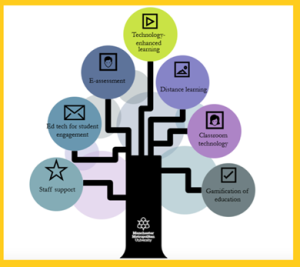
Following the initial brainstorm, where colleagues worked first individually, then in small groups, then in larger groups to discuss the aims and objectives, a small group of colleagues collated these data, grouping similar ideas to create the themes, which can be seen in Figure1 below.
Figure 1.
Aims and areas of interest of the Ed Tech CoP, as co-constructed at the initial meeting of the network
As well as agreeing the aims and areas of interest, colleagues at the initial meeting decided that there were too many priorities identified to be able to focus on them all at once, and the priorities that were agreed by the CoP were refined to a list of six agreed priorities for the 12 to 18 months. These were to:
- disseminate and share good practice and provide a platform for others to do the same and provide moral support and advice;
- use technology effectively to improve teaching and teaching-related activities;
- advocate for access to common technologies;
- suggest an institution wide package of technology tools/platforms (e.g. Padlet, Slack, Poll Everywhere, etc.) and persuade someone to pay for them;
- negotiate a shared approach, outlook, philosophy of education/ technology enhanced learning, internal to the CoP.
Reflecting on those agreed priorities now, they seem rather generic and perhaps in many ways not particularly ambitious or specific, but this was pre-pandemic, and the priorities of the EdTech CoP evolved and developed over the years until the CoP became subsumed under ‘business as usual’ as part of the institution’s DELTA (Digitally Enhanced Learning Teaching and Assessment) strategy, an enabling strategy of the University’s Education Strategy. And we did get a package of ‘apps for teaching and learning’ that are institutionally founded and still supported!
There were difficulties in maintaining the momentum of the network over the seven years that the CoP existed. The CoP was informal, membership was fluid, and colleagues dipped in and out of meetings and seminars as they pleased. However, there was always a core of about six members who acted as an informal management committee. During and post-pandemic, Microsoft Teams channels and chats were used to communicate, and seminars, meetings and workshops were advertised through the university’s regular communication updates, and through the CoP’s internet page on the University Teaching Academy website. We held meetings on a monthly basis, alternately face-to-face and online, and although there were advantages to this, it ended up that there were two cohorts of people, one which largely attended online meetings and one which largely attended face-to-face. The informal management committee attended all meetings and sustained the momentum and the communication. Having a theme for each meeting helped with engagement and attendance; for example, a guest speaker from Nearpod; a session about Adobe Creative Campus, and a session where colleagues shared their experiences of using the institutionally supported ‘Apps for Teaching and Learning’ project which the CoP had advocated for and for which it had run the proof of concept. However, inevitably, having a theme for each meeting meant that some colleagues who were less interested in the theme for a particular meeting did not attend.
There were two events annually which were always well attended. The first was the face-to-face Christmas event, where the SoTL work was integrated with a quiz on educational technology which was designed by members of the CoP. Festive food and drinks were provided and there was a friendly competition and amusing ‘tongue in cheek’ awards for members. The second was the annual EdTech CoP conference, which was held online. Members of the CoP and other colleagues across the institution were invited to submit papers, Pecha Kuchas, discussion groups, and so on. Because the first conference was held in lockdown, there were also online activity packs for colleagues to engage with in the break, and a virtual biscuit baking competition. Again, the success of this conference, which was very well attended, with over 100 colleagues from across the institution in the two years it ran, meant that it has now been integrated with the institution’s university-wide annual learning and teaching conference.
As with the Tierney example, relationships were key to establishing this successful network and to developing it to a stage where the work it had done was considered to be important enough to be part of the University’s strategic plan.
Conclusion
In this chapter, I have provided a comprehensive exploration of the strategies and approaches necessary for building, sustaining, and expanding a Scholarship of Teaching and Learning (SoTL) network. I began by examining the distinctions between formal and informal networks, including the role of Communities of Practice as collaborative frameworks that foster shared learning and ongoing professional development. Through this lens, we have considered the importance of establishing clear goals, defining membership roles, and setting purposeful objectives to create a strong foundation for network activities. Particular emphasis has been placed on the significance of effective leadership structures and inclusive membership models, ensuring that networks remain dynamic, participatory, and responsive to the evolving needs of their members as well as to shifting contextual demands.
In addition to organisational considerations, we discussed the development of shared repositories and resource libraries as practical tools for supporting teaching and learning innovations. These resources, including databases of materials, case studies, and best practices, not only provide members with accessible tools for their work but also strengthen the long-term sustainability of the network by enabling knowledge-sharing and collaboration across disciplines and institutions. Communication strategies emerged as another critical factor in maintaining momentum, reinforcing a sense of connection, and ensuring that members remain engaged in both virtual and in-person environments. Thoughtful approaches to communication—such as regular meetings, newsletters, and digital platforms, were identified as essential elements for keeping networks active and focused.
It is undeniable that building and sustaining a SoTL network requires considerable effort, from initial planning and recruitment to ongoing coordination and evaluation. However, as explored throughout this chapter, the rewards of investing in such networks are equally (if not more) significant. They not only foster innovation in teaching and learning practices but also create spaces for meaningful professional development, reflective practice, and cross-disciplinary collaboration. The broader impact of these networks extends beyond individual participants, influencing institutional cultures and advancing pedagogical knowledge at both local and global levels.
The strategies outlined in this chapter offer you a flexible and adaptable framework for to create and sustain your own SoTL networks. Whether operating within large, resource-rich institutions or smaller, resource-constrained settings, the approaches discussed here can be tailored to meet your own specific needs and contexts. I’d encourage you to reflect on your own institutional landscapes and leverage the tools and strategies provided, to develop networks that address your priorities while remaining responsive to future challenges and opportunities.
Ultimately, the process of establishing a SoTL network is not only about building infrastructure but also about cultivating a shared vision and a collaborative spirit that drives continuous improvement. By emphasising collective inquiry, shared practices, and mutual support, SoTL networks have the potential to transform teaching and learning environments, inspire innovation, and contribute to the ongoing evolution of higher education. While the work involved in sustaining such networks may be demanding, its transformative impact on professional growth, student learning, and institutional development can make it a really worthwhile and fulfilling endeavour.
References
Gale, R. (2007). Points without limits: Individual inquiry, collaborative investigation, and collective scholarship. In D.R. Robertson & L. B. Nelson (Eds.), To improve the academy: Resources for faculty, instructional, and organizational development (26, pp. 39–52). San Francisco: Jossey-Bass.
Menendez Alvarez-Hevia, D., Lord, J., & Naylor, S. (2020). Why don’t they attend? Factors that influence the attendance of HE students of education. Journal of Further and Higher Education, 45(8), 1061–1075. https://doi.org/10.1080/0309877X.2020.1851664.
Minocha, S., & Collins, T., (2023). Impact of Scholarship of Teaching and Learning: A guide for educators. Milton Keynes, UK: The Open University.
Smith, E. R., Calderwood, P. E., Storms, S. B., Lopez, P. G. & Colwell, R. P. (2016). Institutionalizing faculty mentoring within a Community of Practice model. To Improve the Academy; a Journal of Educational Development, 35(1), 35–71. http://dx.doi.org/10.3998/tia.17063888.0035.103
Tierney, A.M. (2026) Case Study: Building a Community.
Tierney, A.M., Aidulis, D., Park, J., & Clark, K. (2020). Supporting SoTL development through Communities of Practice. Teaching & Learning Inquiry, 8(2), 32-52. https://doi.org/10.20343/teachlearninqu.8.2.4
Wenger-Trayner, E. & Wenger-Trayner, B. (2015). Introduction to Communities of Practice. http://wenger-trayner.com/ introduction-to-communities-of-practice/
Wenger-Trayner, E. Wenger-Trayner,B., Reid, P., & Bruderlein, C., (2023). Communities of Practice Within and Across Organizations: A Guidebook. https://www.wenger-trayner.com/wp-content/uploads/2024/03/24-02-21-CoP-guidebook-second-edition-final-2.pdf