SoTL Leadership as Community Work: Establishing, Growing, and Sustaining Communities of Scholars
Jill M. McSweeney
Abstract
The Scholarship of Teaching and Learning (SoTL) depends on intentional relationship-building within and beyond disciplinary and institutional boundaries. Drawing on personal narrative, SoTL literature, and the model of Community of Scholars (CoS), this chapter explores how SoTL leadership is inherently community-centered work and how its principles – , grow, and sustain – can be used to build an inclusive scholarly community. Through practical strategies and reflective insights, I highlight how SoTL leaders can cultivate spaces that support scholarly identity development, collaboration, and mentorship across career stages while also demonstrating and growing their own SoTL leadership. This chapter ultimately positions community-building not as ancillary labor in SoTL, but as a core principle of SoTL leadership that reinforces SoTL as community work and strengthens the field’s capacity to respond to evolving institutional and global contexts.
Creating community and connection has been consistent throughout my career. Like Tierney’s reflection in the opening of this section, I started in a discipline beyond educational development and SoTL. A community, or microculture (Roxå & Mårtensson, 2011), paved the path for me to find SoTL, and throughout the early stages of my career, was critical in building confidence, a cross-disciplinary understanding of my work, and developing networks for collaborations that supported my growth. My journey is not unique, for many, SoTL is a task isolated from their disciplinary community, and for some, engaging in SoTL can be, or has been, an isolated and unsupported venture (Miller-Young et al., 2018; Suart, Cassidy-Neumiller & Harvey, 2023; Vajoczki et al., 2011). While Boyer’s (1990) model of scholarship has been infusing structures in higher education, until recently, most institutions have not intentionally invested in SoTL development, practice, and dissemination for faculty and staff, and many still don’t (Kern et al., 2015; Neubauer et al., 2022); and if they have, it certainly has not been at the same scale as other research activities. As the commodification of education has grown over the last two decades (Bailey et al., 2021; Naidoo, 2003), and with current political tensions around the value of higher education, it is more important than ever for institutions to demonstrate measurable impacts on student learning. As Baily et al. (2021) note, one trickle-down benefit of this consumer-based education is the increase in teaching-focused jobs which are required to demonstrate scholarly teaching and engage in SoTL production. And so, while SoTL may benefit institutions, and institutions are asking more academics to engage in such practices, many of us still face a barren institutional landscape when it comes to SoTL support (e.g., funding structures, peer mentorship, professional development), thus opportunities to find community beyond one’s discipline or institution are much needed.
As more colleagues explore SoTL, there is an increasing need to support them in their development and engagement in this work (Suart, Cassidy-Neumiller & Harvey, 2023), particularly for academics transitioning, changing, and/or evolving disciplinary identities (Simmons et al., 2013; Webb & Tierney, 2019). However, many lack access to this support institutionally, making the external community even more essential for the growth and advancement of SoTL as a normalized practice in our teaching. In recent years, there has been a call for more partnerships and collaboration, particularly across disciplinary and institutional contexts to be a central principle of SoTL (Hamilton & McCollum, 2024; McSweeney & Schnurr, 2023). Networks allow us to come together at both national and international levels to advance our collective knowledge and expertise in SoTL,, as well as finding ways to expand the field. Such spaces structured around a set of goals aimed at supporting and building relationships can create a trusted environment where participants feel able to share concerns, anxieties, difficulties, and challenges (Chang, 2017).
The field of SoTL may also see the development of large global networks as a way to both model and reinforce that fundamental value of ‘appropriately public’ (Felten, 2013). While institutional or smaller networks of communities of practices (CoPs) have been shown to have significant impact on nurturing learning through authentic reciprocal relationships (Hannah & Lester, 2009; Rienties & Hosein, 2015; Roxå & Mårtensson, 2009; Roxå & Mårtensson, 2011), they are also limited in their knowledge sharing (Hannah & Lester, 2009; Roxå et al., 2011; Roxå & Mårtensson, 2011). In this sense, while CoPs offer a significant tool to generate community and build connection, I would argue that an inherent and fundamental goal of the field of SoTL should be the generation of broader interconnected networks. Intentionally expanding and nurturing a broad SoTL community reinforces Boyer’s original intention of SoTL’s role in the academy (Kern et al., 2015) and echoes the idea that teaching is ‘community property’ (Shulman, 1993).
Existing models for building SoTL community
A range of names exist for the various forms of communities dedicated to building a professional’s capacity. These range from more localized and institutionally bounded Professional Learning Communities (PLCs) (DuFour, 2007), CoPs, (Lave and Wenger, 1991), or Faculty Learning Communities (FLCs) (Cox, 2004), to larger networks (both in people and geographical expanse), such as Professional Learning Networks (PLNs) (Brown & Poortman, 2018) or Communities of Scholars (CoS, Ramani et al., 2021). While there is growing success for the use of CoPs and FLCs in SoTL (Bailey et al., 2022; Dich et al., 2017; MacKenzie et al., 2010; Richlin & Cox, 2004), they often do not provide sustained and intentional access to scholars beyond institutional boundaries like larger networks. Such broader networks (e.g., International Society of the Scholarship of Teaching and Learning, EuroSoTL, Society of Teaching and Learning in Higher Education, or Higher Education Research and Development Society of Australasia) focus on intentional relationship building and knowledge sharing through shared interests and mentorship focused on building capacity in one’s work. These communities centralize their efforts around a shared interest or identities.
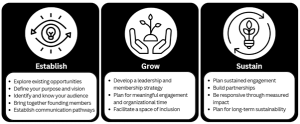
While models have been successfully applied to micro-community networks (e.g., FLCs, CoPs), Ramani et al.’s (2021) Community of Scholars (CoS) has recently been used to explore SoTL community at institutions (see Ford et al., 2024). The CoS model offers a promising framework for building professional networks aimed at fostering the co-creation and sharing of teaching and learning scholarship, developing capacity for engagement in SoTL, and facilitating both formal or informal mentoring. A key strength of this model lies in its flexibility, allowing us to shape and refine these goals according to our needs. Given the diverse nature of SoTL across disciplines, institutional contexts, and methodological approaches, this flexibility ensures that CoS-based communities remain inclusive and responsive to varying scholarly landscapes and to the changing climate of higher education (Yarris et al., 2019). While Ford et al. (2024) have successfully demonstrated this application on a small scale, here I propose that it can offer us guiding steps towards large-scale community creation. Through establishing, growing, and sustaining community (Figure 1), the CoS offers a framework that allows for its purpose to be shaped and adapted as community needs evolve (Ford et al., 2024; Ramani et al., 2021), offering longevity and expansion that traditional micro-community networks often are unable to maintain.
ESTABLISH – GROW – SUSTAIN
Building your own community of scholars
At local, national and global levels, CoS can bring together scholars at different career stages, from novice to SoTL experts, thereby accelerating community development while providing a rich space for exploring diverse perspectives. Unlike FLCs, which often conclude once their predefined goals are met (Cox, 2004), CoS structures are inherently sustainable – offering an evolving ecosystem of networks and engagement that can grow and adapt over time.
SoTL professionals looking to build a CoS can apply Ramani et al.’s (2021) model (Figure 1) through three iterative steps (1) establish – building a community with an intentional focus, vision, audience and goals; (2) grow – set out to cultivate a space that offers growth internally through the curation and cultivation of resources, tools, supports, and short and long-term initiatives, and a space where intellectual, personal, and professional identities and values are shared and supported; and (3) sustain – focus on developing metrics of success that can guide growth and are appreciative of changes in membership, leadership, and larger socio-cultural and economic contexts.
Figure 1.
Adaption of Ramani et al’s (2021) Community of Scholars (CoS) model
Establish
There is a particular need to develop and expand the sense of community for SoTL scholars, given that many of us feel alone, displaced, or foreign in the field (Miller-Young et al., 2018; Williams et al., 2013). Both national and international SoTL organizations can be a critical source of providing us with a sense of community, particularly for those who wish to expand and grow in SoTL but lack the resources, professional development, collaboration or training to do so. While institutional or local CoPs may naturally develop over time, efforts to bring our colleagues together across contexts, particularly geographical, will need deliberate and intentional purpose and goals (Ramani et al., 2021). CoS may come from a shared experience, a known gap or need, or the desire to form intentional relationships. As the idea of establishing begins to percolate, consider how the purpose of your network can appeal to a array of members across a spectrum of institutional, disciplinary, global, cultural, and career contexts, as the success of your network is largely measured by its value to your audience (Bailey et al., 2022). Within SoTL, looking at Special Interest Groups from established organizations such as ISSOTL, EuroSoTL or the POD Network could help you to explore specific topic areas, sub-communities, or geographic clusters that may help you define your audience (a great place to start are the rich communities of Collaborative Writing Groups through ISSoTL and EuroSoTL). Alternatively, you might develop your community based on one of the many processes in the SoTL lifecycle, such as methodology or specific dissemination areas. Once you have determined a need or purpose for your community, you can begin the following steps for its establishment.
Explore existing opportunities
As noted above, local and international organizations exist that might already meet your needs or at least offer you insight into additional areas and gaps. For example, early in my career the development of a local SoTL community in Atlantic Canada came out of engagement with the larger SoTL Canada organization. Colleagues found that while SoTL Canada offered some opportunities for collaboration and community building, there were enough Atlantic Canadians in that community to begin to develop a more localized community to support in-person and cross institutional collaboration. Thus,while there were existing opportunities to engage in a broader SoTL community, creating and facilitating a localized community provided more specific and accessible opportunities locally for us. In this example, the community spontaneously formed around a shared need (Bailey et al., 2022), while for others your community might be deliberately developed out of your own needs, that of others, or forecasting potential needs.
Define your purpose and vision
If there is one thing that folks entrenched in the community of teaching and learning know, it’s the importance of outcomes when planning. If you were to do a quick scan of existing organizations that support SoTL (e.g., ISSoTL, EuroSoTL, POD Network) you would easily see a thoughtful and concise overview of the goals for their community which influence and guide how those communities have grown and are sustained. Unlike CoPs or mico-communities where goals are co-developed through a shared vision (Happel & Song, 2020), larger organizations with their intention to grow and expand will often co-develop their vision and goals with founding members, and work over time to ensure those reflect and align with their membership, which can promote a sense of collective responsibility during the engage stage of development (Alrubian, 2022; Happel & Song, 2020). While goals and intentions can adapt and evolve over time, the first step should be to spend time thinking about what impact and intentions the network should be striving for in order to build a vision for your plans. An important goal of your purpose and vision is to establish a shared investment across your community (Ford et al., 2024). To help with this, consider the following:
- Is this community responding to urgent needs? A predicted need?
- What are your short and long-term goals?
- What are common values and interests that will be shared across the community?
- Who is your audience?
- How might you be able to achieve your goals?
- Why is this network important to your audience?
Consider what the goals of the network might be and dream big at the start! It could be developing and sharing practices; creating a mentoring network; nurturing collaborations across institutions, disciplinary, or international boundaries; or/and offering professional development opportunities and events. The goal is to consider how your community is filling a need or is directed to a specific focus or theme within the area of SoTL or teaching and learning. Your initial exploration of existing opportunities will likely have given you an idea of potential gaps, so consider how you might lean into establishing goals through necessity. Offering your organization a roadmap for success, which identifies short- and long-term goals, progress markers, and timelines can help you establish achievable and realistic goals (from your big dreams!) within a specific timeframe that will ultimately lead to greater success and clarity across leaders and members.
Identify and know your audience
The audience of SoTL at its heart is diverse, welcoming travelers and guests from all disciplines, across various entry points, and with different needs to the table. Given this diverse communtiy, who your audience is will ultimately need thoughtful consideration, as with this diversity comes colleagues with varying personal and professional goals, competencies and comfort with SoTL, and disciplinary perspectives (Ford et al, 2024). Some might say SoTL as a field has a longstanding identity crisis, not quite knowing who we are given the multiple paths we have traveled down, while others would say that inherent in SoTL’s identity is the diversity of our community. While you will likely not be able to solve this wicked problem, it is important to consider who might best serve your community, as this will naturally impact your objectives and the relevance of your work for others.
My work with building community has shifted over the course of my career, as my role required me to not just build community for myself, but also for others. If I were to build a community ten years ago, I might have focused on an audience of colleagues just entering SoTL in order to find partners that supported my own growth and offer opportunities for collaboration and/or mentorship. As I transition to mid-career, having grown my SoTL identity and now supporting others through my SoTL mentorship, I approach building community with other intentions, such as creating a space for returning SoTL scholars looking to reinvigorate their scholarship or even a community of faculty developers who support SoTL development. Consider what you need for your own professional growth and as you transition from SoTL scholar to leader, how a community can support others, as this will help you to navigate the complexity of who we are as SoTL scholars. For example, my time with SoTL Canada allowed me to identify at least four distinct groups that we were serving at any one time: students engaging in SoTL as a partner, scholars new to SoTL, scholars who identified themselves as SoTL scholars, and those supporting SoTL at their institution. While some may hold multiple identities, these four specific groups would often be engaging with our organization with very different intentions, making it difficult to create supports that fit all these needs. So as you consider who your audience is, think about your own needs, where you are in your career, and how your own SoTL leadership might grow with this endeavour.
Bring together founding members
Every community requires a small group of individuals who are willing to put forth the work for its development. Consider individuals who you currently know who are working in this area (this could be inside your institution or discipline, or beyond!), bring characteristics and strengths that complement each other, and are committed to contributing to the establishment and growth of your community (du Plessis et al, 2025). Below are a few tips to help you identify who you might invite with you as you start:
- Who are existing leaders that might be able to support or mentor you through the development? Often these individuals will come with a network themselves and professional credibility that will lend itself to growing your membership. They can offer insight and mentorship to members as well as mentorship to the core leaders of your community.
- What skills and experience do you have and where might be gaps that you will need to fill? Successful communities have a diverse team of individuals that bring unique strengths to help you grow. One person can’t do it all, so consider what you’ll need to grow and sustain and how you might seek colleagues (new and old) to help with that.
- What distinct roles will you need for your team? As your community grows, consider how unique roles can help spread the workload and highlight strengths of the core team. Roles may be based on administrative tasks (e.g., treasurer, communications), event and engagement leads (e.g., professional development organizer, conference planner), or even based on sub-groups of your constituency (e.g., Educational Developers, Students).
- Is my audience represented? Every community has a diverse membership and having individuals that can give insight into who your audience is and their needs is helpful in guiding your objectives and work. Representation also supports a psychologically safe community and its longevity, as it recognizes that members should feel valued and supported within their community.
- Are there individuals who can bring resources to support the network? Consider if it’s possible to leverage institutional support from members. Resources such as listservs, website hosting, or institutional funds can be a strategic advantage when starting out and help you with quickly expanding your membership through sustained communication.
Establish communication pathways
Depending on the formalized nature of your community, organization or group, consider what your audience will need in order to facilitate their engagement. A colleague and I wanted to build an informal hub of communication with local institutions around SoTL as a means of networking, sharing information, and planning small group meetings associated with local conferences. Our goals for this were small – generating an easy means of folks across universities with a similar interest to talk with each other. To do this, we created the “SoTL Atlantic Listserv” through one of our institutions. We advertised at local meetings, through national listservs associated with other communities, and slowly generated a growing list of local colleagues who would use that space to share local events, new literature, collaborative interests, etc. Given our goal, our communication plans were simple: we wanted to ensure constant advertising of our space for recruitment purposes, and allow for member-initiated discussion. However, with an organization like SoTL Canada, our communication structure was much more formal and intentional, we wanted to recruit, advertise, produce, support, and build. This communication required much more than a listserv, as our goals were diverse and our audience needed to know much more about what we were doing, our annual goals, and how we would support them as members. This resulted in organizationally branded social media accounts, a website regularly updated, thoughtful and intentional advertising for our organizational events, a designated platform for hosting resources and events, and organization-branded materials.
Building out a communication plan requires you to define your purpose and vision, know your audience, and lean on the skills and experience of your core leadership team. Starting out, think about how your communication will establish your organization or network, and then consider if those same tools (Table 1) can help you with growing and sustaining your community, or if you’ll need to have a plan for additional communication measures.
Table 1.
Tools for communicating with your community
| Goal | Communication tools |
| Recruitment and advertising | Existing listservs, professional gatherings, social media, directed emails to institutions or centers, information in your email signature, digital flyers for presentations and social media sharing |
| Hosting webinars, events, and other asynchronous or synchronous gatherings | Slack, Microsoft Teams, Google Groups, Zoom Events, Learning Management Systems, hosted website |
| Membership-led communication | Organizational discussion platform (e.g., Google Groups, institutional listservs), social media hashtags, organizational blog/newsletter |
| Communication from leadership team | Membership mailing list, social media, hosted website, organization discussion platform |
| Static information about the organization | Hosted Website, LibGuide, EduBlogs |
Below are a few goals you should consider when establishing your community and potential tools you can utilize for success.
- Recruitment and advertising: Think about ways that both your leadership team as well as network members can bring in new colleagues and share information about your organization. Lean on existing platforms and professional groups, such as the Staff and Educational Development Association (SEDA) or the Professional and Organizations Network (POD), which can help share an expression of interest, advertise events and resources developed, or find collaboration opportunities. Utilizing social media from members, the leadership team, as well as officially branded accounts can help spread the word. (Note: With changing engagement with social media platforms, a tip is to research prior to investing in a social media plan to know what type of platform your audience is engaging with (e.g., LinkedIn, BlueSky, etc.) As platforms evolve and spring up, it can be helpful to keep track of where your engagement will be most effective).
- Hosting webinars, events, and other asynchronous or synchronous gatherings: Virtual events can create greater accessibility across time and space, offering more support and community to diverse groups who may otherwise be unable to participate. Considerations for time zones, availability, depth of engagement, and member-member interaction are all factors for consideration between asynchronous and synchronous communication and engagement.
- Membership-led communications: Organizations nurture growth and relevance when members have a means to engage with each other, this allows for the larger network and personal networks to grow. Centralizing a member-focused communication space can build community, grow resources, increase engagement, and draw in new members. New organizations can utilize free resources such as Google Groups or inquire about institutional supported listservs as a way to create a hub to grow their communications. However, if this becomes part of your communication plan, plan out intentional engagement early so that it becomes a place where community members see value and a relevant use of their time.
- Communication from the leadership team: As the leader of your organization, you’re not just managing the administrative tasks and logistics, you’re also shaping SoTL culture within your community. How might you develop a mission and identity for your community that are grounded in SoTL-aligned values like reflection, inclusivity, accessibility, and evidence-base? As the guiding voice of your network, you have the responsibility of setting a vision for your colleagues and translating that into practice. Bring in what you know about your own SoTL work or scholarship from our community to guide how you engage with members. This might include inquiry-oriented newsletters framed around questions like Hutchings’ (2000) Taxonomy of Questions; an evidence-oriented website or hub of resources that models practices that are grounded in scholarship and reflection while being appreciative of context and diverse ways of knowing; or regular updates from you that share what you and the leadership team are learning as your community grows, or how your work is evolving in current and/or uncertain times within higher education. As a SoTL leader supporting others, focus on communication that invites dialogue and partnerships from members rather than broadcasting authority, model curiosity and experimentation as your community grows, and use language that normalizes iterative growth and productive failure.
Grow
Who your audience is will naturally shape how you engage with prospective and existing members, where you direct resources, and who you partner with.
Develop a leadership and membership strategy
Once established, your community will want to spend time intentionally cultivating leadership and membership. A successful community must consider distributed and collaborative leadership, focused management to ensure goals are met, and active fellowship and followership (McKimm & McLead, 2020, pp 968 as cited in Ramani et al., 2021). To help you quickly grow, you should consider how you can reach your audience through academic conferences, institutional networks, and professional organizations, and how you can regularly promote your community through other spaces your audience engages with. Consider ways members of your community can build relationships through scholarly collaborations, mentorship, and purposeful engagement from your leadership team (Ford et al., 2024), in doing so you will reinforce the value of your community to colleagues who are already limited in time. Deciding if membership must be active or fluid will determine community engagement. As Wenger (2010) suggests, fluid membership is a strategy that allows an individual to join through peripheral participation and move towards the center of engagement. This can help members develop a community identity and shared purpose as part of their initial engagement, without feeling overwhelming. Over time, consider if members might take on diverse roles that lead into named community positions (Ramani et al., 2021), this can support their SoTL leadership and offer purposeful mentorship to again, move from the periphery to the center.
Plan for meaningful engagement and direct your organizational time
Prioritize building a space where your audience can meaningfully engage with each other to build personal connections. As Ramani et al. (2021) note “since such communities are often voluntary, time and effort must be invested in planting the seeds, nourishing the soil, and cultivating relationships so that they bear fruit” (pp. 967). A variety of activities can generate active and passive engagement of community members:
- Webinars and Workshops: Organize virtual or in-person events focusing on SoTL topics.
- Collaborative Research Projects/Collaborative Writing Groups: Facilitate opportunities for members to collaborate on SoTL studies.
- Discussion Forums: Provide spaces for ongoing dialogue about challenges and innovations in teaching and learning.
- Curate a Resource Library: Share publications, tools, and case studies relevant to SoTL.
- Offer Professional Development: Provide training sessions or certification programs in SoTL practices.
- Create Publication Opportunities: Encourage members to co-author articles or contribute to a network-hosted journal.
- Grants and Awards: Offer incentives for engagement and recognition of colleagues who are modelling the values of your community.
Increased engagement that is relevant and purposeful can lead to greater membership satisfaction (Ford et al., 2024) but can also require sustained frequency and considerable resources (e.g., time, funding, humans). Offering opportunities for sustained engagement, or sporadic engagement based on an individual’s need can be helpful to initially draw folks in and increase your community but will not necessarily guarantee active engagement thereafter. Sustained engagement of the community requires thoughtful consideration of both small-scale and larger-scale activities that will create growth while also sustaining momentum.
As your community grows, it will be important to balance the resource investment with impact, remembering that you want to create sustainable expectations, and that this is likely work that is over and above your full-time job. Here, the foundations of the Community of Inquiry (CoI) model can be helpful to direct your time and support community development (Hubball & Clarke, 2010; Hubball, Clarke, & Poole, 2010), by focusing on 1) cognitive presence – how members construct meaning through sustained engagement, reflection, and discourse; 2) social presence – how members socially and emotionally engage with the community in order to develop a sense of belonging and a supportive environment, and 3) facilitator presence – how does the leadership structure intentional and meaningful experiences for members that ensure that the community is meeting its goals, values, and vision.
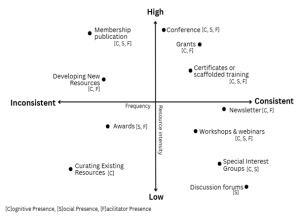
In reflecting on my own experience being a member and leader in SoTL communities for this chapter, I went back and considered the diverse ways I participated and encouraged participation in communities over the last decade. Using the CoI model as a lens for generating presence, I mapped out community activities based on frequency of leadership engagement (how consistency of output for leadership, verses low or inconsistency of frequency) and how resource demanding (high verse low) and activity might be (Figure 2). As you consider how you want to engage membership, consider its impact on presence, the number of resources needed for it to be successful, and if this is a one-time or annual endeavour.
Figure 2.
Community activities by frequency of occurrence and resource intensity (i.e., capacity needed for success)
Creating a space that embraces diversity and promotes psychological safety
As you grow, consider the environment that your community creates and conveys to new and existing members from diverse backgrounds. As noted with CoP’s, their effectiveness relies on members engaging and reinforcing a “cohesive and harmonious community” (Wilson-Mah et al. (2022) cited in du Plessis et al, 2025, pp. 8), so consider your community’s culture and how your values are espoused and reinforced through engagement, artefacts, and collaborations. If individuals feel unsafe or an inability to develop authentic and trustworthy relationships (Bunnell et al., 2022; Rahman et al., 2025), they are likely to discontinue their engagement. Ramani et al. (2021) note challenges such as language proficiencies and expectations, cultural differences, visible or invisible hierarchies, time zones, and resource access as important considerations. I would add disciplinary assumptions and jargon, inherent biases towards differing epistemologies and methodologies, accessibility, neurodiversity, gender, and academic rank as additional considerations particularly important when developing an inclusive and safe SoTL community. This also applies to core leadership and ensuring a unified team that appreciates all voices, while working both as a collective and being appreciative of the individual. Thus, critical to the function of a community is a commitment to continually reflect on, redefine, and reinforce shared values to ensure that leadership and membership engagement nurtures trust, support, growth in a positive environment (Ramani et al., 2021; Wilson-Mah et al., 2022). du Plessis et al. (2025) found that one way to work towards this is ensuring that your short-term and long-term goals are achievable and acknowledged by leadership and members. In doing so, natural collaborations form, relationships are built, and individuals find personal relevance. Similarly, support for individual growth at leadership and membership levels is equally important (du Plessis et al., 2025; Tierney et al., 2020), as it can emphasize value for the individual and appreciation for their own projects, SoTL development, and leadership growth.
Sustain
We’ve discussed the work and intentions that go into establishing and growing your community, the hardest part may be sustaining it. The initial growth of a community is often able to lean into the excitement and novelty of its beginning. Leadership and members are reinforced through the joy of meeting new people, experiencing new engagement, and watching hard work develop into a materialized community. But once the enchantment of the newness wears off, the realities of workload, time, and outside commitments materialize, sustaining the community can be difficult to prioritize, and I believe is the hardest work you as the leader will do. So how can you plan for sustained engagement?
Build meaningful relationships within your community and collaborative external partnerships
Relational opportunities are critical in fostering sustained engagement as your community grows. Sustained engagement comes from creating a “motivated, active, and fulfilled” community (Ramani et al., 2021, pp. 969), where members build relationships, grow together, celebrate diverse perspectives and experiences, and recognize accomplishments. The initial growth and sustained growth of an organization is dependent on nurturing and leaning on important partnerships that draw members in, adding relevance through events and offerings that support membership interests, and collaborations that can provide support through sponsorships and funding. These partnerships can quickly and easily turn into friendships that pop-up when it matters the most (McSweeney & Rahman, 2026). I’m reminded of the POD Special Interest group that I joined over four years ago. We met regularly to discuss literature on the scholarship of educational development and share the SoTL culture and programming at our institutions. Our meetings were not frequent, but we tried our best to meet the goals of POD and connect at least once a semester. A year in my life drastically changed as my husband fell ill. I’m not sure how they knew, but suddenly I was receiving gift cards for meals, photos of their own family and pets to cheer me up, and other personal notes. That community was no longer just a professional space, it was a personal one that provided care. Our group is no longer associated with POD, but we still meet regularly for collaborative projects and to catch up. While my example is of a smaller community, these relationships still exist and are incredibly powerful in professional communities where shared interest extends to the human. In some ways, I think this is what many of us need, and is another way that SoTL’s person-centered values can be embedded and modelled in our leadership and communities.
While you’ll want to focus on building relationships with core members, there are a range of external partnerships available to support your organizations in order to sustain your presence:
- Universities and teaching and learning centers: These organizations can help to extend your research through organizational marketing, partnering for events, or welcoming you into SoTL workshops.
- Professional Organizations: Existing organizations, as mentioned in the communication strategies can also help with providing extended reach to audiences consistently over time. Utilizing listservs, social media, and other forms of advertising through their communications or partnering for a workshop can help build your credibility through your association with a trusted community/organization, as well as provide you with resources for consistent activities (Figure 2).
- Special issues: Partnering with existing journals for special issues related to SoTL or your specific SoTL context (e.g., regional, part-time academics, etc.) can help with spreading the work of who your organization serves while also creating an opportunity for collaboration with your community’s members. Products can then also be used as marketing tools to demonstrate your goals.
- SoTL Experts: Inviting experts in the field or known scholars can help build trust with your membership or pull in new members after you’ve been established is a great way to revitalize recruitment activities. You can also utilize these relationships to mentor you (and your team) in a variety of ways, as often these experts have experience building, engaging, and supporting communities, or can be a way to plan for your own transitional growth, as you become a mentor to new leadership as you rotate out.
Be responsive through measured impact
Given the range of communication and engagement strategies a community can use, it’s important to think about how you can track their impact, check-in with both leadership and membership, and establish ongoing consensus building around goals and vision. From the onset, building metrics that offer you a way to direct your efforts, demonstrate impact for funding requests, convey engagement for advertising, and allow you to understand who is engaging with your work and why. Just like in our SoTL, consider a wide variety of evidence you can use and model the diversity of data available to us in our own teaching. This also offers the leadership team an opportunity to engage in their own scholarship of educational development (Cruz et al., 2022; Kenny et al., 2017; Little, 2014), growing their own experience and skills in SoTL leadership. We can use the literature on center evaluation for insight into potential metrics of success for our own communities (Hines, 2017; Miller-Young & Poth, 2021; Smith & Gadbury-Amyot, 2014; Wright, 2023), once again modelling values of SoTL (Table 2).
Table 2.
Diverse examples of measuring the impact of our SoTL communities
| Quantitative metric examples | Qualitative metric examples |
|
|
Plan for long-term sustainability
Lastly, consider sustainability of the community. I believe that this should be divided into two important aspects: sustainability of the community and sustainability of yourself.
Sustainability of community: As your community grows over time, members of the leadership team will likely need to rotate as careers transition, membership expands, and new individuals want to be involved (this can help to ensure leadership reflects the evolution of and growth to the field of SoTL.) Three critical aspects of community sustainability should be considered:
- Leadership succession planning: How will individuals rotate in and out of leadership without stalling momentum? How will you plan for leadership mentorship? What information around the history of the community, the administration, and day-to-day will a new leader need?
- Equitable rotation: To ensure that your community maintains a space of inclusion, ensure fairness when rotating leadership roles. Bringing in new members or creating new roles that capitalize on strengths within the membership not only shares workload but also sustains community growth and models mentorship (Ford et al., 2024).
- Develop a vision and mission to guide the growth of the network: Without these, your community risks growing in ways that do not reflect the intention of the membership and field of SoTL. This helps to determine when you say ‘yes’ to initiatives, or potentially ‘no’, and helps the leadership plan for short-term and long-term successful. (Note: As leadership rotates, consider how often the vision and mission should be revised.)
- Secure needed resources: Events, networking, funding for grants, promotional materials, and so much more comes along with growth. Securing renewable resources will help strengthen the security of your vision and long-term goals, and your external partnerships can be a place to start. As you grow, you may wish to consider a membership model to guarantee annual funding to support initiatives.
Sustainability of yourself: Much of the work discussed in this chapter is on the shoulders of volunteer labour from our community. To sustain this work, you must consider the scope of what you and the leadership team can reasonably do. Remember that you do not need to be everything to everyone, and in fact, finding a niche area to build your community can help provide much needed structure to avoid burnout. Building a team allows you to lean on others and embraces calls from our community to integrate self-care into your daily practice (Kolomitro et al., 2020; McGowan & Felten, 2021; McSweeney & Rahman, 2026).
Conclusion
Like communities of practice, a community of scholars at a larger-scale has the opportunity to create an environment in which academics across disciplines, institutions, and geographical contexts can come together to share and co-develop knowledge around pedagogical practices within a supportive and inclusive environment (du Plessis et al., 2025). Large communities and networks can offer a dynamic experience where collaborative learning, relationship building, and personal and professional growth can occur, providing meaningful engagement for new, returning, and well-established SoTL scholars to build both their SoTL practice and leadership skills.
Over time, I have worked to build community at a local institutional level, a geographic level, and an international level. In Canada I felt deeply rooted and connected to a national network, but as I settle into a new role, I’m having to find a new community. I now navigate not only integrating into existing communities but look to see what communities might be developed to support my personal and professional contexts. Having recently changed institutions and countries, I am now at a moment of reflection on what communities I still have to support me, and what communities I want to (re)build.
I would like to return to the opening case study and Tierney’s comment that we “spend an inordinate amount of time on operational things, when we should be spending time on creative things.” While this is true for many of us, I argue that creating community is a critical operational task that is essential to our SoTL work, and in fact should be considered an extension of Felten’s seminal principles in that relationships, collaboration, and connection are integral to the quality of our SoTL.
References
Alrubian, A.M. (2022). Adopting buddypress platform as an online community of practice for professional development. Education Research International, 2022(1), 4395048. https://doi.org/10.1155/2022/4395048
Bailey, E., Le Vin, A., Miller, L., Price, K., Sneddon, S., Stapleton, G., & Wolfe, L. (2021). Bridging the transition to a new expertise in the scholarship of teaching and learning through a faculty learning community. International Journal for Academic Development, 27(3), 265-278. https://doi.org/10.1080/1360144X.2021.1917415
Boyer, E. L. (1990). Scholarship reconsidered: Priorities of the professoriate. Princeton University Press, 3175 Princeton Pike, Lawrenceville, NJ 08648.
Brown, C., & Poortman, C. (Eds.). (2018). Networks for learning: Effective collaboration for teacher, school and system improvement. Routledge.
Bunnell, S. L., Felten, P., & Matthews, K. E. (2022). Toward trust in SoTL: The role of relational ethics. In Ethics and the Scholarship of Teaching and Learning (pp. 129-146). Cham: Springer International Publishing.
Chang, M. K. (2017). Re-evaluating collegiality: Relationality, learning communities, and possibilities. Policy Futures in Education, 16(7), 851-865. https://doi.org/10.1177/1478210317722285
Cox, M. D. (2004). Introduction to faculty learning communities. New Directions for Teaching and Learning, 97, 5-23. https://doi.org/10.1002/tl.129
Cruz, L., Dickens, E., Flaming, A. L. B., & Wheeler, L. B. (2022). Embracing complexity: An inclusive framework for the scholarship of educational development. International Journal for Academic Development, 27(1), 45-57. https://doi.org/10.1080/1360144X.2021.1901102
Dich, L., Brown, K. M., Kuznekoff, J. H., Conover, T., Forren, J. P., & Marshall, J. (2017). Growing lemon trees from lemons: lessons reaped from a SoTL faculty learning community’s research “failures”. Journal of the Scholarship of Teaching and Learning, 17(4), 1-16. https://doi.org/10.14434/josotl.v17i4.21377
DuFour, R. (2007). Professional learning communities: A bandwagon, an idea worth considering, or our best hope for high levels of learning?. Middle school journal, 39(1), 4-8. https://doi.org/10.1080/00940771.2007.11461607
du Plessis, A. M., Schreck, C. M., Bisschoff, C. A., Coetzee, D., Kahts-Kramer, S. A., & Oosthuizen, J. J. (2025). Recommendations for Success in Forming and Maintaining a SoTL Community of Practice. Teaching & Learning Inquiry, 13. https://doi.org/10.20343/teachlearninqu.13.9
Felten, P. (2013). Principles of good practice in SoTL. Teaching and Learning Inquiry, 1(1), 121-125. http://dx.doi.org/10.2979/teachlearninqu.1.1.121
Ford, C. R., Wilkins, E. B., Helms, K. L., & Garza, K. B. (2024). Cultivating a sustained community of teaching and learning scholars across disciplines and institutions. New Directions for Teaching and Learning, 2024(177), 49-64. https://doi.org/10.1002/tl.20578
Hamilton, M., & McCollum, B. (2024). Moving From “Good” to “Great” SoTL: The Importance of Describing Your Research Epistemological and Ontological Traditions in Your SoTL Scholarship. Teaching and Learning Inquiry, 12, 1-15. https://doi.org/10.20343/teachlearninqu.12.31
Hannah, S. T., & Lester, P. B. (2009). A multilevel approach to building and leading learning organizations. The leadership quarterly, 20(1), 34-48. https://doi.org/10.1016/j.leaqua.2008.11.003
Happel, C. A. C., & Song, X. (2020). Facilitators and Barriers to Engagement and Effective SoTL Research Collaborations in Faculty Learning Communities. Teaching & Learning Inquiry, 8(2), 53-72. http://dx.doi.org/10.20343/teachlearninqu.8.2.5.
Hines, S. R. (2017). Evaluating centers for teaching and learning: A field‐tested model. To improve the academy, 36(2), 89-100. https://doi.org/10.1002/tia2.20058
Hubball, H., & Clarke, A. (2010). Diverse methodological approaches and considerations for SoTL in higher education. The Canadian Journal for the Scholarship of Teaching and Learning, 1(1). http://dx.doi.org/10.5206/cjsotl-rcacea.2010.1.2
Hubball, H., Clarke, A., & Poole, G. (2010). Ten‐year reflections on mentoring SoTL research in a research‐intensive university. International Journal for Academic Development, 15(2), 117-129. https://doi.org/10.1080/13601441003737758
Hutchings, Pat. (2000). Introduction: Approaching the scholarship of teaching and learning. In Pat Hutchings (Ed.), Opening lines: Approaches to the scholarship of teaching and learning (pp. 1-10). Menlo Park, CA: The Carnegie Foundation for the Advancement of Teaching.
Kenny, N., Popovic, C., McSweeney, J., Knorr, K., Hoessler, C., Hall, S., … & El Khoury, E. (2017). Drawing on the principles of SoTL to illuminate a path forward for the scholarship of educational development. Canadian Journal for the Scholarship of Teaching and Learning, 8(2). https://doi.org/10.5206/cjsotl-rcacea.2017.2.10
Kern, B., Mettetal, G., Dixson, M., & Morgan, R. K. (2015). The role of SoTL in the academy: Upon the 25th anniversary of Boyer’s Scholarship Reconsidered. Journal of the Scholarship of Teaching and Learning, 1-14. https://doi.org/10.14434/josotl.v15i3.13623
Kolomitro, K., Kenny, N., & Sheffield, S. L. M. (2020). A call to action: Exploring and responding to educational developers’ workplace burnout and well-being in higher education. International Journal for Academic Development, 25(1), 5-18. https://doi.org/10.1080/1360144X.2019.1705303
Lave, J., & Wenger, E. (1991). Situated learning: legitimate peripheral participation. Cambridge University Press. https://doi.org/10.1017/CBO9780511815355
Little, D. (2014). Reflections on the state of the scholarship of educational development. To Improve the Academy 33(1), 1-13. http://dx.doi.org/10.1002/tia2.20005
MacKenzie, J., Bell, S., Bohan, J., Brown, A., Burke, J., Cogdell, B., Jamieson, S., McAdam, J., McKerlie, R., Morrow, L., Paschke, B., Rea, P., & Tierney, A. (2010). From anxiety to empowerment: a learning community of university teachers. Teaching in Higher Education, 15(3), 273-284. https://doi.org/doi:10.1080/13562511003740825
McGowan, S., & Felten, P. (2021). On the necessity of hope in academic development. International Journal for Academic Development, 26(4), 473-476. https://doi.org/10.1080/1360144X.2021.1903902
McSweeney, J.M. & Rahman, N. (2026, in-Press). A Call for Sisterhood in Academic Development: Reclaiming Care and Connection. International Journal of Academic Development.
McSweeney, J., & Schnurr, M. A. (2023). Can SoTL generate high quality research while maintaining its commitment to inclusivity?. International Journal for the Scholarship of Teaching and Learning, 17(1), 4.. https://doi.org/10.20429/ijsotl.2023.17104
McKimm, J., & McLean, M. (2020). Rethinking health professions’ education leadership: Developing ‘eco-ethical’leaders for a more sustainable world and future. Medical Teacher, 42(8), 855-860. https://doi.org/10.1080/0142159X.2020.1748877
Miller-Young, J., Marin, L. F., Poth, C., Vargas-Madriz, L. F., & Xiao, J. (2021). The development and psychometric properties of an educational development impact questionnaire. Studies in Educational Evaluation, 70, 101058. https://doi.org/10.1016/j.stueduc.2021.101058
Miller-Young, J. E., Yeo, M., & Manarin, K. (2018). Challenges to disciplinary knowing and identity: Experiences of scholars in a SoTL development program. International Journal for the Scholarship of Teaching and Learning, 12(1). https://doi.org/10.20429/ijsotl.2018.120103
Naidoo, R. (2003). Repositioning higher education as a global commodity: Opportunities and challenges for future sociology of education work. British Journal of Sociology of Education, 24(2), 249-259. https://doi.org/10.1080/01425690301902
Neubauer, L. C., Merzel, C., Weist, E. M., Corvin, J. A., Forsman, A., Fraser, J., … & Runnerstrom, M. G. (2022). Realizing promising educational practices in academic public health: a model for the scholarship of teaching and learning. Frontiers in public health, 9, 750682. https://doi.org/10.3389/fpubh.2021.750682
Rahman, N., Cobb, H., Giddings, L., Helen Truglia, M., Dolan, S., Jhangiani, S., & O’Connor, K. (2025). Context Matters: Enhancing SoTL by Exploring Interpersonal Relationship Building in Higher Education. Teaching and Learning Inquiry, 13 pp. 1–20. https://doi.org/10.20343/teachlearninqu.13.23
Ramani, S., McKimm, J., Findyartini, A., Nadarajah, V. D., Hays, R., Chisolm, M. S., Filipe, H. P., Fornari, A., Kachur, E. K., Kusurkar, R. A., Thampy, H., & Wilson, K. W. (2021). Twelve tips for developing a global community of scholars in health professions education. Medical Teacher, 43(8), 966–971. https://doi.org/10.1080/0142159X.2020.1839034
Richlin, L., & Cox, M. D. (2004). Developing scholarly teaching and the scholarship of teaching and learning through faculty learning communities. New Directions for Teaching and Learning, 97, 127-135. https://doi.org/10.1002/tl.139
Rienties, B., & Hosein, A. (2015). Unpacking (in) formal learning in an academic development programme: A mixed-method social network perspective. International Journal for Academic Development, 20(2), 163-177. https://doi.org/10.1080/1360144X.2015.1029928
Roxå, T., & Mårtensson, K. (2015). Developing higher educational organizations and evaluating effects. In Teaching Skills Assessments: Qualitätsmanagement und Personalentwicklung in der Hochschullehre (pp. 91-115). Wiesbaden: Springer Fachmedien Wiesbaden.
Roxå, T., & Mårtensson, K. (2011). Understanding strong academic microcultures. An exploratory study. Lund University. Lund. https://lucris.lub.lu.se/ws/files/55148513/Microcultures_eversion.pdf
Roxå, T., & Mårtensson, K. (2009). Significant conversations and significant networks–exploring the backstage of the teaching arena. Studies in higher education, 34(5), 547-559. https://doi.org/10.1080/03075070802597200
Roxå, T., Mårtensson, K., & Alveteg, M. (2011). Understanding and influencing teaching and learning cultures at university: A network approach. Higher Education, 62(1), 99-111. https://doi.org/10.1007/s10734-010-9368-9
Simmons, N., Abrahamson, E., Deshler, J. M., Kensington-Miller, B., Manarin, K., MorónGarcía, S., Oliver, C., & Renc-Roe, J. (2013). Conflicts and configurations in a liminal space: SoTL scholars’ identity development. Teaching and Learning Inquiry, 1(2), 9–21. https://doi.org/10.20343/teachlearninqu.1.2.9
Shulman, L. S. (1993). Forum: Teaching as community property. Change: The Magazine of Higher Learning, 25, 6–7. https://doi.org/10.1080/00091383.1993.9938465
Smith, D. B., & Gadbury-Amyot, C. C. (2014). Process evaluation of a teaching and learning centre at a research university. Assessment & Evaluation in Higher Education, 39(4), 427-442. https://doi.org/10.1080/02602938.2013.845646
Suart, C., Cassidy-Neumiller, M., & Harvey, K. (2023). Modalities of faculty engagement with the scholarship of teaching and learning. Journal of Effective Teaching in Higher Education, 6(1). https://doi.org/10.36021/jethe.v6i1.320
Tierney, A. M., Aidulis, D., Park, J., & Clark, K. (2020). Supporting SoTL Development through Communities of Practice. Teaching & Learning Inquiry, 8(2), 32-52. http://dx.doi.org/10.20343/teachlearninqu.8.2.4.
Vajoczki, S., Savage, P., Martin, L., Borin, P., & Kustra, E. D. (2011). Good Teachers, Scholarly Teachers and Teachers Engaged in Scholarship of Teaching and Learning: A Case Study from McMaster University, Hamilton, Canada. Canadian Journal for the Scholarship of Teaching and Learning, 2(1), 2. http://ir.lib.uwo.ca/cjsotl_rcacea/vol2/iss1/2
Webb, A. S., & Tierney, A. M. (2019). Investigating support for scholarship of teaching and learning; we need SoTL educational leaders. Innovations in Education and Teaching International, 57(5), 613-624. https://doi.org/10.1080/14703297.2019.1635905
Wenger, E. (2010). Conceptual tools for CoPs as social learning systems: Boundaries, identity, trajectories and participation. In Social learning systems and communities of practice (pp. 125-143). London: Springer London.
Williams, A., Verwoord, R., Beery, T.A., Dalton, H., McKinnon, J., Strickland, K., Pace, J., & Poole, G. (2013). The power of social networks: A model for weaving the scholarship of teaching and learning into institutional culture. Teaching and Learning Inquiry, 1(2), 49- 62. http://dx.doi.org/10.2979/teachlearninqu.1.2.49
Wilson-Mah, R., Axe, J., Childs, E., Hamilton, D., & Palahicky, S. (2022). A Collaborative Self-Study: Reflections on Convening a SoTL Community of Practice. International Journal for the Scholarship of Teaching and Learning, 16(2), 4. https://doi.org/10.20429/ijsotl.2022.160204
Wright, M. C. (2023). Centers for teaching and learning: The new landscape in higher education. JHU Press.
Yarris, L. M., Chan, T. M., Gottlieb, M., & Juve, A. M. (2019). Finding your people in the digital age: virtual communities of practice to promote education scholarship. Journal of graduate medical education, 11(1), 1-5. http://dx.doi.org/10.4300/JGME-D-18-01093.1