Novice to SoTL Leader: Building Confidence and Capacity in the Education Focus Workforce
Tanya Lawlis
Abstract
Education-Focused faculty members are integral to building a positive culture and advancing scholarship and SoTL. However, many enter academia with limited skills in teaching and scholarship. In this chapter, through the lens of an Education-Focused faculty member and the development of an Education- Focused faculty members Community of Practice, I describe the activities and experiences that have informed the progression of scholarship and SoTL in an Australian university. While the activities and suggestions are informed from the Education focus and a Health faculty perspective, they can be applied to many disciplines, faculties and academic employment tracks.
Embracing the Education Focus faculty member journey – from PhD to Academic leadership
I am honoured to be invited to write a chapter for the Academic/SoTL Leadership Identities section in this book, Routes to Change: Strategic Leadership in the Scholarship of Teaching and Learning. Honoured and surprised as I did not see myself as an academic leader in SoTL. However, while writing this chapter and seeking feedback from colleagues, I recognised being a SoTL leader does not necessarily mean having a lot of papers or being in formal education leadership roles. A SoTL leader models and inspires; provides opportunities through mentoring, education and activities that embrace and promote SoTL work locally, nationally and internationally; and supports faculty members to build confidence and capabilities, so they become champions in scholarship and SoTL and advance SoTL as a field of inquiry. In this chapter I will share my journey in being an academic and leader in SoTL and how I have encouraged and empowered others through evidence-informed practical and actionable tools and strategies to become SoTL champions and leaders.
At the time of writing this chapter, I was the Associate Dean Education (ADE) in the Faculty of Health, University of Canberra. I have been an Education-Focused (EF) faculty member in a Health faculty for the last 14 years and have created my own academic journey and pathway into SoTL. My move into education was not deliberate, it was opportunistic and framed by a diverse background both prior to and during my studies with a bachelor’s degree in nutrition, honours in immunology and PhD in health education. I have a Graduate Certificate in Tertiary Education and a Certificate in Curriculum and Pedagogy. My early academic career focused primarily on teaching within the discipline of nutrition. I then developed and delivered Work-Integrated Learning (WIL) programs for non-clinical undergraduate programs in health science, nutrition and psychology and quickly developed expertise in WIL. In formal leadership roles, I have focussed on ensuring course, faculty, and university quality assurance and governance processes, and through these roles promoted the importance of scholarship and SoTL.
My SoTL journey, although I was not aware at the time, commenced with my PhD, Interprofessional Education: Higher Education Health Professional Attitudes, Barriers and Enablers (Lawlis, 2012). Back then, there was little discussion around scholarship or SoTL within the faculty, as I was told on many occasions during my PhD ‘this is not real research’. While I engaged in ‘real’ research when appointed from Level A (Associate Lecturer) to Assistant Professor to meet university expectations, I realised my passion was in SoTL when I led my first major project, the Development of the national nutrition science competencies for undergraduate degrees in Australia (Lawlis et. al., 2019). Due to the limited support from those around me and the challenges I encountered, I made it my mission to be a leader in education and scholarship and advocate for a positive culture in relation to scholarship and SoTL in my faculty, university and those I work with nationally.
As an EF faculty member I thought it important to provide context on the EF faculty landscape and challenges as this has framed my experiences as a SoTL leader and the examples I have provided. Similarly, my perspectives are from a Health faculty, thus the examples provided come from this context. While these contexts frame the chapter, the concepts covered, advice and strategies provided can translate to any academic faculty member that has a teaching workload allocation or any discipline area from science and information technology to the arts.
Education focus roles: expectations and challenges
The staffing profile of higher education institutions has evolved over the last 15-20 years with many institutions moving to increase faculty members in EF roles (Probert, 2013; Rogers & Swain, 2022) to address reductions in government funding, poor performances in local, national and international quality of teaching and learning metrics, and enhance the institutional expertise in learning and teaching (Probert, 2013; QS Quacquarelli Symonds Limited, 2023; Times Higher Education, 2023). In Australia, for example, some higher education institutions have developed specific programs to attract and increase their EF workforce (Fleischner, 2025). As a result, the academic staffing profiles of many institutions have shifted from 5% to between 25-50% teaching/EF faculty (Fleischner, 2025; Probert, 2013; Rogers & Swain, 2022).
Education-Focused faculty members are expected to be experts in education and scholarly approaches to learning and teaching (Probert, 2013; Rogers & Swain, 2022), including: designing and leading educational approaches; applying curriculum and pedagogical theories and methodologies; lead and advocate curriculum and pedagogical change; and be SoTL leaders (Godbold, Matthews, & Gannaway, 2023; Simmons et. al., 2021). In my experience this has not always been the case due to a poor understanding of EF roles, and negative attitudes towards these roles, scholarship and SoTL (McEwan, 2022; Simmons et. al., 2021; Webb et. al., 2020; Webb & Tierney, 2020). While this is slowly changing, many higher education institutions, particularly those with a research focus, have very few or no senior academics in EF leadership positions, rather EF faculty are more likely to be employed as Associate Lecturers (Level A) or Lecturers (Level B) (Webb et. al., 2020) with very little or no teaching, research or SoTL experience. This results in fewer EF role models and mentoring of those in lower academic levels. Higher proportions of EF faculty are also found in both the health and education faculties (Probert, 2013). The workload allocation for EF roles varies across institutions with the teaching loads between 40-90%, and scholarship, including SoTL, between 0 and 40% (McEwan, 2022; Probert, 2013; Rogers, & Swain, 2022; Webb, Hubball, Clarke, & Ellis, 2020).
The literature reports many challenges to being employed as an EF faculty member and academic leader in a higher education institution, these include, poor teaching and learning cultures across higher education institutions (Probert, 2013), high teaching workloads, and limited career pathways, institutional support and resourcing for EF faculty development (Fleischner, 2025; Webb, 2012; Webb et. al., 2020). While the challenges seem insurmountable to some, in my experience being an EF faculty member is powerful and rewarding and these challenges can be overcome. As EF academic and SoTL leaders we have the voice to shift the culture for EF faculty members, overall institutional quality teaching and learning and educational scholarship and SoTL.
Academic leadership to engage and inspire faculty in scholarship and SoTL
Many academic faculty members, particularly those in a health faculty, are employed for an academic teaching role due to their subject/discipline and clinical/healthcare expertise and not their experience in learning and teaching (Bennett, et al., 2018; McLeod & Steinert, 2015; Webb & Tierney, 2020). While faculty members have completed a qualifying degree related to their discipline, many have not completed a PhD. For the most part, higher education institutions do not provide the support, culture or resources to develop these faculty members in teaching and learning, and scholarly activities including SoTL (Bennett, et al., 2018; Godbold, Matthews, & Gannaway, 2023; Simmons, et al., 2021). Faculty members who are new to teaching are, therefore, left to navigate this landscape themselves. There are some exceptions where institutions have developed successful structured programs to support faculty members through their pathway to SoTL leadership, for example, the widely recognised International Program for the Scholarship of Educational Leadership: University of British Columbia Certificate on Curriculum and Pedagogy in Higher Education (Hubball, et al., 2015; Webb, et al., 2020; Webb, et al., 2021), reported a positive impact on participant understanding and engagement in research-based, methodological sound strategic inquiry (Webb, et al., 2021). Similarly the Post Graduate Certificate in Academic Practice and the SoTL I and SoTL II courses offered in the United Kingdom reported benefits relating to the promotion of SoTL engagement and support provided within and beyond the program (McEwan, 2022); and the implementation of social networks at Lund University, Sweden provided a sense of community (Mårtensson, Roxå, & Stensaker, 2014). Other reported strategies to support EF and faculty members new to teaching include: providing mentors, workshops and short programs, funding for SoTL projects, communities of practice and workload offsets (Simmons, et al., 2021; Webb & Tierney, 2020).
Despite the success of these programs, there remains numerous sector wide challenges contributing to the poor perception towards SoTL and educational research (Bennett, et al., 2018; Simmons, et al., 2021). In particular, teaching and SoTL being undervalued, lacking a scholarly basis and rigour (Felten, 2013), academic faculty members’ limited understanding of scholarly activities and SoTL (McEwan, 2022), lack of appropriate methodological expertise and faculty members finding it difficult to construct SoTL research (Webb, et al., 2020). Faculty members themselves, particularly EF faculty members, agree with these findings as they report confusion in understanding their role and conduct in scholarship and SoTL (Bennett, et al., 2018; Simmons, et al., 2021; Webb & Tierney, 2020). Faculty members also expressed concern that their SoTL work is not as rigorous as their discipline research (Webb & Tierney, 2020) as they are not familiar with educational theoretical frameworks and methodological rigor (Kanuka, 2011). As a result of being novices in SoTL, faculty members either do not consider theories and appropriate methods in their work, are unsure of how to engage in SoTL or avoid engaging with scholarship and SoTL (Webb & Tierney, 2020).
As ADE and a Program Director in the Faculty of Health, I observed that very few faculty members were engaging in scholarly activities, SoTL, or educational research in their home discipline. There was a culture and perception from senior faculty members that engaging in scholarship and SoTL took time from engaging in ‘real’ research, and faculty members stated they were not engaging due to time constraints and limited availability of training and resourcing opportunities. Using my platform as ADE, and as an educational leader, I set out to change the perceptions and culture of teaching, scholarship and SoTL across the faculty. Before deriving a strategy, I needed to understand what training and resources faculty members needed, their time capacities and level of understanding particularly in relation to scholarship and SoTL. I knew I needed buy-in from faculty members as telling people what they had to do was not going to work. In 2021, I surveyed faculty members on their teaching and learning professional development needs, understanding and capacity, reviewed the professional development opportunities provided to faculty members at other higher education institutions and took into account relevant regulatory requirements set by the Tertiary Education Quality and Standards Agency (TEQSA), including the TEQSA scholarship guidelines (TEQSA, 2022). I then developed a scaffolded strategy to build faculty member’s confidence, capacity and empower them to actively engage in quality assurance through scholarship and SoTL. The strategy first provided training for all faculty members in teaching and scholarship to build their knowledge and skills, then enhanced and extended current initiatives and opportunities to engage faculty members in rigorous scholarship and SoTL projects. The third component of the strategy was focused on building scholarly capacity in EF faculty members. To engage faculty members and ensure their buy-in, I promoted the strategy and highlighted the benefits to faculty members at various meetings and forums, including senior faculty meetings.
Strategies for All Faculty Members
- Build Faculty member capacity and experience in learning and teaching through:
- Faculty of Health Learning and Teaching Professional Development Calendar; and
- Extension of existing Faculty member learning and teaching professional development initiatives
- EF specific strategies
- Build EF faculty member confidence, capacity and leadership in learning and teaching and scholarship, including SoTL, through the development of an Education Focus Community of Practice (EF CoP)
Faculty of Health Learning and Teaching Professional Development Calendar
The professional development calendar sets the foundations of the strategy and provides academic members with regular opportunities to build their knowledge and skills in learning and teaching, and scholarship. The calendar includes scheduled monthly lunch hour sessions on different aspects, such as, SoTL, scholarly activities, academic integrity, generative AI, student support and inclusion services; bi-monthly course convener networking; and casual/sessional faculty member induction training. The topics covered are based on faculty member needs/gaps via a survey and emerging educational topics. The annual Faculty of Health Learning and Teaching Symposium focuses on key learning and teaching topics and applications. Speakers external and internal to university share their expert views and scholarly work through presentations or workshop sessions. Faculty members present their work in a safe and engaging environment, as well as inspire others to improve their assessment, content delivery, teaching and scholarly practices, thereby becoming SoTL leaders. The professional development is mostly conducted online, with the exception of the symposium, and recorded to ensure all faculty members including those from our partner institutions have access to the sessions. Originally designed for Faculty of Health members, the sessions are open to members from other faculties across the university.
Scholarship and SoTL initiatives
The second component of the strategy builds upon the professional development calendar by enhancing current development opportunities, particularly in relation to rigour, methodological approaches and theoretical frameworks. In doing so, developing faculty academic leaders to enhance and advocate for education and scholarship. When I was appointed ADE a number of opportunities were supported by the faculty and available to all faculty members, these included:
- Teaching Innovation Generating Education Research (TIGER) Faculty grants program funded SoTL projects led by faculty members.
- The Faculty of Health Excellence in Teaching Awards recognised quality faculty teaching practices and outstanding contributions to the student experience, learning and outcomes.
- Higher Education Academy (HEA) fellowship awarded by AdvanceHE (Advance HE, 2025).
- Enrolment of faculty members in the University of British Columbia (UBC) Certificate in Curriculum and Pedagogy in Higher Education (University of British Columbia, 2025).
The Faculty of Health Education Conference Funding Scheme was the latest opportunity to be added to the above opportunities when I was ADE to support the dissemination of SoTL undertaken by faculty members. This also ensured the faculty was able to support faculty members in all aspects of SoTL.
When developing the scholarship and SoTL strategy in the faculty I noticed that the application instructions for the above-mentioned opportunities, such as the TIGER Grants, Teaching awards, and the University of British Columbia program did not explicitly require applicants to include information regarding theoretical frameworks or methodological approaches. This was mirrored by the applications themselves. Using my expertise from completing the UBC in Curriculum and Pedagogy in Higher Education (University of British Columbia, 2025), I revised the application process to include information on rationales, methodological approaches and educational theoretical frameworks in the application instructions and relevant rubrics. To build faculty member knowledge and skills in these areas, SoTL sessions were included in the professional development calendar. Since implementing the changes, I have observed an improvement in the quality of applications with faculty members using relevant theories and appropriate methodologies to inform their teaching and scholarly activities across the TIGER Grant, Teaching Awards and certificate applications. I have also noticed greater depth on these areas in faculty member HEA fellowship applications. However, there have been challenges and resistance to these additional requirements. These challenges were mostly linked to the perception that SoTL is ‘not real research’ and therefore does not need to have rigour or sound methodological approaches. In these instances, I met with the faculty members, encouraged them to attend the professional development sessions, and in some instances aligned the faculty member with a mentor.
Overall, the professional development activities and initiatives have been well received by faculty members. The number of faculty members attending the sessions and achieving buy-in has improved over the last 5 years. There has been a culture shift across the faculty with improved engagement and high levels of enthusiasm towards education and an increase in faculty members engaging in scholarly activities and SoTL. The sessions are now seen as business as usual by most and not an imposition on time. SoTL as ‘real research’ is also changing but more slowly. As an educational and SoTL leader, my educational leadership philosophy has evolved to align with my growth as a leader. What I learned in this process, is that despite regulatory processes, policy requiring faculty members to engage in scholarship and SoTL, or my view that everyone should be engaging in scholarship, changing culture, particularly deep-seated culture, takes time, patience and champions. Leadership is about listening to and respecting differences, allowing each person to be heard, managing the differences and working to find a common ground to address an issue while acknowledging the compromises (Bolman & Gallos, 2011) and seeking their buy-in. This together with clear and effective communication, both verbal and non-verbal, are key to obtaining faculty member buy-in and can positively influence engagment.
Education Focus Community of Practice
When I commenced as an EF faculty member in the Faculty of Health, I found that EF faculty members were generally not well supported, there were limited career pathways and while there were professional development programs most were for those on the education/research track and EF faculty members were either not eligible or the programs not suitable. As an educational leader in the faculty, I made it my mission in 2020 to change the narrative and set up an EF Community of Practice (CoP). At the time I did not formally align the CoP to a theoretical perspective or framework, the sessions were about sharing knowledge and ideas, but this changed as the CoP evolved and I reflected on the value of the CoP. Over time, I did refer to different theoretical perspectives, most notably Wenger-Trayer and Wenger-Trayner (2015). The theoretical perspectives and how CoP can be used in SoTL are covered in more detail in How to Build a SoTL Network by Janet Lord.
The Faculty of Health EF CoP involves a group of like-minded faculty members employed on the EF track that regularly come together to support and learn from each other, share experiences and build confidence and capacity in the EF workforce. EF faculty members from all 14 faculty disciplines are invited to attend the EF CoP sessions. The EF CoP meets bi-monthly for an hour, either online or in-person with approximately 20-30 EF faculty members attending each session. As being an EF faculty member is central to the EF CoP the concept of boundary crossing as discussed by Janet Lord, brings in another layer. The bringing of faculty members from diverse health professional backgrounds creates an environment in which the faculty members can share their knowledge, skills and practices to identify areas of academic commonality, proficiencies and efficiencies, and collaborate to initiate change in the wider academic setting.
Over the last two years I extended the original intent of the EF CoP in response to EF faculty members seeking support to engage in scholarship and university requirements for EF faculty members to engage in scholarship and SoTL. Although this extension went beyond the definition of a CoP as stated by Wenger-Trayner, & Wenger-Trayner (2015), the use of the CoP as a mechanism to develop the teaching and scholarship capabilities of the EF faculty members has been successful. Using the expertise I gained from completion of the UBC Certificate in Curriculum and Pedagogy in Higher Education, I designed a scholarship and educational research program specifically for EF faculty members in the Faculty of Health. In the Faculty, there are ~60 EF faculty members, of which only a quarter have a PhD and limited or no experience in undertaking research or scholarly activities and were not sure where to start. The inclusion of this program increased the attendance and engagement of the EF CoP. The program was underpinned by the TEQSA guidelines on scholarship (TEQSA, 2022), the 2022 UC scholarship strategy (University of Canberra, 2023) and loosely based on the university research program available for education/research faculty members. Embedded in the bi-monthly EF CoP sessions, the program introduced faculty members to the basics of scholarly activities, SoTL, pedagogical and curriculum theories and research design. The following sections outline two topics that formed part of the program and are integral to faculty members as they become SoTL leaders – professional identity and the continuum of scholarship.
Since implementation of the EF CoP, EF faculty members are now more strongly positioned to demonstrate the University of Canberra Performance Expectations for Academic Staff (PEAS) and improve promotion and teaching excellence award prospects. The CoP has created a sense of belonging which was previously non-existent, for example: “The EF Faculty Member CoP sessions have been extremely valuable to me as a new academic faculty member. The sessions provided relevant and practical content that deepened my understanding of scholarly practice. The sessions helped me connect with other EF faculty members in the Faculty and offer a supportive space to share ideas, exchange experiences, and build a sense of community.” (EF Faculty Member 2025). I have observed that the improved faculty member knowledge and confidence in SoTL and educational research has increased, EF faculty members are leading FoH teaching grant applications, submitting conference abstracts and presenting SoTL/educational research at Faculty of Health Learning and teaching sessions and various conferences.
The pathway to SoTL leadership: Building capabilities and confidence
Tensions between professional identities
Professional Identity Formation is loosely defined as a complex, multidimensional, continual and transformative process that individuals move through as they align their current attributes, beliefs, values, behaviours, motives and experiences with those they perceive in their new career (Holden et. al., 2015). While there are a number of definitions for professional identity formation, the medical education definition is broad enough to apply to both health and other faculties, whereby professional identity formation is the ‘adaptive, developmental process that happens simultaneously at two levels:
- at the level of the individual, which involves the psychological development of the person, and;
- at the collective level, which involves socialization of the person into appropriate roles and forms of participation in the community’s work’ (Jarvis-Selinger, Pratt & Regher, 2012).
Informed by the social-cognitive and social categorisation theories, professional identity formation considers both the person and the social environment that influences and challenges one’s professional identity (Holden et. al., 2015, Jarvis-Selinger, Pratt, & Regher, 2012). The formation of one’s professional identity is therefore not static, it evolves as the individual learns new knowledge, skills and practices, and develops new or renewed behaviours and attitudes (Jarvis-Selinger, Pratt, & Regher, 2012). As mentioned earlier EF faculty members in the Faculty of Health, similar to other faculties, are often employed due to their subject/discipline and/or clinical/healthcare expertise (Bennett et. al., 2018; McLeod & Steinert, 2014; Webb & Tierney, 2020). Moving to academia the professional identity of the new faculty member is challenged as they move from being an expert as a health professional (nurse, physiotherapist, occupational therapist), artist, lawyer, engineer or researcher to a novice teaching in higher education. For a new faculty member there are tensions pulling them from one professional identity to another as they understand the new environment and the requirements of working in that environment. EF CoP faculty members found that these tensions impacted how they did their job and that they could not appropriately apply themselves to one profession without feeling a little guilty about a professional identity they seemed to be losing. This feeling is then further compounded when the novice faculty member attempts to understand and engage in scholarship and SoTL within the complexities of being an EF faculty member in a research dominant profession. To feel a sense of belonging, and not feeling inadequate or incapable, the faculty member needs to better understand themselves, who they are, their professional identity/ies, what the expectations of them are and how to achieve their goals. In doing so, the faculty member can derive their individual and professional ‘place’ in the new environment. To do this new faculty members need to be guided and supported as they grow and evolve.
During the first component of the program I developed for the EF CoP, the concept of professional identity and Molinero and Pereira’s (2013) Professional Identity Framework was first described. I then asked a series of questions. The first was, “How do you describe your professional identity?”. While those who had been in academia for more than seven years were able to articulate their identity, most however, found this question challenging. I then asked two further questions, “Was ‘educator’ part of your professional identity or was it the role/think that you do?” and was “’education focussed’ part of your professional identity or do you refer to this in terms of your employment track?”. For most they did not see either ‘educator’ or ‘education focussed’ as part of their professional identity. The EF faculty member stated it was challenging to distinguish between professional identity and your role/job. These last questions were confronting as the EF faculty members realised they had not considered that being a teaching faculty member (or educator) and/or an EF faculty member was part of their professional identity.
The discussions from this EF CoP session, and the challenges being experienced by faculty members indicated that people saw professional identities as one or the other and that you could not be both. Chng’s reference (from Contextualizing SoTL of this book) to hyphenated identities, aligns and extends the singular professional identity many associate with. That is, where a faculty member moves between their identities formed from their multifaceted roles and engagement with various environments, for example health professional-educator-SoTL leader or artist-educator-researcher. While there are different models or frameworks describing professional identity, regardless of which you chose to refer to in terms of constructing and adapting your professional identity, in essence, as EF faculty member engaging in teaching and SoTL, understanding and acknowledging your evolving and integrative professional identity is key to informing your teaching and education philosophies and approaches to teaching, research and SoTL leadership.
Continuum of scholarship
SoTL involves the systematic inquiry of teaching and learning using educational methodological approaches and publicly disseminating the findings (Felten, 2013). Leadership in SoTL, extends the SoTL definition and is defined as, ‘a distinctive form of strategic inquiry for educational leaders with an explicit transformational agenda of educational practices within and across the disciplines in diverse university contexts’ (Webb et. al., 2020; Webb et. al., 2021). Engaging in SoTL as a new faculty member or one who has never engaged in scholarship previously may feel daunting. For others engaging in scholarship and SoTL, they believe they have to start learning a new area of inquiry, but don’t realise they may already be informing and evolving teaching and learning through scholarship and SoTL in their own discipline areas. Ensuring faculty members understand the progression or continuum of scholarship and where they are in this continuum is important for the development of SoTL scholars, advocates and leaders. As many EF CoP faculty members were novices to scholarship and SoTL, this topic formed the second part of the program I developed for the EF CoP.
The continuum of scholarship comprises a strategic and scaffolded approach, that guides novice faculty members through the stages of scholarly activities, scholarship, SoTL and SoTL leadership. This approach also ensures faculty members are adequately equipped with the knowledge and skills to undertake rigorous and widely accepted scholarly inquiry (Simmons et. al., 2021; Webb & Tierney, 2020). Through this approach higher education institutions can foster a culture of scholarship and SoTL into everyday practice. Faculty members can build their confidence, capacity and expertise in SoTL and become advocates and leaders in SoTL. The continuum of scholarship as represented in Figure 1 below, is adapted from Hubball et al., (2015) and outlines the progression for a new faculty member with no experience in scholarly practice to being a leader in SoTL. While each stage has been attributed an academic level, these are based on a new faculty member commencing employment at a Level A (Associate Lecturer) or Level B (Lecturer) and are a guide. The stage at which you align with the continuum is dependent upon your previous experience.
Figure 1.
Continuum of scholarship across academic faculty member levels (adapted from: Hubball, et al., 2015)
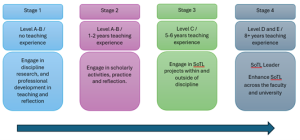
The activities for each stage as proposed in Table 1 are aimed at building faculty member knowledge, capacity and capabilities so they can strategically and systematically become rigorous and strong SoTL leaders. Each level is expected to meet and continue with the activities listed in the previous level. The example activities below are listed as a guide and are not inclusive of all activities for each stage. You do not have to wait until you are Level C to engage with SoTL. In fact, my first SoTL project, while I did not know it at the time, was my PhD.
Table 1.
Suggested activities for each of the levels of the Continuum of Scholarship (adapted from: Gayle et. al., 2013; Hubball, et al., 2015; University of Canberra, 2023) (Link to downloadable PDF of Table 1)
| Stage 1 | Stage 2 | Stage 3 | Stage 4 |
|
In addition to Stage 1 activities:
|
In addition to Stage 2 activities:
|
In addition to Stage 3 activities:
|
Through each stage, faculty members are encouraged to document their activities through reflective practice and a log, and store this in their SoTL portfolio. Building the SoTL portfolio early allows faculty members to take stock and identify where they need to strengthen their knowledge and skills and plan their pathway to being a leader in SoTL. The following tips may assist you when planning your pathway:
- Make the most of what you are currently doing: scholarship and SoTL does not have to be something additional in your workload and you do not need to design a new activity or project that does not relate to what you are already doing. Embed scholarly practice in all activities of your teaching, design a SoTL project in the areas in which you already teach, and engage others who have similar areas that need investigating in these projects.
- Demonstrating leadership in SoTL does not require you to be in a formal leadership role, nor at a specific academic level. As stated in the Case Study by Pandit & van Leeuwen (in this book), ‘leadership is a process or practice that promotes change’, by doing SoTL you are contributing to the changing SoTL landscape, and through your actions and advocacy can lead this change.
- Be strategic in your approaches to SoTL, particularly early on in your journey. Engaging in too many projects can result in no projects being completed in a timely manner. Review your plan to SoTL leadership and review how this ‘new’ opportunity can contribute to your plan. If it does not fit, you can say No.
- Find a mentor, someone who is a SoTL leader. A mentor can help guide you through the continuum and provide advice on where you can develop the gaps in your knowledge and skills. Mentors are also good sounding boards.
- Don’t be afraid to be a SoTL champion.
Conclusion
In this chapter I have provided a snapshot of what we have been doing to build the confidence, capabilities and capacity of EF Health faculty members in scholarship and SoTL. While the context and examples are informed by this work, the application of the suggestions and activities are transferable to other disciplines, professions and faculty areas. Central to this work has been building a CoP and the evolution of the EF CoP as a mechanism to grow scholarship and SoTL through supported boundary crossing, challenging professional identities and providing a strategic approach to moving through the continuum of scholarship to become leaders. While this chapter has touched on two of the components of the scholarship and educational research program specifically for EF faculty members, together with the other case studies in this book they provide a comprehensive approach for those striving to be a SoTL leader.
Acknowledgements
I would like to thank both Andrea Webb and Irma Meijerman for inviting me to contribute to this book. I would also like to thank those who attend the EF CoP, without you we would not have our community nor would we have changed the culture of scholarship within the Faculty of Health at the University of Canberra.
References
Advance HE. (2025). Fellowship. https://www.advance-he.ac.uk/fellowship.
Bennett, D. Roberts, L., Ananthram, S., & Broughton, M. (2018). What is required to develop career pathways for teaching academics?. Higher Education, 75, 271-286. https://doi.org/10.1007/s10734-017-0138-9
Bolman, L.G. & Gallos, J.V. (2011). Reframing academic leadership. Jossey-Bass publications.
Felten, P. (2013). Principles of Good Practice in SoTL. Teaching and Learning Inquiry, 1(1); 121-125. https://doi.org/10.2979/teachlearninqu.1.1.121
Fleischner, C. (2025). Education Focused Academic Roles in Australia. PhD Doctorate. University of New South Wales. https://unsworks.unsw.edu.au/entities/publication/2fe5c4cd-a82d-493f-bad9-2cfd162dccb4.
Gayle, B.M., Randall, N., Langley, L., & Preiss, R. (2013). Faculty learning Processes: A model for moving from scholarly teaching to the scholarship of teaching and learning. Teaching and Learning Inquiry, 1(1); 81-93.https://doi.org/10.20343/teachlearninqu.1.1.81
Godbold, N., Matthews, K., & Gannaway, D. (2023). Capturing teaching focused academic work: a learning-practice framework for a richer understanding of changing academic roles. Journal of Higher Education Policy and Management, 45(3); 323-334. https://doi.org/10.1080/1360080x.2022.2148237
Holden, M.D., Buck, E., Luk, J. et al. (2015). Professional identity formation: Creating a longitudinal framework through TIME (transformation in medical education). Academic Medicine, 90, 761–767. https://doi.org/10.1097/acm.0000000000000719
Hubball, H., Clark, A., Webb, A., & Johnson, B. (2015). Developing institutional leadership for the scholarship of teaching and learning: lessons learned with senior educational leaders in multi-national research-intensive university contexts. International Journal of University Teaching and Faculty Development. 4(4); 1-18.
Jarvis-Selinger, S., Pratt, D.D., & Regehr, G. (2012). Competency is not enough: Integrating identity formation into the medical education discourse. Academic Medicine, 87, 1185–1190. https://doi.org/10.1097/acm.0b013e3182604968
Kanuka, H. (2011). Keeping the scholarship in the scholarship of teaching and learning. International Journal for the Scholarship of Teaching and Learning, 5(1), Article 3.https://doi.org/10.20429/ijsotl.2011.050103
Lawlis, T. (2012). Interprofessional education: health professional attitudes, barriers and enablers. Doctoral thesis. University of Canberra.
Lawlis, T., Torres S.J., Coates A.M., Clark K., Charlton K.E., Sinclair A.J., Wood L.G., & Devine A. (2019). Development of nutrition science competencies for undergraduate degrees in Australia. Asia Pacific Journal of Clinical Nutrition, 28(1), 166-176. doi: 10.6133/apjcn.201903_28(1).0022
McLeod, P., & Steinert, Y. (2015). Twelve tips for curriculum renewal. Medical Teacher, 37(3), 232-8. https://doi.org/10.3109/0142159x.2014.932898
McEwan, M.P. (2022). The journey of SoTL: Institutionally supporting a transition to scholars of teaching and learning. International Journal for the Scholarship of Teaching and Learning, 16(2), Article 5. https://doi.org/10.20429/ijsotl.2022.160205
Mårtensson, K., Roxå, T., & Stensaker, B. (2014). From quality assurance to quality practices: An investigation of strong microcultures in teaching and learning. Studies in Higher Education, 39(4), 534-545. https://doi.org/10.1080/03075079.2012.709493
Molinero, A., & Pereira, R. (2013) Professional identity construction in higher education: A conceptual framework of the influencing factors and research agenda. World Academy of Science, Engineering and Technology, 7, 1179-1184.
Myatt, P., Gannaway, D., Chia, I., Fraser, K., & McDonald, J. (2018). Reflecting on institutional support for SoTL engagement: developing a conceptual framework. International Journal for Academic Development, 23(2), 147-160. https://doi.org/10.1080/1360144X.2017.1346511
Pratt, D.D. (2016). Chapter 3 – Alternative frames of understanding. In Five Perspectives on Teaching in Higher Education. UBC Press, 2nd Edn.
Probert, B. (2013). Teaching-focused academic appointments in Australian universities: recognition, specialisation or stratification?. OLT Report.
QS Quacquarelli Symonds Limited. (2023). QS World University Rankings. https://www.topuniversities.com/qs-world-university-rankings
Rogers, B., & Swain, K. (2022). Teaching academics in higher education: resisting teaching at the expense of research. The Australian Education Researcher, 49, 1045-1061. https://doi.org/10.1007/s13384-021-00465-5
Simmons, N., Scharff, L., Eady, M.J., & Gregory, D. (2021). SoTL in the margins: Teaching-focused role case studies”. Teaching & Learning Inquiry, 9(1), 61-78. https://doi.org/10.20343/teachlearninqu.9.1.6
Tertiary Education Quality and Standards Agency (TEQSA), (2022). Guidance Note: Scholarship. Australian Government. https://www.teqsa.gov.au/guides-resources/resources/guidance-notes/guidance-note-scholarship
Times Higher Education. (2023). World University Rankings 2023. https://www.timeshighereducation.com/world-university-rankings/2023/world-ranking
University of British Columbia (2025). Scholarship of Educational Leadership. https://international.educ.ubc.ca/soel-homepage/.
University of Canberra. (2023). University of Canberra Model and Guide for Scholarly Practice. University of Canberra, Canberra.
Webb, A.S., Hubball, H.T., Clarke, A., & Ellis, S. (2020). Strategic Approaches to SoEL inquiry within and across disciplines: Twenty-year impact of an International faculty development program in diverse university contexts. Global Research in Higher Education, 3(1). https://doi.org/10.22158/grhe.v3n1p1
Webb, A.S., Hubball, H.T., & McKenzie, M. (2021) Strategic approaches to glocalising curriculum: Responding to faculty development needs and circumstances in diverse university contexts. International Journal of Curriculum and Instruction, 13(2), 1209-1225. https://files.eric.ed.gov/fulltext/EJ1291846.pdf
Webb, A. S., Tierney, A.M. (2020). Investigating support for scholarship of teaching and learning; we need SoTL educational leaders. Innovations in education and teaching international, 57(5), 613-624. https://doi.org/10.1080/14703297.2019.1635905
Wenger-Trayner, E., & Wenger-Trayner, B. (2015). Introduction to communities of practice. Accessed from: https://www.wenger-trayner.com/introduction-to-communities-of-practice/
Wenger, E. (1998). Communities of Practice: Learning, Meaning and Identity. Cambridge University Press.