Representing the intervention
6.4 The logic model
“What is a logic model? Basically, it is a tool that describes the theory of change underlying an intervention, product, or policy. It characterizes a project through a system of elements that include components and connections, with context being an important qualification” (Fretchtling, 2007, p. 1).
The logic model is a visual representation of the resources, activities, and the results as well as their intended causal relationships. Results include outputs, outcomes, and impacts (Mayne, 2015). Outputs are the first results of the activities. They indicate the “quantity of service delivered” and “the first change for which the program is accountable” (Funnel & Rogers, 2011, p. 390). Outcomes are results in relation to goals and objectives (Fretchtling, 2007). Outcomes can also be unexpected (positive or negative). Impacts are generally considered more distal results or results in specific domains such as health, prosperity, or the broader environment. In a logic model, arrows matter and carry meaning: they represent causal relationships. In some models the intervention’s objectives will be indicated (usually before the resources), as well as the reach (i.e. the population targeted by the intervention).
A way to build the logic model is to start by identifying the intended outcomes of the intervention (see Figure 6.1’s blue box for example), then keep asking “how?” and build the logic chain backwards, from outcomes to resources. Existing documentation on the intervention and the knowledge of people involved in its conception, funding, or delivery will be used for this process. Once a rough sketch is drafted, the evaluator needs to work on the chain of results. Interventions have more results than the main intended effects. Interventions can contribute to different kinds of effects beyond the expected ones, including unintended or undesirable effects and impacts. All of these should be included in the logic model if they can be predicted in advance of collecting data. Furthermore, longer term impacts on natural and human systems are often ignored in logic models as they are not considered as core to the intervention, given funding and the timeframe for implementing a program or policy. However, given that all actions have environmental and human impacts, they should be systematically represented in logic models. Dimensions to consider are impacts on pollution (including greenhouse gas emissions), land and water, biodiversity, prosperity, equity, and health.
Other contextual factors should also be represented (MacDonald, 2018) as they often influence access to resources, the implementation of the activities, and the intervention’s results. Relevant factors related to governance and power relations can be documented while elaborating the plan of the intervention, when mapping the context, and when identifying groups to involve (see Figure 6.3).
Figure 6.3 Logic Model for Planetary Health
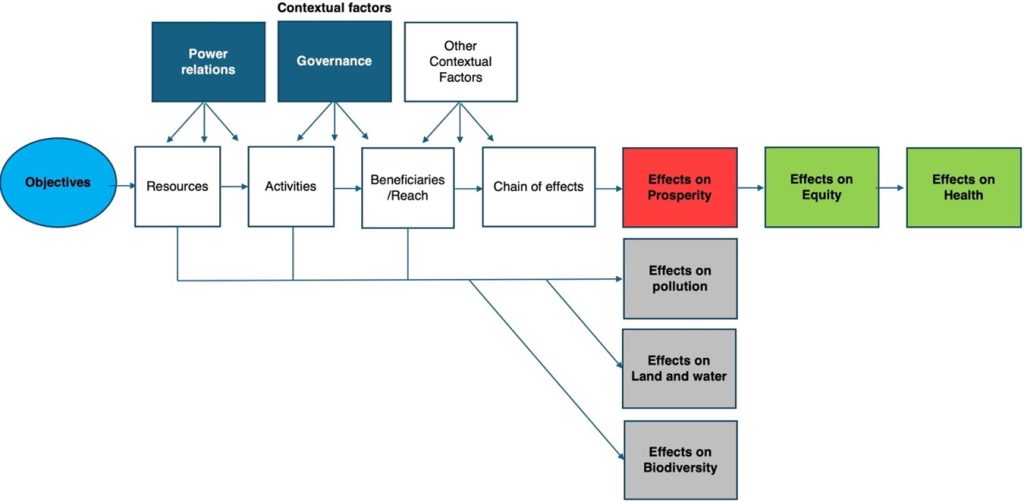
Logic models are built using existing documentation on the intervention and in consultation with individuals familiar with it, such as professionals involved in its design and implementation including funders and regulators.
The visual representation of logic models varies according to the characteristics of the intervention. Logic models can include stages and/or feedback loops. Components of the model and arrows linking these components are equally important. Some projects are more complex than others. Good logic models represent the intervention with accuracy, but they are also simple enough to provide a representation that is easily understood by a diversity of actors. Among the steps in an evaluation, building and communicating the logic model is often the most effective for encouraging engagement.
Media Attributions
- Figure 6.3 Logic Model for Planetary Health