
"

An Example: Evaluating a Local Government Official Community Plan Using Planetary Health Lenses

13.2 Characterizing the OCP within the context of the Planetary Health Framework

Astrid Brousselle and Kai Mountfort

It was not easy to represent the OCP within a logic model. It is a document which identifies 329 policies and actions linked to multiple layers of goals, with some duplications due to their associations with more than one goal. This first step of the project consisted of drafting a representation that would help participants develop their own position on the OCP.

Next, the OCP policies and actions were regrouped under major areas of community policies: agriculture and food systems, arts and culture, community economic development, equitable community, green building, housing, infrastructure, natural environment, parks and trails, recreation and community services, transportation. All actions were then assessed as tangible or non-tangible, and actions specifically involving the T’sou-ke Nation were identified. Tangible policies and actions are palpable and concrete, and non-tangible policies and actions are abstract, vague and not easily measurable (e.g., language such as to engage, discuss and meet with…). While tangible policies and actions are important for public accountability, non-tangible policies and actions are also critical in delivering the OCP’s commitments. Non-tangible policies and actions often involved conversations with key partners in furthering an important initiative for the community. A summary table of the OCP was built and handed to participants. Figures synthesizing the information were created (see Figures 13.1 and 13.2).

Figure 13.1 The Official Community Plan’s Unique Policies and Actions, Categorized by Tangible, Non-Tangible and T’sou-ke Nation
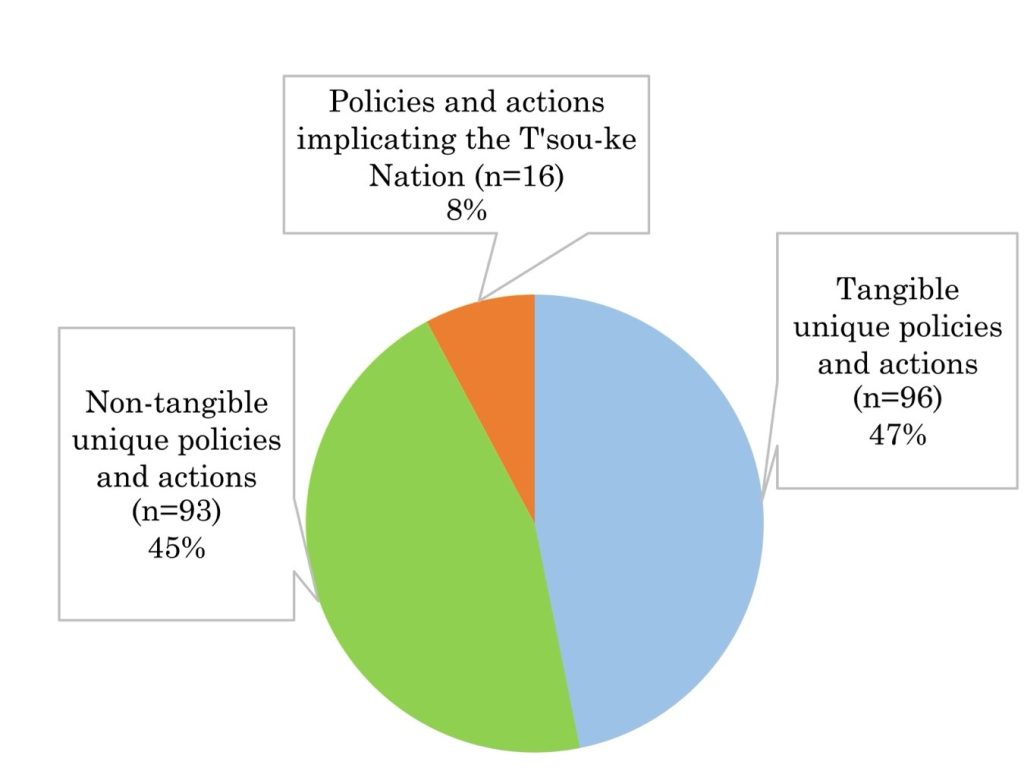
Pie chart showing the distribution of policies and actions: 47% are tangible unique policies and actions, 45% are non-tangible unique policies and actions, and 8% involve the T’sou-ke Nation.
Source: Mountfort, K. R. (2025). An Evaluation of the District of Sooke’s Official Community Plan from a Planetary Health Perspective. University of Victoria. https://hdl.handle.net/1828/20884

Figure 13.2 Numbers of Unique Policies and Actions from the Official Community Plan Sorted Most to Least by Community Policy
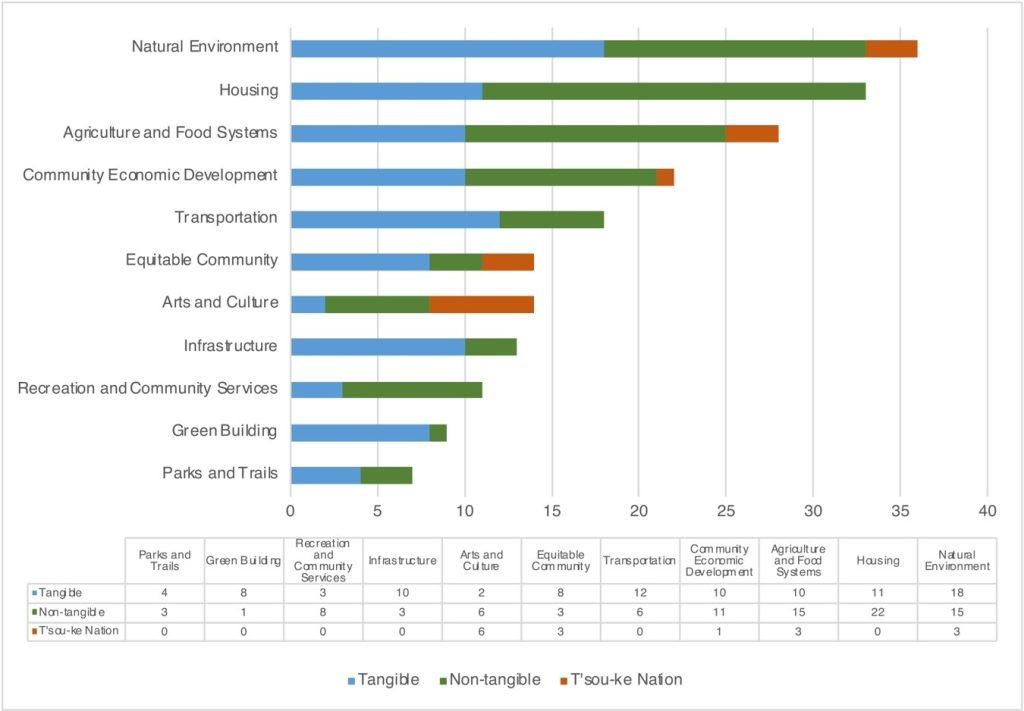
Graph and table showing the distribution of tangible, non-tangible, and T’sou-ke Nation-involving policies and actions across different domains of activity.
Source: Mountfort, K. R. (2025). An Evaluation of the District of Sooke’s Official Community Plan from a Planetary Health Perspective. University of Victoria. https://hdl.handle.net/1828/20884

Media Attributions

  • Figure 13.1 The Official Community Plan’s Unique Policies and Actions, Categorized by Tangible, Non-Tangible and T’sou-ke Nation
  • Figure 13.2 Numbers of Unique Policies and Actions from the Official Community Plan Sorted Most to Least by Community Policy

About the authors

Astrid Brousselle is a professor in the School of Public Administration at the University of Victoria. Her expertise relates to the approaches, theories and evaluative methods that she applies to the field of health and to Planetary Health. She holds a Ph.D. in Public Health from the University of Montreal. Before joining the University of Victoria as the Director of the School, she held a Canada Research Chair in Evaluation and Analysis of the Health System at the University of Sherbrooke (Prov. of Quebec).

Kai holds a Master of Public Administration, a Bachelor of Science (Biology and Earth & Ocean Sciences), and a Diploma in Business Administration, all from the University of Victoria. His academic pursuits included a directed study on Chinook salmon population dynamics and a thesis on planetary health evaluation of the District of Sooke’s Official Community Plan.

His professional journey began with co-op placements at the Canadian Wildlife Service, followed by a role as a wildlife biologist, where he contributed to biodiversity conservation programs and developed guidelines for Indigenous conservation requests. Transitioning to the Government of BC, Kai now serves as a conservation policy analyst, focusing on wetland protection, regulatory amendments, and Indigenous capacity funding.

Dedicated to protecting Earth’s habitability, Kai is driven to make an impact on biodiversity and climate change through policy and advocacy. He lives in Sooke, BC, with his family on the traditional unceded territories of the T’sou-ke Nation and the Scia’new Nation. He is actively involved in the local agricultural community and enjoys outdoor activities, envisioning a future off-grid homestead.


License

Icon for the Creative Commons Attribution-NonCommercial 4.0 International License

Foundations of Evaluation for Planetary Health Copyright © 2026 by Astrid Brouselle is licensed under a Creative Commons Attribution-NonCommercial 4.0 International License, except where otherwise noted.