Evaluation for Planetary Health
2.3 The United-Nations Sustainable Development Goals
In 2015, all United Nations Member States adopted the 2030 Agenda for Sustainable Development. This initiative calls for action to support “peace and prosperity for people and the planet, now and into the future” (United Nations, 2025). The agenda outlines 17 goals and 169 targets. However, researchers quickly identified potential risks in the proposed approach and made suggestions to strengthen the implementation and achievement of these Sustainable Development Goals (SDGs). Below, we provide a brief overview of these discussions.
Rockström and Sukhdev (2016) observed that the SDGs are interconnected and illustrate how, for example, the food system spans multiple SDGs, including Life Below Water (#14), Life on Land (#15), Gender Equality (#5), Good Health and Well-being (#3), Clean Water and Sanitation (#6), Climate Action(#13), Responsible Consumption and Production (#12), No Poverty (#1), Zero Hunger (#2), and Decent Work and Economic Growth (#8). However, SDGs are in most cases not considered in a holistic manner and their connections are being ignored.
Second, interventions can offer win-win solutions, yielding positive impacts on multiple SDGs simultaneously (Bowen et al., 2017). However, they may also involve trade-offs, potentially having negative impacts on some SDGs (Bowen et al., 2017). Choosing a few SDGs to work on, without considering their negative impacts on other SDGs is unlikely to bring good to societies overall. Lim et al. (2018) emphasize that identifying a clear end goal would help resolve conflicts when an intervention creates trade-offs in impact. Unfortunately, no such objective has been clearly defined.
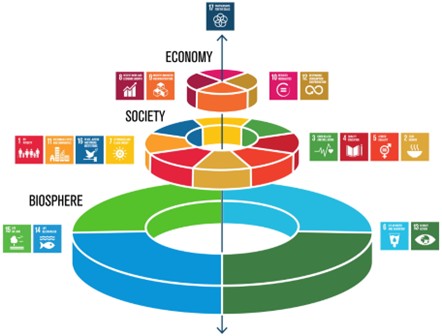
Third, the linear presentation of the SDGs does not accurately reflect their causal relationships. Some SDGs are, in fact, determinants of others. The Stockholm Resilience Center (2016) offers a pyramidal representation of the SDGs, highlighting which ones serve as foundational to others (see Figure 2.1).
Figure 2.1 The SDGs Wedding Cake
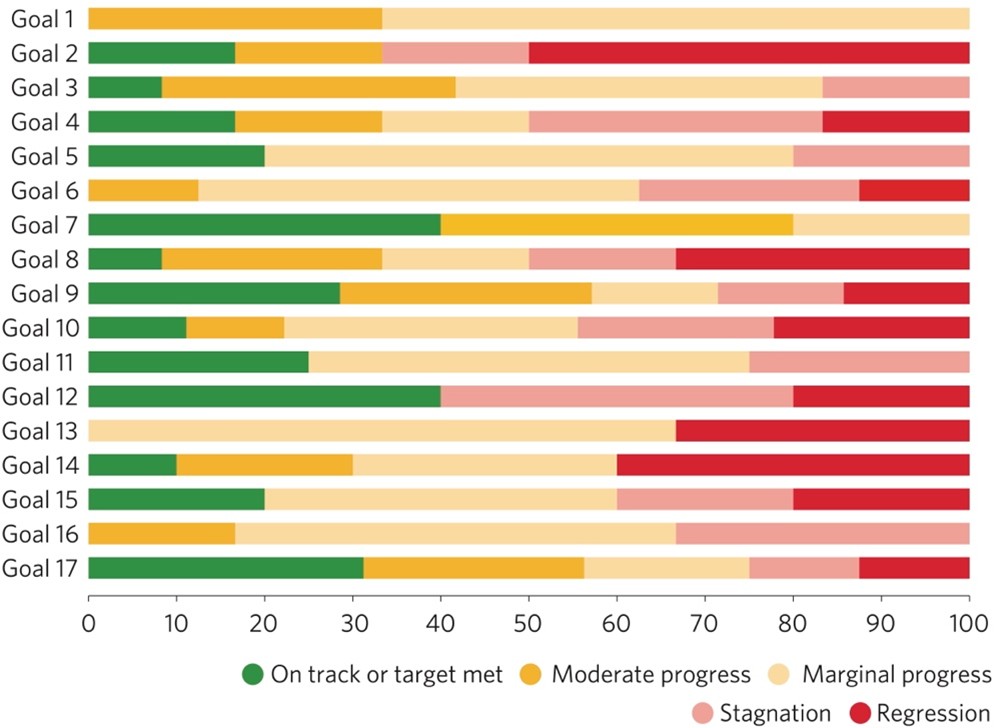
Overall, progress toward the implementation of the goals has been largely insufficient. The United Nations indicates that we are collectively off-track (United Nations, 2024) (see Figures 2.2 and 2.3).
Figure 2.2 Overall Progress Across Targets Based on 2015-2024 Global Aggregate Data
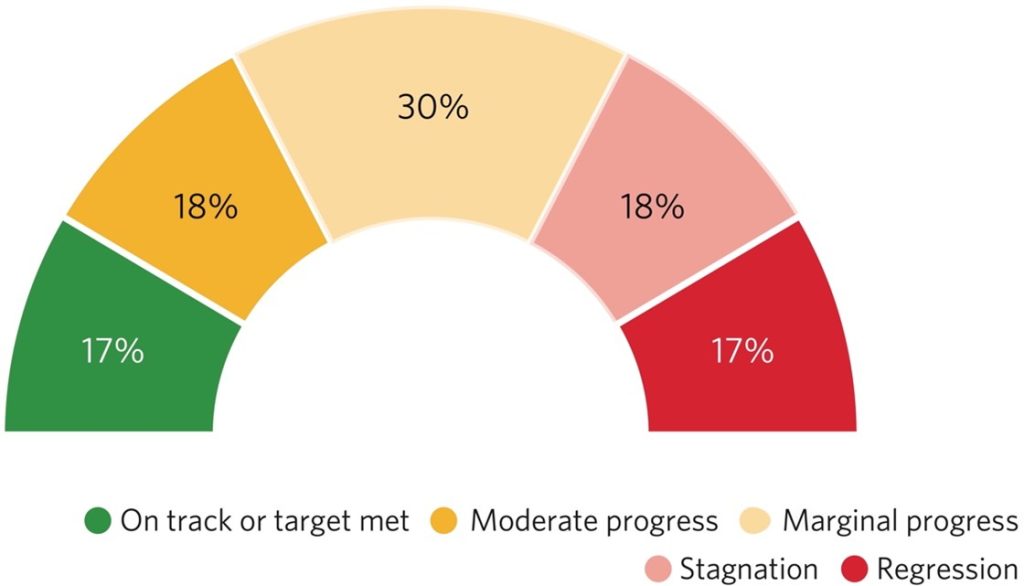
Figure 2.3 Progress Assessment for the 17 Goals Based on Assessed Targets, by Goal (percentage)
In fact, studies show that when organizations adopt the SDGs, they often cherry-pick certain dimensions. Dimensions related to Earth’s life support systems are frequently overlooked, as they are considered more difficult to implement (Heras-Saizarbitoria et al., 2022; Lim et al., 2018; Stafford-Smith et al., 2017).
In the majority of the cases, the SDGs only serve to add color and fancy icons to the reports in a trend towards “SDG icon-picking” that may point to impression management and SDG-washing. (Heras-Saizarbitoria et al., 2022, p. 325)
The fact that the SDGs are so broad has given ample room for cherry-picking and given rise to a form of sustainability metonymy, whereby meeting selected targets of choice (e.g., economic growth, eliminating global hunger) are taken to signify conformity to the whole of the 2030 Agenda, irrespective of other goals and targets disregarded in the process. (Siegel & Lima, 2020, p. 2 cited in Heras-Saizarbitoria et al., 2022, p. 325)
Studies recommend that all goals be approached from a systemic perspective, taking planetary boundaries into account. This approach would highlight both co-benefits and trade-offs, enabling real progress toward sustainable and healthy ways of living within planetary boundaries.
Using the Planetary Health Framework to guide our actions can help holistically address the United Nations 2030 Sustainable Development Agenda and avoid the commonly used pick and choose approach (Uitto, 2021). However, the dimensions of the Planetary Health Framework have been developed based on the literature from various knowledge domains, rather than being specifically tailored to the SDGs. For example, the concept of prosperity was used to avoid apparent contradictions between certain dimensions, such as Economic Growth and the respect for Planetary Boundaries. The Planetary Health Framework covers all SDGs and could be tailored to specifically address the specificities of each one and all.
Media Attributions
- Figure 2.1 The SDGs Wedding Cake
- Figure 2.2 Overall Progress Across Targets Based on 2015-2024 Global Aggregate Data
- Figure 2.3 Progress Assessment for the 17 Goals Based on Assessed Targets, by Goal (percentage)