Evaluation for Planetary Health
2.4 The Planetary Health Framework
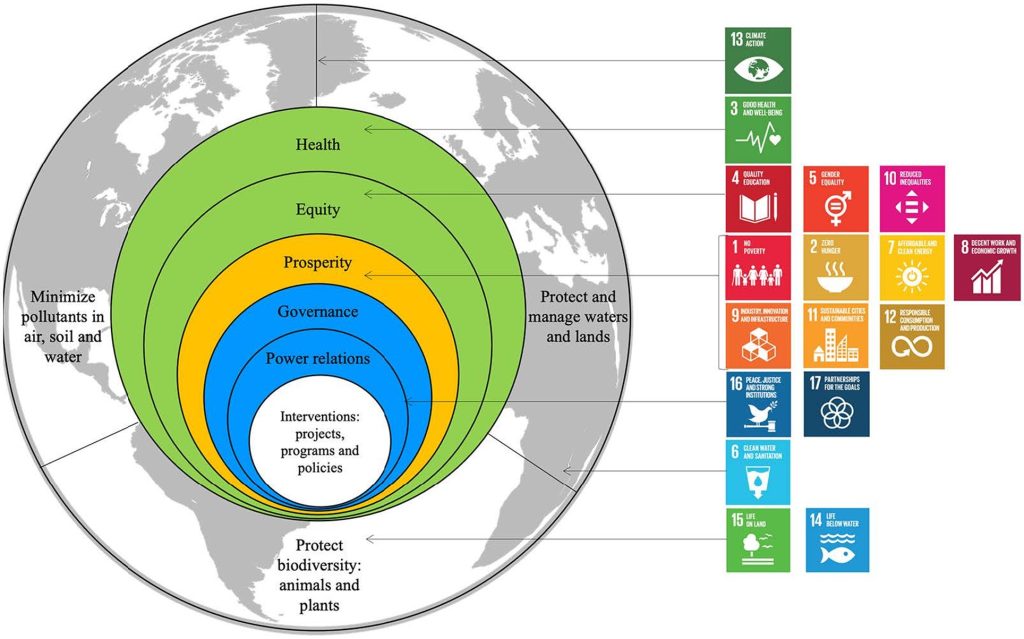
The Framework (see Figure 2.4) identifies interconnected natural systems (exterior circle) and human systems (interior circles). Key dimensions of natural and human systems have been included based on what researchers have identified as critical dimensions that will lead to positive outcomes for both natural and human systems. The dimensions of governance and power relations are of different nature. They were included as their consideration maximizes the chances of any given intervention (project, program, policy) to be successfully implemented.
Figure 2.4 The Planetary Health Framework
Natural systems
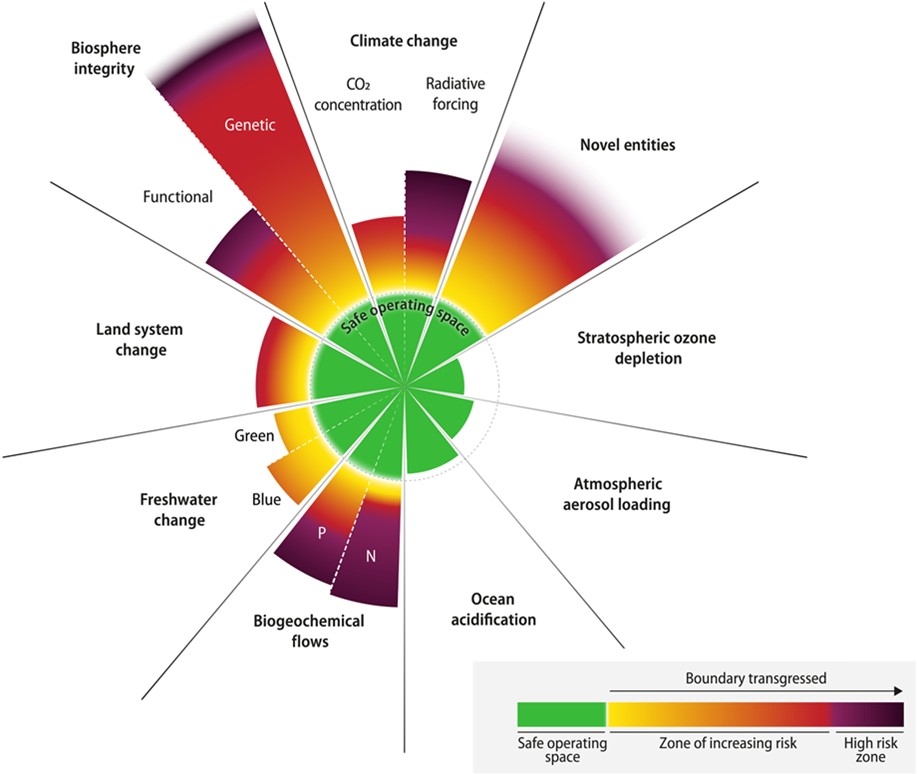
Nine planetary boundaries have been scientifically identified along with the ‘safe operating space’ in which human beings can live (Richardson et al., 2023; Rockström et al., 2009; Steffen et al., 2015). Some of the systems identified within these nine boundaries are interconnected and impact one another, such as climate change and biodiversity. For instance, evidence indicates that crossing the planetary boundary for either climate change or biosphere integrity can sharply heighten the risk of crossing the other (Richardson et al., 2023). Steffen et al. (2015)’s study indicated that four of the nine systems have already transgressed what is considered a safe space for human life on Earth. Richardson et al. (2023)’s updated study indicates that six out of nine systems are beyond safe limits and that for all boundaries previously transgressed, the level of transgression has increased. Figures 2.5 and 2.6 illustrate this evolution.
Figure 2.5 Planetary Boundaries in 2015
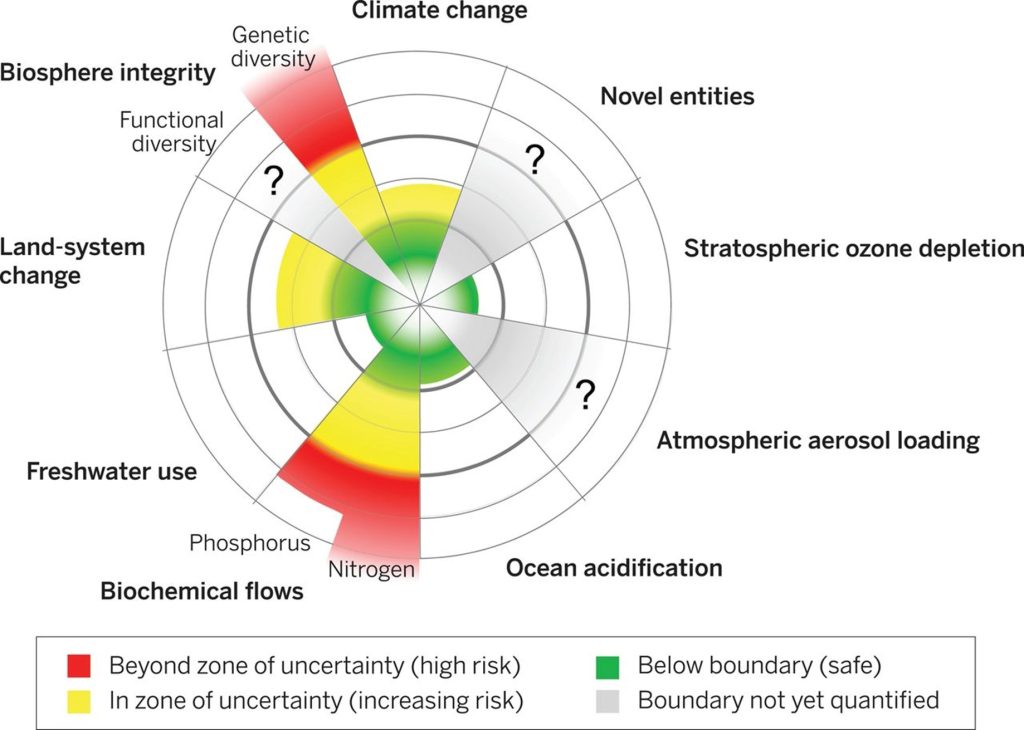
Figure 2.6 Planetary Boundaries in 2023
Rockström et al.’s (2009) and Steffen et al.’s (2015) work on Planetary boundaries was used as a foundation for identifying the natural systems dimensions of the Planetary Health Framework. To make the dimensions more accessible to everyone, these nine dimensions were synthesized as three main dimensions: (1) pollutants in air, soil, and water; (2) land and water preservation and management; and (3) biodiversity.
- Pollutants in air, soil, and water.
These dimensions aim at reducing and controlling sources and quantities of CO2, chlorofluorocarbons, pesticides, fertilizers, aerosols, plastics, heavy metals and radioactive products that are disposed into the biosphere. Greenhouse gas emissions are pollutants. Reducing pollutants will directly affect climate change, ocean acidification, chemical pollution, atmospheric aerosols, global freshwater, stratospheric ozone depletion as well as biogeochemical flow boundaries.
- Land and water preservation and management.
These dimensions focus on protecting natural environments (land and water) from human-led alterations that disturb natural cycles. Restoring and regenerating land and water spaces and systems will increase thriving lifeforms and enhance natural systems. Critical zones are carbon sinks (sequestering carbon), river basins, moisture feedback cycles and water quality. This dimension will affect climate change, ocean acidification, changes in land use, global freshwater use, and biodiversity loss.
- Biodiversity.
This dimension is about protecting plants and animals by creating conditions that maintain and enhance ecological diversity. Species are disappearing, but the density of living species populations is also decreasing (World Wild Fund for Nature, 2022). Diverse ecologies are more resilient, more adaptable and more likely to withstand climate change-related shocks. By paying attention to biodiversity and to our impact on biodiversity we can create opportunities for living species to thrive in rich and healthy ecosystems.
Human Systems
The framework includes five dimensions of human systems. Health, equity, and prosperity dimensions can have a positive and protective effect for human beings. The two other dimensions, power and governance, relate to the capacity to successfully implement initiatives; as such, they are of a different nature than the three other human systems dimensions.
The following sections describe each dimension and illustrate their interconnection with one another and with planetary boundaries.
1. Health.
Health is a determinant of our ability to enjoy and thrive in life.
“Health is a state of complete physical, mental and social well-being and not merely the absence of disease or infirmity. The enjoyment of the highest attainable standard of health is one of the fundamental rights of every human being without distinction of race, religion, political belief, economic or social condition.” (World Health Organization)
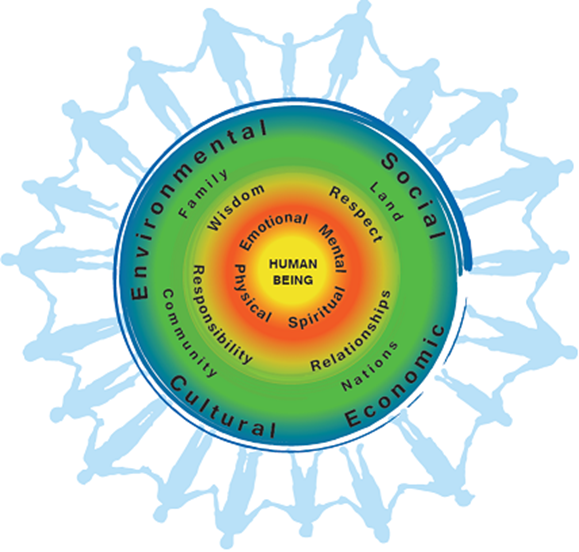
Health is determined by many factors related to individual behaviors and characteristics, our physical environment, access to health services, and is largely determined by our position in society in terms of income, education, gender, racism, employment and working conditions. Culture also influences what matters for our health (see Figure 2.7).
Culture normalizes behaviors and influences our attitudes and actions. For example, in the past, driving without wearing a seatbelt was common, as was smoking in public indoor spaces. Over time cultural attitudes have shifted; new norms have emerged that protect our health. We can reduce our impact on the environment while working on population health determinants by prioritizing programs and policies that create co-benefits. By selecting climate change interventions that positively impact health, we create poly-benefits that impact the health of our families, communities, and the natural world. For example, active transportation (e.g. cycling or walking) reduces greenhouse gas emissions and improves air quality in urban environments, which leads to reduced hospitalizations and health conditions. Increasing physical activity also has positive consequences on physical and mental health. Furthermore, scientists have documented positive health impacts of having public spaces where people can walk and meet, of having green spaces that include trees and forests, and streets that are safe for children, pedestrians, and cyclists. Demonstrating and communicating how new projects, programs, and policies have the potential to create opportunities for people to improve their health can increase public support for projects designed to meet climate or sustainability targets.
2. Equity.
Equity is defined as “the absence of unfair, avoidable or remediable differences among groups of people, whether those groups are defined socially, economically, demographically, or geographically or by other dimensions of inequality (e.g. sex, gender, ethnicity, disability, or sexual orientation). Health is a fundamental human right. Health equity is achieved when everyone can attain their full potential for health and well-being.” (World Health Organization)
Equity is a major but often overlooked determinant of health.
In 1980, the Black Report (Black et al., 1980) showed that inequities explained the persistence of mortality gradients over time: even if health outcomes improved for a whole population and major causes of deaths were reduced, a gradient persisted among different social classes of the population. This work led public health researchers to consider equity as a major factor impacting population health. Inequities are defined as inequalities on which we can act. They are perceived to be a central matter for health and social justice. To positively impact health, one needs to improve equity. If not, there is a risk of increasing inequalities which, in the end, will have a negative health effect for those who are disadvantaged (Buregeya et al., 2019). (as cited in Brousselle & McDavid, 2021, p. 175)
As we saw in the previous chapter, equity is also a major determinant of population resilience. It is a major determinant of our collective capacity to adapt, be less impacted, and recover from crises.
Implementing equity lenses would invite to consider the local, global and intergenerational perspectives to redress environmental injustices.
Figure 2.7 First Nations Health Authority Health and Wellness Framework
3. Prosperity.
Prosperity in societies enables individuals, families, communities and the state to make choices that can enhance well-being. Adequate income is a condition necessary to meet needs ranging from food and shelter to well-being. Ensuring minimum income is met at the individual level is central. But the logic of continuous growth at a collective (societal and global) level is not sustainable (Alexander, 2015b). Recent writings contest the need to grow the economy as if there were no limits and suggest instead that beyond a certain level, the quest for (material) growth negatively impacts the environment. O’Neill et al. (2018) indicate that a certain level of income and thus of economic activity is required for a country to implement social programs that would ensure population well-being and to allow population needs to be met, but that economic growth shouldn’t be an end in itself. To live collectively within planetary boundaries, steady-state economic activity or even de-growth of the wealthiest economies would be needed to allow other countries to reach a level of wealth necessary for their population well-being (Alexander, 2015b; O’Neill et al., 2018). Economic growth cannot indefinitely be pursued knowing that there are limited resources and that global population continues to grow. (as cited in Brousselle & McDavid, 2021, p. 174)
We choose to use the term prosperity rather than economic growth to include the many forms of economic and social activities that contribute to well-being. Prosperity includes contributions such as social capital, informal exchange and sharing systems, and/or out-of-market solidarity systems, for example. GDP is no longer considered a valid indicator of progress (Alexander, 2015a; Jackson, 2017; O’Neill et al., 2018; Raworth, 2017). There is an on-going debate around Green Growth, Degrowth and Green New Deal. Green growth is likely to lead to reduced greenhouse gas emissions but also to increased unemployment and inequities unless strong redistributive social programs are concurrently implemented (O’Neill, 2020). Degrowth, with strong redistributing policies, and Green New Deal seem to be models that would allow for reduced impacts on greenhouse gas emissions while also mitigating negative social impacts and achieving a just transition (D’Alessandro et al., 2020; O’Neill, 2020). The use of the term prosperity in the framework refers to the rights of human beings to have enough resources to fulfil their basic needs and enjoy life. (as cited in Brousselle et al., 2022, p. 340)
4. Governance.
Governance refers to the ways and means employed by society to make collective decisions, choose collective goals, and take action to achieve those goals. (Chaffin et al. 2016, p.401)
With regards to climate change and the need for effective governance models to respond to the climate crisis, the 2023 IPCC report states:
C.1.2 Government actions at subnational, national and international levels, with civil society and the private sector, play a crucial role in enabling and accelerating shifts in development pathways towards sustainability and climate resilient development (very high confidence). Climate resilient development is enabled when governments, civil society and the private sector make inclusive development choices that prioritize risk reduction, equity and justice, and when decision-making processes, finance and actions are integrated across governance levels, sectors, and timeframes (very high confidence). Enabling conditions are differentiated by national, regional and local circumstances and geographies, according to capabilities, and include: political commitment and follow-through, coordinated policies, social and international cooperation, ecosystem stewardship, inclusive governance, knowledge diversity, technological innovation, monitoring and evaluation, and improved access to adequate financial resources, especially for vulnerable regions, sectors and communities (high confidence). (IPCC, 2023, p. 24)
These findings apply to planetary health. When exploring what governance for planetary health means for a project, evaluators should also consider Indigenous self-determination rights on lands where Indigenous Peoples live.
In 2007, the United Nations adopted The Declaration on the Rights of Indigenous Peoples (United Nations, 2007) which reinstates the human rights of Indigenous Peoples and their right to self-determination. This declaration was adopted, with 144 states voting in favour, 4 votes against – not surprisingly: Australia, Canada, New Zealand and the United States- and 11 abstentions (https://www.un.org/development/desa/indigenouspeoples/declaration-on-the-rights-of-indigenous-peoples.html).
Canada reversed its position in 2016 by removing their permanent objectors status to the Declaration and in June 2021, the United (United Nations, 2007) Declaration on the Rights of Indigenous Peoples Act became federal law (Bill C-15). Additionally, one of its provinces, British Columbia, made UNDRIP into law, in November 2019 (https://www2.gov.bc.ca/gov/content/governments/indigenous-people/new-relationship/united-nations-declaration-on-the-rights-of-indigenous-peoples). Today, in different regions of the world, colonial oppressive systems are still largely in place, with many intersecting layers at play such as environmental racism, cultural depletion, land dispossession, and many others with the consequence of deeply affecting Indigenous Peoples and communities (Deranger et al., 2021; Nesmith et al., 2021). Many solutions supported by national governments are further negatively impacting Indigenous Peoples and are not taking into consideration Indigenous Peoples’ reality, contributing to further marginalizing and dispossessing them from their rights (Deranger et al., 2021). (as cited in Brousselle et al., 2022, p. 332)
Governance in Canada, as in many countries, is a multi-level function. Working respectfully with local Indigenous peoples and communities, expanding shared decision-making with these communities and institutions, and giving space to a diversity of cultural practices is part of building more equitable and more resilient communities.
5. Power relations. Power is a dimension that encompasses many aspects of projects.
Closely related to governance, power relations are an important determinant of whether/how resources for policies and programs are allocated and benefits and costs are distributed, how programs are designed and whether/how they are implemented. It is important to consider who holds power due to systemic inequity/bias, how power can be redistributed to people and communities who are marginalized by dominant systems, and what and how opportunities and partnerships for shared capital, resources, land, governance are created. (Brousselle et al., 2022, p. 342)
Transformational projects that aim for changes in how we live and work to reduce our collective footprint may also lead to strong political opposition from some interest groups, particularly those that are invested in activities that are carbon emissions sensitive. Anticipating resistance as interventions are designed and especially as they are implemented can help address power-related challenges; some approaches include finding allies, sharing decision-making, building coalitions, and using governance institutions effectively.
The framework has inspired different approaches and tools (Brousselle & Buregeya, 2018; Brousselle et al., 2024b; Brousselle et al., 2022). In particular, the Rapid Assessment Tool for Planetary Health (Brousselle et al., 2024b) was created to assess projects, programs, and policies at the local government level in Canada. The tool and its use and contribution will be presented in Chapter 3.
Media Attributions
- Figure 2.4 The Planetary Health Framework
- Figure 2.5 Planetary Boundaries in 2015
- Figure 2.6 Planetary Boundaries in 2023
- Figure 2.7 First Nations Health Authority Health and Wellness Framework