Economic evaluation
10.11 A proposal for useful economic evaluations for planetary health
This proposal is based on several observations. First, applying planetary health lenses involves considering dimensions that are not normally integrated into economic evaluations, such as intervention’s impacts on equity, prosperity, biodiversity, pollution, and land and water systems. Recent efforts have been made to move in this direction. However, these analyses present the same ethical and methodological problematic aspects as when giving an economic value to human life in economic evaluations. Second, as evaluators we have a responsibility to be transparent. The less complex the methodology, the more transparent the information tends to be.
Over the years, some researchers and health economists have advocated for Cost-Consequence analysis (CCA) as the preferred approach for economic evaluation. CCA is often considered a partial economic evaluation approach (Bryan et al., 2017; Rabarison et al., 2015) because it presents results in a disaggregated format; however, it’s this feature that makes it a good alternative. In CCA,
the predicted effects of the intervention (i.e., clinical outcomes including adverse events, quality of life impact, utility impact) are usually listed in tabular form without aggregating across different dimensions (Coast, 2004; Mauskopf et al., 1998; Williams et al., 2008). Other types of outcomes, such as humanistic outcomes (e.g. increased power over one’s life), can be included (Coast, 2004; Simoens & Laekeman, 2005). The same process is applied to resources (i.e., direct medical costs, hospital costs, direct non-medical costs, and indirect costs, such as loss of earnings), with attribution of values and quantities being shown separately (Mauskopf et al., 1998; Williams et al., 2008). CCA can include data from a variety of sources, including, but not limited to, clinical trials and observational and administrative databases (Mauskopf et al., 1998). Some authors stress that this type of analysis allows decision-makers to use their local data on costs and consequences (Eddama & Coast, 2008; Mauskopf et al., 1998). CCA can also present the impact of the intervention on different population groups (Mauskopf et al., 1998). Furthermore, it allows the consideration of different perspectives of analysis and the identification of all relevant dimensions for data interpretation (Mauskopf et al., 1998). The non-aggregated format offers a transparent reading, allowing decision-makers to see clearly what types of information are included and omitted, and where information is quantitative or qualitative (Coast, 2004). (as cited inBrousselle & Lessard, 2011, p. 836)
The costs and effects in CCA are usually presented in a tabular format, though can also be presented as a logic model. Brousselle and colleagues have used this methodology for conducting economic evaluations of public health interventions (Benmahrnia et al., 2017; Tchouaket et al., 2013) (see Figure 10.1). The logic model in Figure 10.1 describes the intervention by presenting all its resources, activities, and effects. The grey boxes identify the elements that were included in calculating the intervention’s benefits (Tchouaket et al., 2013).
Figure 10.1 Logic Model of Quebec’s Water Fluoridation Program
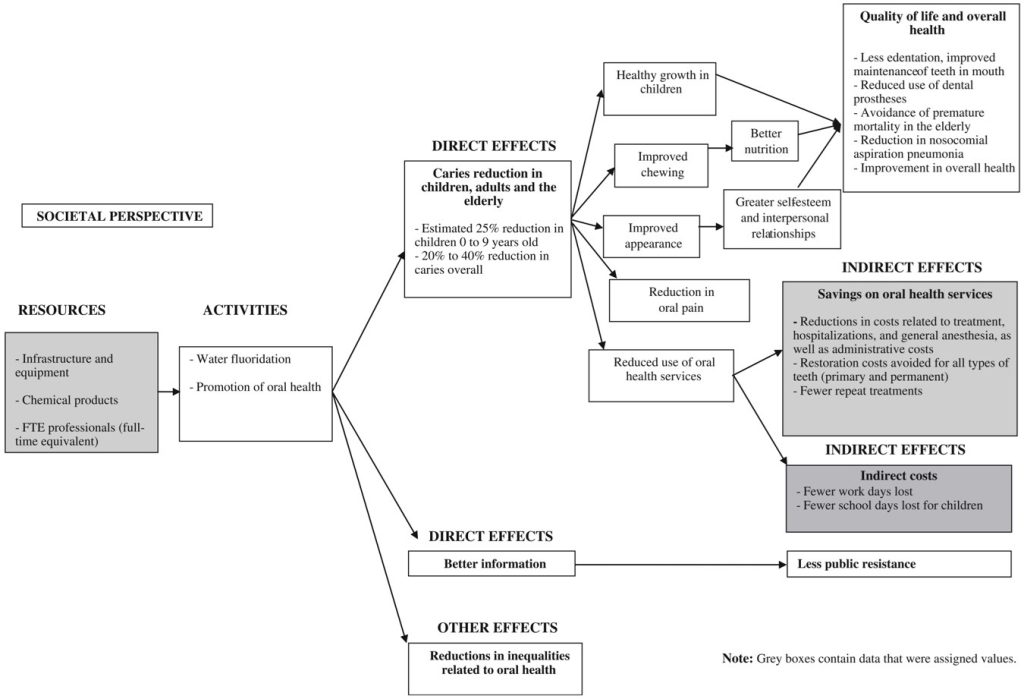
A logic model can be used in economic evaluation for a representation of the full range of results, from direct effects to indirect effects and externalities, as well as to include the logic sequence of results from outputs to outcomes to impacts. Results that can be readily and objectively converted into monetary values may be identified, valued, and compared to costs, enabling an assessment of whether the intervention offers a return on investment. However, a logic model presentation makes considering the whole range of impacts possible without making controversial methodological and ethical choices. It offers transparent information for decision-makers. Most importantly, the use of logic models in economic evaluation allows the inclusion of all relevant planetary health dimensions, alongside those specific dimensions decision-makers care about.
Media Attributions
- Figure 10.1 Logic Model of Quebec’s Water Fluoridation Program