Context Matters: Evaluation in the 21st Century
1.4 Reducing risks
Risk exists when there is a conjunction of three elements: hazard, exposure to this hazard, and vulnerability (see Figure 1.1).
Figure 1.1 Understanding Risk
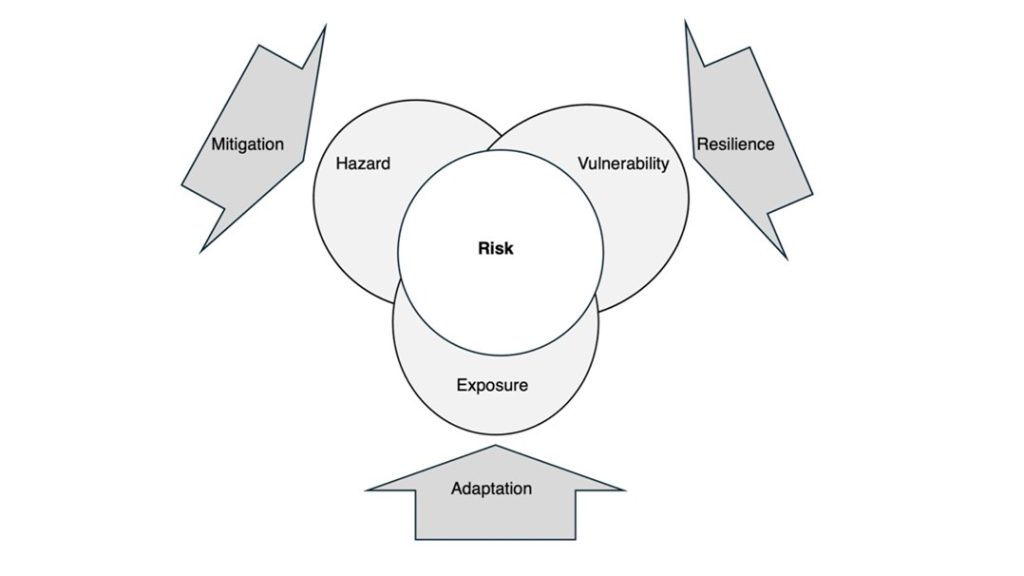
To reduce risks, one can target any of these three elements. For example, the appearance of COVID-19 created a new hazard. However, to experience the risk associated with infection, one needed to be exposed to the virus and to have some vulnerability to the infection. Vaccines reduced vulnerability, while masks reduced the exposure to the virus.
In the case of climate change, mitigation efforts aim to reduce hazards. For example, to lessen risks related to climate change, we need to reduce greenhouse gas emissions. Adaptation measures, on the other hand, aim to reduce exposure. Reducing risks attributable to climate change can include protecting communities from fires, drought, and flooding. To reduce vulnerability, one needs to increase resilience which can be community resilience and population resilience. Community resilience is about sustaining the needs of communities during emergencies and recognizing the importance of key sectors—like food, water, energy, and production capacity—that we depend on more heavily in crisis situations (Brousselle et al., 2020). Building population resilience requires addressing inequalities to protect health at the population level (Brousselle et al., 2020).
Studies on resilience in countries experiencing economic crises have observed better population health outcomes when governments invested in social support rather than cutting budgets as recommended by international financial organizations (Karanikolos et al., 2013; Stuckler & Basu, 2013; Stuckler et al., 2009). Foundational writings in public health show that equity and social support matter for health. Even if causes of death change over time, a gradient of mortality persists, explained mainly by social status and inequities (Evans, 1994; Black et al., 1980). Policies that reduce social inequities will have a positive impact on population health. Greve’s work on happiness shows that countries with fewer social disparities also demonstrate greater happiness scores (Greve, 2012). Altogether, these writings show that, when basic needs are met, what matters most to increase happiness, health, and resilience is not the level of wealth, but welfare policies that reduce inequities. (as cited in Brousselle & McDavid, 2020, p. 195)
Attempts at increasing the resilience of the population necessarily involve reinvesting in measures that reduce social inequalities, which can be done through investments in public health and healthcare, education, early childhood development, income support and social protection, better housing and living environments, policies that foster social and human capital, and improved job and workplace conditions (Brousselle & McDavid, 2021; World Health Organization, 2019).
Actions at the levels of mitigation, adaptation, and resilience can be implemented separately or in combination. In a world where risk is a dynamic phenomenon, a complementary consideration of these three dimensions increases the likelihood of reducing harmful effects and amplifying beneficial ones.
Media Attributions
- Figure 1.1 Understanding Risk