Want to create or adapt books like this? Learn more about how Pressbooks supports open publishing practices.
Chapter 1 – Script and Pronunciation
Unit 1 — Devanāgarī Script
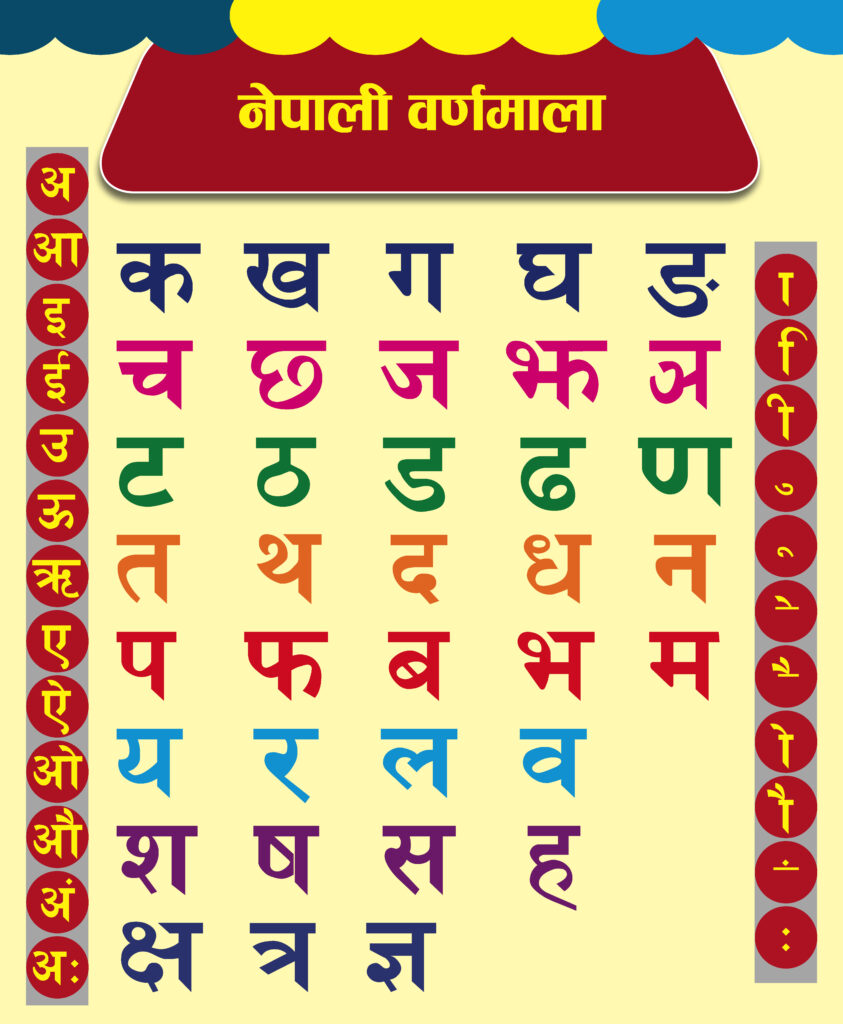
Nepali alphabets
What Is devanāgarī?
1. Overview
devanāgarī is the script used to write Nepali.
In this unit, you will learn the basic parts of the script and begin reading Nepali in small written units called akṣara, or syllable blocks.
Nepali writing is built from four main elements:
consonants
vowels
vowel signs
conjuncts, or consonant clusters
These elements combine to form the akṣara used in words and sentences.
2. Consonants
Consonants are the main letters in Nepali.
A key feature of Nepali orthography is that each consonant letter carries an inherent vowel sound, a. This vowel is already built into the consonant, so it has no separate visible form and does not need a vowel sign or diacritic.
For example:
क = ka, not just k
When this built-in a sound is removed, the consonant is sometimes called a bare consonant. In devanāgarī, this is shown with the halanta mark ्.
क् = k
Examples:
क = ka ख = kha ग = ga घ = gha ङ = ṅa
However, when a consonant combines with a vowel sign, something important happens: the inherent a sound is replaced by another vowel sound. Notice how the vowel signs, or diacritics, change the sound of the consonant in Nepali script.
For example:
क = ka का = kā कि = ki कु = ku के = ke को = ko
Consonants can also combine with other consonants to form conjuncts, which you will study in detail in Unit 6.
3. Vowels and Vowel Signs
स्वर (swara) means a vowel sound in Nepali. In Nepali orthography, vowel sounds are written in two main ways:
as independent vowel letters, when the akṣara begins with a vowel
as vowel signs attached to consonants, when the vowel comes after a consonant
3.1 Independent Vowels
Independent vowels are used when an akṣara begins with a vowel.
Examples:
अ = a आ = ā इ = i ई = ī उ = u ऊ = ū ए = e ऐ = ai ओ = o औ = au
These vowels stand on their own. They do not need to attach to a consonant.
3.2 Vowel Signs
Vowel signs are used when a vowel sound comes after a consonant. They attach to the consonant and replace the consonant’s built-in a sound.
Examples of vowel signs include:
ा = ā ि = i ी = ī ु = u ू = ū े = e ै = ai ो = o ौ = au
For example, with the consonant क:
क = ka का = kā कि = ki की = kī कु = ku कू = kū के = ke कै = kai को = ko कौ = kau
In each example, the base consonant क remains the same, but the attached vowel sign changes the vowel sound.
4. Conjuncts
Sometimes two consonants occur together with no vowel between them. These form a conjunct, or consonant cluster, written as a single combined shape inside one akṣara.
Examples:
क् + त → क्त = kta स् + त → स्त = sta प् + र → प्र = pra ग् + य → ग्य = gya
You will learn how conjuncts are formed and written in Unit 6. For now, treat each conjunct as one reading unit, or one akṣara.
4.1 Common Conjuncts
क्ष = kṣa त्र = tra ज्ञ = jña, often pronounced close to gya in modern Nepali
5. Common Writing Features
devanāgarī also uses several important writing features and marks. You will see these often when reading Nepali.
akṣara means a syllabic writing unit in devanagari—typically a vowel (अ) or a consonant with its vowel (क = ka), and it can include vowel sign (mātrā) (कि, का) or conjuncts (क्त, स्त) as one written unit.
halanta (्) is the devanāgarī sign that removes a consonant’s built-in vowel, so the consonant is read without any vowel sound (e.g., क ka → क् k).
śirorekhā is the horizontal “headline” at the top of many devanāgarī letters that often joins across a word, visually linking the letters together.
candrabindu (ँ) is a nasalization mark written above a letter that shows the vowel is nasalized (e.g., हाँ hā̃).
bindu (ं) is a nasalization mark written above a letter that signals a nasal sound in the syllable (e.g., गंगा gaṅgā).
pūrṇa wirām is the punctuation mark (।) placed at the end of a complete sentence; full stop; period.
wisarga is a devanagari sign written as ः. In Nepali, it appears mainly in Sanskrit-derived words and represents a breathy sound after a vowel.